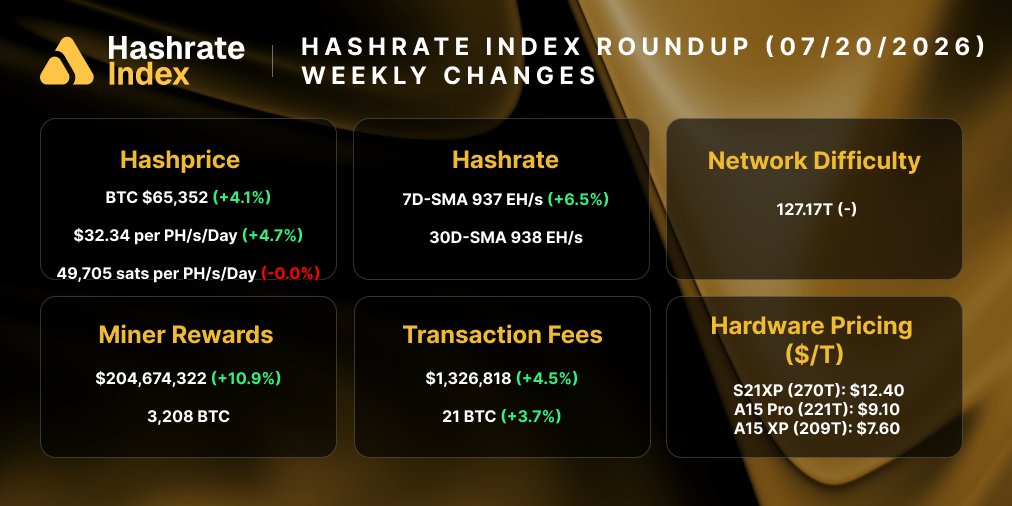
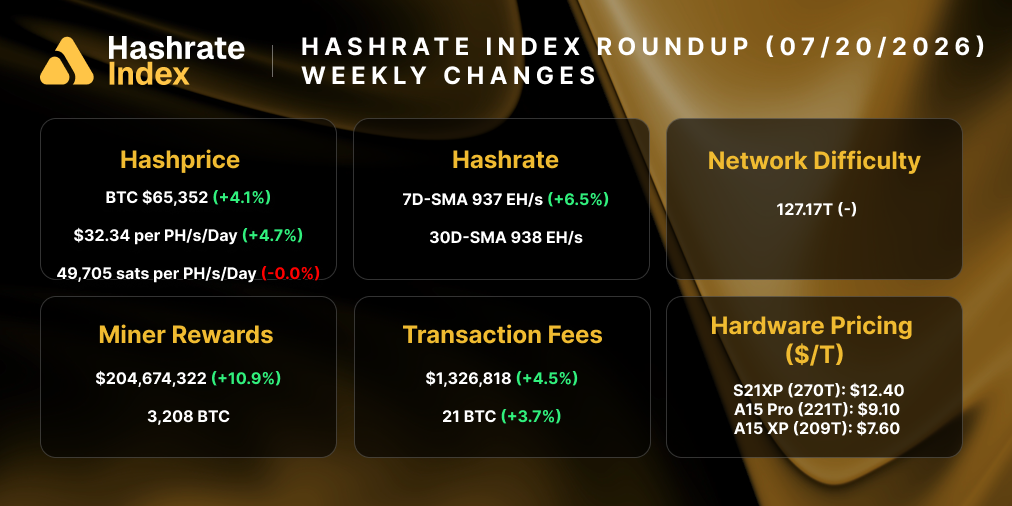
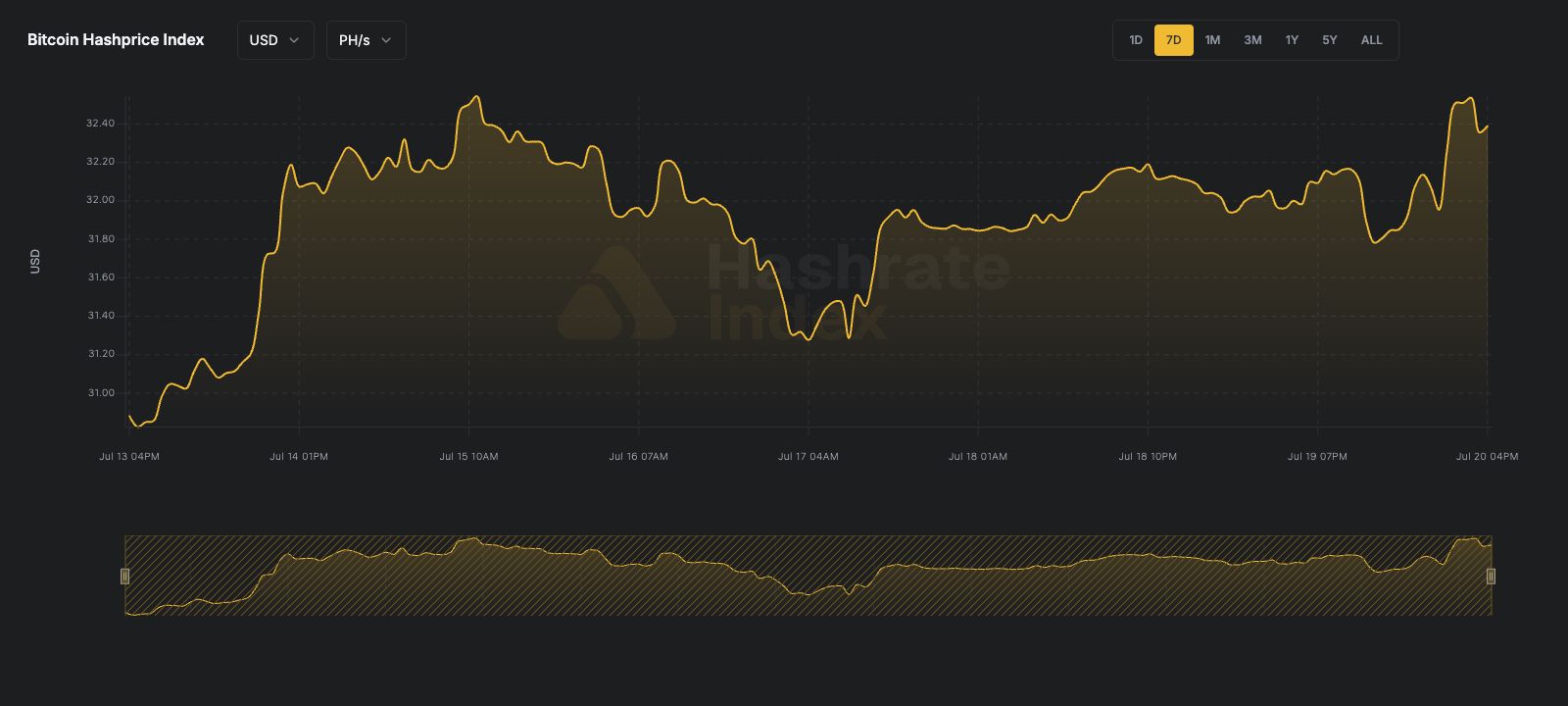
The global Bitcoin mining industry exhibited a significant recovery during the week ending July 20, 2026, characterized by a synchronized rise in asset valuation, network participation, and operational revenue. According to the latest market data, Bitcoin’s price climbed by 4.1%, moving from approximately $62,759 to a spot price of $65,330. This upward price action provided much-needed relief to mining participants, directly translating into a 4.7% increase in the USD hashprice—a critical metric representing the expected value of 1 petahash per second (PH/s) of hashing power per day. As the industry navigates the post-halving landscape of 2026, the stabilization of hashprice at $32.34 per PH/s/Day suggests a temporary equilibrium between network difficulty and market demand, even as total network hashrate surges toward new psychological milestones.
Revenue Dynamics and Block Reward Analysis
During the seven-day period concluding on July 20, Bitcoin miners successfully extracted a total of approximately 3,208 BTC in block rewards. At current market valuations, this output is equivalent to roughly $204 million in gross revenue. While the bulk of this revenue is derived from the fixed block subsidy, transaction fees contributed a modest but essential 0.65% to the total rewards, totaling 21 BTC or approximately $1.33 million. On a per-block basis, miners collected an average of 0.0208 BTC in transaction fees, representing a 4% increase from the previous week’s average of 0.0200 BTC.
The slight uptick in transaction fee revenue indicates a consistent, albeit low, level of on-chain activity. In the context of 2026, where block subsidies have been reduced by successive halving events, the long-term sustainability of the mining sector remains heavily dependent on the growth of the fee market. Current data shows that while the 7-day average for fees is rising, the 30-day average has seen a slight decline of 2.1%, currently sitting at 0.0213 BTC per block. This volatility underscores the ongoing challenge for miners to predict secondary revenue streams as they manage high fixed costs associated with energy procurement and hardware maintenance.
Network Hashrate and the Difficulty Landscape
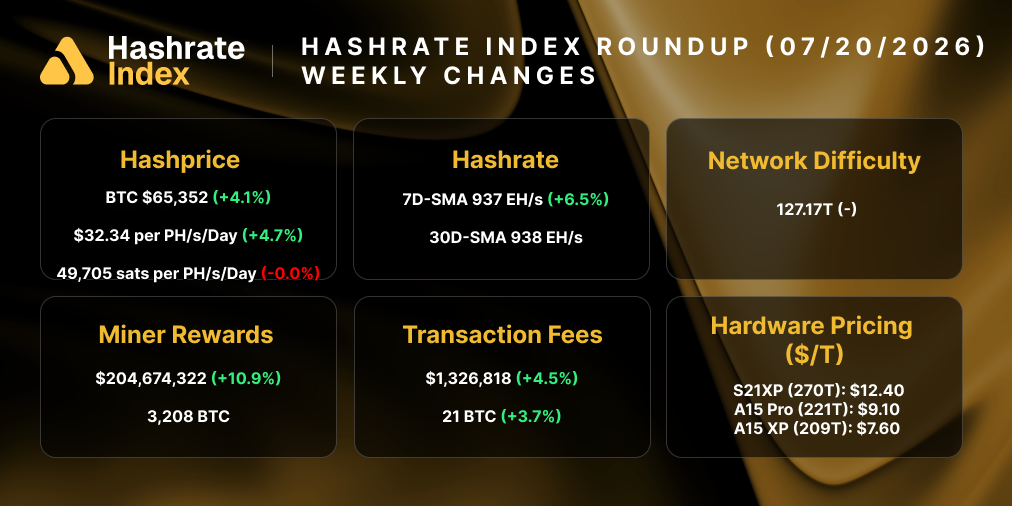
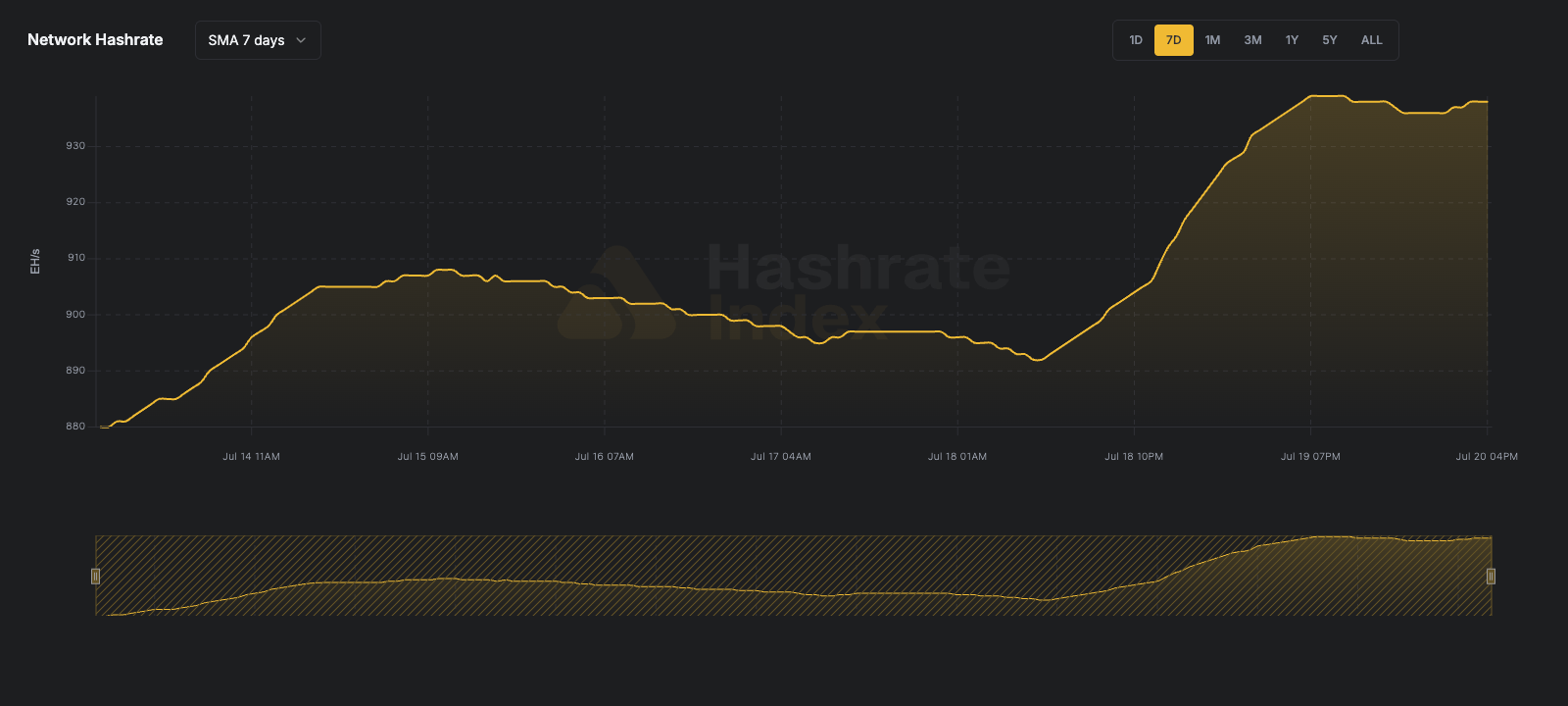
The Bitcoin network’s computational power, or hashrate, saw a substantial surge over the past week. The 7-day simple moving average (SMA) rose by 6.5%, climbing from 880 exahashes per second (EH/s) to 937 EH/s. This growth reflects the continued deployment of next-generation hardware, specifically the S21 and specialized liquid-cooled rigs, as institutional miners expand their fleet capacities. The 30-day SMA currently aligns closely with this figure at 938 EH/s, indicating that the network is sustaining high levels of security and competition despite the economic pressures of the current year.
Network difficulty, the self-adjusting mechanism that ensures blocks are found approximately every ten minutes, remained unchanged during this specific weekly window following a -5.00% downward adjustment on July 11, 2026. This previous reduction to 127.17T provided a temporary operational "window of opportunity" for less efficient miners to remain profitable. However, with the recent 6.5% jump in hashrate, the network is now producing blocks faster than the target interval. Over the last 24 hours, block times have averaged 9 minutes and 45 seconds. Consequently, the upcoming difficulty adjustment, scheduled for approximately July 25, 2026, is estimated to increase by 2.56%. This anticipated rise will likely compress profit margins once again, forcing operators to focus on maximizing hardware efficiency.
Operational Efficiency and Energy Metrics
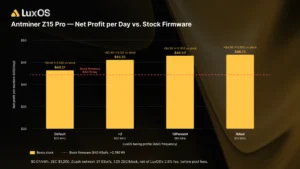
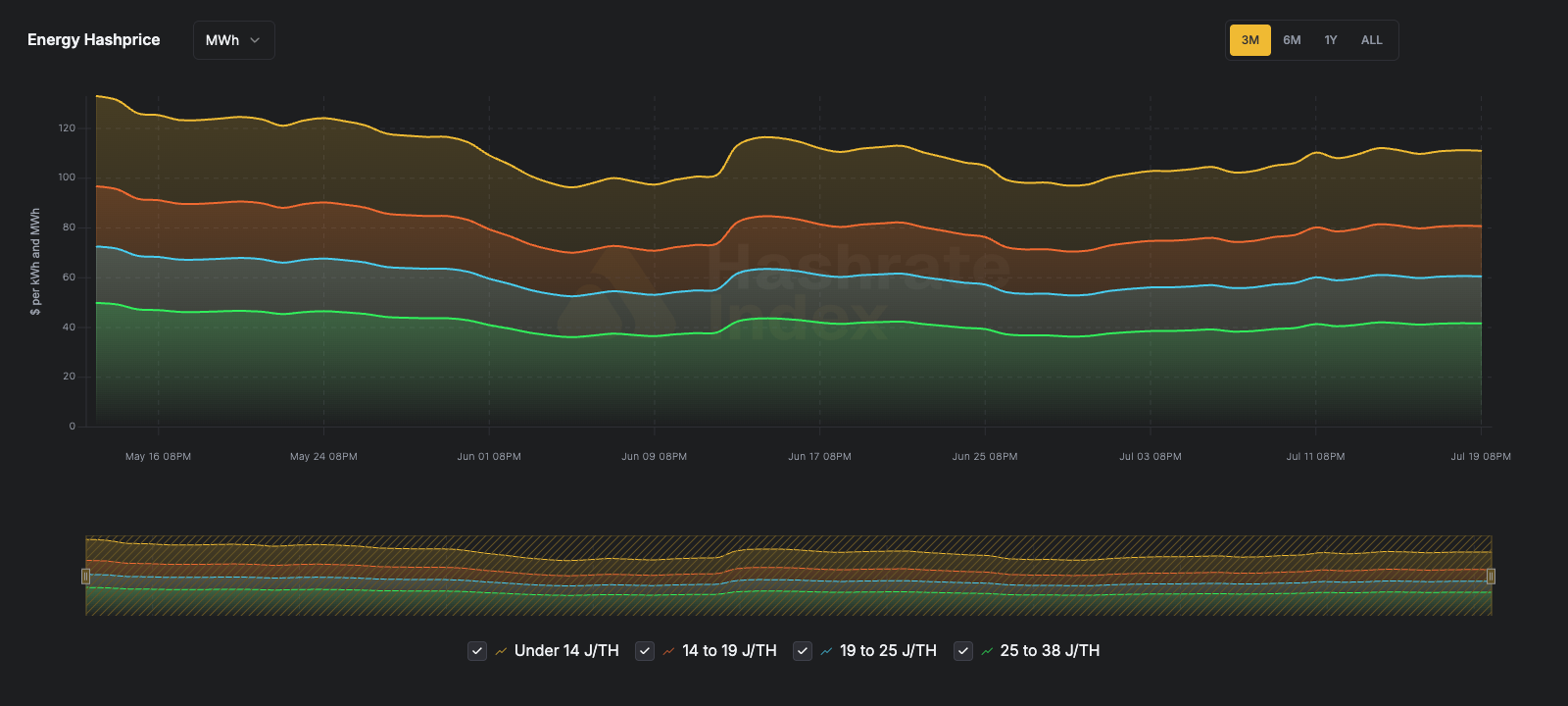
As hashprice hovers around the $32 mark, the industry is witnessing a divergence in profitability based on machine efficiency and power costs. For many operators, $32 per PH/s/Day represents a "breakeven" threshold. Data from the Energy Hashprice Index indicates that mining operations are increasingly sensitive to watt-hour revenue. To combat these tightening margins, there has been a notable shift toward the adoption of custom firmware solutions. By optimizing the voltage and frequency of ASICs (Application-Specific Integrated Circuits), miners can extract more hashrate per watt, effectively lowering their "floor" for profitable operation.
The 3-month view of the Energy Hashprice Index (May 2026 – July 2026) reveals a sector in transition. Large-scale miners in North America and Northern Europe are increasingly integrating with renewable energy grids and demand-response programs to offset costs. The ability to curtail power during peak demand periods has become as vital to a mining firm’s balance sheet as the Bitcoin price itself.
Performance of Publicly Traded Mining Stocks
The equity markets reflected a complex and fragmented sentiment toward the Bitcoin mining sector over the past week. While Bitcoin itself gained 4.1%, mining stocks showed a wide variance in performance, often dictated by individual company news, debt structures, and perceived operational efficiency.
CleanSpark (CLSK) emerged as one of the week’s strongest performers, posting a 16.7% gain to reach a market capitalization of $3.70 billion. Similarly, Soluna Holdings (SLNH) saw a significant jump of 21.4%, likely driven by its focus on green energy integration. IREN (formerly Iris Energy) maintained its position as a heavyweight in the sector with a 3.1% increase, bringing its market cap to a staggering $14.37 billion, the highest among the tracked group.
Conversely, several firms faced significant headwinds. AIBZ saw a sharp decline of 18.7%, while Sphere 3D (ANY) dropped 15.8%. These losses highlight a growing trend in 2026: investors are becoming increasingly discerning, favoring "pure-play" miners with low power costs and high-efficiency fleets over smaller or more leveraged operators. Terawulf (WULF), despite its robust infrastructure, saw a 9.7% pullback, though it maintains a substantial market cap of $9.35 billion. The mixed performance suggests that while the underlying asset is recovering, the "mining proxy" trade is no longer a monolithic movement, but rather a stock-picker’s market.
Forward Market Projections and Implications
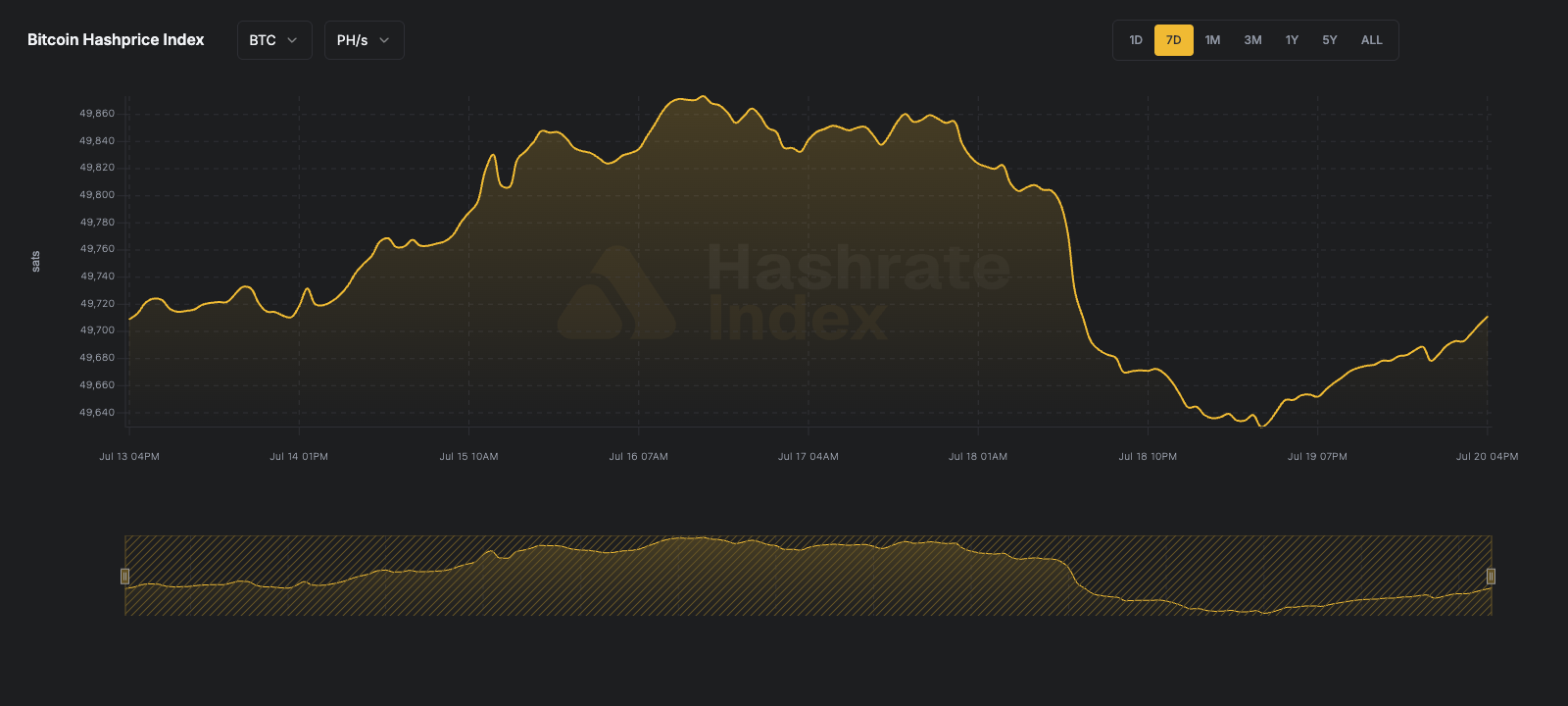
The Hashrate Forward Market provides a glimpse into the industry’s expectations for the remainder of the year. Currently, the forward curve for July through December 2026 is pricing in an average hashprice of $30.77, or 0.00048 BTC. This indicates that market participants expect a slight cooling of revenues or a continued increase in network difficulty that outpaces price appreciation.
The implications of these projections are twofold. First, they signal a period of continued consolidation. Smaller miners who cannot hedge their production or secure sub-market power rates may find the sub-$31 hashprice environment unsustainable. Second, it encourages the trend of "hashrate financialization," where miners use forward contracts to lock in revenues, providing the stability needed to secure traditional financing for infrastructure expansion.
Broader Impact and Industry Outlook
The current state of the Bitcoin mining industry in July 2026 reflects a mature, institutionalized sector that is deeply integrated into global energy and financial markets. The rise in hashrate to 937 EH/s is a testament to the resilience of the network’s decentralized security model. However, the year-to-date performance of Bitcoin, which stands at -25.3%, serves as a reminder of the volatile macro environment that miners must navigate.
The stabilization of the spot price around $65,000 is a positive signal for the broader cryptocurrency ecosystem. For miners, the focus for the third quarter of 2026 will undoubtedly remain on the July 25 difficulty adjustment and the management of operational overhead. As transaction fees remain a small portion of the total revenue, the drive for technological innovation in ASIC hardware and energy management systems will continue to be the primary differentiator between industry leaders and those struggling to maintain parity.
In summary, the week ending July 20 provided a "green bag" of metrics that bolster short-term confidence. With Bitcoin price, hashrate, and hashprice all trending upward, the industry enters the latter half of the month on a footing of cautious optimism. The upcoming weeks will test whether this momentum can be sustained in the face of an impending difficulty increase and the broader economic shifts of 2026.