
Bitcoin Core developers have officially published comprehensive advisories detailing three significant security vulnerabilities that were originally identified and patched in late 2025. The disclosures, made public following the expiration of the software’s standard vulnerability grace period, shed light on a Tor-related permission flaw affecting thousands of reachable network nodes, a high-severity block assembly bug impacting mining operations, and a consensus-adjacent denial-of-service vector capable of delaying block processing.
While the public release of these technical findings has drawn considerable attention across digital asset forums, core developers and infrastructure specialists emphasize a critical distinction: the advisories describe historical implementation weaknesses in node software rather than active exploits, stolen private keys, or systemic failures in Bitcoin’s fundamental supply and consensus rules. Nevertheless, the disclosures serve as an urgent reminder of the operational hygiene required to maintain a secure, decentralized financial network.
Overview of the Disclosed Vulnerabilities
The newly detailed security flaws cover distinct attack vectors within the Bitcoin Core architecture, ranging from network-layer permission misconfigurations to localized block generation disruptions. Although patches for all three vulnerabilities were deployed to the mainnet ecosystem in October 2025, the Bitcoin Core security policy dictates that full technical details remain restricted until the affected software versions reach their official end-of-life milestone.
1. The Tor Trust Boundary Misconfiguration (CVE-2025-62860)
The most widespread vulnerability involved a configuration oversight regarding incoming Tor network connections. According to the medium-severity advisory, inbound traffic arriving via Tor could inadvertently inherit permissions specifically intended for trusted local computers. This occurred when an operator’s network configuration whitelist included the local service address utilized by the Tor daemon.
As a result, external connections routed through Tor received exemptions typically reserved for trusted peers, effectively bypassing standard denial-of-service rate-limiting defenses and privacy-preserving heuristics. The developers noted that this misconfiguration led to thousands of reachable mainnet nodes inadvertently whitelisting all incoming Tor connections. Importantly, nodes that did not utilize the non-default whitelist setting remained entirely secure. Fixes for this issue were integrated into Bitcoin Core versions 28.3, 29.2, and 30.0.

2. Chain Reorganization Mining Interruption Bug (CVE-2025-62861)
Classified as a high-severity issue, the second vulnerability directly impacted the operational continuity of Bitcoin mining nodes. Discovered and responsibly reported by developer Niklas Goegge in September 2025, the flaw surfaced during chain reorganizations—events where a node switches to a competing valid blockchain featuring a higher cumulative proof-of-work.
Under specific, narrow conditions, affected software versions (28.0 through 28.2, and 29.0 through 29.1) would inconsistently restore pending transactions from disconnected blocks back into the node’s memory pool (mempool). Consequently, an affected mining node could attempt to assemble a candidate block containing transactions whose required input dependencies were missing. The node’s internal validity checks would subsequently reject its own generated block template, halting successful block creation until a manual or automated software restart cleared and restored a consistent mempool state. Developers stressed that this was strictly a localized operational failure for individual miners rather than a mechanism allowing invalid blocks to be forced onto the broader network.
3. Delayed Block Processing and Availability Vector (CVE-2025-62859)
The third advisory outlined a medium-severity vulnerability wherein a malicious or poorly behaved peer could artificially delay an affected node’s ability to process newly broadcast blocks efficiently. While this flaw did not alter transaction ownership, compromise cryptographic keys, or permit double-spending, it posed a direct threat to network availability. For commercial entities, exchanges, and custodial services relying on real-time node synchronization, such processing lags can severely complicate transaction monitoring, confirmation verification, and liquidity management. Patches addressing this availability vector were rolled out alongside the Tor fixes in Bitcoin Core versions 29.2 and 30.0.
Chronology and the Responsible Disclosure Framework
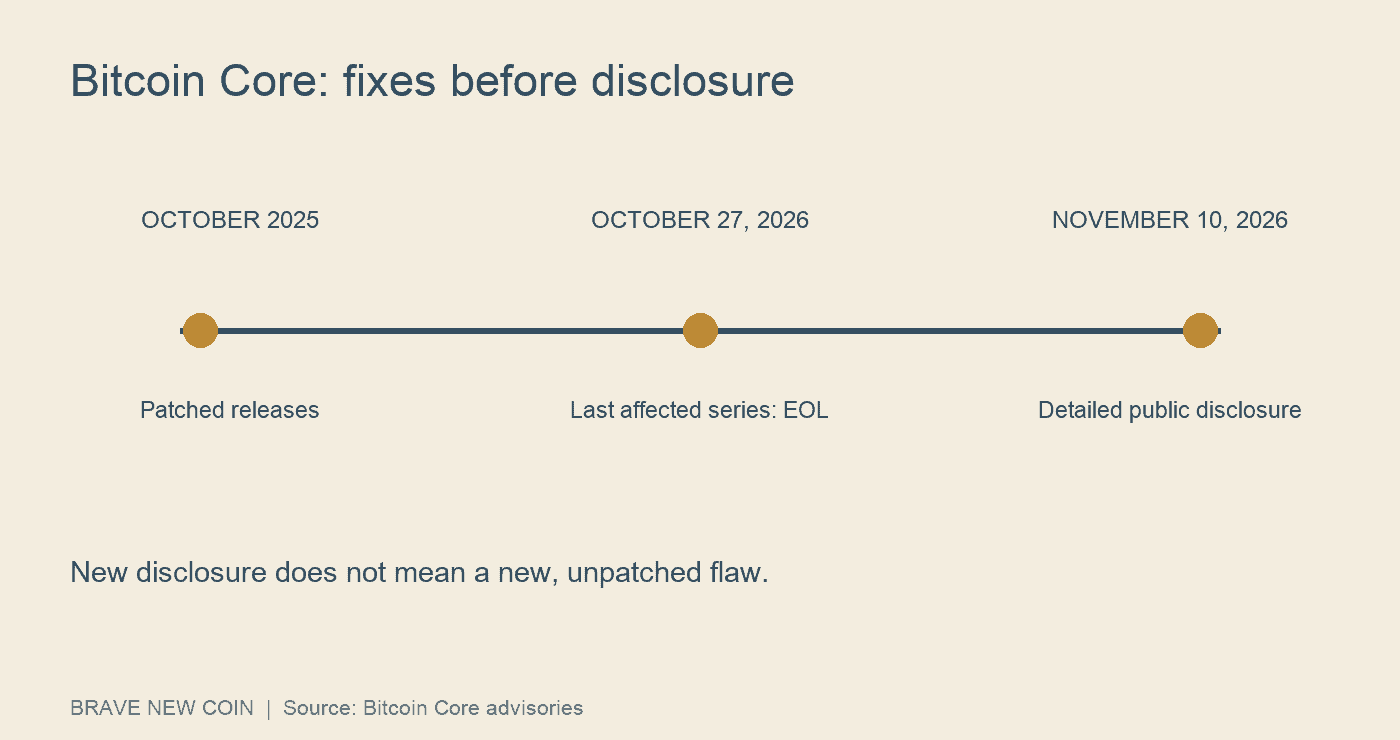
The timing of the November 2026 public disclosure highlights the structured, safety-first methodology governing Bitcoin Core development. Rather than announcing critical software bugs immediately—which could inadvertently provide malicious actors with a window of opportunity to target unpatched infrastructure—the development team adheres to a strict coordinated vulnerability disclosure (CVD) lifecycle.
Under standard Bitcoin Core policy, medium- and high-severity security issues are patched in immediate software updates, but exhaustive technical write-ups are withheld until two weeks after the final affected software release reaches its official end-of-life (EOL) status. With the vulnerable versions hitting their EOL milestone on October 27, 2025, the mandatory waiting period culminated in the public documentation released on November 10, 2026.
This deliberate delay ensures that node operators, enterprise custodians, and mining pools have ample time to upgrade their systems before technical exploitation details become public knowledge. Furthermore, the Bitcoin Core project has adapted its disclosure framework to account for modern threat landscapes, including vulnerabilities easily discovered through automated tools and artificial intelligence models. Easily identifiable or actively exploited flaws can receive accelerated disclosures, though the three vulnerabilities detailed in November followed the comprehensive long-term timeline.
Operational Implications for Node Operators and Market Participants
The release of these advisories has prompted extensive discussions across the cryptocurrency engineering community regarding node management, software dependencies, and infrastructure security. Security analysts emphasize that the findings carry distinct implications depending on how individuals and institutions interact with the Bitcoin network.
For independent node operators, the disclosures underscore the dangers of "set-and-forget" infrastructure deployment. Operators are strongly advised to audit their configuration files rather than relying solely on default settings or application names, particularly because third-party packaging tools often bundle Bitcoin Core with custom initialization parameters or auxiliary networking scripts. The Tor trust-boundary flaw serves as a prime example of how seemingly minor configuration choices can inadvertently expand an attack surface.
For everyday cryptocurrency holders who utilize hosted wallets, hardware devices, or centralized exchanges, the disclosures require no direct user action. End-users are not instructed to move funds or generate new addresses, as the underlying infrastructure management is handled by their respective service providers. Industry commentators have been careful to separate these software implementation bugs from broader structural or cryptographic concerns, such as the long-term migration paths required to safeguard Bitcoin against future quantum computing capabilities.
Broader Economic and Network Resilience Analysis
From a macro perspective, the handling and disclosure of these vulnerabilities illustrate the robust maturity of Bitcoin’s decentralized engineering ecosystem. Complex open-source software projects inevitably encounter implementation bugs; however, the ability of independent researchers—such as Niklas Goegge—to identify sophisticated edge-case failures, coupled with the disciplined execution of multi-version patch deployment, demonstrates systemic resilience.
Market analysts note that while headlines regarding "Bitcoin Core security flaws" can occasionally generate unnecessary panic among retail participants, the separation between consensus failure and implementation software bugs remains absolute. The network’s core economic guarantees—including the immutable 21 million supply cap, cryptographic signature security, and decentralized transaction validation—remained completely uncompromised throughout the lifecycle of these bugs.
Ultimately, the November 2026 disclosures reinforce the fundamental axiom of decentralized monetary systems: digital sovereignty relies heavily on vigilant engineering, continuous peer review, and the proactive maintenance of software infrastructure by both developers and node operators alike.