The official deployment of protocol version 24 on the IOTA Mainnet marks a significant milestone in distributed ledger technology, introducing the Starfish consensus mechanism to a live production environment. Following the initial rollout of the Starfish mainnet architecture, the IOTA Foundation’s research and engineering teams have released comprehensive technical telemetry detailing the mechanics, design choices, and performance metrics of the network’s newly integrated Byzantine Fault Tolerant (BFT) protocol. Moving far beyond standard release notes, this update addresses fundamental challenges in Directed Acyclic Graph (DAG) protocols, specifically targeting the synchronization and data dissemination bottlenecks that have historically constrained high-throughput decentralized networks.
The Synchronization Problem in DAG-Based Consensus
In the theoretical framework of distributed systems, consensus is most frequently defined as an agreement problem. A distributed group of independent validators must reach a shared, immutable history of transactions, maintaining operational integrity even in the face of delayed message transmission and active Byzantine participants. While fundamentally accurate, this traditional framing often obscures a critical physical constraint: a validator cannot validate a block it has not observed, cannot attest to data it cannot reconstruct, and cannot drive network progress if necessary operational metadata arrives too late.
Beneath the abstract layer of agreement lies a fundamental synchronization problem. Ensuring the correct information reaches the right network nodes with minimal latency is the core challenge addressed by the Starfish architecture. Unlike prior uncertified DAG protocols, Starfish treats dissemination not as a peripheral implementation detail, but as a central component of the consensus algorithm itself.
Within a DAG structure, blocks are not merely ordered entries; they serve as a dynamic record of mutual knowledge. Each newly minted block cryptographically references preceding blocks observed by the issuing validator. When multiple validators independently reference the same historical block, the network exhibits convergence around a shared state. Conversely, missing references expose network gaps immediately. Consequently, the DAG functions simultaneously as a commitment structure and a synchronization framework.
Cordial Dissemination: Push Versus Pull Strategies
To maintain structural health, distributed networks rely on dissemination strategies to propagate blocks and metadata. In academic literature, proactive dissemination integrated directly into protocol logic is known as "cordial dissemination," a concept formalized in recent distributed systems research such as the Cordial Miners paper presented at DISC 2023. Rather than merely broadcasting their own local proposals, participants actively forward information they deduce other honest peers require to maintain synchronization.
Historically, networks have utilized two primary dissemination methodologies: pull and push. The pull strategy relies on reactive requests. A validator requests missing blocks only after identifying a gap in its local DAG view. While bandwidth-efficient in optimal conditions—as no redundant data is transmitted—pull mechanisms severely degrade latency. Every missing block introduces an additional request-response round trip. Under heavy network loads, pull mechanisms often exacerbate the exact congestion they aim to resolve, forcing slower validators to issue an influx of recovery requests while faster peers expend critical bandwidth answering them.
Conversely, the push strategy proactively forwards anticipated data to peers, significantly reducing latency by ensuring data is present locally before a node detects a missing dependency. However, naive push architectures introduce prohibitive bandwidth overheads, as full-payload broadcasting scales exponentially with the size of the validator set.
Architectural Innovations: Metadata Separation and Erasure Coding
To resolve the historical tension between lean-yet-slow pull systems and fast-yet-expensive push models, Starfish introduces two foundational architectural innovations.
First, the protocol systematically separates consensus metadata from transaction payloads. Consensus-critical components—such as structural references, validator votes, timing data, and acknowledgments—must be processed with absolute urgency. In contrast, transaction payloads represent heavy data volumes. Previous DAG iterations tightly coupled payloads to the consensus path, enabling high performance in small configurations but introducing severe bandwidth bottlenecks as throughput scaled. Starfish streamlines the core consensus path by restricting block headers to lightweight consensus structures and payload commitments, allowing validators to aggressively push critical headers without flooding the network with raw transaction data.
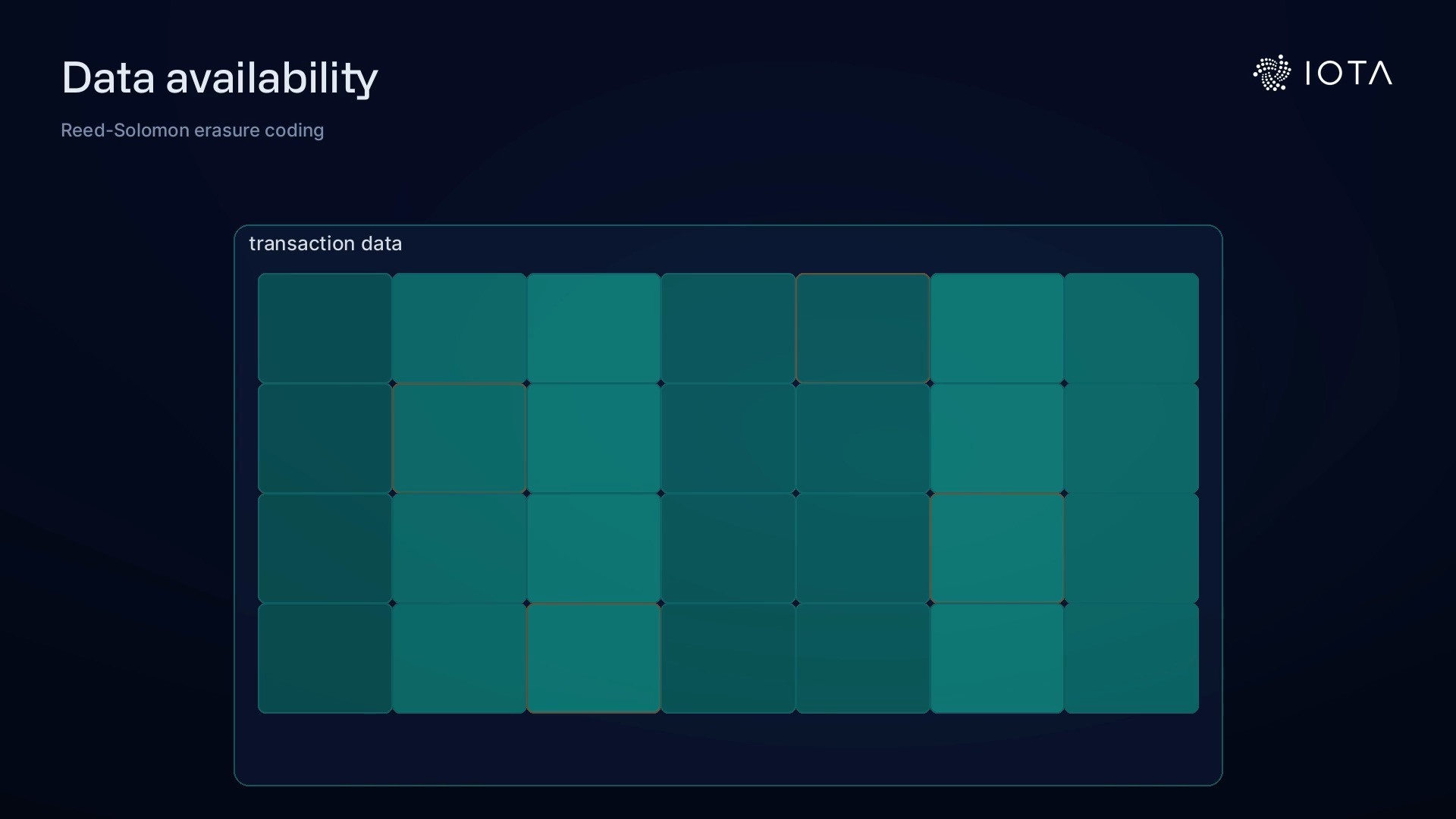
Second, Starfish integrates Reed-Solomon erasure coding to manage data availability efficiently. Analogous to error-correction methodologies used in optical storage and data transmission, Starfish fragments a block’s transaction data into distinct shards distributed across the validator set. The Reed-Solomon parameters are calibrated such that any valid subset of fragments ($f+1$ valid fragments) can fully reconstruct the original payload, even if the remaining shards are lost or withheld by faulty nodes.
This mechanism underpins the Data Availability Certificate (DAC). Rather than enforcing a separate, costly network-wide availability round, availability accumulates organically as the DAG expands. Once a specific threshold of validators ($2f+1$) acknowledges receipt and verification of payload fragments within the causal history of a subsequently committed block, that block acts as an implicit certificate of availability.
The structural graph simultaneously guarantees transaction ordering, recoverability, and liveness without bloating the critical consensus path.
The Push Pacemaker and Liveness Guarantees
Uncertified DAG-based BFT protocols, such as Mysticeti, have gained traction for achieving ultra-low latency by eliminating per-block quorum certificates. However, recent cryptographic analyses have identified subtle vulnerability vectors in uncertified models, including desynchronization attacks where honest validators fail to commit network leaders even after network stabilization. These vulnerabilities typically stem from round advancement without mandatory local block creation, leaving structural "holes" in the DAG that prevent the protocol from accumulating the quorum structures required to finalize leadership.
Starfish addresses this structural risk by implementing a Push pacemaker. Under this rule, a validator cannot advance to subsequent operational rounds without successfully proposing its own local block. Lagging participants catch up upon observing a valid quorum of current-round blocks from peers. This enforcement mechanism ensures that validators cannot drift ahead of the network without contributing the structural components necessary for ongoing voting and certification, thereby preserving liveness under adverse conditions.
Empirical Performance Metrics and Variance Reduction
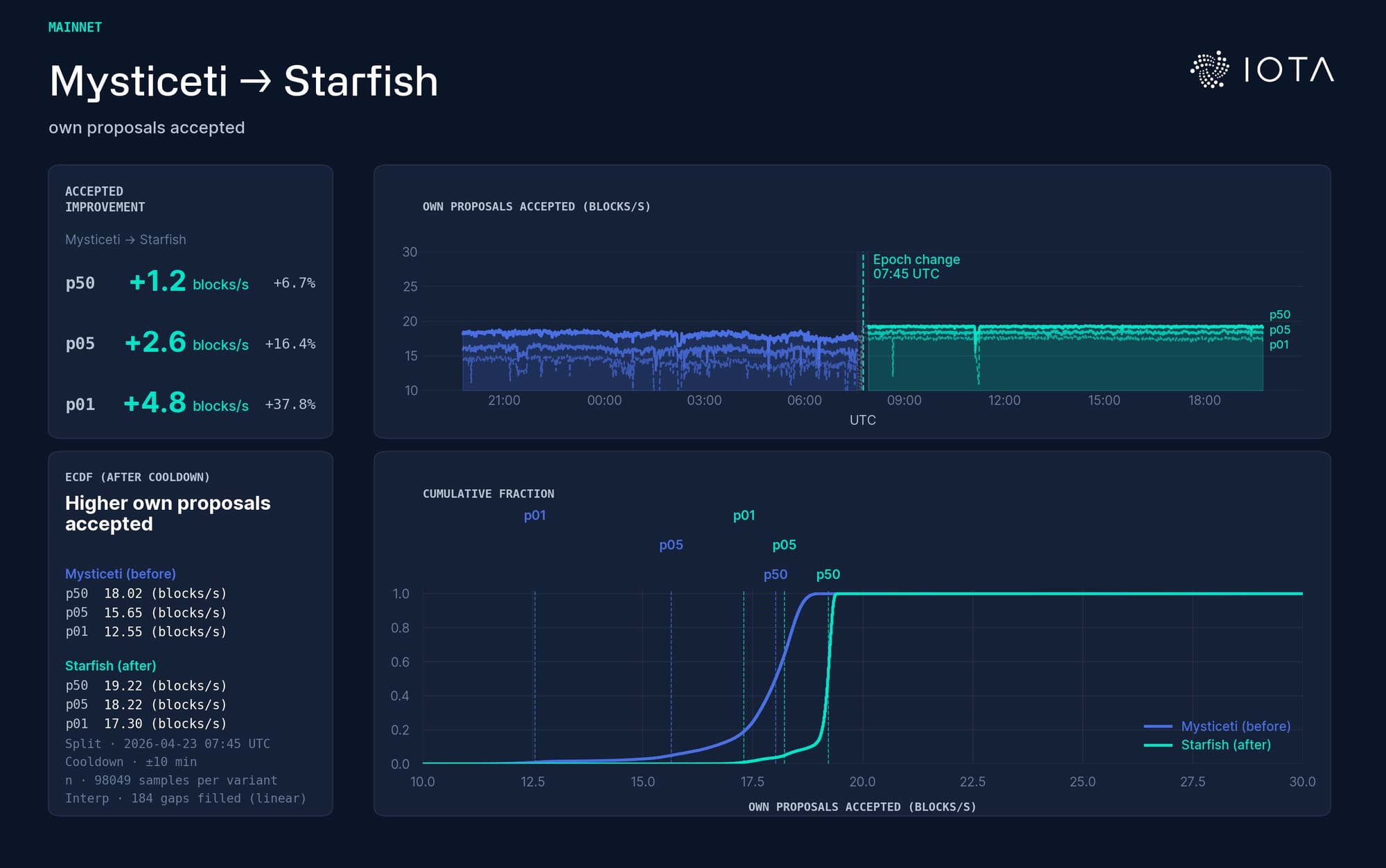
Mainnet telemetry comparing the legacy uncertified model (Mysticeti) with the newly deployed Starfish protocol reveals significant improvements in system robustness. While academic benchmarks traditionally prioritize peak throughput and median latency, industrial system design emphasizes variance reduction and tail-latency minimization—principles well-established in statistical process control and Six Sigma methodologies.
Production metrics from the IOTA Mainnet deployment illustrate the practical impact of these design choices:
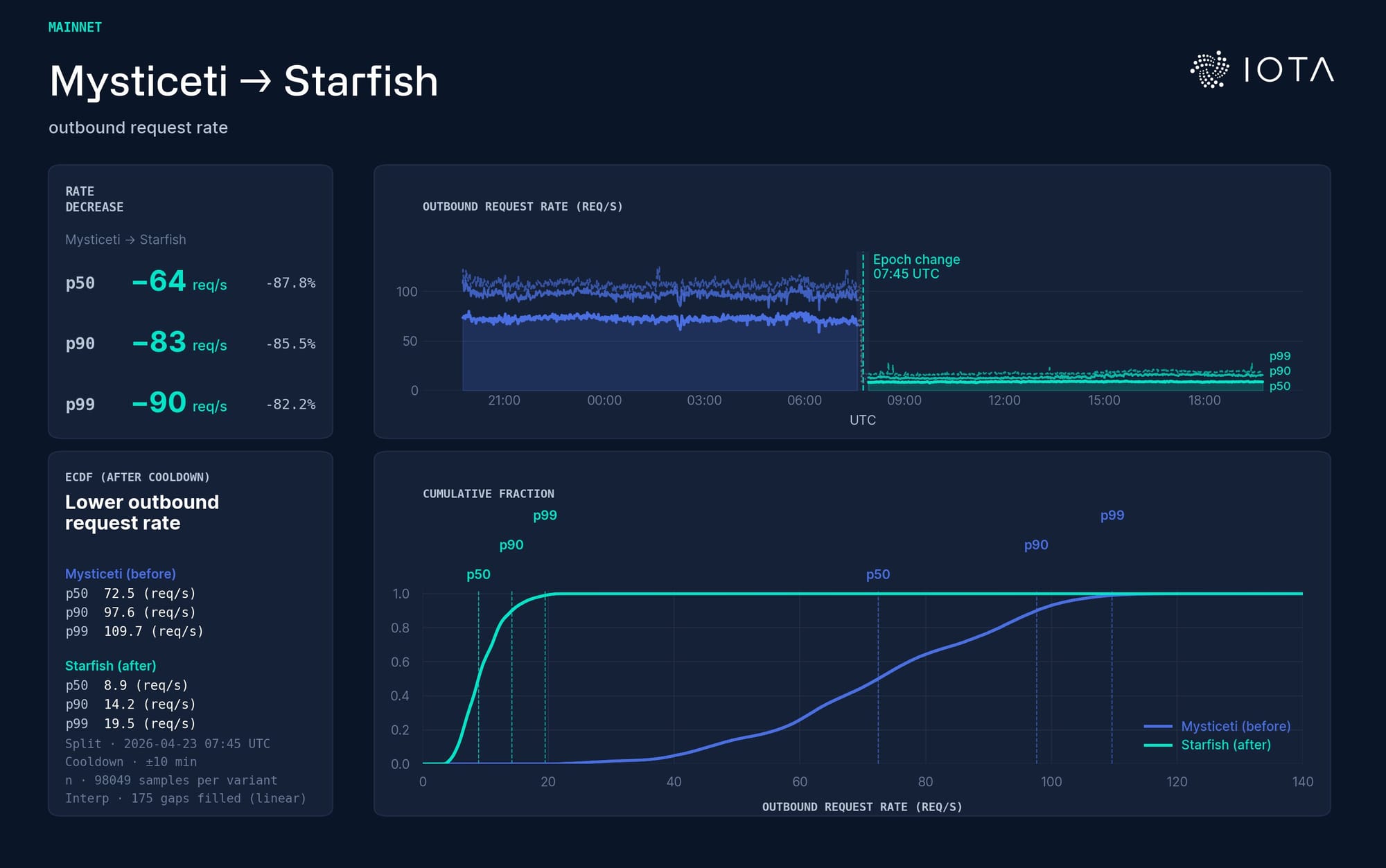
- Outbound Request Rates: Following the activation of Starfish, outbound recovery requests—the primary metric for the reactive pull path—dropped by approximately an order of magnitude. Validators spend significantly less bandwidth and time executing recovery routines on the critical path.
- Commit Latency Distribution: While median (p50) latencies remain comparable, tail latencies exhibit pronounced improvements. The p99 commit latency improved markedly, transitioning from approximately 486 milliseconds down to 312 milliseconds. Cumulative distribution functions confirm a narrower distribution curve, indicating fewer delayed commits during network disturbances.
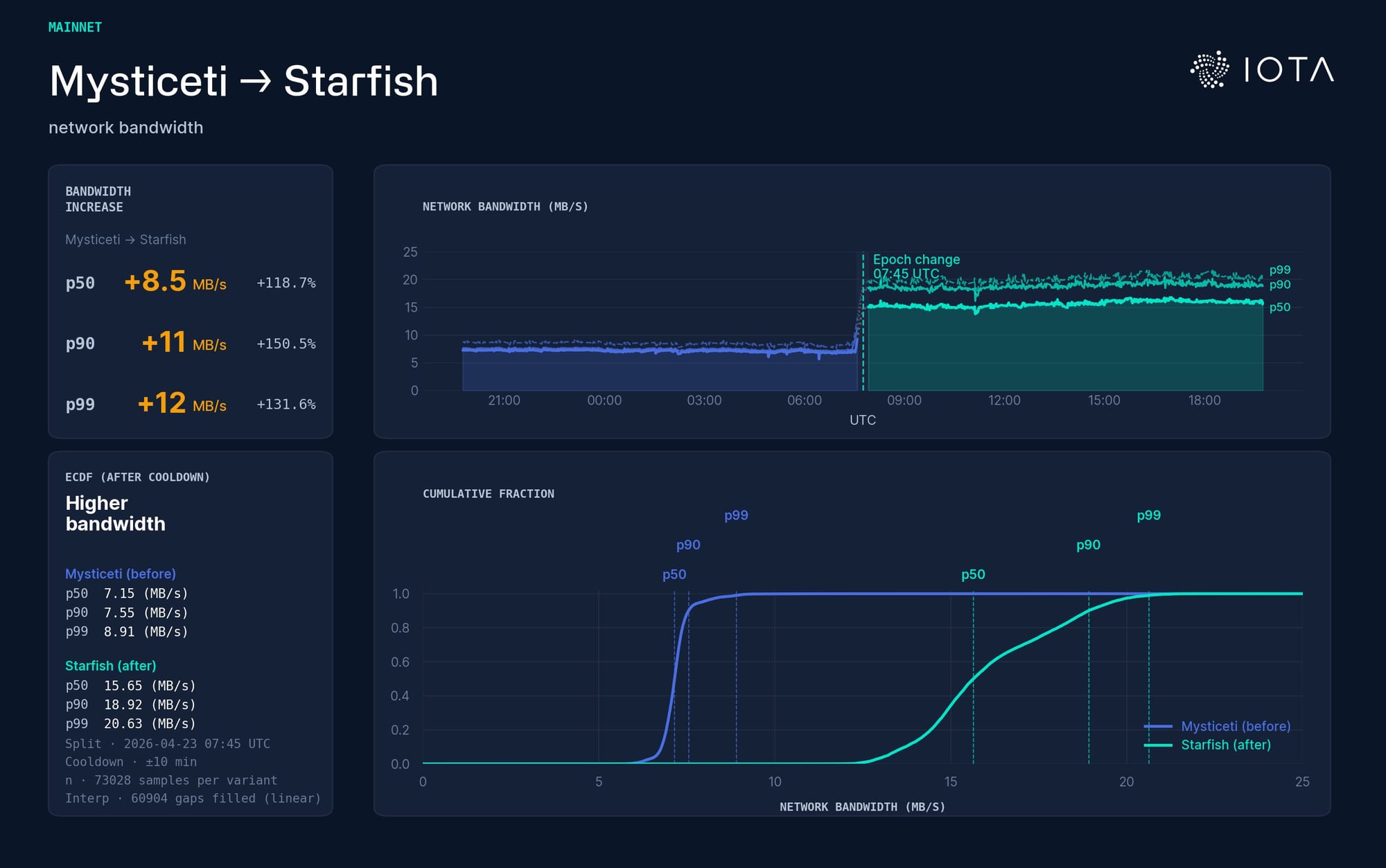
- Bandwidth Utilization: Starfish exhibits a structured, predictable increase in upfront communication overhead to distribute metadata and erasure-coded fragments. This upfront investment successfully suppresses catastrophic recovery costs and latency spikes during high-load scenarios.
Broader Implications and Industry Impact
The deployment of Starfish on the IOTA Mainnet represents a paradigm shift in how distributed ledger protocols reconcile the competing demands of throughput, latency, and Byzantine fault tolerance. By elevating data dissemination and availability to first-class protocol primitives rather than treating them as background networking assumptions, the architecture provides a blueprint for resilient decentralized infrastructure.
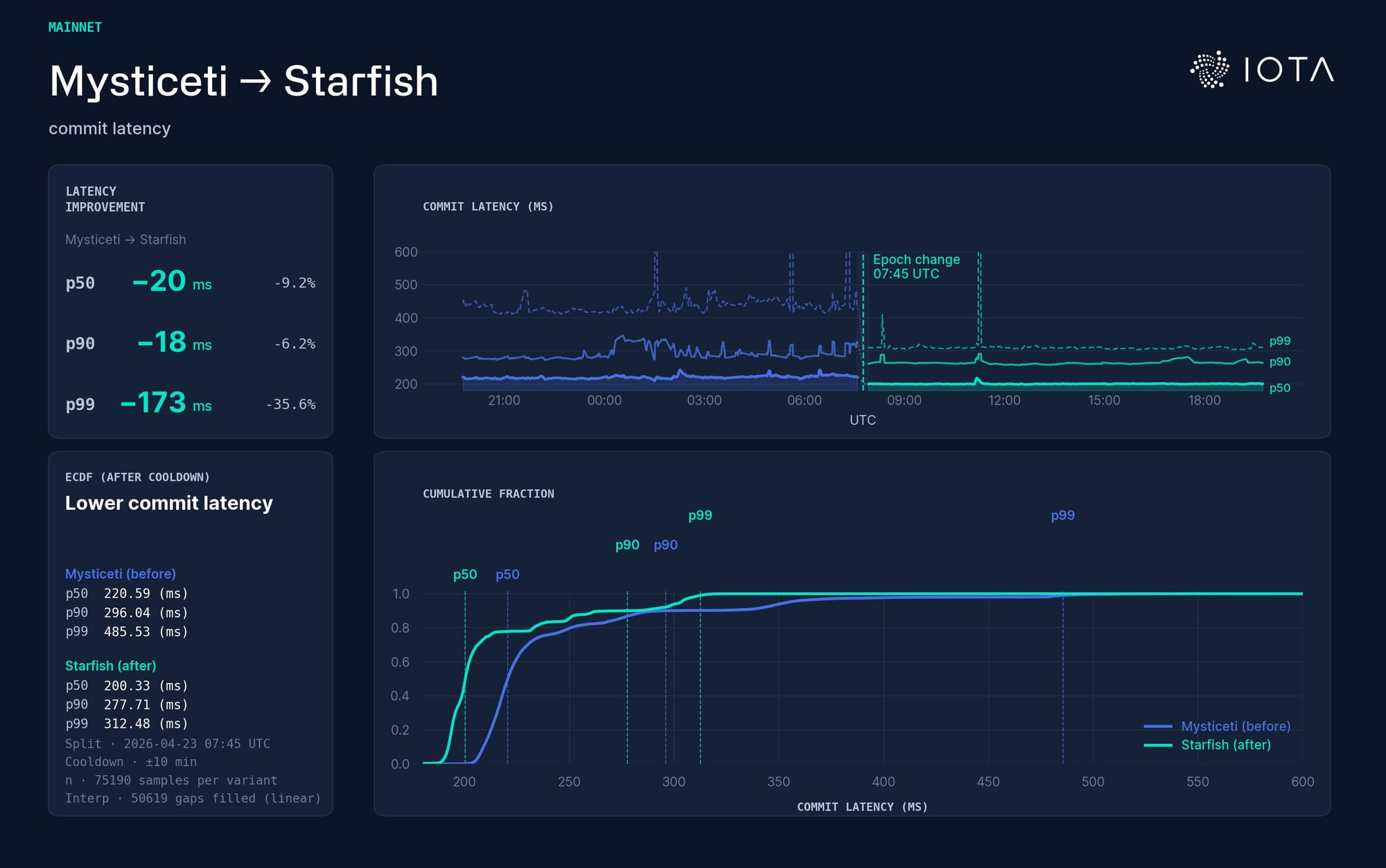
Real-world validator networks operate under inherently imperfect conditions, characterized by heterogeneous hardware, fluctuating geographical latency, and transient network partitions. Protocols designed exclusively for optimal laboratory environments frequently exhibit brittle degradation patterns under these pressures. By prioritizing low operational variance and structural determinism, Starfish establishes a framework for maintaining predictable performance under duress.
As the distributed ledger technology sector matures, the transition from average-case benchmarking to tail-latency optimization will likely define the next generation of consensus engineering. IOTA’s technical shift demonstrates that addressing the foundational plumbing of distributed systems—specifically how information is synchronized and disseminated—yields tangible gains in production reliability, security, and long-term network viability.