In an era where modern supply chains, clinical trials, and multinational regulatory frameworks span fragmented digital ecosystems, establishing absolute trust in data remains one of enterprise technology’s most stubborn challenges. Business records are typically scattered across isolated databases, legacy spreadsheets, and internal system logs, creating an environment ripe for unilateral alterations, backfilled entries, and prolonged disputes. When cross-border partners, external auditors, or regulatory authorities demand proof of a transaction’s authenticity, organizations often rely on manual, exported reports that require blind trust.
To resolve this structural vulnerability, the IOTA Foundation has officially launched IOTA Audit Trails, an innovative open-source solution housed within the broader IOTA Notarization toolkit. This new alpha-stage release introduces a decentralized, tamper-resistant method for anchoring governed, ordered histories directly onto a public ledger. By doing so, the platform enables enterprises to maintain the privacy of their sensitive underlying source documents while establishing a globally verifiable chain of custody for hashes, metadata, and operational proofs.
The Architectural Foundation: Moving Beyond Siloed Logs
Traditional audit logging mechanisms are fundamentally designed for internal visibility. They allow system administrators and internal compliance teams to investigate security incidents, satisfy localized reporting obligations, and monitor operational health. However, this centralized model collapses the moment a business workflow crosses organizational boundaries.
When an insurer, customer, regulatory body, or downstream manufacturing partner requires validation that a record was added at a precise time, by an authorized actor, and under strict governance rules, internal database logs carry little weight. They can be manipulated or disputed.
IOTA Audit Trails addresses this dilemma by bridging the gap between private enterprise infrastructure and public ledger transparency. Rather than forcing organizations to expose confidential business records, proprietary reports, or personal data on a public chain, the system operates on a selective disclosure model. Organizations store their raw data off-chain while anchoring cryptographic hashes, structural references, and non-sensitive metadata to an immutable, ordered on-chain ledger.
This approach guarantees that every record’s existence, chronological sequence, and data integrity can be independently verified by any authorized external party. Verifiers can inspect the trail state and transaction sequence using read-only clients, eliminating the need for write permissions or reliance on centralized intermediaries.
Expanding the IOTA Notarization Ecosystem
The debut of IOTA Audit Trails builds directly upon the foundation established by IOTA Notarization, which previously allowed developers to anchor isolated, single-instance records onto the IOTA network. While notarization serves as a powerful tool for proving that a specific file or piece of data existed at a given point in time, complex real-world workflows demand more than isolated proofs. They require sequential context and strict governance.
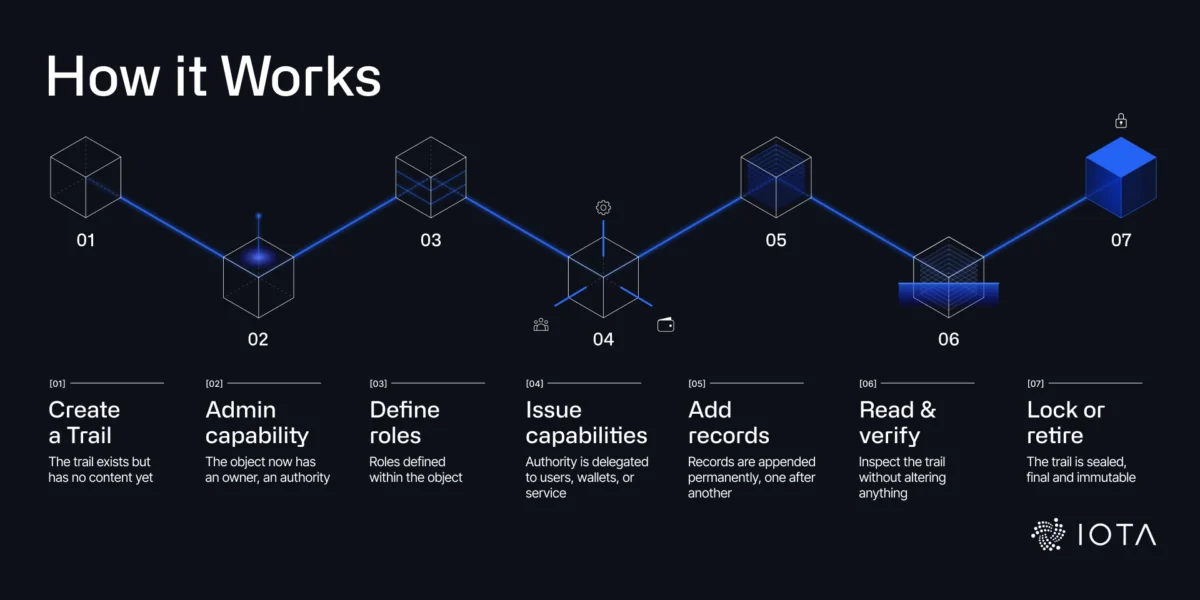
An IOTA Audit Trail functions as a shared, on-chain object that manages records in a strict chronological sequence. Each record within the trail can encapsulate text or binary data, optional metadata, and specific categorization tags. Furthermore, the trail itself stores immutable creation metadata, updatable operational parameters, locking configurations, and automated tag rules.
This shifts the foundational question from simply asking, "Has this data been altered?" to exploring a comprehensive set of operational inquiries: Who added this record? Under which assigned role? In what precise order? And governed by what lifecycle rules?
Granular Governance Through Role-Based Access Control
Enterprise environments are characterized by complex hierarchies and division of labor. A single workflow may involve a product manufacturer recording lifecycle events, an independent auditor inspecting compliance metrics, a compliance officer managing data retention protocols, and a system operator maintaining categorization tags.
To accommodate these diverse operational needs, IOTA Audit Trails integrates robust, role-based access control directly into its smart contract logic. Roles define the specific classes of actions permitted within a workflow, while explicit capabilities delegate those roles securely to designated cryptographic wallets or automated services.

This native governance model spares developers from the immense complexity of engineering custom smart contracts for every unique audit workflow. Whether managing customs clearances or pharmaceutical supply chains, teams can enforce separation of duties seamlessly.
Implementation and Developer Tooling
To accelerate adoption across diverse technology stacks, the IOTA Foundation has released Audit Trails with comprehensive multi-language developer tooling. The solution is distributed across three primary integration pathways:
- The Move Package: Designed for native on-chain contract logic, allowing developers to deploy secure, immutable rules directly to the network.
- The Rust SDK: A strongly typed software development kit tailored for robust backend integrations and enterprise server environments.
- WebAssembly (WASM) Bindings: Built specifically for JavaScript and TypeScript applications, enabling seamless integration into modern web and mobile frontends.
Additionally, the official repository includes ready-to-run examples demonstrating practical use cases such as customs clearance protocols, clinical trial tracking, and digital product passports. The architecture intentionally separates transaction construction from transaction submission. This decoupling allows engineering teams to integrate Audit Trails directly into their existing wallet infrastructure, signing mechanisms, or automated gas station flows without disrupting established operational pipelines.
Industry Applications and Real-World Implications
The cross-industry implications of shared, verifiable audit trails are vast, particularly for sectors where data crosses jurisdictional boundaries and carries heavy regulatory weight.
In supply chains and digital product passports, manufacturers can securely record lifecycle events, maintenance milestones, and third-party certifications that accompany a physical component from initial production to final recycling. This transparency satisfies tightening global sustainability regulations and combats counterfeit goods.
For legal and compliance teams, Audit Trails provides an unassailable framework for logging regulatory filings, contract amendments, and governance approvals. Because the historical sequence is cryptographically locked, legal disputes regarding missing or backfilled documents are effectively neutralized.
In international trade and customs workflows, multi-party clearance steps, border inspections, and regulatory declarations can be coordinated transparently. Multiple sovereign and corporate entities can rely on a single source of truth without exposing trade secrets.
Finally, Internet of Things (IoT) and industrial automation systems can leverage the ledger to log machine-to-machine events, sensor attestations, and system state transitions, establishing an immutable provenance for automated industrial machinery.
Strategic Outlook and Future Integration
As industries increasingly demand cryptographically verifiable accountability, solutions like IOTA Audit Trails represent a paradigm shift in how digital trust is established. By moving away from siloed internal databases toward shared, publicly verifiable record histories, organizations can eliminate costly reconciliation processes and foster greater transparency with partners and regulators.
The alpha release of IOTA Audit Trails is available immediately for development teams looking to experiment with architectures, stress-test governance models, and provide critical feedback to the IOTA developer community. Organizations can deploy and test their workflows on the IOTA Testnet before transitioning production-grade systems to the Mainnet.
By bridging the gap between internal operational privacy and global cryptographic verification, IOTA Audit Trails provides the foundational infrastructure necessary to ensure that trust can finally travel wherever modern business operations lead.