In the high-stakes environment of organ transplantation, minutes can dictate the boundary between life and death. When a viable organ becomes available, a complex, high-pressure medical logistical operation swings into motion. A human heart, for instance, remains viable outside the body for only a matter of hours. Within this narrow operational window, a vast network of actors—spanning regional hospitals, provincial agencies, and national coordinators—must execute their duties in absolute synchronization. Every consent form, medical evaluation, and transit authorization must be meticulously documented, flawlessly verified, and executed right the first time. A single clerical error, an untraceable signature, or a lost physical document can disrupt the entire chain of custody, with catastrophic human costs.
To mitigate these systemic vulnerabilities, Argentina has officially integrated decentralized identity and cryptographic notarization technology into its national transplant architecture. Through a collaborative effort involving the national organ authority, the Latin American decentralized identity firm Extrimian, and the layer-1 public ledger IOTA, Argentina has successfully transitioned its organ, tissue, and cell donation systems onto a live, publicly verifiable onchain infrastructure.
Navigating Argentina’s Complex Transplant Network
At the apex of this life-saving ecosystem is the Instituto Nacional Central Único Coordinador de Ablación e Implante (INCUCAI). Operating as Argentina’s national coordinator for organ and tissue transplants, INCUCAI oversees the national waiting list and coordinates closely with 24 jurisdictional procurement agencies—comprising one agency for each of the nation’s 23 provinces, alongside the Autonomous City of Buenos Aires. These agencies interface directly with a vast network of public and private hospitals, as well as specialized transplant centers across the country.
Managing the flow of sensitive medical data, donor consents, and recipient matching across this decentralized national apparatus has historically presented severe administrative and logistical challenges. Paper-based documentation, manual verification steps, and siloed databases frequently introduced friction and delays into a process where absolute efficiency is paramount. Recognizing the urgent need to modernize its digital backbone without compromising data security, INCUCAI sought a technological framework capable of delivering uncompromising transparency, legal certainty, and robust protection for sensitive medical records.
Enter Extrimian, a regional technology company specializing in self-sovereign identity (SSI) and decentralized digital architecture. Extrimian’s mission centers on empowering individuals and institutions with direct control over their digital identities and the data they share. To construct the public, neutral verification layer required for a national healthcare deployment, Extrimian selected IOTA. As an enterprise-grade distributed ledger technology, IOTA provides a scalable, eco-friendly, and cost-efficient environment where institutional identities and document integrity can be cryptographically validated without centralized gatekeepers.
Technological Architecture: Privacy Meets Public Verification
A primary concern in deploying blockchain or distributed ledger technology within healthcare is the protection of patient privacy. To comply with strict medical confidentiality laws and ethical standards, the architecture deployed by Extrimian and INCUCAI ensures that no personally identifiable information (PII) or raw patient medical data is ever stored on the public blockchain.
Instead, the system utilizes cryptographic hashes—unique, mathematical fingerprints of documents and process steps—which are permanently anchored to the IOTA mainnet. This ensures absolute immutability and tamper-proof auditing capabilities while keeping the underlying medical data entirely private. Healthcare professionals, provincial regulators, and families can mathematically verify that every procedural step occurred exactly as recorded, ensuring total system integrity without exposing sensitive personal details.
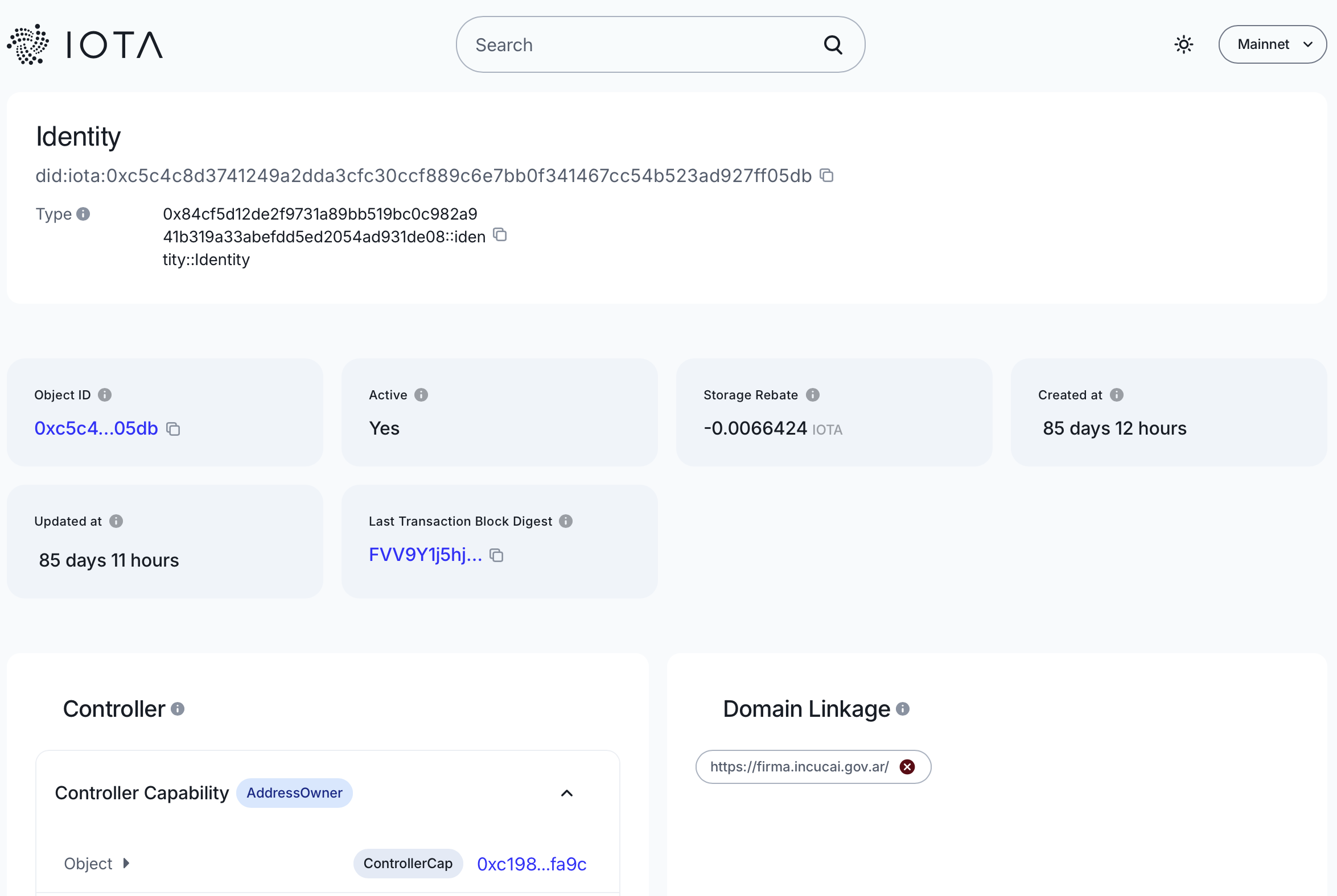
The deployment leverages several core IOTA building blocks, operating entirely on open, verifiable standards. The digital identities and credentials within the ecosystem adhere strictly to World Wide Web Consortium (W3C) specifications. Furthermore, INCUCAI’s institutional onchain identity is cryptographically linked to its official government domain, enabling anyone to verify that the entity executing digital transactions is indeed the legitimate national authority rather than a malicious actor.
To reinforce national data sovereignty, critical components of the system also operate on infrastructure provided by ARSAT, Argentina’s state-owned telecommunications and satellite solutions company. This integration ensures that foundational elements of the digital architecture remain securely under national control.
Independent technical audits conducted by the IOTA Foundation confirmed the robustness of the deployment. By examining public endpoints and the IOTA Explorer, engineers verified that all 24 provincial agency identities successfully resolved onchain, their cryptographic trust federations matched national registry data, and direct ledger calls confirmed the legitimacy of the accredited entities.
Legislative Milestones and the Rollout of IncucaiID
The transition to a digital-first transplant administration shifted from development to active national adoption through Resolution 199/2026, published in Argentina’s Official Gazette (Boletín Oficial). This legislative milestone formally authorized the implementation of advanced electronic signatures across every procedural workflow managed by SINTRA—Argentina’s National Procurement and Transplant Information System—alongside its associated institutional databases.
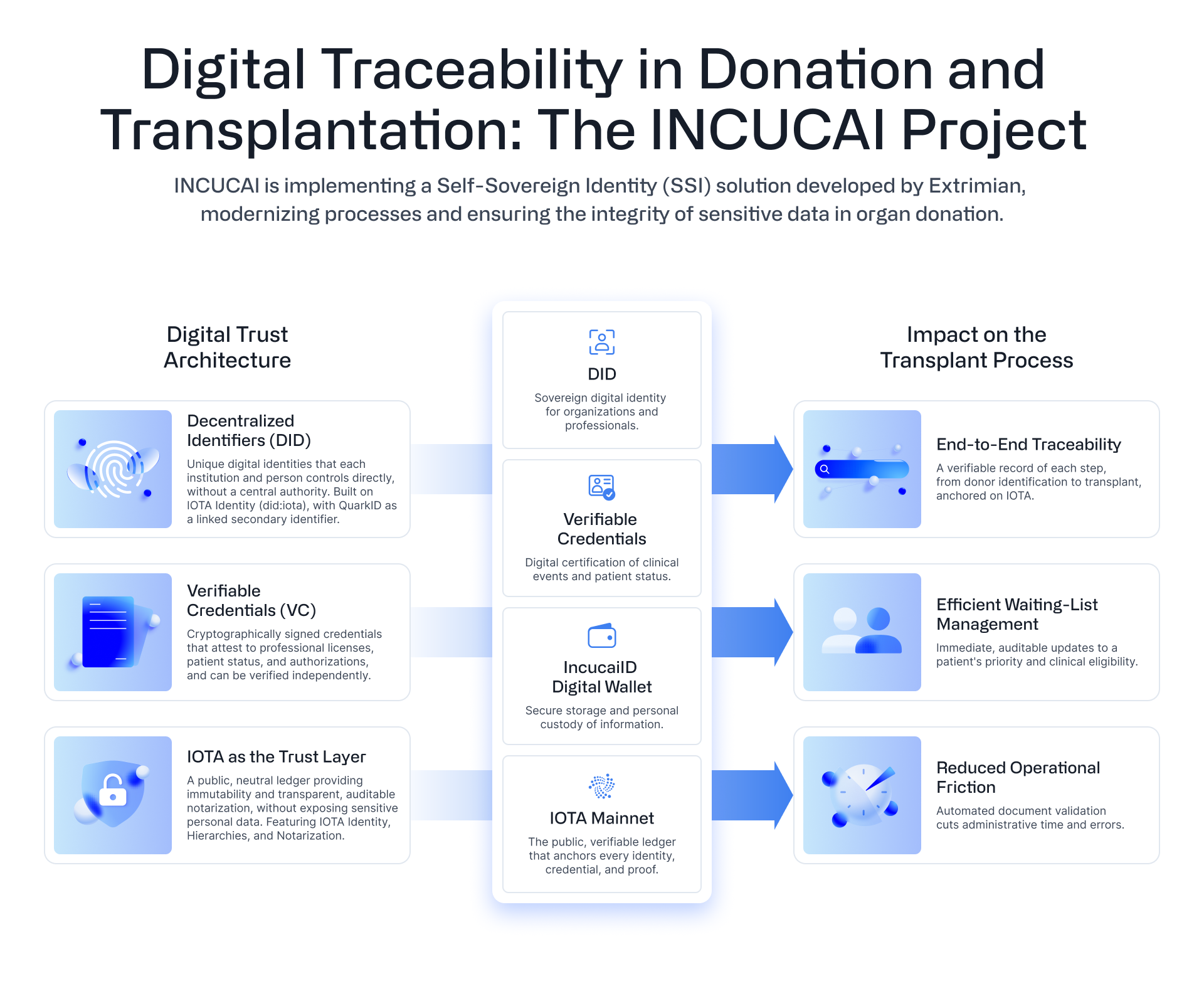
The cornerstone of this rollout is IncucaiID, the ecosystem’s official decentralized wallet application available for download on major mobile platforms. Through IncucaiID, registered patients, accredited healthcare professionals, and authorized administrative personnel receive verifiable digital credentials. These credentials allow users to securely authenticate their identities and apply legally binding electronic signatures to documents tied to the donation and transplantation lifecycle.
In alignment with self-sovereign identity principles, users retain custody of their own credentials within the wallet application, disclosing only the specific attestations required for each individual step of the medical workflow. The implementation strategy is phased, beginning with the waiting-list registration procedures for heart and lung transplants. Subsequent phases will systematically incorporate remaining organ waiting lists, eventually absorbing all administrative and clinical documentation managed within the SINTRA network. The ultimate objective is a fully paperless, frictionless workflow that eliminates the physical transport of documents and the delays associated with manual inter-provincial bureaucracy.
Official Perspectives on National Digital Transformation
The integration of decentralized technology into a critical public infrastructure project has drawn praise from both public sector leadership and technology architects, underscoring the tangible impact of blockchain solutions in real-world governance.
Daniela Hansen Krogh, Director of Information Technology and Information Systems at INCUCAI, emphasized the foundational role of trust in medical logistics: "Trust is at the heart of every organ donation and transplantation process. Our responsibility is to ensure that every decision is supported by reliable, secure, and verifiable information. By incorporating decentralized identity and cryptographic verification into our national systems, we are strengthening the integrity, traceability, and legal certainty of every critical stage, while safeguarding sensitive patient information. This initiative reflects INCUCAI’s ongoing commitment to modernizing Argentina’s transplant system through secure, transparent, and citizen-centered digital innovation."
Esteban Musso, Professional Services Manager and Partner at Extrimian, highlighted the broader significance of deploying decentralized systems at a national scale: "At Extrimian, we believe that trust is the foundation of every digital transformation. By combining open standards with privacy-preserving technologies, we’ve helped build a solution that enhances traceability, security, and interoperability while respecting the privacy of every participant. Projects like this demonstrate that decentralized technologies are no longer a vision for the future—they are delivering tangible value today in critical public services."
Dominik Schiener, Co-Founder and Chairman of the IOTA Foundation, echoed these sentiments regarding the utility of distributed ledger technology for public good: "This is what IOTA’s open technology can do for critical public services at national scale: real infrastructure, already coordinating decisions that save lives."
Implications and Broader Industry Impact
The successful deployment of INCUCAI and Extrimian’s onchain transplant infrastructure represents a significant precedent for the public sector adoption of decentralized identity technologies globally. Historically, public administration blockchain initiatives have struggled to move beyond proof-of-concept stages due to regulatory hurdles, privacy concerns, and technological complexity.
By prioritizing strict data minimization—anchoring only cryptographic proofs while keeping personal health data offchain—Argentina has established a viable blueprint for securing high-stakes government workflows. The integration of W3C-compliant decentralized identifiers with national domain linkages demonstrates how public institutions can harness cryptographic verifiability without relinquishing regulatory oversight or compromising citizen privacy.
As SINTRA expands its electronic signature mandate across additional organ categories, the system is expected to yield quantifiable improvements in auditability, processing speed, and cross-jurisdictional coordination. In a medical discipline where administrative friction carries an immediate human toll, the marriage of decentralized identity and high-performance ledger technology offers a compelling model for modernizing public infrastructure, turning the cryptographic promise of verifiable trust into an active instrument of public health.