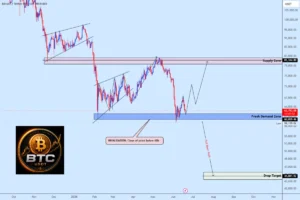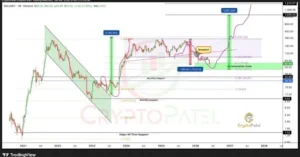
The digital asset landscape is currently navigating a period of profound turbulence, characterized by persistent bearish pressures, macroeconomic headwinds, and a noticeable retreat of institutional capital from alternative cryptocurrencies. Over the past thirty days, the broader altcoin market has experienced a severe contraction, with key metrics revealing that a staggering majority of digital assets are trading significantly below their critical technical thresholds. As Bitcoin (BTC) struggles to maintain momentum and hovers below the psychological $60,000 threshold, major altcoins—including Ethereum (ETH), Solana (SOL), and XRP—have found themselves entrenched in the red zone. This market-wide correction has reignited debates among traders and institutional analysts regarding whether current price levels represent a multi-month accumulation opportunity or the early stages of a more prolonged cyclical downturn.
Technical Breakdown: The Significance of the 200-Day Moving Average
Market analysts at prominent on-chain intelligence platforms, including CryptoQuant, have highlighted a worrisome technical development: the vast majority of altcoins have decisively broken below their 200-day moving average (DMA). This indicator has historically served as the definitive dividing line between macro bull and bear markets. When digital assets persistently trade below the 200 DMA, it signals a structural shift in market momentum, often triggering automated sell-offs from algorithmic funds and risk-averse institutional portfolios.
The severity of the current correction is further underscored by the performance of the Total 3 index, a widely monitored metric that tracks the cumulative market capitalization of all cryptocurrencies excluding Bitcoin and Ethereum. The Total 3 index has plunged deeper beneath its 200 DMA, reflecting widespread capital erosion across mid- and small-cap altcoins. According to exchange-level data from platforms like Binance, inbound transfer volumes have spiked, indicating that market participants are actively positioning themselves to offload assets rather than accumulate during dips. This behavior points to a pervasive lack of confidence among retail traders, many of whom are capitulating to prevent compounding losses as portfolio values shrink week over week.
Macroeconomic Pressures and Liquidity Constraints
The ongoing contraction in the digital asset sector does not exist in a vacuum; it is deeply intertwined with broader macroeconomic conditions. Central bank policies, particularly the evolving trajectory of the United States Federal Reserve’s balance sheet and reserve ratios, have tightened overall market liquidity. As global financial conditions remain restrictive, risk-on assets such as cryptocurrencies face acute capital constraints.
Furthermore, institutional appetite—which served as a primary catalyst for the market’s previous rallies—has cooled noticeably. Spot exchange-traded funds (ETFs) tied to major digital assets like Ethereum have registered significant net outflows over rolling thirty-day periods, reversing the massive inflows witnessed earlier in the year. Institutional investors, facing macroeconomic uncertainty and higher yields in traditional fixed-income markets, are rationalizing their portfolios. This capital reallocation has disproportionately impacted altcoins, which inherently carry a higher risk premium compared to Bitcoin.

Market historians have noted striking parallels between the current market structure and previous cyclical troughs. Observers point out that the ongoing period of prolonged stagnation represents the second-longest underperformance streak for altcoins since 2020. A comparable consolidation and depreciation phase was last observed during the protracted bear market of the previous cycle, where similar market dynamics persisted for approximately ten months before structural bottoming occurred.
Individual Asset Performance: Ethereum, Solana, and XRP Under Pressure
Amid this overarching market slump, individual top-tier altcoins are exhibiting varying degrees of resilience, though nearly all remain under sustained downward pressure.
Ethereum, the undisputed pioneer of smart contract platforms, has extended its sideways and downward trajectory. Over the past week, ETH prices slid an additional 5.2%, deepening its monthly losses to over 22%. Trading at approximately $1,566, Ethereum finds itself well below the bullish projections formulated by analysts at the close of previous quarters. Despite these declines, fundamental metrics such as layer-2 network adoption and total value locked (TVL) remain robust, leading long-term proponents to argue that the current price action reflects temporary macro-driven exhaustion rather than a fundamental flaw in the network’s value proposition.
Solana has demonstrated relative strength compared to its peers, despite enduring minor intraday pullbacks. Although SOL recorded a modest 1.5% decline in recent daily trading, it managed to maintain a positive weekly inflow, boasting gains of roughly 4% over a seven-day window. This outperformance is frequently attributed to consistent network activity, active decentralized exchange (DEX) volume, and a resilient developer ecosystem that continues to attract capital even during broader market downturns.
Conversely, XRP has faced continued headwinds, sliding roughly 6% over the same weekly timeframe. Regulatory uncertainties, combined with broader risk-off sentiment across centralized exchanges, have weighed heavily on XRP’s price action, dampening the enthusiasm generated by earlier legal milestones.
Overall, the aggregate cryptocurrency market capitalization contracted by approximately 2.07%, bringing the total valuation down to roughly $2.04 trillion. This contraction highlights a generalized apathy among retail and institutional participants alike, as trading volumes dry up and market participants await clearer macroeconomic signals.

Chronology of the Recent Market Correction
To fully understand the current state of the altcoin market, it is essential to examine the chronological progression of events leading up to the present contraction:
- Q1 2025: Institutional accumulation drives a significant wave of capital inflows into digital assets, fueled by optimism surrounding spot ETF approvals and favorable macroeconomic projections. Bitcoin reaches multi-month highs, pulling select altcoins upward in sympathy rallies.
- Late Q1 to Early Q2 2025: Macroeconomic pressures intensify. Central bank hawkishness and tightening reserve metrics begin to restrict global liquidity, causing early signs of capital flight from risk-on asset classes.
- Mid-2025: Bitcoin loses crucial support levels, slipping decisively below the $60,000 threshold. The failure of BTC to sustain upward momentum triggers a wave of cascading liquidations across the broader crypto ecosystem.
- Last 30 Days: Altcoins take the brunt of the correction. Over 84% of altcoins fall below their 200-day moving averages. Spot Ethereum ETFs record substantial net outflows, while retail and whale addresses alike increase exchange inflows, signaling widespread capitulation and a lack of near-term bullish catalysts.
- Present Day: The total crypto market cap languishes near $2.04 trillion. Analysts warn that if current liquidity constraints persist, the altcoin sector may endure an extended period of sideways consolidation reminiscent of historical bear market troughs.
Analyst Insights and Market Implications
Financial analysts and market structure experts have offered varied interpretations of the current climate. While short-term technical indicators unambiguously point to a bearish regime, long-term proponents emphasize that cyclical corrections are a natural component of digital asset evolution.
From a structural standpoint, the clustering of altcoin prices beneath the 200 DMA suggests that a rapid V-shaped recovery is unlikely in the immediate term. Market participants will likely require concrete signals of monetary policy easing, stabilization in macroeconomic liquidity, or renewed institutional product inflows before meaningful capital re-enters the altcoin ecosystem.
Furthermore, the ongoing shift of capital away from altcoins and toward Bitcoin—often measured by Bitcoin’s market dominance metric—illustrates a classic "flight to safety" behavior within the crypto economy. During periods of heightened uncertainty, investors routinely consolidate their holdings into the most liquid and established asset, temporarily starving alternative tokens of necessary trading volume and price support.
Conclusion and Future Outlook
The current market environment serves as a rigorous test of endurance for altcoin investors and developers. With technical indicators signaling deep-seated bearish momentum, macroeconomic liquidity tightening, and key assets lingering beneath critical moving averages, the immediate path forward remains challenging. However, historical precedent suggests that prolonged periods of underperformance and retail capitulation frequently precede major cyclical accumulation phases. Whether the current downturn marks the prelude to a prolonged consolidation or a necessary reset before the next major market expansion will depend heavily on upcoming macroeconomic developments and the return of institutional risk appetite.