In the increasingly competitive landscape of global Bitcoin mining, the distinction between a profitable operation and one facing insolvency often comes down to a single, critical metric: J/TH. As mining difficulty reaches record highs and the block subsidy undergoes periodic halvings, the industry has shifted from a "growth at all costs" mentality to a rigorous, efficiency-driven model. Joules per Terahash (J/TH) serves as the industry-standard benchmark for hardware performance, representing the amount of energy required to generate a specific unit of computational output. As Bitcoin mining matures into a sophisticated industrial sector, understanding this efficiency coefficient is no longer optional; it is the prerequisite for survival in a volatile market.
Defining the Efficiency Standard
At its core, J/TH measures the energy intensity of the SHA-256 hashing process. One Joule is defined as one watt of power consumed over one second. Because mining hardware produces hashrate—measured in Terahash per second (TH/s)—the units consolidate into a clean, comparative ratio: the total wattage consumed by a machine divided by its total hashrate.
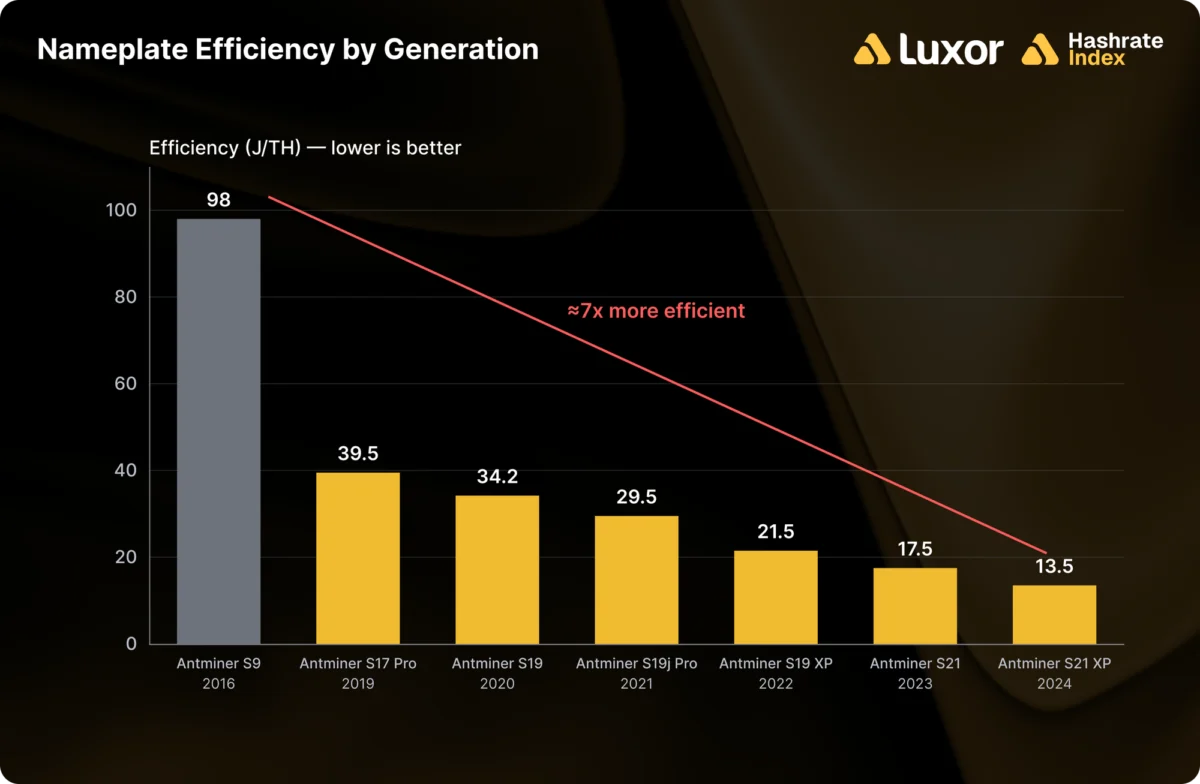
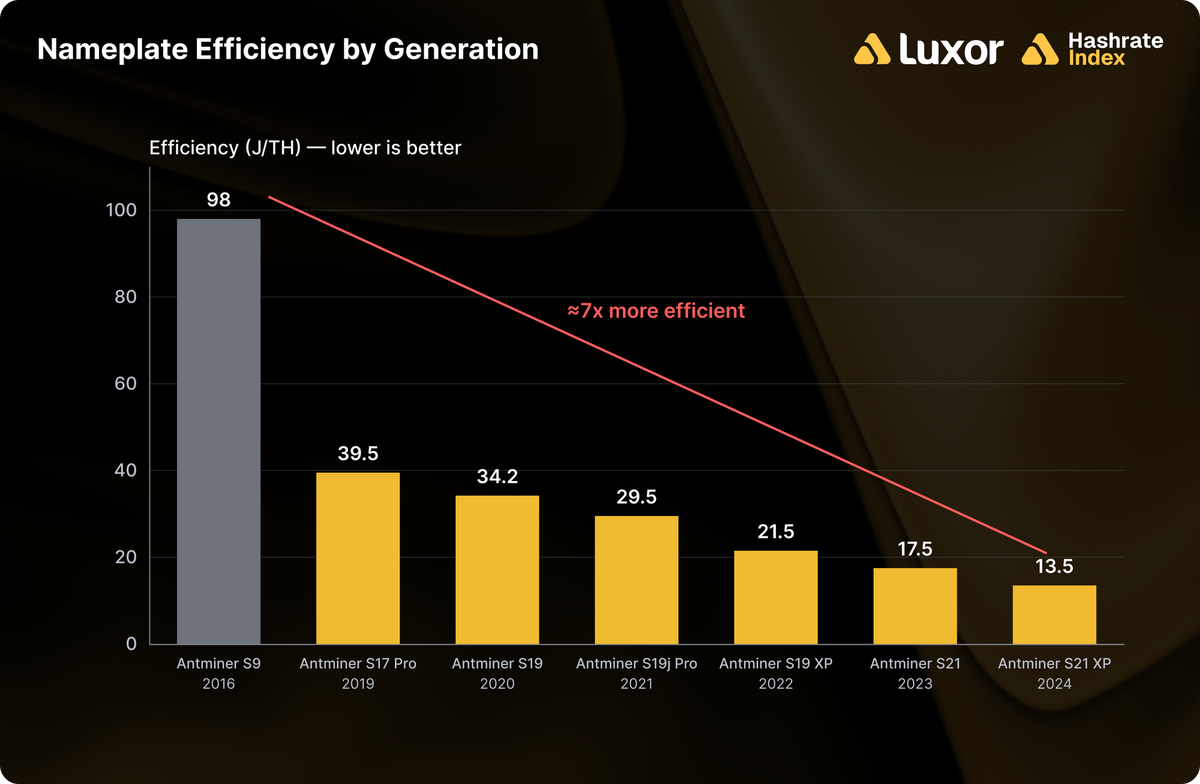
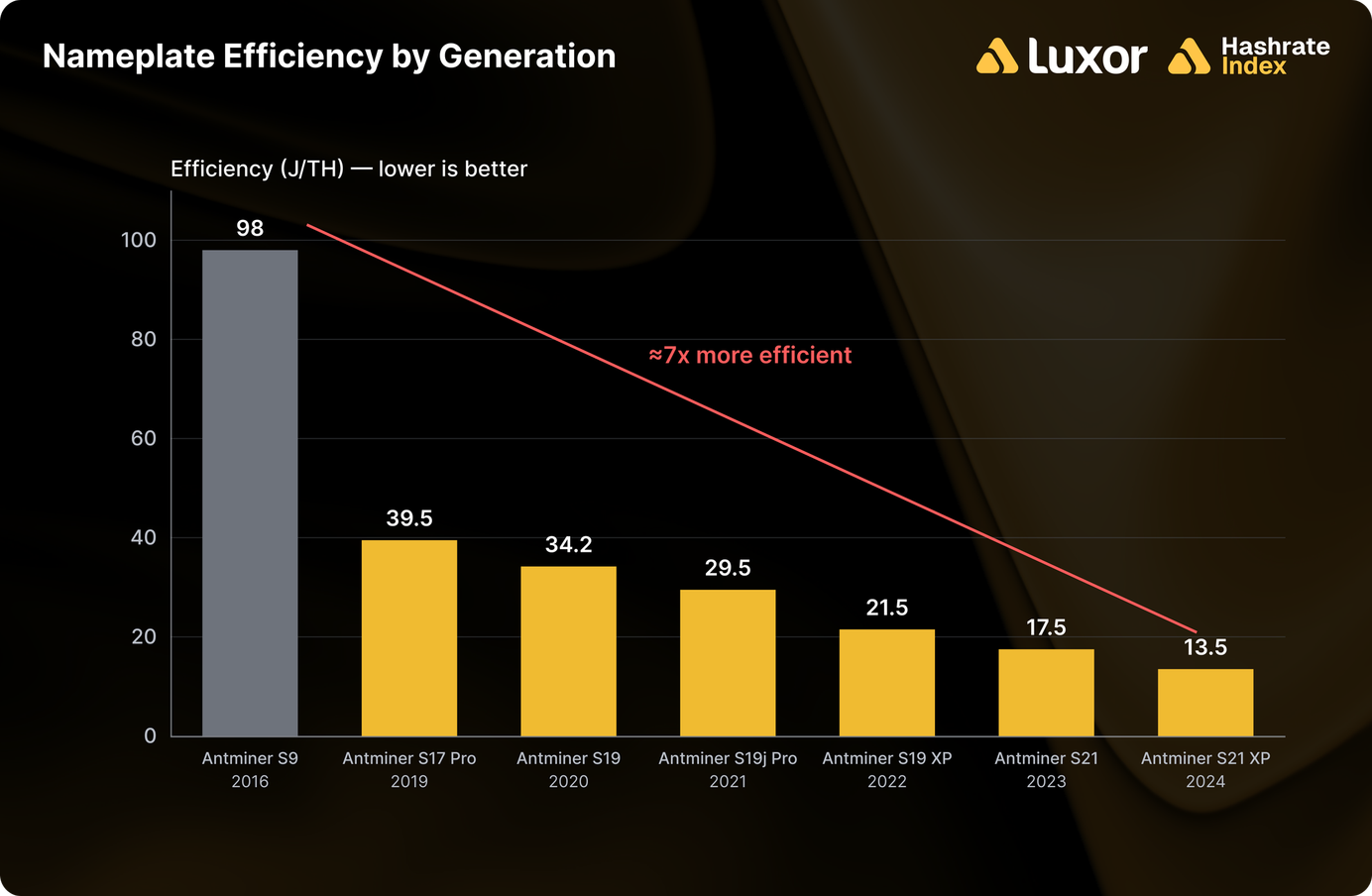
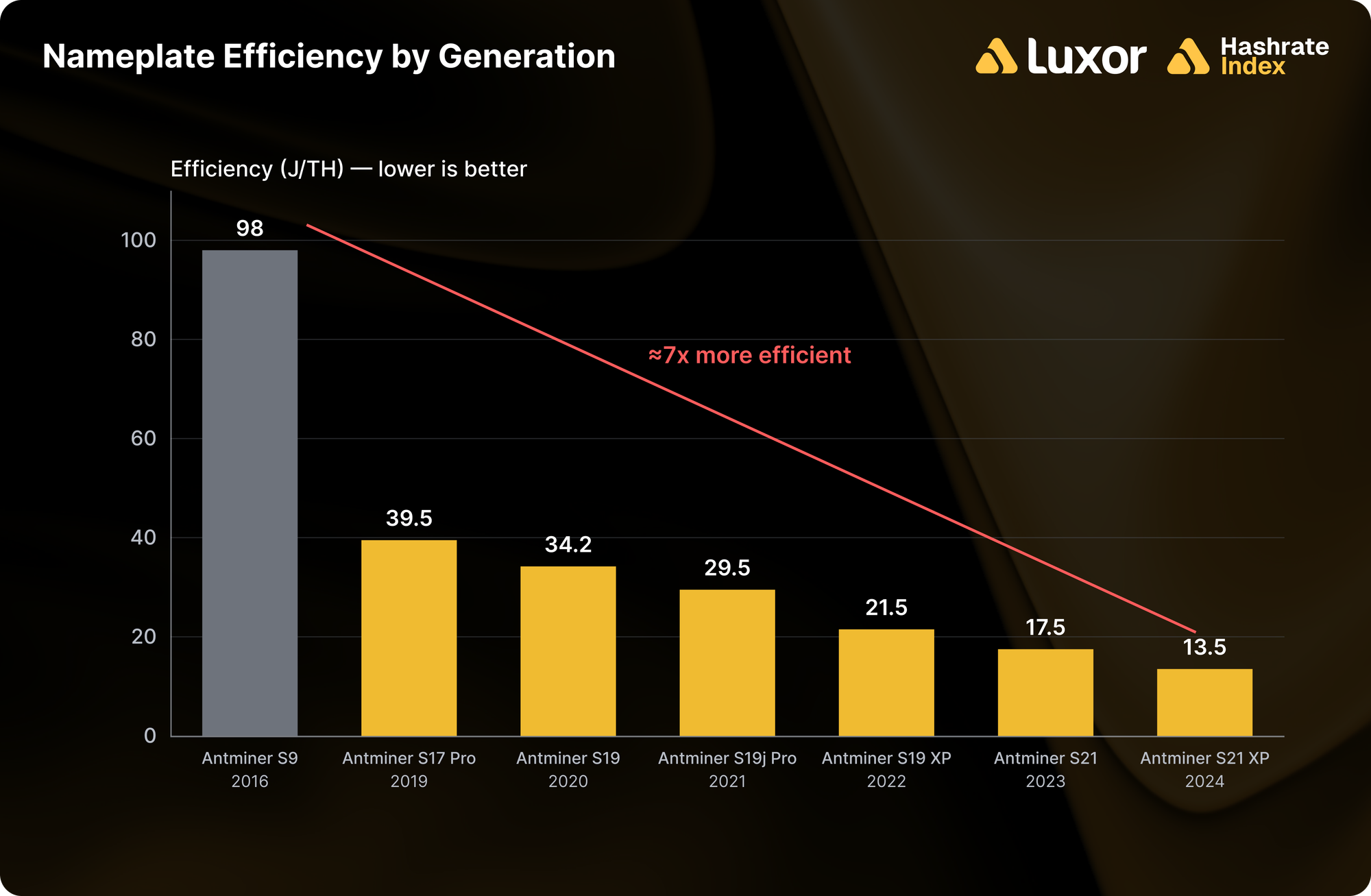
This metric allows operators to compare hardware generations that vary wildly in raw output. For instance, a legacy machine like the Antminer S9, which was the industry workhorse during the 2017–2018 bull run, operated at approximately 98 J/TH. In stark contrast, modern hardware like the Antminer S21 XP operates in the neighborhood of 13.5 J/TH. This transition represents nearly a seven-fold improvement in efficiency over the last decade. This evolution is not merely an engineering milestone; it is a defensive moat against the diminishing returns of the Bitcoin network’s programmed supply issuance.
The Chronology of Efficiency Gains
The history of Bitcoin mining hardware is essentially a history of miniaturization and thermodynamic optimization. In the early years, miners utilized general-purpose CPUs and GPUs. The introduction of Application-Specific Integrated Circuits (ASICs) marked the beginning of the efficiency arms race.
- The 28nm Era (Circa 2016-2017): During this period, machines were characterized by high power consumption relative to their output. The focus was on deploying as many units as possible, as the electricity-to-hashrate ratio was not yet the primary bottleneck for profitability.
- The 7nm and 5nm Transition (2019-2022): As the network difficulty adjusted upward, energy costs became the dominant variable in operational expenditure (OpEx). Manufacturers began prioritizing "performance-per-watt," leading to the widespread adoption of advanced lithography, which allowed for more transistors to be packed into the same space, reducing the voltage required to perform the same number of calculations.
- The Current Era (2025-2026): We have entered the era of the "sub-15 J/TH" machine. With the most recent halving events squeezing margins, miners are now laser-focused on marginal gains. The current state of the art is defined not just by the raw chip design, but by the ability to fine-tune these chips through sophisticated firmware, pushing the hardware to its absolute thermodynamic limits.
Why J/TH Governs the Cost Curve
Every miner on the Bitcoin network receives the same revenue per Terahash—a metric known as "hashprice." Because this revenue is fixed by the network, the only variable an operator can control to maximize net income is the cost of production.
The cost to produce a Terahash is calculated by multiplying the operator’s electricity rate (in dollars per kilowatt-hour) by the efficiency of their hardware (in J/TH). This formula reveals a harsh reality: two miners sitting in the same facility, earning the same amount of Bitcoin, can have vastly different net margins. If Operator A runs a fleet at 30 J/TH and Operator B runs a fleet at 15 J/TH, Operator B is essentially insulated against power price spikes that would force Operator A to shut down.
When the network’s hashprice compresses—often following a halving or a massive influx of new hashrate—the least efficient hardware is the first to become "underwater." This is why J/TH is the primary indicator of a miner’s breakeven point. It dictates the "shutdown price" of an ASIC; when the cost of electricity exceeds the value of the Bitcoin produced by that specific J/TH efficiency, the machine must be powered down to prevent financial loss.
Strategic Implications for Fleet Management
Modern mining enterprises are increasingly viewing their fleets through the lens of capital expenditure (CapEx) versus operational efficiency. Purchasing the most efficient machine on the market often commands a significant price premium. Therefore, the strategic buying decision is rarely based on J/TH alone, but on the "efficiency-adjusted price." This involves calculating the payback period of a machine by balancing the higher upfront cost of high-efficiency hardware against the lower long-term energy costs it provides.
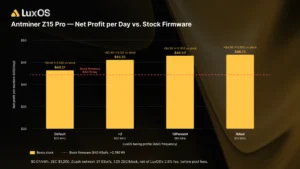
Furthermore, the role of firmware has emerged as a critical lever. Many machines ship with factory settings that are optimized for stability rather than peak performance. Custom firmware solutions allow operators to "tune" their rigs, either by undervolting the chips to reach a lower J/TH (increasing efficiency) or by overclocking them to maximize hashrate (increasing total revenue at the expense of efficiency). The decision to prioritize efficiency or output is a strategic choice that depends entirely on the operator’s specific cost of electricity.
Industry Expert Perspectives
Industry analysts at platforms like Hashrate Index have frequently highlighted that the industry is currently undergoing a "great pruning." As the cost of mining rises, capital is flowing away from older, high-J/TH hardware and toward the newest, low-J/TH machines.
"Efficiency is the ultimate competitive advantage," says one mining analyst. "In a market where the revenue is capped by the protocol, the only way to outperform your peers is to be the lowest-cost producer. If you aren’t tracking your J/TH at the individual machine level, you are essentially flying blind in a storm."
Operators who fail to monitor these metrics often find themselves paying for "phantom power"—energy wasted on inefficient tuning or neglected hardware that is not performing to its nameplate capacity. Maintaining a fleet’s J/TH requires constant vigilance, including periodic maintenance to ensure proper cooling, as heat is the enemy of efficiency. When a chip runs hot, it requires more voltage to maintain stability, causing the J/TH to spike and profitability to plummet.
Conclusion: The Path Forward
As the Bitcoin mining industry continues to integrate into the global energy grid, the focus on J/TH will only intensify. We are moving toward a future where mining operations are indistinguishable from high-performance data centers. The winners in this space will be the companies that can bridge the gap between hardware capability and operational excellence.
For the individual miner, the lesson is clear: the hardware you purchase sets the ceiling for your potential efficiency, but the firmware and operational management you employ determine whether you actually reach it. As the industry moves into the late 2020s, the margin for error has vanished. Understanding and optimizing J/TH is no longer just a technical nuance; it is the foundational requirement for any participant looking to remain profitable in the unforgiving, high-stakes environment of Bitcoin mining. The era of brute-force mining is over; the era of precision efficiency has begun.