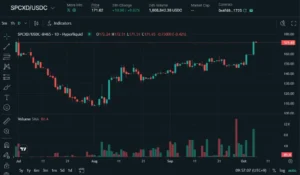
The financial landscape is undergoing a profound transformation as traditional assets, particularly stocks, are increasingly being integrated into blockchain ecosystems. According to a comprehensive analysis released by Binance Research on September 11, 2026, the movement toward "on-chain" assets has accelerated dramatically, reflecting a broader trend where traditional equity markets and decentralized finance (DeFi) are converging. This shift represents not merely a technological upgrade but a fundamental change in how capital is moved, settled, and accessed across global borders.
The Surge of On-Chain Asset Integration
The report highlights a staggering increase in the adoption of tokenized stocks—a process whereby ownership of traditional securities is represented by digital tokens on a distributed ledger. Data compiled by Binance Research indicates that the total value locked (TVL) in tokenized stock protocols has experienced exponential growth throughout 2026. As of early September, the market saw a 314% increase in activity compared to the beginning of the year.
This growth is supported by a significant shift in investor behavior. While traditional trading platforms remain the primary vehicle for equity investment, the friction associated with cross-border settlements, T+2 clearing cycles, and institutional operating hours is driving investors toward blockchain-based alternatives. On-chain stocks offer near-instant settlement and 24/7 accessibility, features that are increasingly attractive to institutional and retail investors alike who seek to maximize capital efficiency in an interconnected global economy.
Chronology of Adoption and Market Expansion
The trajectory of on-chain asset growth throughout 2026 serves as a barometer for the maturation of the sector. At the beginning of the year, the market for tokenized stocks was relatively nascent, with total liquidity figures hovering in the low millions. However, as infrastructure improved and regulatory clarity began to emerge in several jurisdictions, the sector experienced distinct phases of expansion.
By the end of the first quarter, interest was largely confined to niche crypto-native participants. By the second quarter, however, the integration of "bStocks"—a classification of tokenized equity products—began to gain traction among broader investor demographics. The most dramatic acceleration occurred between July and September 2026, where the market saw a surge in daily trading volumes, jumping from approximately $365,000 in early months to over $1.2 million by the late summer. This upward trend suggests that the initial skepticism surrounding the security and legitimacy of tokenized assets is being replaced by confidence in smart contract auditing and institutional-grade custodial solutions.
Supporting Data and Technical Performance
The technical performance of these assets has been characterized by high levels of interoperability with major blockchain networks, primarily BNB Chain and Ethereum. The Binance Research report notes that "bStocks" have seen a consistent rise in their monthly volume, growing from 0.8% of the total asset market in June to 87.8% by early September. This shift is largely attributed to the reduction in counterparty risk and the transparency provided by on-chain transaction history.
Furthermore, the data suggests that approximately 58.5% of the total circulating supply of these tokenized assets is backed by regulated, high-liquidity underlying securities. This backing is crucial for investor trust, as it bridges the gap between the volatile nature of crypto-assets and the stability of traditional equities. For instance, the tokenization of major indices, such as the QQQ, has allowed decentralized protocols to offer exposure to tech-heavy portfolios without the need for traditional brokerage accounts, effectively democratizing access to global market trends.
DeFi Integration and Market Liquidity
The synergy between tokenized stocks and decentralized finance (DeFi) protocols has been a primary driver of the current growth. By allowing users to utilize tokenized stocks as collateral in lending and borrowing protocols, these assets have unlocked liquidity that was previously trapped in traditional brokerage accounts.
The total value locked in these DeFi-integrated protocols reached record highs in September 2026, with an increase of over 1,200% compared to the start of the year. This growth is not accidental; it is the result of refined protocol design that allows for the seamless "wrapping" of traditional assets. The ability to use tokenized stocks for automated market making (AMM) has also improved price discovery, ensuring that the spread between the on-chain price and the traditional market price remains within an efficient range, typically under 0.5%.
Institutional Perspectives and Regulatory Evolution
The entry of major financial institutions, such as the New York Stock Exchange (NYSE) and various global clearing houses, into the RWA (Real-World Asset) tokenization space signals a shift from experimental pilot programs to strategic implementation. Collaborations with industry leaders like Securitize have provided the necessary regulatory scaffolding to ensure that tokenized assets remain compliant with anti-money laundering (AML) and know-your-customer (KYC) standards.
Industry experts observe that the primary challenge for this sector remains the harmonization of disparate regulatory frameworks. While jurisdictions in the European Union and parts of Asia have moved quickly to establish clear guidelines, the United States remains in a period of consultative deliberation. Despite this, the pressure from institutional clients to adopt blockchain-based settlement systems is forcing regulators to prioritize the development of clear oversight mechanisms.
Implications for the Future of Financial Infrastructure
The implications of this transition are wide-ranging. If the current growth rate continues, traditional financial infrastructure may face a dual reality: one where legacy systems provide the foundation for clearing and settlement, and another where the execution layer is entirely decentralized.
- Efficiency Gains: The move toward T+0 settlement significantly reduces capital requirements for market makers and liquidity providers, as the risk of "failure to deliver" is virtually eliminated by smart contract enforcement.
- Global Access: Tokenization lowers the barrier to entry for retail investors in developing nations, who may have previously been excluded from accessing blue-chip U.S. or European equities due to high brokerage fees and minimum deposit requirements.
- Risk Management: While the technology provides greater transparency, it also introduces new risks, such as smart contract vulnerabilities and oracle manipulation. The industry is responding with rigorous multi-signature security models and decentralized oracle networks that aggregate data from multiple exchanges to prevent price manipulation.
Conclusion
As the boundary between traditional equities and on-chain assets continues to blur, the role of blockchain technology in finance is evolving from a speculative curiosity to a core infrastructure component. The findings from the September 2026 report by Binance Research underscore that the market is no longer in a purely developmental phase; rather, it is entering a period of institutional adoption.
The sustained growth of tokenized stocks, backed by increasing institutional interest and robust DeFi integration, points toward a future where assets are liquid, global, and always available. While challenges related to global regulation and cybersecurity persist, the momentum behind the tokenization of real-world assets is undeniable, signaling a fundamental, long-term evolution in the global financial order. Investors and stakeholders should prepare for a landscape where the distinction between "traditional" and "digital" assets becomes increasingly obsolete, replaced by a unified, blockchain-enabled market ecosystem.