Eastern Asia remains home to one of the most economically diverse and dynamic cryptocurrency ecosystems in the world. Ranging from strict institutional frameworks to underground peer-to-peer marketplaces, the region’s distinct regulatory environments, localized risk appetites, and varied business objectives push users toward vastly different use cases. Although the broader regional crypto economy contracted modestly overall between July 2025 and June 2026—aligning with a global crypto bear market—this downturn was far from uniform. Institutional platforms in Hong Kong experienced an 87% increase in inflows compared to the previous year, marking the fastest institutional growth in the region, while Japanese retail users increasingly migrated toward decentralized exchanges (DEXs), where inflows surged by 36%.
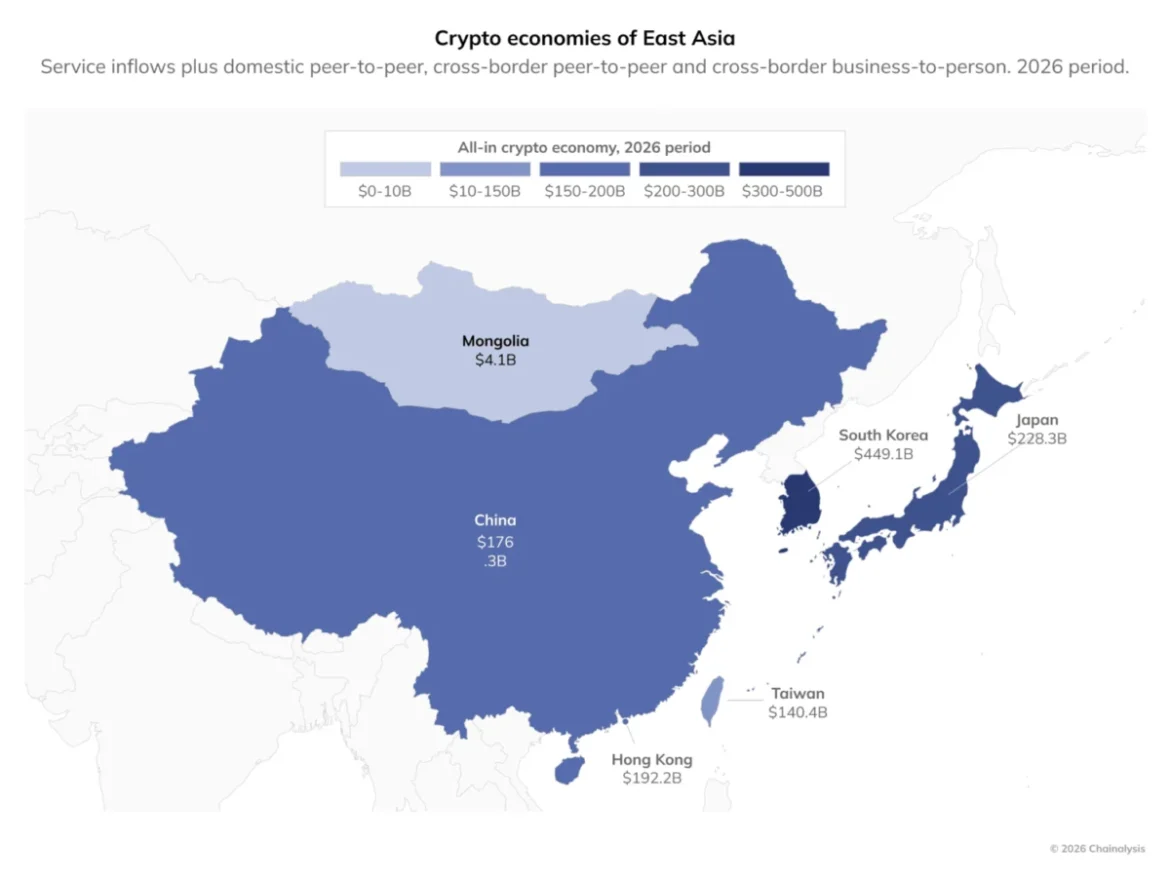
Examining the data across individual territories reveals a mosaic of distinct financial behaviors. South Korea cemented its status as the region’s premier grassroots market, boasting a $449 billion crypto economy driven heavily by retail participation and a massive influx of capital into artificial intelligence-associated cryptocurrencies. Meanwhile, China demonstrated the resilience of grey-market peer-to-peer (P2P) systems under strict state prohibitions, and Japan continued to balance a conservative, highly regulated banking sector with a surprisingly active retail user base utilizing decentralized finance (DeFi) tools for macro-hedging.

Chronology of Regulatory and Market Shifts (2024–2026)
To understand the current state of East Asian crypto markets, industry observers must look back at a sequence of deliberate policy interventions and legislative changes that shaped the landscape between 2024 and mid-2026:
- Early 2024 to Late 2024: Cumulative net business-to-business (B2B) inflows into Hong Kong began an accelerated climb, driven by early moves toward establishing a licensed virtual asset trading platform (VATP) framework.
- March 2025: The Chinese government officially expanded its social credit system into finance and the internet. Concurrently, domestic Chinese stablecoin P2P transactions experienced an immediate and sustained monthly acceleration, signaling a structural shift toward censorship-resistant alternative payment rails.
- February 2025: South Korea’s Financial Services Commission announced a landmark roadmap to open domestic markets to nonprofits, exchanges, listed companies, and registered professional investment corporations, though actual institutional participation remained in a preparatory phase.
- October 2025: Japan introduced its first locally useful yen-denominated stablecoin, JPYC, opening new pathways for international remittances and cross-border settlement.
- February 2026: The South Korean government began easing a longstanding, restrictive ban on corporate crypto trading, allowing major banks and securities firms to step up pilots in tokenization, custody, and stablecoins.
- June 2026: The study period concluded with SBI Group launching JPYSC for over-the-counter trading, real-world asset (RWA) settlement, and foreign exchange. By this time, AI-crypto assets had surpassed payment tokens like XRP to become the most popular thematic investment category by South Korean won-denominated trading volume.
- July 2026: Advanced tax reforms began moving through the Japanese legislature, promising to potentially lower top marginal crypto tax rates from 55% to a separate taxation bracket of roughly 20%, setting the stage for expected retail revitalization heading into 2027.
South Korea’s Retail Dominance and the AI-Crypto Phenomenon

South Korea stands out as East Asia’s largest standalone crypto economy, valued at an all-in total of $449 billion during the 2026 period, which represented a 12.3% period-over-period growth alongside an additional $51.1 billion in exchange-related flows. Characterized by experts as famously retail-driven, the market has expanded without immediate, large-scale capital deployment from major domestic financial institutions. Legislative roadblocks have historically restricted institutional players, leaving banks and securities firms in what industry leaders describe as preparatory mode. Every major South Korean bank currently runs digital asset custody or stablecoin pilots, yet retail investors have dictated immediate market trends.
A primary catalyst for retail engagement has been the absence of capital gains taxes on crypto throughout the 2026 period. While a long-delayed 22% tax on profits is scheduled to take effect in January 2027, the prospect of its implementation has created a tense regulatory intersection with upcoming corporate access expansions.
South Korean retail investors have demonstrated a distinct preference for high-risk, high-reward opportunities, perfectly encapsulated by the meteoric rise of the AI-crypto trade. Growing in tandem with the traditional stock market dominance of memory-chip manufacturer SK Hynix, digital assets associated with AI infrastructure and projects captured the single largest share of won-denominated trading volume by June 2026. Worldcoin (WLD) led the sector with $7.41 billion in trading volume, followed by newcomer tokens such as SAHARA, VIRTUAL, BIO, and NEAR.

The velocity of this sector is unmatched globally. Won-denominated trading activity in AI-crypto assets reached levels nearly 20 times higher than Japanese yen-denominated AI trades, and far outpaced the euro, British pound, or Brazilian real. Analysts note that Korean retail traders rotate through thematic assets at a frequency and intensity unseen elsewhere in the world.
Japan’s Dual Identity: Institutional Caution and Consumer DeFi Engagement
Japan’s $228 billion crypto economy presents a fascinating duality. While external observers frequently view the world’s fourth-largest GDP by lens of institutional banking and regulatory prudence, on-chain data uncovers a surprisingly robust consumer footprint.

While centralized exchange (CEX) activity in Japan remained relatively flat between 2022 and 2026, decentralized exchange (DEX) activity surged by over 200%. DEXs captured nearly 35% of Japan’s services industry market share during the 2026 period—the highest share of any mature CEX market in the region. Furthermore, approximately one in four users withdrawing funds from domestic exchanges subsequently deposited those assets into DeFi protocols.
Market experts attribute the popularity of on-chain derivative instruments, particularly perpetual futures (perps) traded on venues like Hyperliquid, to the country’s sophisticated population of foreign exchange traders. Accustomed to currency hedging, Japanese retail investors utilize these instruments to manage real-world macroeconomic exposure rather than treating them purely as speculative crypto tools.
Regarding asset selection, store-of-value tokens like Bitcoin remained the most popular category, commanding a 73.8% share of yen trading volume. However, this share dipped by over 4 percentage points amid an overall 27% drop in store-of-value trading volume. Conversely, smart contract platforms like Ethereum and Solana emerged as the primary gainers, growing their volume share to 15.4% following a 17.7% absolute increase.

Institutional developments in Japan are likewise maturing. Major financial institutions are increasingly framing digital assets—including stablecoins, tokenized deposits, and real-world asset (RWA) tokenization—as fundamental business lines. The introduction of domestic stablecoins like JPYC in late 2025 and SBI Group’s JPYSC in mid-2026 provides vital infrastructure for bridging traditional banking systems with on-chain liquidity. Moreover, proposed tax reforms moving through the legislature to reduce top marginal rates from 55% to a competitive 20% flat tax are expected to ease participation barriers for retail traders by 2027.
Hong Kong as the Premier Institutional Settlement Layer
If South Korea represents retail passion and Japan represents institutional preparation, Hong Kong stands firmly as East Asia’s preeminent institutional hub. Accounting for a $192 billion crypto economy, the city’s trajectory has been purposefully engineered through government policy, positioning digital assets at the core of its financial strategy.

Hong Kong’s newly implemented Five-Year Plan and official policy addresses prioritize stablecoins, tokenized finance, and central bank digital currencies (CBDCs). By issuing its first stablecoin licenses and initiating market testing with institutional participants, the special administrative region has cultivated an environment where regulatory clarity directly fosters financial innovation.
This regulatory certainty has transformed Hong Kong into a magnet for institutional platforms. Over-the-counter (OTC) desks, custody providers, and market-making desks captured 16% of Hong Kong’s service inflows during the 2026 period—nearly triple the share of any regional neighbor and up significantly from 9% two years prior. Cumulative net business-to-business (B2B) inflows reached $17.4 billion by mid-2026, with inbound service-to-service transfers hitting nearly $24 billion—dwarfing the institutional inflows of Japan and South Korea.
Data confirms that institutional capital is not merely transiting through Hong Kong, but settling permanently within its regulated perimeter. As wallet-based non-B2B flows ran net-negative, institutional B2B channels accelerated, proving that clear licensing frameworks successfully capture high-value corporate operations.

China’s P2P Economy and the Impact of Social Credit Expansion
In sharp contrast to Hong Kong’s transparent, institutional model, Mainland China’s crypto economy operates under the heavy shadow of a comprehensive government ban on commercial crypto services. Despite this official prohibition, on-chain analytics estimate China’s crypto economy reached at least $176 billion during the 2026 period, driven primarily by peer-to-peer (P2P) transactions.
Domestic P2P trading accounted for 59.1% of China’s total crypto economy, representing a 3.5-fold increase in share compared to prior periods. A significant structural catalyst for this growth coincided with the expansion of China’s social credit system into finance and the internet in March 2025. As behavioral scoring and financial blacklists increasingly restricted citizens from accessing traditional banking and travel services, individuals turned to censorship-resistant alternatives.

Month-over-month data reveals a dramatic, sustained surge in stablecoin domestic payments starting in March 2025, scaling from approximately $240 million in initial monthly volume additions to nearly $5 billion per month a year later. Furthermore, the velocity of money for self-custodied stablecoin holdings in China reached an astounding 33.2 turnovers per year—more than three times the global average of 9.3x and vastly outpacing regional peers like Japan (9.9x) and Hong Kong (6.1x). This high velocity strongly indicates that Chinese users treat stablecoins as active working capital and practical domestic payment rails to bypass traditional financial surveillance.
Implications and Future Outlook
The diverging paths of East Asian crypto markets offer a clear blueprint for how public policy impacts digital asset adoption. While China’s prohibition drove users toward underground, high-velocity P2P stablecoin networks, jurisdictions like Hong Kong, Japan, and South Korea chose supervised-access regimes.

As regulatory frameworks continue to mature—highlighted by Hong Kong’s institutional consolidation, impending tax reforms in Japan, and corporate access updates in South Korea—the center of gravity in East Asia’s crypto economy is visibly shifting toward institutional maturity. However, the region’s enduring appetite for high-risk retail trading, AI-themed tokens, and decentralized hedging ensures that grassroots participation will remain a powerful counterweight for years to come.