The global cryptocurrency landscape over the past year has been defined by extreme volatility, contrasting starkly with an underlying economic durability that surprised market analysts. Between July 1, 2025, and June 30, 2026, the digital asset ecosystem weathered its most severe bear market since the cascading failures and corporate scandals of 2022. Driven by a dramatic shift in how different populations utilize blockchain technology, the global crypto economy experienced only a marginal contraction of 1.6 percent, recording $9.4 trillion in economic activity compared to $9.5 trillion during the preceding twelve-month period.
This striking resilience occurred against the backdrop of significant macroeconomic turbulence. Bitcoin reached historic heights during the period before suffering its largest-ever dollar-value retreat, shedding roughly $67,000 from peak to trough. Simultaneously, the broader cryptocurrency market capitalization experienced a 50 percent drawdown, translating to a staggering $2.1 trillion contraction. Yet, despite a shrunken market valuation that required participants to move twice as much capital merely to match previous transaction values, fundamental global usage held firm, anchored heavily by the proliferation of stablecoins, peer-to-peer (P2P) transfers, and expanding retail engagement.

Chronology and Market Evolution: The 2025–2026 Cycle
To understand the trajectory of the 2025–2026 market cycle, analysts point to a rapidly maturing financial infrastructure set against global economic uncertainty. The period under review began with strong momentum carried over from late 2024 and early 2025, pushing major assets like Bitcoin to unprecedented all-time highs by mid-2025. However, tighter global monetary conditions and shifting macroeconomic sentiment triggered a sharp correction beginning in the autumn of 2025.
By September 2025, global measured on-chain balances peaked at approximately $0.86 trillion before descending into a prolonged nine-month drawdown that bottomed out at $0.44 trillion by June 2026. Unlike previous speculative manias where market crashes prompted widespread desertion of the asset class, the 2025–2026 downturn highlighted a bifurcated ecosystem: while speculative trading volumes contracted sharply alongside asset prices, utility-driven transactional activity expanded across emerging markets and developing economies.

Regulatory Developments and Institutional Adaptation
The structural stability observed during the downturn was further reinforced by evolving international regulatory frameworks. During the 2025–2026 reporting window, policymakers across major global jurisdictions established clearer guardrails for digital assets. In the United States, legislative progress surrounding stablecoins—exemplified by frameworks such as the GENIUS Act—alongside the European Union’s Markets in Crypto-Assets (MiCA) regulation and targeted actions in the United Kingdom, Japan, Singapore, and Hong Kong, provided traditional financial institutions and fintech operators with the legal clarity necessary to integrate blockchain rails into mainstream commerce.
Industry leaders noted that these regulatory milestones directly influenced user behavior. Philip Gradwell, vice president of economics at stablecoin issuer Tether, highlighted the changing nature of on-chain liquidity during the bear market. "Activity has become consistent, routed through wallets in a steady rhythm rather than in bursts," Gradwell observed, noting that such behavior serves as "the signature of trade and business activity, not speculation."

Data-Driven Insights: Retail Persistence and Cross-Border Stablecoin Booms
A granular analysis of the Chainalysis Geographies report reveals that resilience was not uniform across all sectors, but rather concentrated in specific use cases. Retail-level participants demonstrated remarkable tenacity despite depressed asset prices. Small-dollar inflows into cryptocurrency services surged significantly, with transfers under $100 increasing by 78.4 percent, and transfers valued between $100 and $1,000 rising by 58.6 percent. While these retail-sized transactions accounted for $273 billion of the nearly $10 trillion aggregate economic activity, their growth underscores a deepening grassroots adoption curve.
Institutional participation also proved resilient. Transfers valued at $1 million or more experienced a modest drawdown of just 7.2 percent year-over-year. Given that the underlying assets had depreciated by up to 50 percent, institutional actors maintained steady capital deployment to achieve transaction volumes comparable to the previous year.

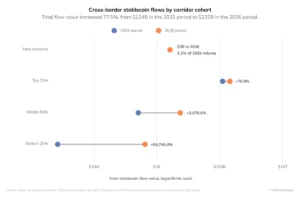
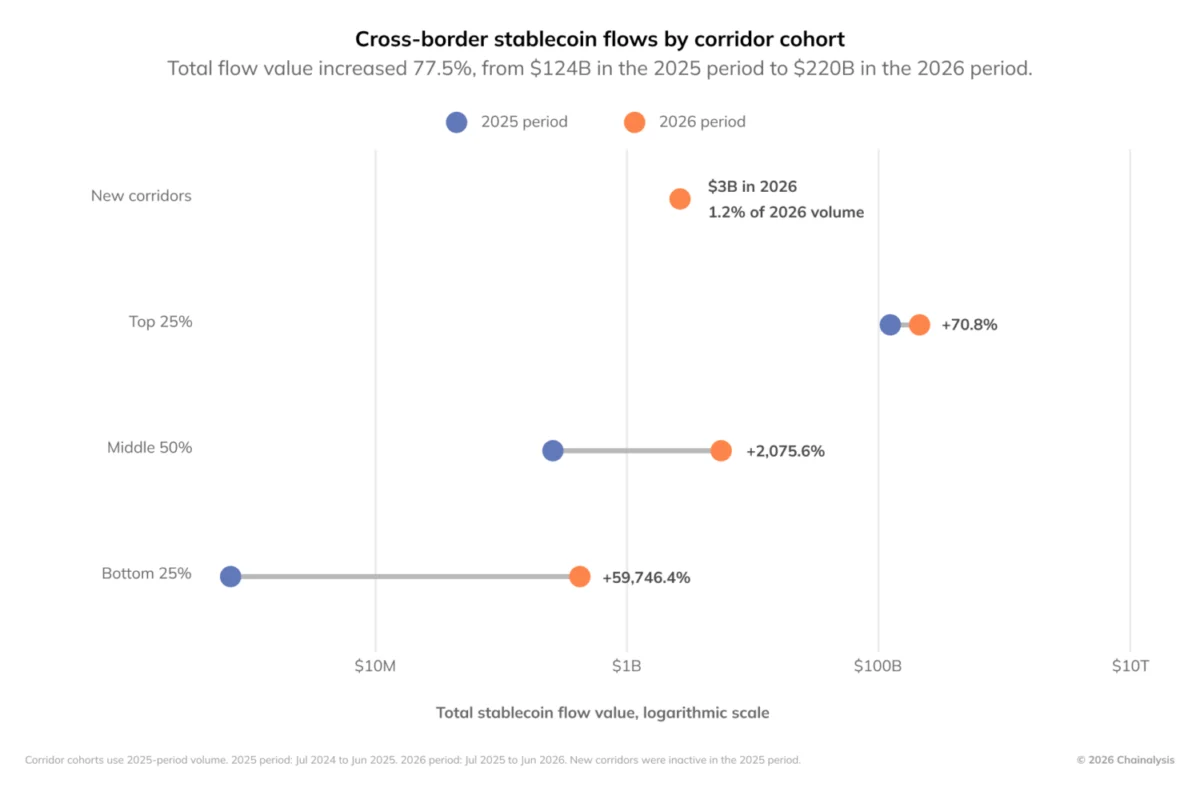
Meanwhile, cross-border stablecoin transfers emerged as a primary growth engine. Conservative estimates of monthly cross-border stablecoin value more than doubled, climbing from $11 billion in January 2025 to $24 billion by June 2026. Total cross-border stablecoin volume rose 77.5 percent over the twelve-month period, expanding from $124.2 billion to $220.3 billion. This activity was predominantly driven by transactions averaging approximately $3,000—a bracket too small for institutional treasury management, aligning instead with international trade settlements, remittances, and capital preservation in economies plagued by domestic currency depreciation.
Furthermore, trade corridors expanded rapidly. The top quartile of payment corridors accounted for 96.1 percent of cross-border stablecoin value, growing 70.8 percent. Simultaneously, lower-tier corridors experienced explosive expansion; the bottom three quartiles of corridors carried $8.66 billion during the 2026 period, up from just $0.26 billion previously. Analysts tracked 4,708 newly formed payment corridors collectively carrying $2.64 billion, with the vast majority of this transactional velocity driven by USDT.
"The real power of USDT is in the long tail, the parts of the economy that were priced out or shut out because traditional financial technology was too expensive or too restricted," Gradwell explained. "USDT can serve them because it costs on average one cent per transaction, settles instantly, and needs nothing more than a phone."

Peer-to-Peer Networks and Stablecoin Dominance
The divergence between speculative trading and utilitarian finance was further illustrated by the explosive growth of domestic peer-to-peer (P2P) networks. While value flowing into centralized exchanges and decentralized finance (DeFi) protocols dipped by 4.3 percent—falling from $9.30 trillion to $8.90 trillion—direct, person-to-person transfers between personal wallets surged by 302.9 percent, jumping from $56.8 billion to $228.7 billion. P2P transactions expanded across all eight global regions tracked in the study, increasing their share of combined service and P2P activity from 0.6 percent to 2.5 percent.
Crucially, P2P networks evolved into overwhelmingly stablecoin-denominated economies, with stablecoins comprising approximately 96 percent of all P2P volume. Because stablecoins are pegged to the U.S. dollar, their on-chain value remained insulated from the wider crypto market sell-off. Stablecoin balances held steady between $98 billion and $109 billion throughout the nine-month drawdown, driving their share of global cryptocurrency balances to 22.5 percent by June 2026 simply as other volatile assets depreciated around them.

Global Adoption Rankings: Brazil Takes the Lead
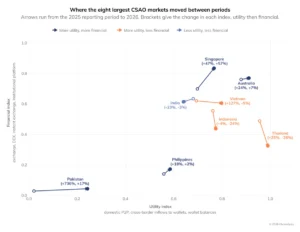
Reflecting these shifting dynamics, the seventh annual Geographies report introduced a revised methodology to measure grassroots adoption. The updated framework weighs service inflows, domestic P2P transactions, cross-border movements, and on-chain balances, adjusting raw figures through purchasing power parity and GDP per capita to ensure balanced cross-country comparisons.
Brazil emerged as the top-ranked country globally for grassroots crypto adoption. While not leading any single sub-index individually, Brazil delivered consistently robust performance across all four categories, outranking larger established markets such as the United States (ranked 2nd) and India (ranked 6th). Latin America as a region bucked the global contraction entirely, growing its crypto economy by 9.8 percent period-over-period, propelled by widespread stablecoin adoption as a hedge against macroeconomic instability. Sub-Saharan Africa similarly recorded leading growth metrics, driven by exceptionally strong peer-to-peer activity, with Nigeria securing the 3rd overall rank globally.

Implications and Future Outlook
The 2025–2026 market cycle marks a structural transition for the digital asset industry. The findings suggest that cryptocurrency is no longer tethered solely to the speculative sentiment of retail traders or the risk-on appetites of institutional investors. Instead, a dual-track economy has emerged: one side tied to price-sensitive speculative trading, and the other anchored by essential financial utilities such as cross-border remittances, business-to-business settlements, and inflation hedges in developing nations.
As regulatory clarity continues to take shape across North America, Europe, and Asia, the integration of blockchain rails into traditional financial infrastructure appears positioned to accelerate. The ability of the global crypto economy to maintain nearly flat economic activity during a $2.1 trillion market capitalization drawdown signals that digital assets have successfully embedded themselves into the daily financial survival and operational workflows of millions of users worldwide, laying a durable foundation for the next phase of industry development.