Decentralized finance (DeFi) protocol Synthetix has officially marked a major milestone in its ongoing development timeline, confirming that its perpetual futures (perps) trading venue is live and scaling on Ethereum Mainnet. Following an intensive four-month private alpha phase designed to stress-test core infrastructure away from the noise of public token incentives and airdrop farming, the protocol is transitioning toward broader public access. The update underscores a strategic evolution from a conceptual redesign into a fully operational, high-performance decentralized trading ecosystem capable of competing directly with centralized exchange (CEX) incumbents.
The release of the Synthetix 2026 Roadmap earlier this year established a clear mandate: leverage the foundational architectural work completed throughout 2025 to scale Synthetix Perps into a premier, institutional-grade venue on Ethereum Mainnet. While the initial months of the year required significant back-end optimization—what developers informally describe as "eating vegetables"—this unglamorous engineering groundwork has successfully established a robust operational foundation.
Private Alpha Performance and Real-World Stress Testing
Unlike many decentralized applications that rely heavily on speculative incentive schemes, public points campaigns, and aggressive marketing pushes to attract initial volume, the Synthetix private alpha phase prioritized organic engagement. Access was strictly invitation-only, ensuring that every trade executed over the first four months of 2026 originated from active traders utilizing the platform strictly on its structural merits.
Despite the absence of artificial liquidity incentives, the alpha phase generated steady transaction volumes and provided critical telemetry data regarding platform performance under live market conditions. Core metrics tracked via Synthetix Stats demonstrated consistent order execution, reliable margin management, and stable liquidation processing. Protocol developers noted that these early figures are expected to grow exponentially as onboarding gates open to the wider public and partner frontends are integrated.
Architectural Milestones: Multi-Collateral Support and SLP
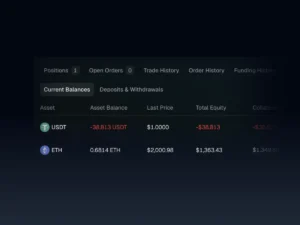
A core component of the recent deployment is the introduction of multi-collateral margin capabilities. Historically, traders on decentralized derivatives platforms frequently faced friction requiring them to convert underlying assets into stablecoins prior to opening positions. Synthetix’s multi-collateral framework unlocks billions of dollars in idle Ethereum (ETH) and Bitcoin (BTC) held on Mainnet, allowing participants to deposit native assets directly as productive trading collateral without mandatory pre-swaps.
This multi-collateral architecture serves as the critical gateway for upcoming phases of the 2026 roadmap, including basis trading vaults, the public launch of the Synthetix Liquidity Provider (SLP) vault, and the realization of the protocol’s "Digital Dollars" vision for sUSD.
The SLP functions as the load-bearing market-making and liquidation vault that underpins the entire protocol ecosystem. Currently operating in a private capacity while generating approximately 20% APY, the SLP acts as the primary counterparty for liquidations and supplies essential market depth. Protocol contributors have exercised deliberate caution regarding public capital deposits, emphasizing that ensuring absolute resilience in the liquidation engine and counterparty mechanics takes precedence over rapid capital acquisition. Public access to the SLP remains on schedule for deployment later in the second quarter.
Concurrently, the user trading experience has undergone iterative refinements. A comprehensive suite of interface upgrades, order-routing enhancements, and speed optimizations has transformed the platform from a rudimentary decentralized application into a sophisticated trading venue. These improvements have facilitated advanced integration discussions with leading wallet providers and trading aggregators, including Infinex, establishing distribution channels aimed at securing organic, long-term trading volume.
Expanding Market Offerings: Crypto Perps and Real-World Assets (RWAs)
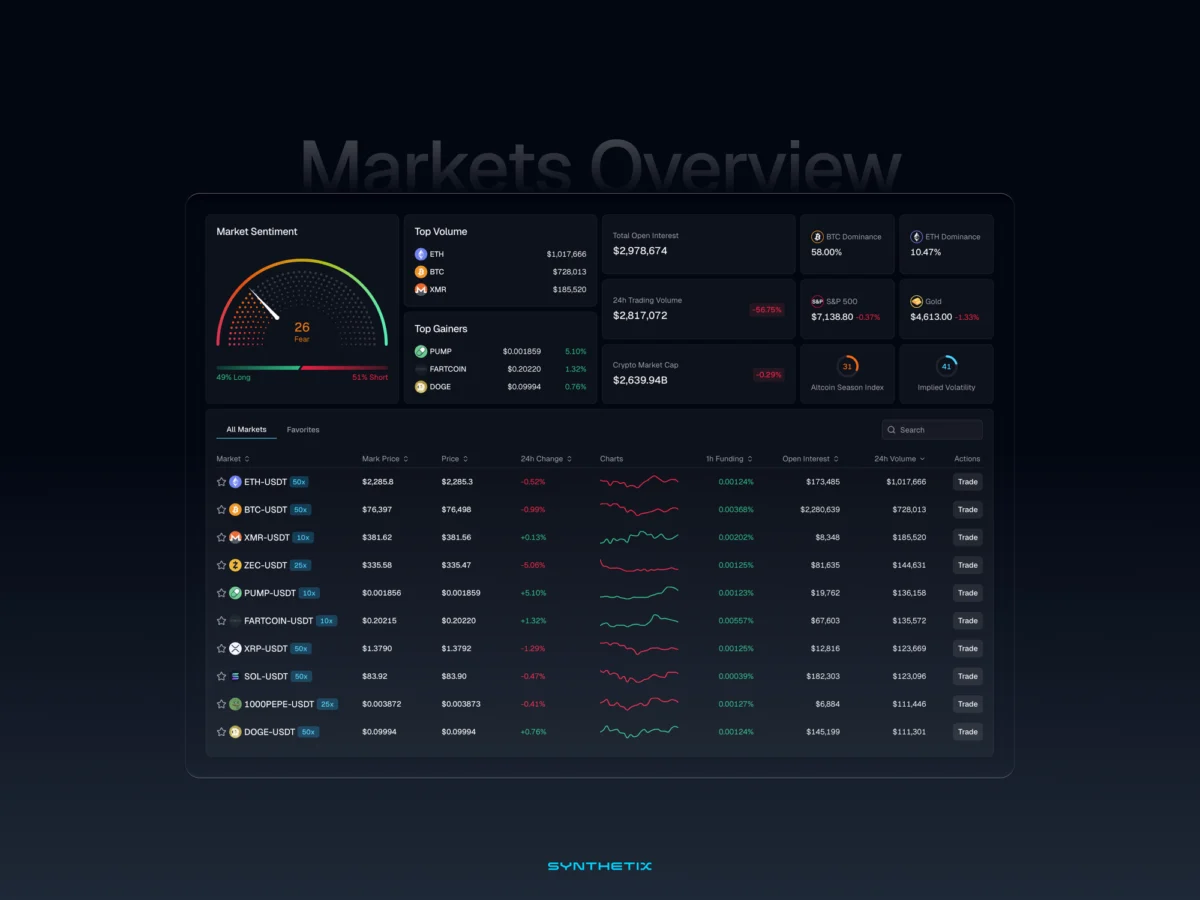
Synthetix commenced 2026 supporting three primary trading markets but rapidly expanded its crypto perpetual offerings to ten assets by the conclusion of April. The current crypto asset suite encompasses Bitcoin (BTC), Ethereum (ETH), Solana (SOL), Zcash (ZEC), Ripple (XRP), Dogecoin (DOGE), Monero (XMR), Pepe (PEPE), Fartcoin, and Pump.

However, the more strategically significant expansion involves the integration of Real-World Assets (RWAs), starting with commodities. While crypto-native perpetual markets operate on a continuous 24/7 basis, commodity trading requires specialized infrastructure capable of accommodating traditional financial market schedules, session-handling protocols, and customized oracle feeds.
The pricing, session-handling architecture, and market configuration for West Texas Intermediate (WTI) crude oil—the protocol’s inaugural commodity market—have been finalized, with deployment imminent. Subsequent roadmap milestones include the rollout of foreign exchange (Forex) markets scheduled for June, further broadening the protocol’s cross-asset utility. Industry analysts note that successfully capturing non-crypto RWA volume presents a substantial growth vector for decentralized derivatives platforms seeking to capture market share traditionally dominated by legacy brokerages.
Operational Reliability and Security Architecture
A defining characteristic of the platform’s initial operating period has been its flawless operational record. Over four months of live Mainnet trading, Synthetix reported zero security incidents resulting in trader capital loss, zero unscheduled maintenance downtime affecting order entry, and absolute accounting accuracy across all open positions.
This reliability stems from rigorous engineering practices, including comprehensive halt protocols, decentralized administrative controls across microservices, robust dead-letter queues for messaging paths, and end-to-end observability on hot execution paths. Furthermore, operating natively on Ethereum Mainnet provides a structural security advantage over centralized exchanges. Even in the event of an emergency exchange halt, user collateral remains secured within immutable Mainnet smart contracts, ensuring participants retain continuous, unrestricted withdrawal access without the risk of frozen funds.
Broader Implications and Outlook for the Second Half of 2026
The maturation of Synthetix from a theoretical protocol pivot into an actively utilized trading venue marks a psychological and structural turning point for the project. Where previous development updates focused on conceptual pivots and architectural rebuilding, current updates reflect the operational reality of a functioning derivatives exchange processing real-world volume and executing automated liquidations.

The aggressive roadmap targets established for 2026—encompassing multi-collateral margin, commodities, forex, public SLP deployment, basis vaults, and a delta-hedged digital dollar iteration of sUSD—represent a heavy development workload. Nevertheless, core contributors maintain that current execution cadences remain aligned with projected timelines, with Q2 targets actively populating and H2 planning proceeding as intended.
As capital inflows, active traders, and external integrations accelerate, the primary operational challenge facing Synthetix has shifted from proving technical viability to managing scaling capacity and expanding onboarding access.
About Synthetix
Synthetix is a decentralized perpetual futures protocol built on Ethereum Mainnet and powered by the SNX token. The protocol utilizes off-chain order matching via a high-performance central limit order book combined with on-chain settlement executed on Ethereum, providing institutional-grade trade execution alongside decentralized self-custody and security.