• Home
Crypto Gohan
keep your memories alive
Japanese & Asian Crypto Markets

US Regulators SEC and CFTC Unveil Joint Framework to Overhaul Digital Asset Oversight

by Muslim September 16, 2026
written by Muslim

United States financial regulators have taken a monumental step toward establishing a unified regulatory perimeter for the burgeoning digital asset economy. On September 16, the Securities and Exchange Commission (SEC) and the Commodity Futures Trading Commission (CFTC) jointly released a comprehensive regulatory framework designed to eliminate regulatory arbitrage, provide legal certainty to market participants, and streamline the oversight of cryptocurrencies and blockchain-based financial instruments.

The collaborative initiative, centered around the ongoing legislative discussions surrounding the Digital Asset Market Clarity Act, marks a departure from the historical fragmentation that has long characterized American crypto regulation. For years, digital asset firms, decentralized finance (DeFi) protocols, and token issuers have operated in a complex grey area, often caught in turf wars between the SEC and the CFTC over whether specific tokens should be classified as securities or commodities.

Legislative Momentum and Statutory Adjustments

Under the newly proposed framework, both regulatory agencies have outlined synchronized guidelines designed to update current statutory definitions. Crucially, the initiative builds upon legislative text currently moving through Congress, which seeks to amend sections of federal securities and commodities laws. Specifically, recent revisions target amendments to Section 49, Section 50, and crucially, Section 60 of the foundational regulatory acts, creating a statutory bridge that bridges the gap between traditional finance and decentralized technologies.

The joint approach aims to address the enforcement-heavy paradigm of the past, offering a transparent pathway for digital asset projects to register, comply, and innovate without the constant threat of retroactive litigation. Industry stakeholders have long argued that regulatory ambiguity stifles innovation and drives capital offshore; this new framework seeks to reverse that trend by establishing predictable, transparent compliance standards.

Chronology of Regulatory Convergence

The path toward a unified regulatory framework has been years in the making, accelerated by rapid market maturation and high-profile industry failures throughout the early 2020s.

  • Early 2022 – 2023: Heightened volatility and systemic collapses across major crypto platforms exposed significant gaps in federal oversight, prompting calls from lawmakers for a cohesive inter-agency approach.
  • Late 2023 – 2024: Congressional committees accelerated bipartisan discussions on market structure bills, establishing the groundwork for clearer definitions separating digital commodities from digital securities.
  • Early 2025: Leadership changes at both the SEC and CFTC signaled a cultural shift toward inter-agency cooperation rather than jurisdictional competition.
  • September 16, 2025: The SEC and CFTC officially release their joint regulatory framework, establishing synchronized oversight protocols and setting a clear roadmap for legislative alignment.

Official Statements and Regulatory Responses

Leadership from both agencies took to social media and official press channels to emphasize the collaborative nature of the announcement.
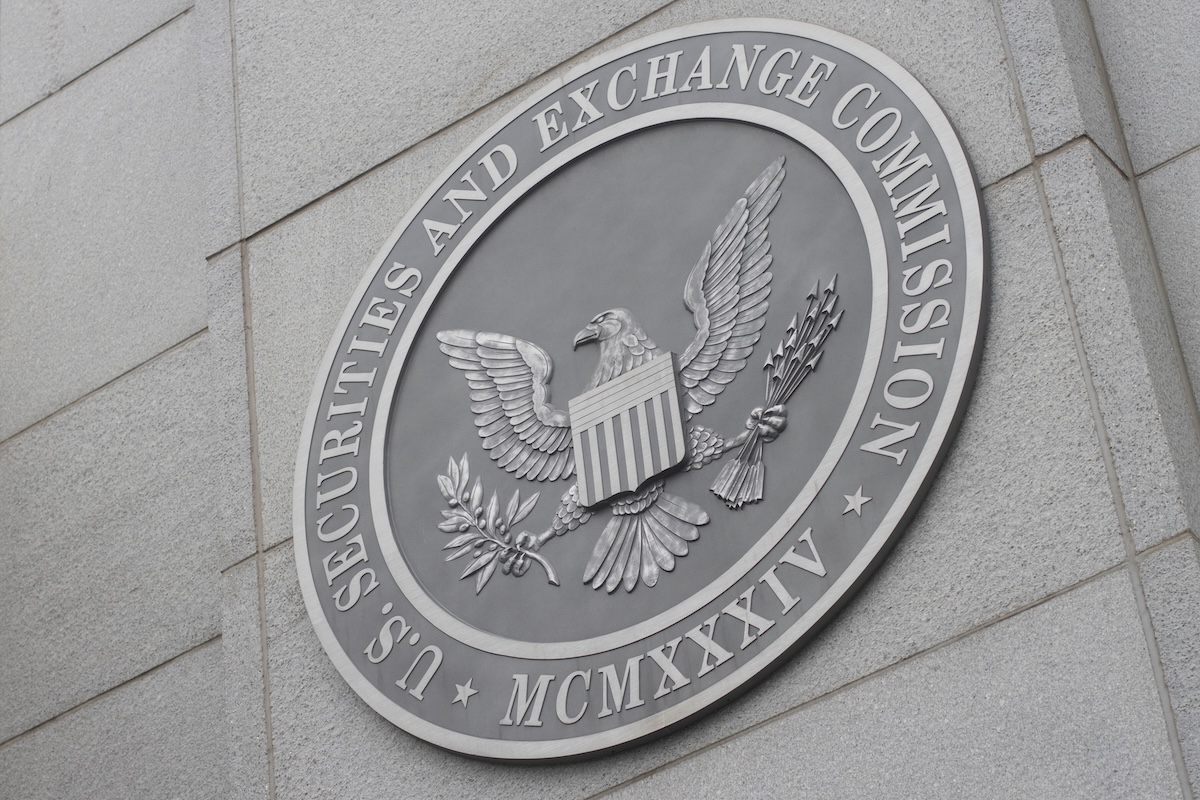
クラリティ法案停滞、SEC・CFTCが規則整備を本格化 | NADA NEWS(ナダ・ニュース)

SEC Chairman Paul Atkins addressed the public via X (formerly Twitter), highlighting that the new policy framework represents a pragmatic shift toward modernization. "Our regulatory perimeter must adapt to technological innovation rather than stand in its way," Atkins stated, emphasizing that the SEC’s updated approach is designed to foster a secure environment for capital formation while maintaining rigorous investor protection standards.

Similarly, CFTC Chairman Summer Mersinger underscored the operational synergy between the two commissions. Mersinger noted that the joint guidance reflects a shared commitment to market integrity and statutory consistency, ensuring that market participants are not subjected to contradictory regulatory mandates. "By leveraging our respective statutory tools in tandem, we are paving the way for a more resilient and transparent digital asset marketplace," Mersinger remarked.

Supporting Data and Market Impact

The digital asset sector has responded with cautious optimism. According to recent market data compiled ahead of the announcement, institutional adoption of blockchain-based financial products has faced persistent headwinds due to legal uncertainty. Analysts estimate that clear regulatory guidelines could unlock billions of dollars in dormant institutional capital currently sitting on the sidelines.

The framework introduces a streamlined registration process for digital asset exchanges and broker-dealers, offering a safe harbor period for existing platforms to transition into full compliance. This structured transition is expected to significantly reduce compliance costs for compliant startups while imposing stricter penalties on bad actors who intentionally bypass federal registration requirements.

Broader Implications for the Global Financial Ecosystem

The joint SEC-CFTC framework signals to international regulators that the United States is moving toward a mature, cohesive policy posture regarding digital assets. As global financial centers compete to attract blockchain and fintech innovation, the establishment of clear, predictable rules positions the U.S. market as an attractive jurisdiction for compliant digital asset enterprises.

However, challenges remain. Financial policy experts note that the ultimate success of the framework depends heavily on Congressional action to pass complementary legislation. While the SEC and CFTC have harmonized their operational interpretations, definitive statutory backing from Capitol Hill will be essential to ensure long-lasting regulatory stability across future political administrations.

As the industry digests the comprehensive guidelines, market observers will be closely monitoring how both agencies handle pending enforcement actions and whether token issuers swiftly move to adopt the newly established compliance pathways.
September 16, 2026 0 comment
0 FacebookTwitterPinterestEmail
Japanese & Asian Crypto Markets

A Comprehensive Guide to Phantom Wallet: Features, Setup, and Multi-Chain Integration for Crypto and NFT Management

by Asro September 16, 2026
written by Asro

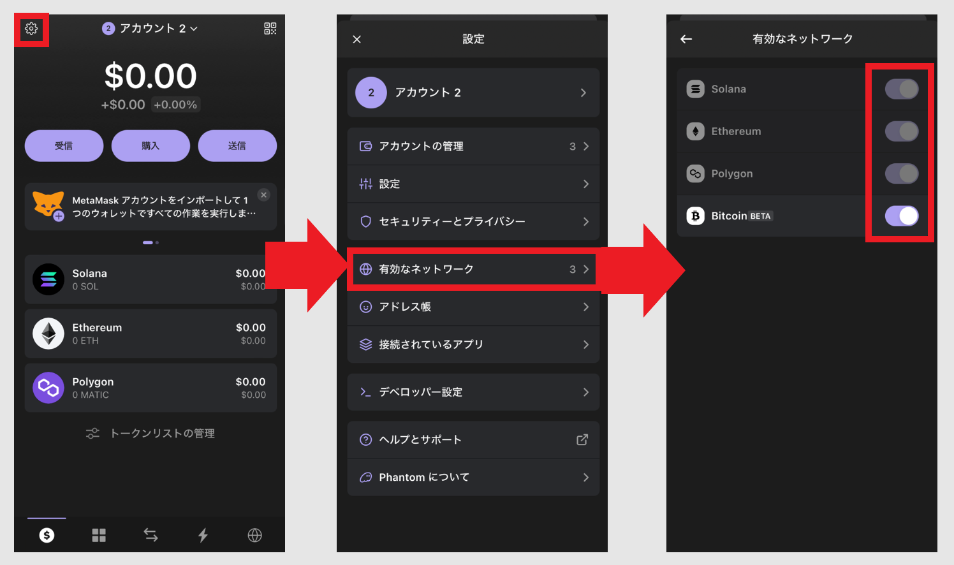
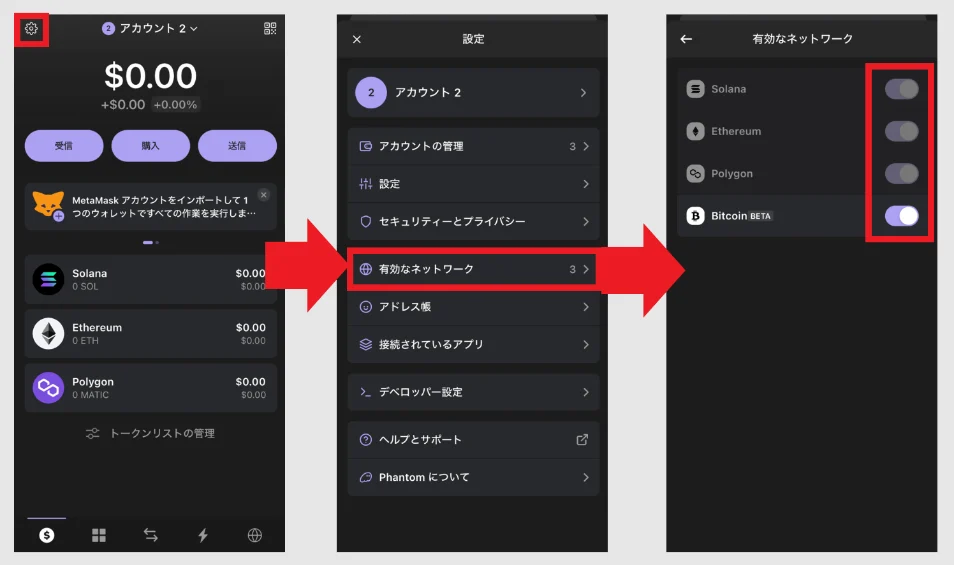
The rapid expansion of decentralized finance (DeFi) and non-fungible tokens (NFTs) has fundamentally transformed the digital asset landscape, placing self-custodial wallets at the core of user interaction. Originally launched in April 2021 as a purpose-built wallet for the Solana blockchain, Phantom Wallet has rapidly evolved into a leading multi-chain digital asset manager. Designed with an emphasis on user experience, high-speed execution, and security, Phantom addresses the traditional complexities of Web3 navigation. By integrating support for multiple high-performance networks—including Solana, Ethereum, and Polygon—Phantom has positioned itself as an essential tool for both novice traders and seasoned crypto enthusiasts. This comprehensive guide explores the core functionalities, installation procedures, security protocols, and advanced features of Phantom Wallet, offering an objective analysis of its role in the modern cryptocurrency ecosystem.

Phantom Wallet|ウォレット作成方法と入金・出金の使い方

The Evolution and Core Architecture of Phantom Wallet

Phantom Wallet|ウォレット作成方法と入金・出金の使い方

When Phantom was introduced to the market in early 2021, the Solana ecosystem was experiencing exponential growth, driven by low transaction fees and high throughput. Users demanded a wallet that could match the speed of the underlying network while offering seamless interaction with decentralized applications (dApps). Phantom met this demand by combining robust key management with a clean, intuitive user interface (UI) modeled after popular Web3 standards, yet optimized for high-speed processing.

Phantom Wallet|ウォレット作成方法と入金・出金の使い方

Unlike custodial exchanges where third parties hold private keys, Phantom operates on a strict self-custodial model. Users retain absolute control over their cryptographic assets and private keys, minimizing counterparty risk. Over the subsequent years, the development team expanded the wallet’s capabilities beyond Solana, incorporating cross-chain bridging, integrated token swapping, and specialized NFT management tools. This strategic evolution transformed Phantom from a single-chain utility into a comprehensive portfolio management hub capable of handling diverse digital assets across leading blockchains.

Phantom Wallet|ウォレット作成方法と入金・出金の使い方

Step-by-Step Installation and Wallet Creation Guide

Phantom Wallet|ウォレット作成方法と入金・出金の使い方

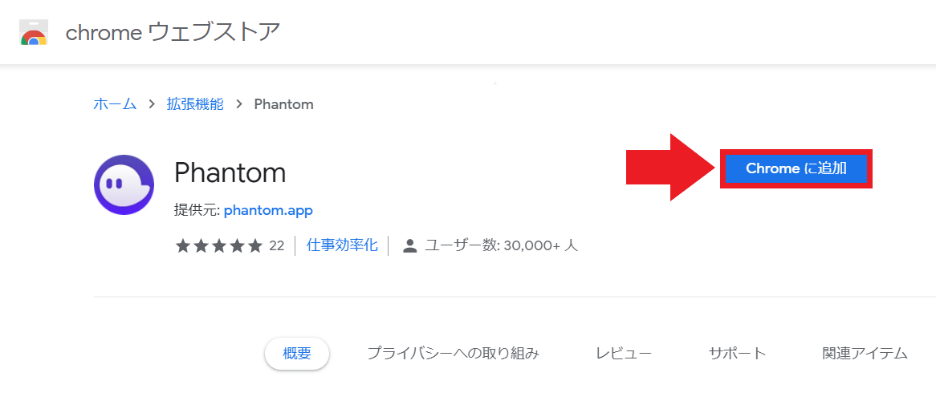
Getting started with Phantom Wallet requires a straightforward installation process tailored for modern web browsers and mobile operating systems. To ensure maximum security and authenticity, users should always download the application through official channels, such as the Google Chrome Web Store for desktop extensions or the official iOS and Android application stores.

Phantom Wallet|ウォレット作成方法と入金・出金の使い方
  1. Extension Installation: Navigate to the official Chrome Web Store or Phantom’s primary website. Select the option to add the extension to your compatible browser (such as Google Chrome, Brave, or Microsoft Edge).
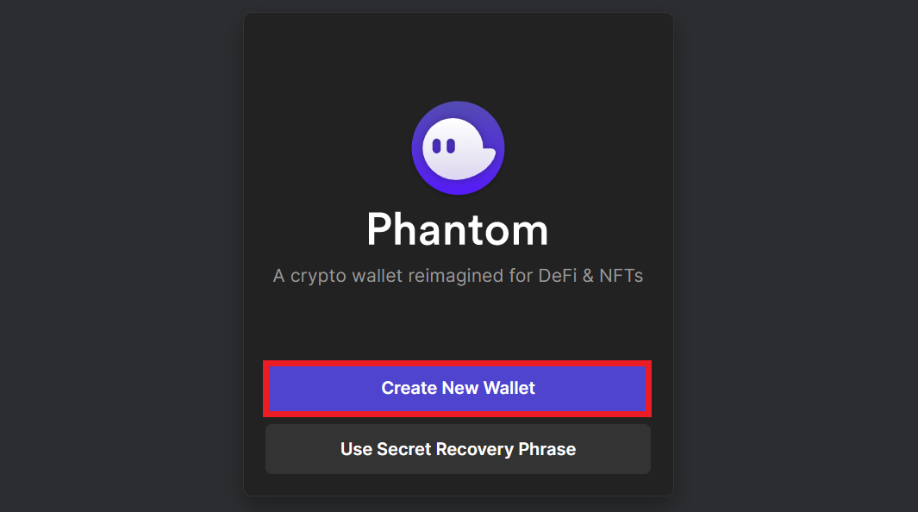
  2. Wallet Initialization: Upon installation, the browser will open a welcome tab presenting two primary options: "Create New Wallet" or "I already have a wallet." For new users, selecting "Create New Wallet" initiates the setup sequence.
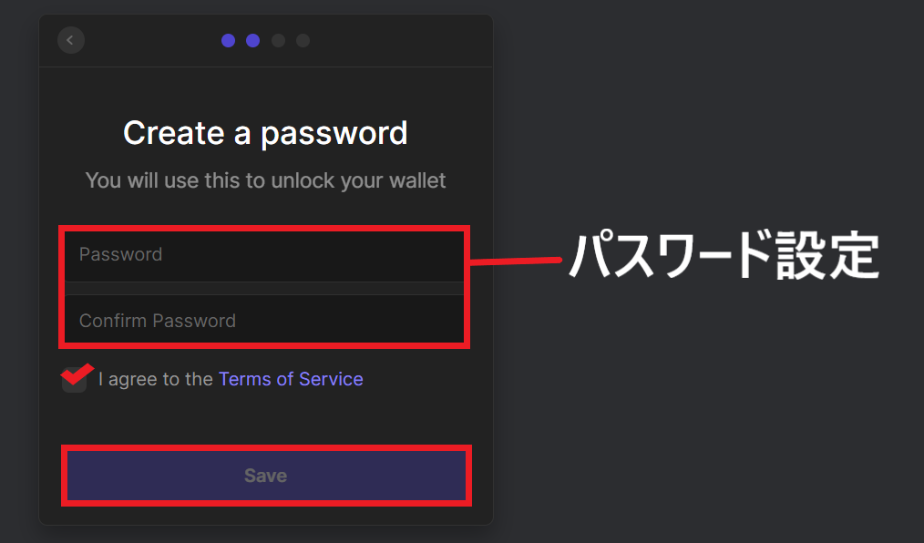
  3. Password Configuration: Users must establish a strong, unique password. This password encrypts the local wallet data on the device, ensuring that unauthorized local users cannot access the application interface without authorization.
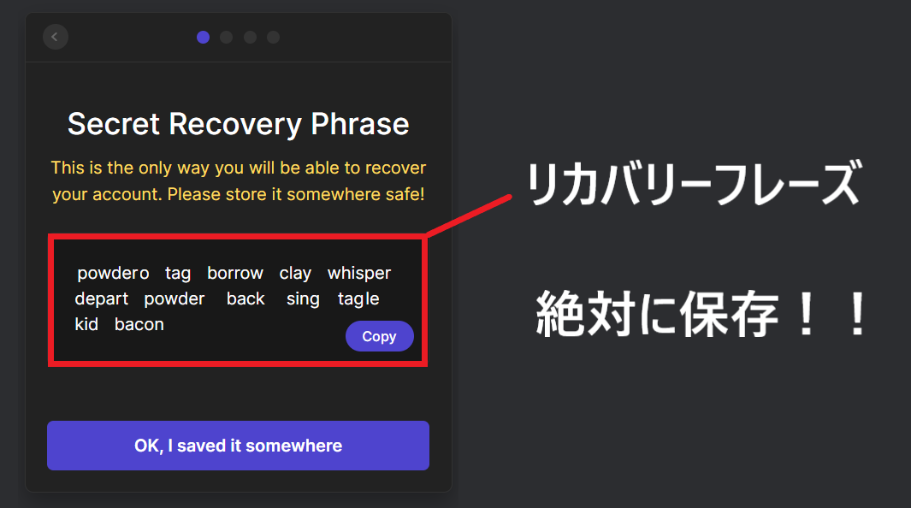
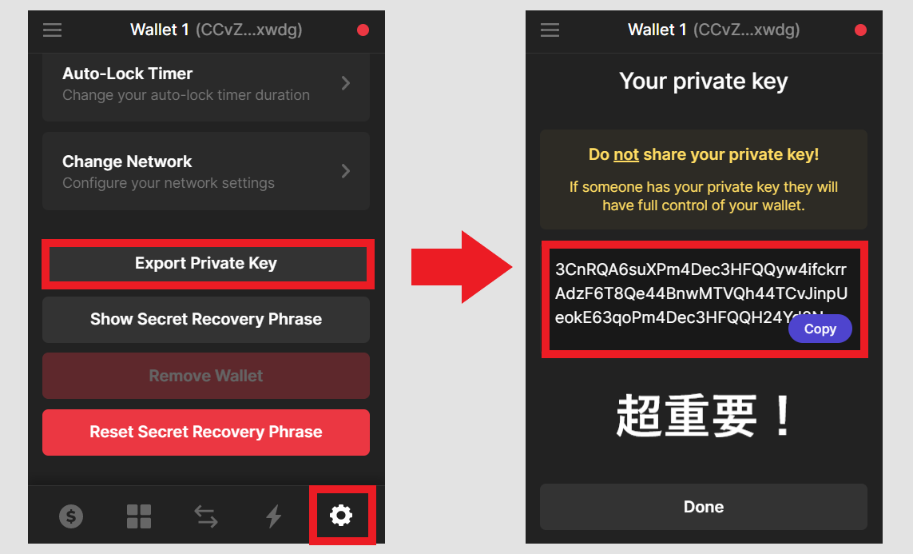
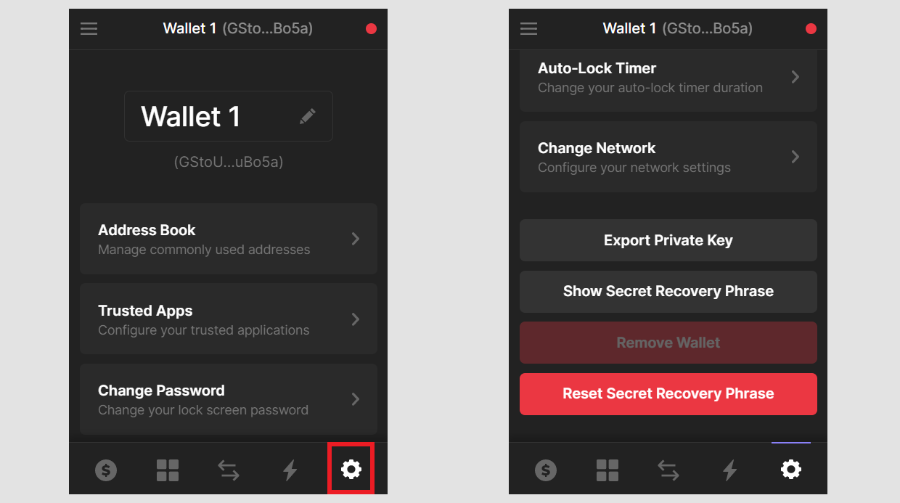
  4. Secret Recovery Phrase Backup: The system generates a unique 12-word or 24-word Secret Recovery Phrase (also known as a seed phrase). This phrase is the cryptographic master key required to recover funds if the device is lost or damaged. Users must record these words physically on paper, store them in a secure offline location, and confirm the sequence within the app. Under no circumstances should digital screenshots or cloud backups of the recovery phrase be saved, as digital exposure compromises ultimate security.
  5. Account Finalization: Once the recovery phrase is verified, the wallet installation is complete. Users can immediately access their main dashboard, where balances, transaction history, and integrated features are displayed.

Advanced Security Protocols and Key Management

Phantom Wallet|ウォレット作成方法と入金・出金の使い方

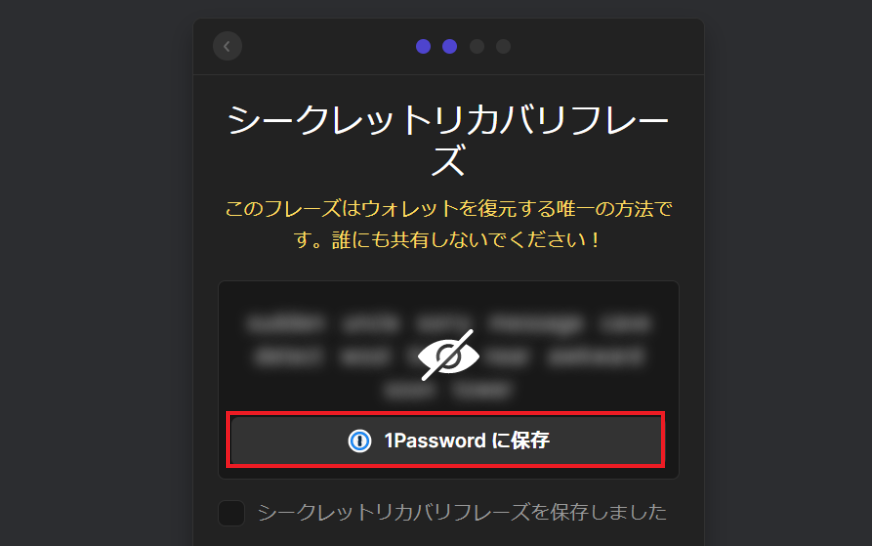
Security remains the paramount concern within the decentralized finance sector. Phantom Wallet incorporates industry-standard cryptographic safeguards while offering integration with hardware security keys and password managers like 1Password to streamline credential management without sacrificing safety.

Phantom Wallet|ウォレット作成方法と入金・出金の使い方

A critical aspect of wallet security is understanding the distinction between public keys and private keys. A public key functions similarly to a bank account number; it can be shared freely to receive funds, view transaction history, or interact with dApps. Conversely, a private key or secret recovery phrase acts as the digital signature authorizing transactions and proving ownership of assets. If a malicious actor gains access to a private key, they gain total control over the associated funds.

Phantom Wallet|ウォレット作成方法と入金・出金の使い方

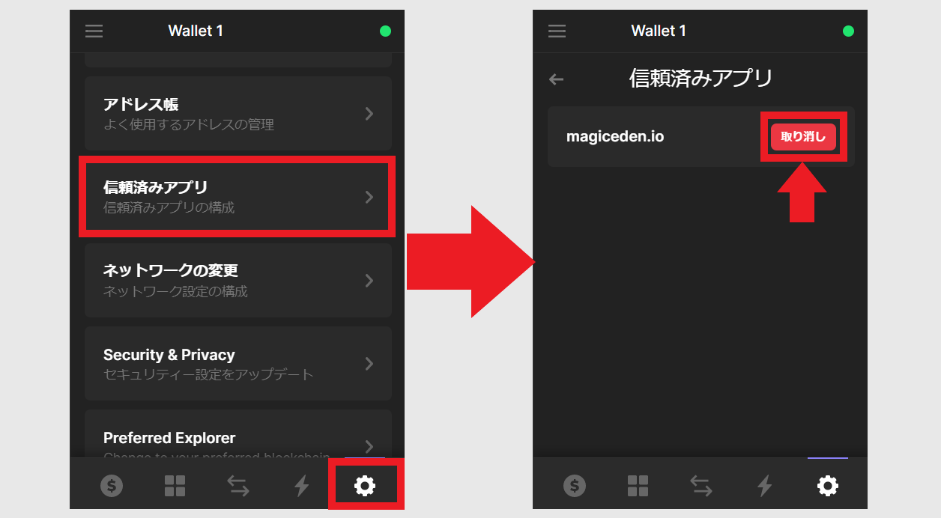
To mitigate authorization risks, Phantom provides built-in tools for managing permissions and revoking smart contract approvals. Over time, active Web3 users frequently grant dApps permission to interact with or spend specific tokens. If a dPapp is compromised, these lingering approvals can pose severe security risks. Phantom’s revocation features allow users to audit active smart contract approvals and revoke unnecessary permissions directly within the interface, aligning with best practices for proactive asset protection.

Phantom Wallet|ウォレット作成方法と入金・出金の使い方

Managing Cryptocurrencies: Receiving, Sending, and Storing Digital Assets

Phantom Wallet|ウォレット作成方法と入金・出金の使い方

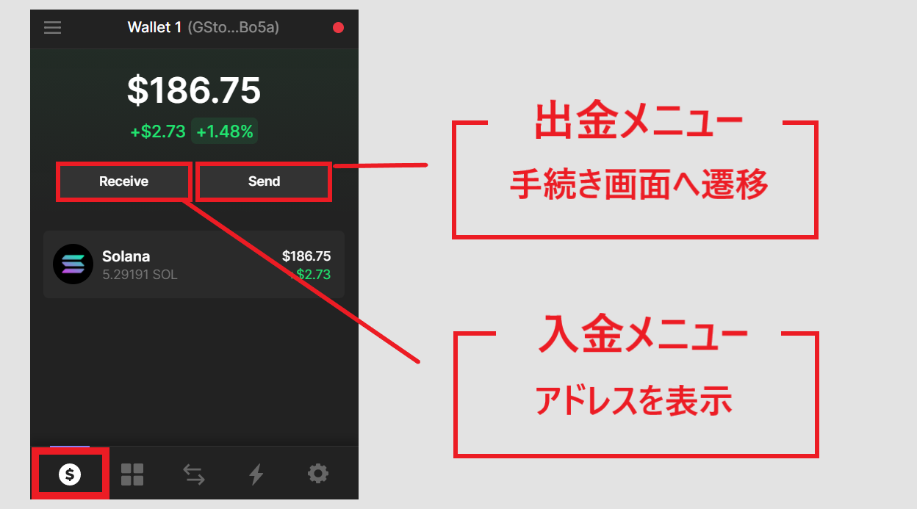
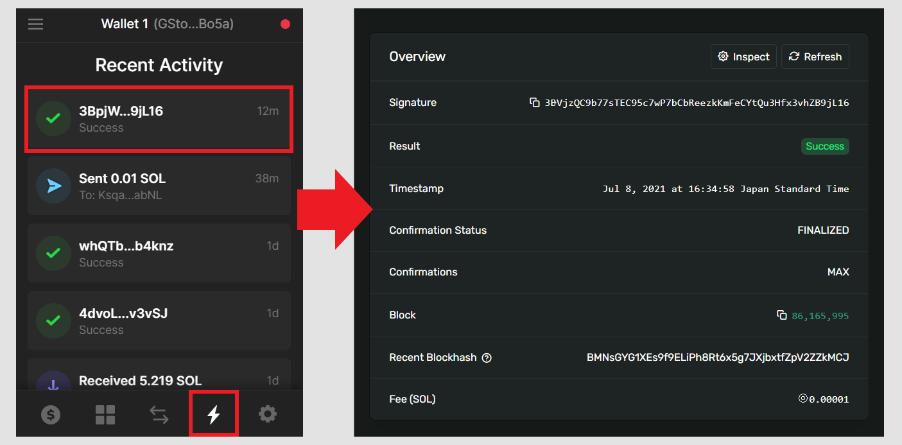
Phantom Wallet streamlines the fundamental mechanics of sending and receiving cryptocurrencies across supported networks. The interface is engineered to reduce transaction friction while maintaining rigorous confirmation steps to prevent user error.

Phantom Wallet|ウォレット作成方法と入金・出金の使い方

Receiving Assets
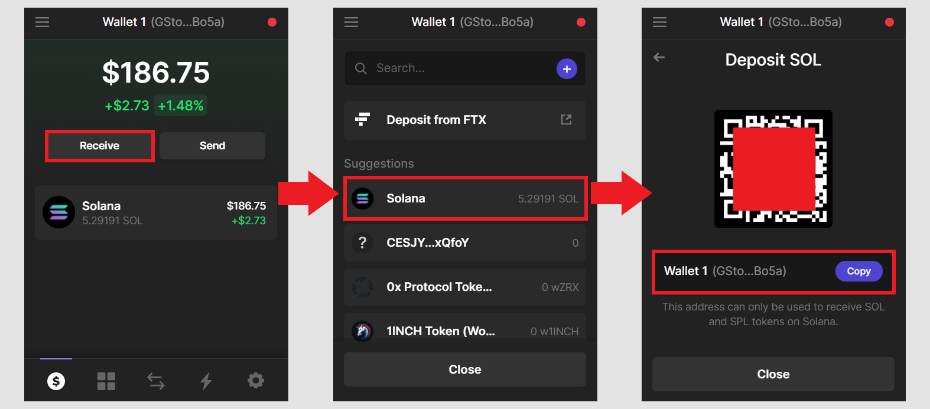
To receive funds, users select the "Receive" option within the dashboard. The application displays the specific public address and a corresponding QR code for the chosen network. Users can copy the address or scan the QR code using an external wallet or exchange. Because different blockchains utilize distinct address formats, users must ensure they select the correct network (e.g., Solana, Ethereum, or Polygon) before initiating a transfer to prevent permanent loss of funds.

Phantom Wallet|ウォレット作成方法と入金・出金の使い方

Sending Assets
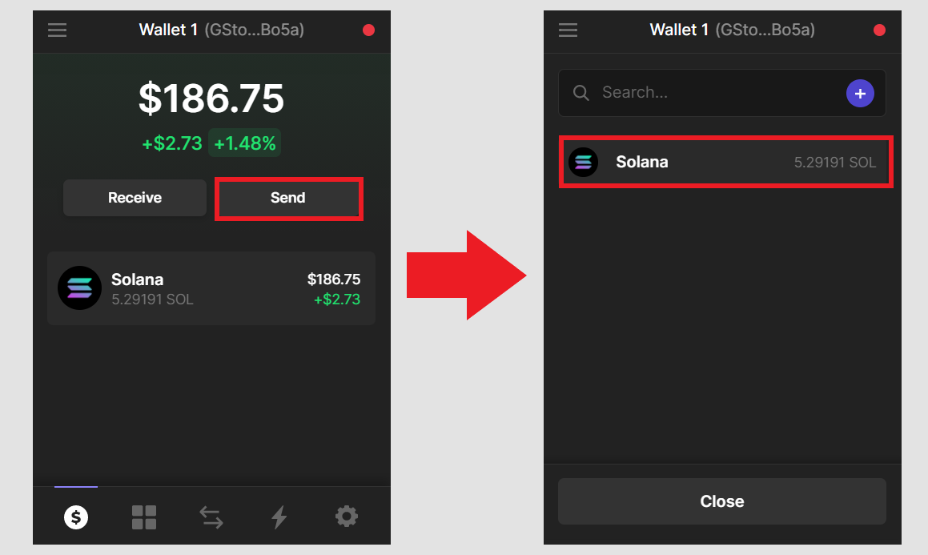
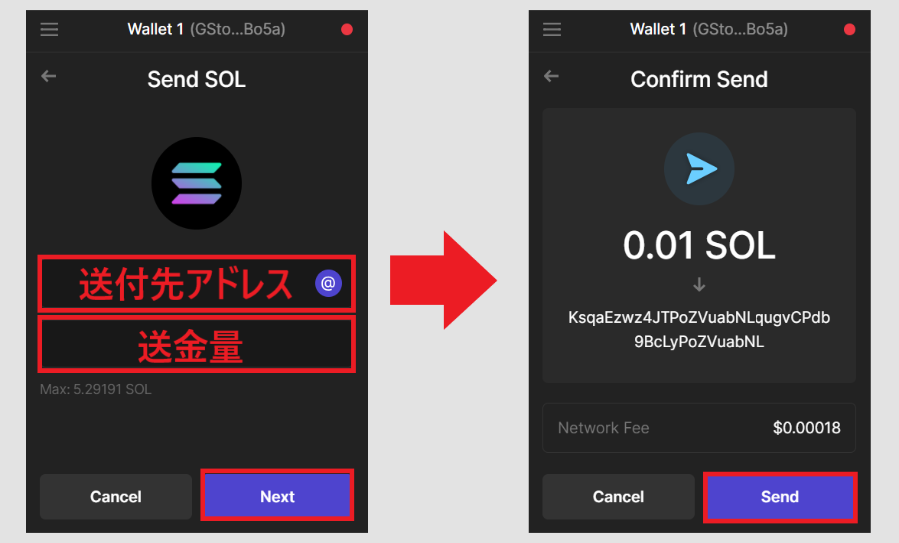
Executing outbound transfers involves selecting the "Send" function, designating the recipient’s public address, specifying the asset type, and inputting the desired amount. Phantom calculates estimated network fees in real-time, allowing users to review transaction costs before final authorization. Once confirmed with the user’s password or biometric authentication, the transaction is broadcast to the network for validation.

Phantom Wallet|ウォレット作成方法と入金・出金の使い方

Staking SOL for Passive Yield

Phantom Wallet|ウォレット作成方法と入金・出金の使い方

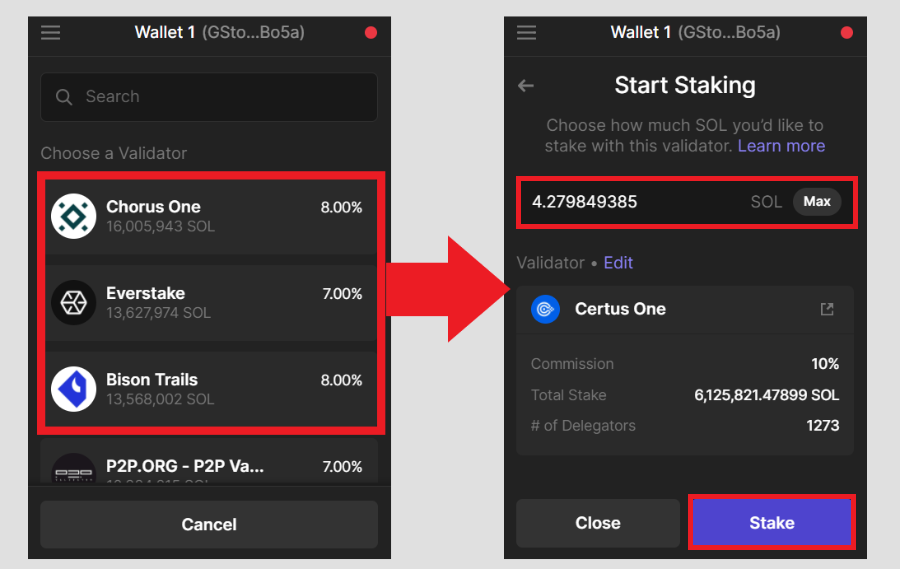
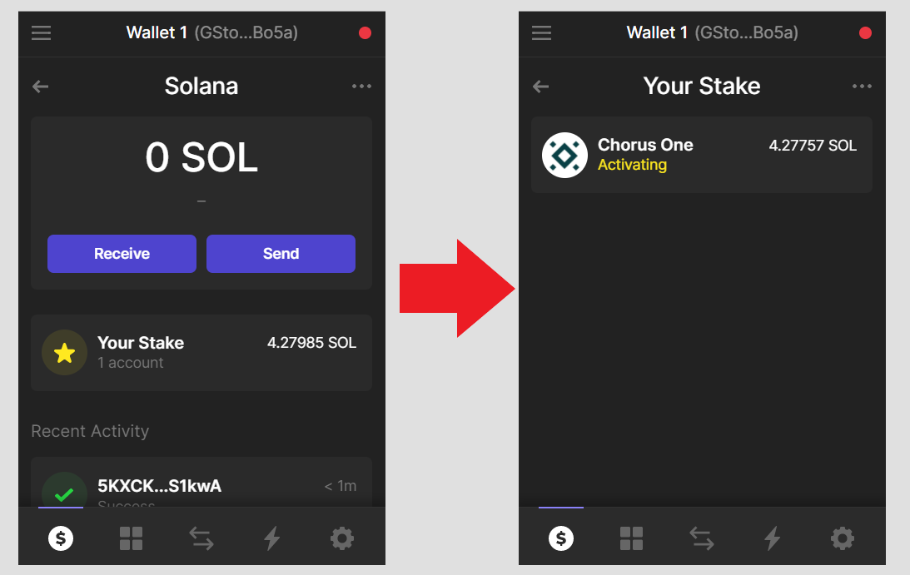
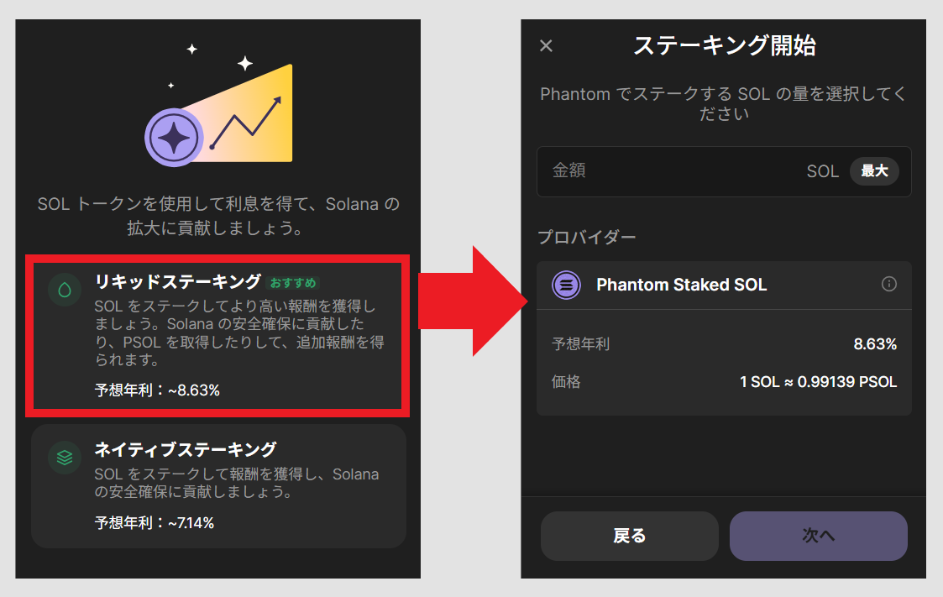
One of Phantom’s most popular native features is the ability to stake Solana (SOL) directly within the wallet interface. Staking allows token holders to earn passive rewards by supporting the security and consensus mechanism of the Solana blockchain, all without relinquishing custody of their assets.

Phantom Wallet|ウォレット作成方法と入金・出金の使い方

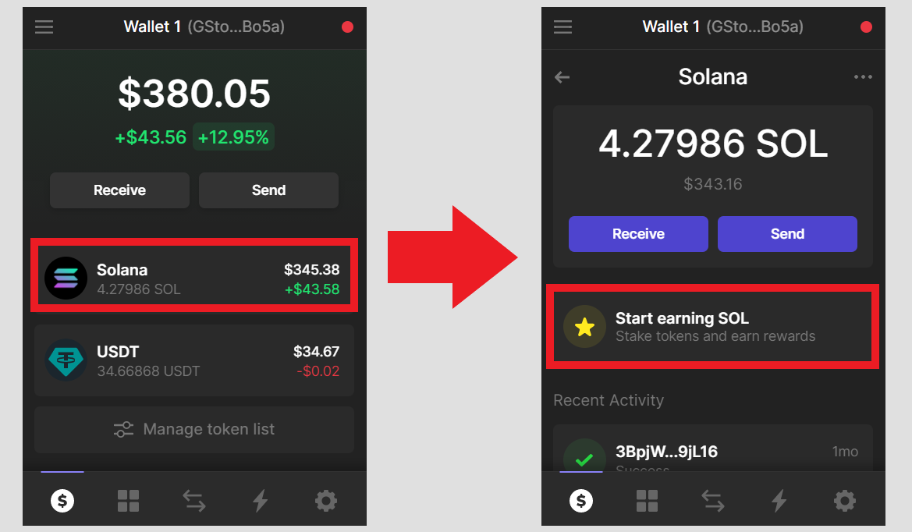
By navigating to the SOL balance within the dashboard and selecting "Start earning SOL," users are presented with a list of vetted validator nodes. Staking yields fluctuate based on overall network participation and validator performance, but the process is entirely non-custodial. Users retain full ownership of their staked SOL while accumulating rewards dynamically over time. Unstaking is similarly straightforward, though withdrawals typically require a brief cooling-off period spanning a few network epochs before funds become liquid again.

Phantom Wallet|ウォレット作成方法と入金・出金の使い方

Comprehensive NFT Storage and Marketplace Integration

Phantom Wallet|ウォレット作成方法と入金・出金の使い方

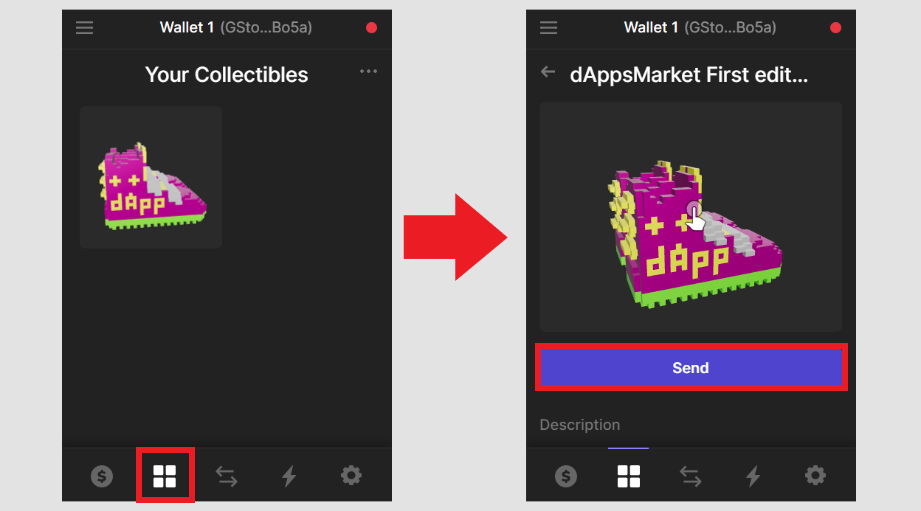
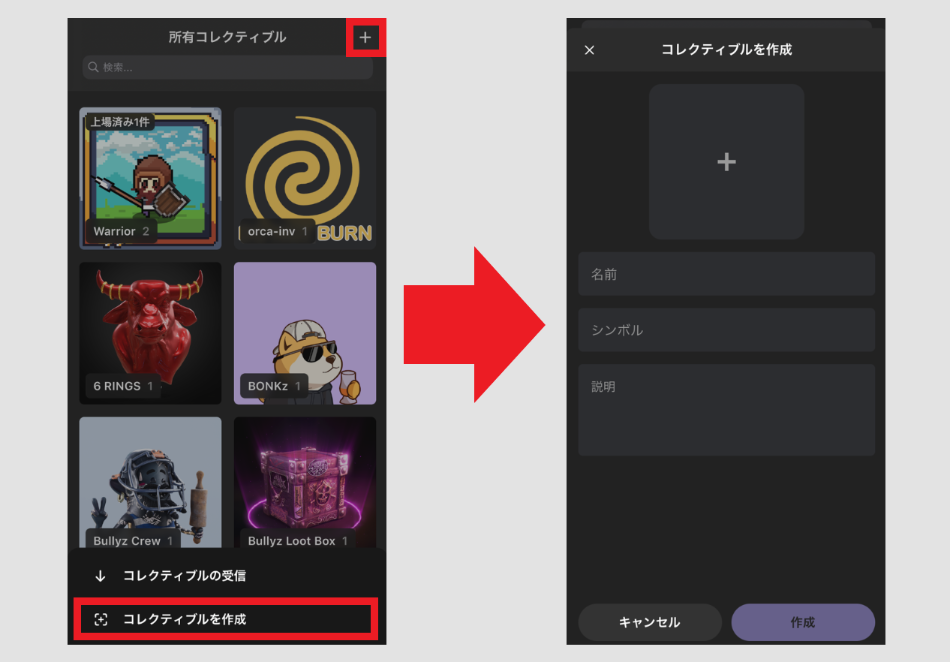
Phantom Wallet was among the first major digital wallets to recognize the cultural and economic significance of non-fungible tokens. The application features a dedicated, highly visual tab explicitly designed for NFT storage, organization, and trading.

Phantom Wallet|ウォレット作成方法と入金・出金の使い方

Rather than displaying NFTs as a generic list of transaction hashes, Phantom renders high-resolution artwork, gaming assets, and digital collectibles directly inside the user interface. Users can view metadata, floor prices, and collection details without navigating to external platforms.

Phantom Wallet|ウォレット作成方法と入金・出金の使い方

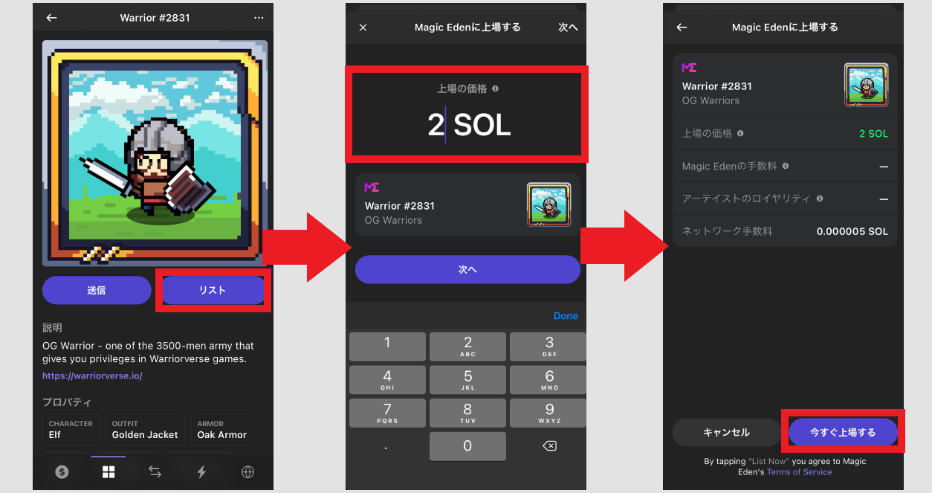
Furthermore, Phantom integrates natively with Magic Eden, the leading NFT marketplace on Solana. This integration allows users to buy, sell, make offers, and sweep floor prices directly from their wallet interface. The inclusion of compressed NFTs (cNFTs)—a scalable technology developed on Solana that significantly reduces the cost of minting large collections—further enhances Phantom’s utility for high-volume collectors and creators alike.

Phantom Wallet|ウォレット作成方法と入金・出金の使い方

Cross-Chain Swaps and Advanced Trading Features

Phantom Wallet|ウォレット作成方法と入金・出金の使い方

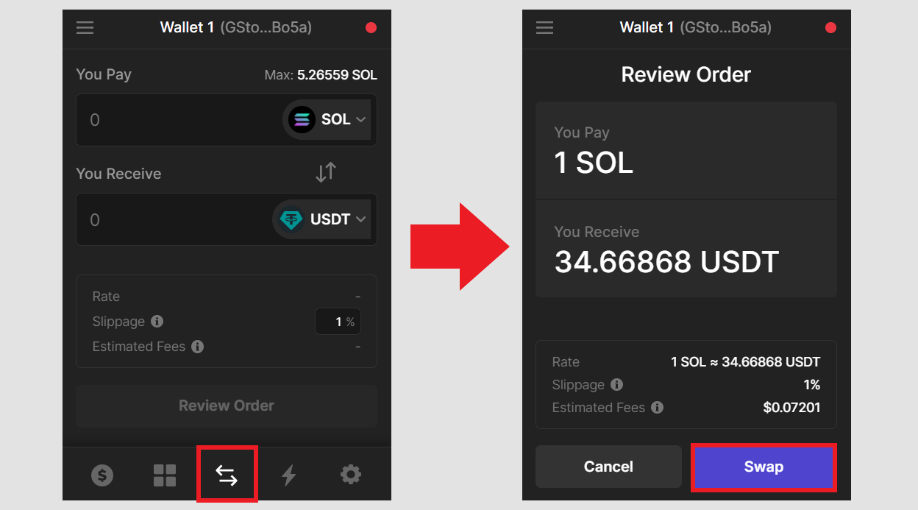
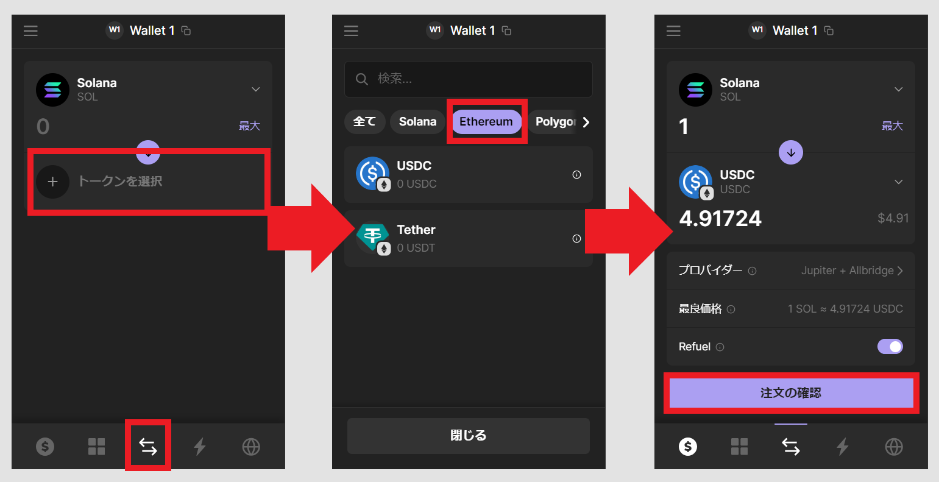
Beyond basic asset management, Phantom functions as a robust decentralized exchange (DEX) aggregator. The built-in Swap feature allows users to exchange tokens natively within the wallet without needing to connect to external centralized exchanges or decentralized trading platforms.

Phantom Wallet|ウォレット作成方法と入金・出金の使い方

The Swap tool routes transactions across multiple liquidity sources to secure the best available market prices with minimal slippage. Whether exchanging Solana-based tokens or interacting with cross-chain assets on Ethereum and Polygon, the interface provides transparent fee structures and execution estimates.

Phantom Wallet|ウォレット作成方法と入金・出金の使い方

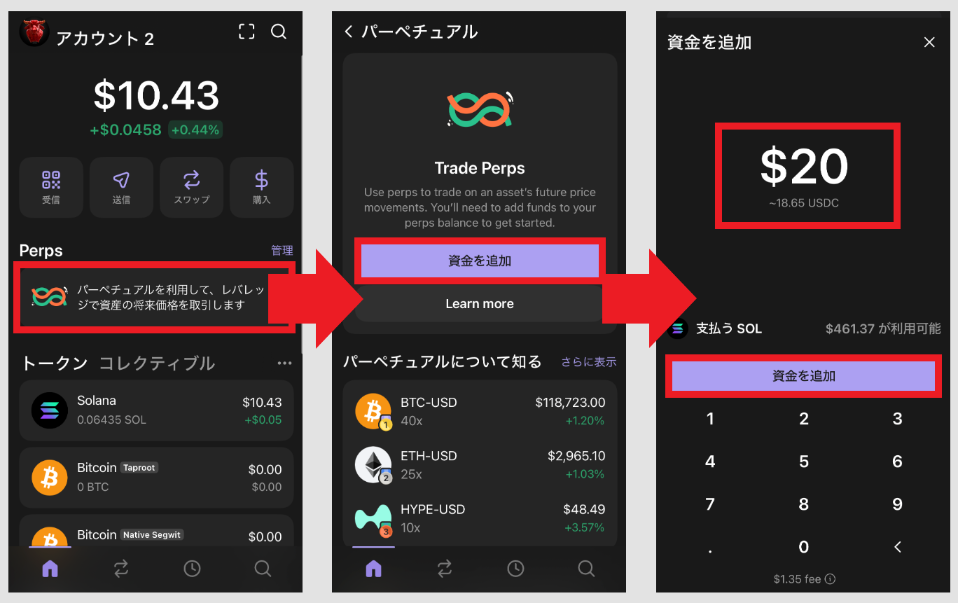
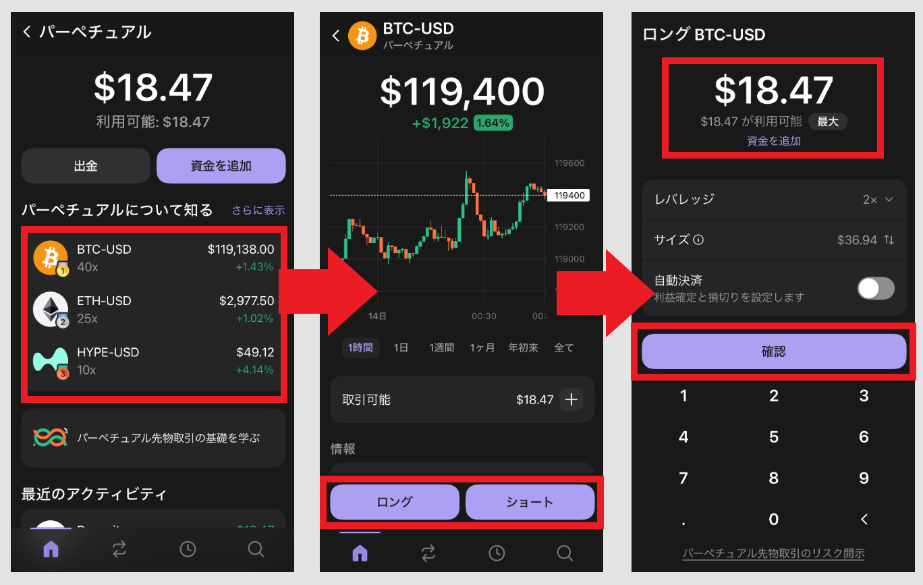
Additionally, Phantom has expanded into advanced trading verticals, including integrations with perpetual decentralized exchanges like Hyperliquid. This enables users to access high-leverage trading directly from their self-custodial environment, bridging the gap between basic wallet functionality and professional-grade financial tooling.

Phantom Wallet|ウォレット作成方法と入金・出金の使い方

Implications and Future Outlook

Phantom Wallet|ウォレット作成方法と入金・出金の使い方

The rapid ascent of Phantom Wallet underscores a broader shift in financial technology: the migration toward non-custodial, multi-chain infrastructure that prioritizes user experience without compromising security. By bridging the once-fractured ecosystems of Solana, Ethereum, and Polygon into a single interface, Phantom has effectively lowered the barrier to entry for mainstream cryptocurrency adoption.

Phantom Wallet|ウォレット作成方法と入金・出金の使い方

As regulatory frameworks evolve and decentralized applications become increasingly sophisticated, the role of the digital wallet will continue to expand from a simple storage mechanism to the foundational operating system of Web3. Through continuous security enhancements, cross-chain expansion, and intuitive interface design, Phantom Wallet remains a benchmark for digital asset management in the modern financial era.

September 16, 2026 0 comment
0 FacebookTwitterPinterestEmail
Japanese & Asian Crypto Markets

The Rising Threat of Web3 Phishing Attacks and How to Secure Your Digital Assets

by Rifan Muazin September 16, 2026
written by Rifan Muazin

The rapid proliferation of decentralized finance (DeFi), non-fungible tokens (NFTs), and Web3 gaming ecosystems has fundamentally shifted how individuals interact with the internet. However, this transition to a decentralized digital landscape has also introduced significant security vulnerabilities, most notably the rise of sophisticated phishing attacks. As users engage with new platforms, the risk of granting malicious smart contracts access to their digital wallets has reached a critical threshold, requiring a comprehensive understanding of security protocols, such as "token approvals," to prevent the catastrophic loss of assets.

【3分でわかるWeb3.0基礎講座】セキュリティ

The Anatomy of a Web3 Phishing Attack

Unlike traditional phishing, which typically relies on stealing login credentials or credit card information, Web3 phishing often targets the "allowance" mechanism of a blockchain wallet. When a user interacts with a decentralized application (dApp), they are frequently asked to "approve" a token. This transaction gives the smart contract permission to move a specific amount of a specific token on the user’s behalf.

Legitimate dApps use this feature to facilitate seamless trading on decentralized exchanges (DEXs) or to allow NFT marketplaces to list items for sale. Malicious actors, however, leverage this same functionality to trick users into signing transactions that grant an unlimited or high-value allowance of their assets to a malicious contract. Once this permission is granted, the attacker can drain the user’s wallet without further interaction, effectively bypassing the security measures that users believe are protecting them.

【3分でわかるWeb3.0基礎講座】セキュリティ

Chronology of Vulnerability: From Click to Drain

The lifecycle of a typical Web3 exploit follows a predictable, albeit devastating, pattern. It usually begins with social engineering, often via Discord, Twitter (now X), or Telegram. Attackers frequently pose as legitimate project moderators or customer support agents, directing users to fake websites that perfectly mirror official platforms.

  1. The Initial Contact: A user may receive an unsolicited direct message (DM) regarding an "airdrop," a "security update," or a "problem with their account."
  2. The Deception: The user is directed to a malicious URL designed to mimic a trusted interface, such as an NFT marketplace or a staking dashboard.
  3. The Connection: The fake site prompts the user to connect their wallet (e.g., MetaMask, Rabby, or Trust Wallet).
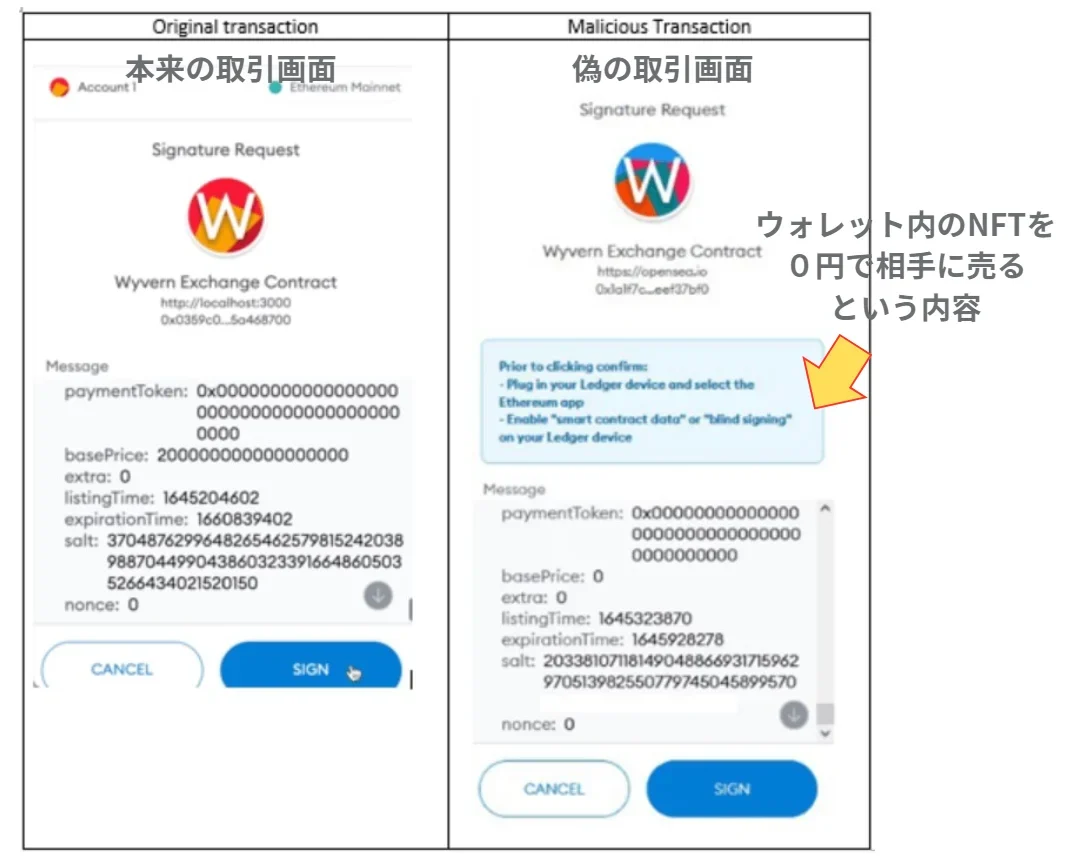
  4. The Malicious Approval: The attacker initiates a "SetApprovalForAll" transaction or a high-value token allowance request. If the user signs this transaction, they are essentially handing the keys to their vault to the attacker.
  5. The Asset Extraction: Once the transaction is confirmed on the blockchain, the smart contract is authorized to transfer the user’s tokens or NFTs at any time.

The Role of Etherscan and On-Chain Transparency

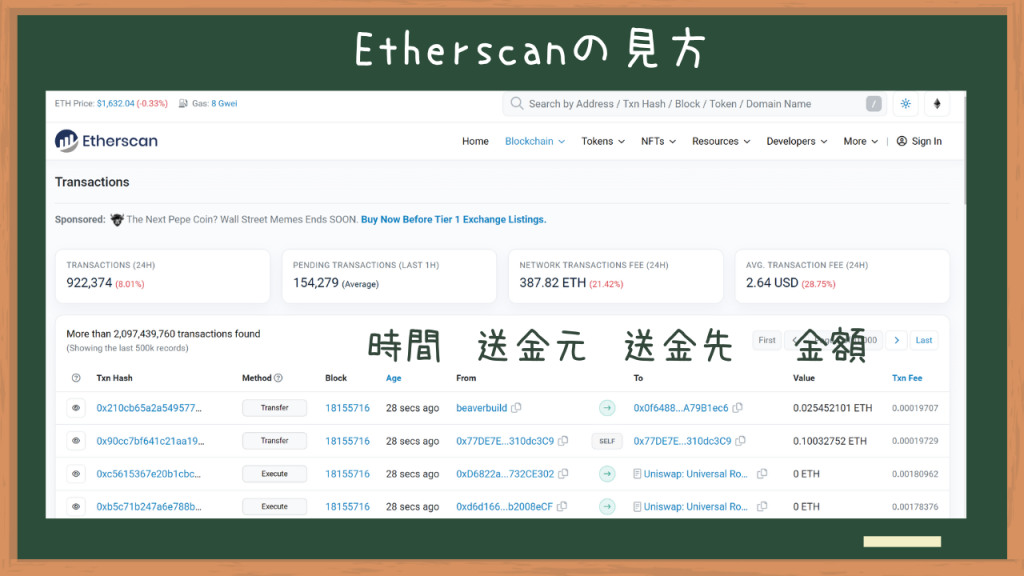
Blockchain transparency is a double-edged sword. While it allows for the verification of transactions via explorers like Etherscan (for Ethereum) or BscScan (for BNB Chain), it also means that once a malicious approval is signed, the damage is often irreversible.

【3分でわかるWeb3.0基礎講座】セキュリティ

Users can monitor their wallet’s active permissions by navigating to the "Token Approval" section of these block explorers. By connecting their wallet to the block explorer, users can view every contract they have authorized to move their funds. If an unfamiliar contract appears with high-value permissions, it is a red flag indicating a potential compromise.

Defensive Strategies: How to Revoke Access

The most effective defense against this specific vector of attack is the proactive management of token approvals. Users should regularly perform a "revoke" operation on any contract that is no longer in use or appears suspicious.

【3分でわかるWeb3.0基礎講座】セキュリティ

The revocation process is straightforward:

  • Navigate to an Approval Manager: Utilize trusted platforms such as Revoke.cash or the built-in "Token Approval" tools provided by major block explorers.
  • Connect Your Wallet: Ensure you are using a secure connection.
  • Identify Risky Permissions: Sort by the value of the allowance or look for "SetApprovalForAll" permissions granted to unknown contracts.
  • Execute the Revoke: Pay the necessary gas fee to update the blockchain state, effectively canceling the permission previously granted.

It is critical to note that revocation requires a gas fee because it involves writing a new transaction to the blockchain. Users should prioritize this expense as a mandatory insurance policy for their digital portfolio.

【3分でわかるWeb3.0基礎講座】セキュリティ

Industry Context and the Responsibility of Security

The prevalence of these attacks has spurred a shift in how Web3 security is discussed. Experts now argue that "security literacy" is as important as the technology itself. Major industry players are increasingly integrating security warnings directly into browser extensions and wallet interfaces to alert users before they sign a high-risk transaction.

For example, tools like Kekkai have emerged to provide real-time simulation of transactions, allowing users to see exactly what will happen to their assets before they click "Confirm." These security layers serve as a critical safety net, preventing the most common mistakes made by both novice and experienced users.

【3分でわかるWeb3.0基礎講座】セキュリティ

The Psychological Aspect of Web3 Scams

Beyond the technical hurdles, the success of these attacks relies heavily on psychological manipulation. By creating a sense of urgency—claiming a user’s NFT is at risk or that an exclusive reward is about to expire—attackers bypass the user’s critical thinking.

Official projects will rarely, if ever, initiate contact via private DMs to request sensitive information or ask users to sign transactions on external links. Developing a habit of verifying information through official community channels rather than private messages is the first line of defense. If an offer seems too good to be true, or if a "support agent" is pressuring the user to act quickly, it is almost certainly a scam.

【3分でわかるWeb3.0基礎講座】セキュリティ

Implications for the Future of Decentralization

As the Web3 space matures, the burden of security is being shared between infrastructure providers and end-users. While wallet developers are working to make interfaces more intuitive and transparent, the nature of self-custody dictates that the final responsibility for asset security remains with the individual.

The financial implications of these attacks are significant. Beyond the immediate loss of capital, such incidents erode trust in the broader Web3 ecosystem, potentially hindering mainstream adoption. Therefore, the adoption of rigorous security hygiene—including the regular use of revocation tools, the implementation of hardware wallets, and the adoption of a "zero-trust" approach to unsolicited messages—is essential.

【3分でわかるWeb3.0基礎講座】セキュリティ

In conclusion, while the decentralization of digital assets provides unparalleled control and ownership, it also removes the traditional safety nets provided by centralized financial institutions. Securing one’s digital life requires an active, vigilant approach. By understanding how token approvals function and utilizing the available tools to audit and revoke permissions, users can significantly reduce their risk and navigate the Web3 landscape with confidence. The future of the digital economy depends on this culture of vigilance, where security is treated not as an afterthought, but as the foundation of every transaction.

September 16, 2026 0 comment
0 FacebookTwitterPinterestEmail
Crypto Mining & Infrastructure

Compute is your revenue now: The rise of the AI factory paradigm shift

by Jia Lissa September 16, 2026
written by Jia Lissa

At GTC 2026 in San Jose, NVIDIA CEO Jensen Huang delivered a keynote that served as a watershed moment for the global data center industry. With a succinct five-word declaration—"Compute is your revenue now"—Huang signaled a fundamental departure from the traditional data center business model. For decades, the industry has operated on the premise of selling "availability" or "stored capacity." Today, that logic is being aggressively supplanted by the "AI factory" thesis, where the core metric of success is not how much rack space is filled, but how much token throughput a facility can generate.

The Evolution of the Data Center

To understand the gravity of this shift, one must look at the historical trajectory of infrastructure. In the early 2010s, data centers were primarily storage and networking hubs. By 2020, cloud migration pushed the industry toward massive scaling of general-purpose compute. However, the rise of Large Language Models (LLMs) and agentic workflows has necessitated a specialized facility architecture.

Since 2024, NVIDIA has championed the term "AI factory" to describe infrastructure capable of managing the entire AI lifecycle: from raw data ingestion and model training to high-volume inference. While vendors like Dell and NVIDIA have utilized the term as a product branding strategy for validated hardware stacks, the broader industry has adopted it to describe a specific class of facility that treats intelligence as its primary industrial output.

The primary distinction between a conventional data center and an AI factory is the economic risk profile. In a traditional colocation model, a facility operator earns revenue based on power consumption and space, regardless of whether the tenant’s servers are actively processing data. In the AI factory model, idle compute is a depreciating liability. Consequently, the operational philosophy has shifted from maximizing uptime to maximizing token throughput per megawatt.

The Energy Constraint and the Interconnection Crisis

The transition to AI-centric infrastructure has placed unprecedented pressure on global power grids. At GTC 2026, ERCOT CTO Venkat Tirupati provided a sobering assessment of the supply-demand imbalance. Currently, roughly 230 gigawatts (GW) of large-load requests sit in the interconnection queue—70% of which are attributed to data centers—against a system peak of approximately 85 GW.

The "factory" model acknowledges that the real constraint is not just the availability of power, but the timeline of delivery. While new demand for AI capacity can manifest in 6 to 18 months, building the necessary generation and transmission infrastructure can take two to six years. This structural lag has forced operators to treat energy as a flexible input rather than a fixed utility.

Innovative operators are now utilizing "demand-response" strategies to manage this volatility. A notable milestone occurred when Luxor Energy and Bentaus successfully demonstrated the ability to throttle a live GPU’s power draw to 25% in under 500 milliseconds in response to an ERCOT 4CP (Four Coincident Peaks) signal. This maneuver, performed without disrupting the inference workload, proves that AI factories can operate as dynamic grid participants, turning potential downtime into a revenue-generating balancing service.

The Economics of Token Throughput

The shift to token-based accounting represents a pivot from "capacity planning" to "efficiency engineering." A token—a fragment of text or data—is the granular unit of model output. The industry is now obsessively tracking "tokens per watt" as the definitive key performance indicator (KPI).

Hardware advancements are accelerating this metric at an exponential rate. NVIDIA’s GB300 NVL72 systems, for instance, are theoretically capable of delivering up to 50 times the token throughput of previous Hopper-era architectures per megawatt. While such benchmarks are manufacturer-defined and subject to real-world variables, they set the standard for what modern AI infrastructure must achieve to remain competitive in a market where price-per-million-tokens is set by model providers, not by the hardware owners themselves.

The nature of the workload itself has also evolved. Traditional training cycles were bursty, requiring high-intensity compute for limited windows. Conversely, agentic AI workloads—where models act autonomously to execute tasks—are continuous. This creates a "24/7/365" duty cycle that demands superior thermal management and structural reliability, as the revenue stream no longer pauses for maintenance windows or off-peak hours.

Retrofitting and the Digital Twin Imperative

For existing data center operators, the "AI factory" transition poses a difficult question: how to adapt aging infrastructure for high-density, liquid-cooled, and power-hungry GPU clusters?

The industry is increasingly relying on "digital twins"—physics-accurate simulations—to answer this before committing capital. Unlike the digital twins of the past, which were often simple architectural visualizations, these models integrate complex data on power distribution, cooling loops, and structural weight limits.

The most common failure point for retrofits is not cooling, but floor loading. High-density AI racks can exceed the structural capacity of older, legacy data center slabs. Engineers are now using simulations to test if an existing site can support the weight of thousands of NVIDIA Blackwell-class GPUs and if the power distribution units can handle the surge loads required by current-generation clusters. Failure to conduct this level of due diligence often leads to stranded assets that cannot be efficiently converted to AI-native standards.

Strategic Implications: Who Owns the Risk?

The AI factory frame forces operators to define their position in the value chain. There are three primary tiers, each with a different relationship to the "tokens per watt" metric:

  1. The Landlord: This entity supplies power, space, and cooling. They earn a flat rate per kilowatt and carry tenant credit risk, but they are insulated from the utilization risk of the underlying hardware.
  2. The Infrastructure Operator: This entity owns the compute and sells GPU-hours. They face the highest capital expenditure (CapEx) and carry both utilization and residual hardware value risk, but they capture the highest potential margin.
  3. The Contracted Operator: This entity benefits from offtake agreements, where a third party guarantees payments regardless of compute utilization. This is the "gold standard" for stability, though it relies heavily on the creditworthiness of the buyer.

Even for the "Landlord," the efficiency of the tenant matters. If a tenant is operating an inefficient factory that yields a low tokens-per-watt ratio, they will eventually face margin compression that threatens their ability to pay rent. Consequently, the AI factory paradigm is not merely a technical classification—it is a financial one.

Future Outlook and Conclusion

The term "AI factory" is more than just marketing jargon; it is a nomenclature that finally aligns facility output with revenue. By shifting the focus from uptime to throughput, the industry has created a more disciplined approach to capital allocation.

As the sector matures, two major trends will likely dominate: the extension of hardware lifecycles and the integration of heterogeneous compute. Michael Intrator of CoreWeave has noted that with advanced inference disaggregation, the useful life of a GPU could extend from the traditional four-year cycle to as long as eight or ten years. If software continues to improve in its ability to support older hardware, the primary challenge for the AI factory will shift from purchasing new silicon to squeezing maximum efficiency out of existing assets.

Ultimately, the AI factory frame provides the industry with the clarity needed to navigate a high-stakes, capital-intensive future. It serves as a reminder that in the age of generative AI, infrastructure is not merely a foundation—it is a machine that converts energy into intelligence, and that intelligence is the commodity that defines the new global economy. For operators, the question is no longer about how much power they have, but how effectively they can turn that power into the currency of the future: the token.

September 16, 2026 0 comment
0 FacebookTwitterPinterestEmail
Crypto Mining & Infrastructure

Foundry to Launch Institutional-Grade Zcash Mining Pool in April 2026 to Bridge Infrastructure Gap for Privacy Coins

by Nila Kartika Wati September 16, 2026
written by Nila Kartika Wati

Foundry, globally recognized as the operator of the largest Bitcoin mining pool by total computational power, has officially announced its strategic expansion into the privacy-centric cryptocurrency sector. The company plans to launch a dedicated, institutional-grade Zcash (ZEC) mining pool in April 2026. This development marks a significant milestone for the Zcash ecosystem, as it introduces enterprise-level infrastructure tailored specifically to institutional entities, publicly traded corporations, and large-scale digital asset miners.

The initiative aims to address a long-standing structural deficiency within the Zcash network: the lack of robust, compliant, and institutional-ready mining pools. By leveraging its extensive experience managing Foundry USA—the dominant player in the Bitcoin hashing ecosystem—Foundry intends to bring enterprise standards of reliability, transparency, and security to the Zcash mining landscape.

Background and Context of the Expansion

The decision by Foundry to branch out into Zcash mining comes at a transformative time for both the company and the broader digital asset industry. Foundry, a subsidiary of Digital Currency Group (DCG), has built its reputation on providing robust infrastructure for proof-of-work (PoW) networks. However, until now, its primary operational focus has remained tightly anchored to Bitcoin.

Zcash, launched in October 2016, occupies a unique niche in the cryptocurrency landscape. Operating as a decentralized, open-source blockchain, it utilizes advanced zero-knowledge cryptography—specifically zk-SNARKs—to offer optional transaction privacy. While foundational cryptocurrencies like Bitcoin and Ethereum maintain transparent public ledgers where transaction amounts and wallet addresses are openly visible, Zcash allows users to shield their transaction data while still maintaining network consensus.

Over the years, Zcash has grappled with a tension between its privacy-focused design and the demands of regulatory compliance. Proponents argue that the integration of selective disclosure mechanisms enables Zcash to bridge the gap between financial privacy and regulatory standards. However, the lack of institutional-grade infrastructure has historically deterred large, publicly traded corporations and regulated financial institutions from actively participating in Zcash network consensus through mining.

Bitcoin Mining Giant Enters Zcash With Institutional Service

By introducing a US-based, highly compliant mining pool, Foundry aims to mitigate these concerns, offering institutional miners a secure and legally sound environment to contribute computing power to the Zcash network.

The Mechanics of Mining Pools and Zcash Tokenomics

To understand the significance of Foundry’s upcoming launch, it is necessary to examine the mechanics of mining pools and how Zcash operates under its proof-of-work consensus model.

A mining pool is a collaborative cooperative where individual miners from around the world pool their computational power—known as hashrate—over a decentralized network. Because the difficulty of solving cryptographic puzzles to mine a new block is exceptionally high, individual miners with modest equipment have a very low statistical probability of successfully earning block rewards independently. By combining hashrate, pool participants stabilize their earnings, receiving payouts proportional to the computational share they contribute toward solving blocks.

Zcash shares deep historical roots with Bitcoin. The protocol was originally launched using a modified version of Bitcoin’s codebase. Consequently, its core tokenomics closely mirror those of the world’s largest cryptocurrency:

  • Maximum Supply Cap: Zcash has a hard-coded supply limit of 21 million ZEC tokens, protecting against inflationary devaluation.
  • Block Rewards: New tokens are minted and distributed to miners as a reward for adding verified blocks to the blockchain.
  • Halving Schedule: To control inflation, the Zcash block reward is cut in half approximately every four years through programmed halving events, mirroring Bitcoin’s monetary policy.

Despite these similarities, Zcash utilizes the Equihash proof-of-work algorithm rather than Bitcoin’s SHA-256, requiring specialized ASIC (Application-Specific Integrated Circuit) hardware designed specifically for memory-hard cryptographic computations.

Network Growth and Hashrate Boom

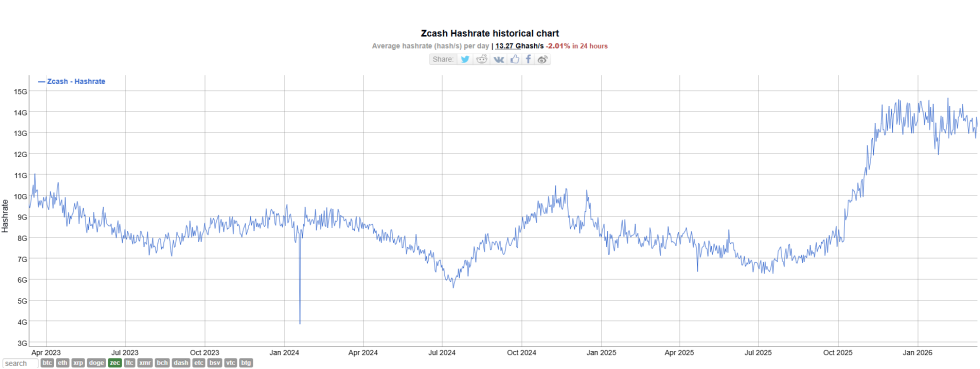
Foundry’s strategic entry into the Zcash ecosystem does not happen in a vacuum; it follows a profound technical resurgence within the Zcash network itself. Over the preceding months, the Zcash blockchain has experienced a substantial expansion in total network hashrate, reflecting renewed interest from industrial-scale miners.

Bitcoin Mining Giant Enters Zcash With Institutional Service

Data compiled by analytics platform BitInfoCharts highlights this dramatic upward trajectory. In October of the previous year, the total computing power securing the Zcash blockchain languished below 8 gigahashes per second (Ghash/s). However, market conditions, hardware efficiencies, and shifting miner economics catalyzed a sharp reversal. By early 2026, the network hashrate climbed steadily, stabilizing at over 13 Ghash/s.

This surge in computational power indicates that industrial miners are increasingly allocating hardware resources to the Zcash network. Yet, this influx of enterprise-level hardware has outpaced the existing mining pool infrastructure, creating a market vacuum that Foundry’s new institutional-grade pool is explicitly designed to fill.

Official Responses and Industry Reactions

The announcement has garnered widespread support from key stakeholders across the cryptocurrency industry, particularly from organizations dedicated to the development and promotion of Zcash.

Zooko Wilcox, founder of Zcash and chief product officer at Shielded Labs—an independent Swiss-based support and development organization for the ZEC ecosystem—welcomed the news with great enthusiasm.

"We at Shielded Labs are delighted that Foundry—the largest Bitcoin mining pool, and one based in North America—is launching an enterprise-grade Zcash mining pool," Wilcox stated in the official press release. His remarks underscore the importance of securing backing from premier North American crypto infrastructure operators to bolster global confidence in the privacy coin.

Mike Colyer, Chief Executive Officer of Foundry, emphasized that the decision was driven by market maturation. "Zcash has matured into an institutional-grade asset, but the mining infrastructure supporting it hasn’t kept pace," Colyer noted, positioning Foundry’s upcoming pool as the natural bridge required to reconcile this discrepancy.

Bitcoin Mining Giant Enters Zcash With Institutional Service

Market Context and Price Performance of ZEC

While network fundamentals and infrastructure developments point toward long-term network strengthening, the immediate market pricing of Zcash reflects the inherent volatility of the broader digital asset market.

At the time of writing, Zcash (ZEC) is changing hands at approximately $209 per token. The asset has experienced a downward correction of over 11% across the trailing seven-day period, retracing a portion of its earlier multi-month recovery rally. Technical analysts note that while macro price action remains subject to broader market liquidity cycles and regulatory headlines regarding privacy coins, foundational network improvements—such as the integration of institutional mining operators—frequently serve as structural tailwinds for long-term valuation.

Broader Impact and Industry Implications

The introduction of an institutional-grade Zcash mining pool by Foundry carries several broad implications for the cryptocurrency mining and privacy coin sectors:

  1. Legitimization of Privacy Assets: By extending its operational footprint to a prominent privacy-focused token, Foundry—a heavily regulated entity operating within North America—signals to the broader financial market that privacy technology can coexist within compliant corporate frameworks.
  2. Geographic and Corporate Distribution of Hashrate: As regulatory scrutiny surrounding cryptocurrency mining intensifies globally, the addition of a major US-based pool ensures that North American miners have access to localized, enterprise-grade infrastructure without needing to rely on overseas alternatives.
  3. Template for Future Multi-Asset Expansion: Foundry’s successful transition from a Bitcoin-exclusive operator to a multi-asset infrastructure provider may establish a blueprint for other dominant mining pools to diversify their operations across alternative proof-of-work networks.

As the April 2026 launch date approaches, market participants will closely monitor how institutional miners respond to the new offering and whether the enhanced infrastructure catalyzes further growth in the Zcash network’s computing power and asset liquidity.

September 16, 2026 0 comment
0 FacebookTwitterPinterestEmail
Global Cryptocurrency News

The Justin Sun Prize Launches As A $1 Million Decentralized Academic Bounty For Breakthroughs In Artificial Intelligence And Fundamental Mathematics

by Nana Wu September 16, 2026
written by Nana Wu

GENEVA, SWITZERLAND — In an ambitious move set to reshape how humanity incentivizes and rewards fundamental science, the Office of Justin Sun officially announced the establishment of the Justin Sun Prize on September 16, 2026. Designed as a zero-trust, decentralized academic bounty mechanism, the initiative pivots away from traditional credential-based honors, lifetime achievement awards, and bureaucratic nomination committees. Instead, it relies on a dynamic "problem list" where complex mathematical challenges and machine-verifiable formal proofs serve as the sole criteria for winning. Offering a top prize of up to $1 million for a single resolved problem, the initiative aims to catalyze human-AI collaboration and redefine scientific recognition for the artificial intelligence era.

The inauguration of the prize coincided with the announcement of its very first cohort of laureates. Recognizing solutions and formalized proofs across 66 distinct mathematical challenges, the inaugural awards committee handed its premier $1 million prize to the OpenAI research team. The award acknowledged the team’s groundbreaking solution and formalized proof regarding the Existence and Smoothness of the Three-Dimensional Navier–Stokes Equations. According to public technical disclosures released by OpenAI, the core mathematical proof was generated by an internal foundational model, while the subsequent Lean formalization and rigorous machine verification were successfully executed by GPT-6 Astra.

Historical Context and the Weight of the Millennium Problems

The Navier–Stokes equations—commonly abbreviated as the N–S equations—represent a cornerstone of classical physics, describing the motion of viscous fluid substances. Developed during the 19th century by French physicist Claude-Louis Navier and Irish-born British mathematician George Gabriel Stokes, these equations have puzzled mathematicians for approximately two centuries. Despite their ubiquity in modeling weather, ocean currents, and aerodynamic flow, a complete mathematical proof demonstrating that smooth, physically reasonable solutions always exist in three dimensions has remained elusive.

Recognizing the monumental difficulty of this challenge, the Clay Mathematics Institute designated the Navier–Stokes Existence and Smoothness problem as one of its seven Millennium Prize Problems in May 2000, attaching a $1.4 million bounty to its resolution. By leveraging machine-verifiable formal proofs, the Justin Sun Prize has now successfully incentivized a breakthrough on one of mathematics’ most notorious mountains, bridging the gap between historical theoretical physics and modern automated machine verification.

A Radical Paradigm Shift in Scientific Incentives

Unlike legacy academic awards that operate on rigid four-year cycles, require institutional nominations, or prioritize senior researchers near the ends of their careers, the Justin Sun Prize introduces an open-access, continuous-delivery model. There are no barriers to entry based on nationality, institutional affiliation, or human versus machine status. Any individual, collaborative group, or artificial intelligence system can claim a bounty as long as they are the first to publish a valid, machine-verified proof for any problem featured on the official registry.

The architecture of the prize registry is designed for permanent immutability and transparency. Problems can be added to the list over time, but once listed, they are permanently locked and cannot be removed. Furthermore, awarded prize funds are non-returnable under any circumstances, guaranteeing financial security for successful contributors.

The current problem list already features some of the most formidable unsolved riddles in mathematical history. These include formal verification pursuits for the Poincaré Conjecture, the Riemann Hypothesis, Goldbach’s Conjecture, and an extensive catalog of unsolved problems proposed throughout the lifetime of the late mathematician and Wolf Prize laureate Paul Erdős.

Ceremonial Honors and Core Operating Principles

Winners of the Justin Sun Prize receive more than just digital asset payouts; they are honored with a physical certificate and a custom-minted medal. Etched along the edge of each medal is the Latin phrase "Quod probatur, solvitur"—translating directly to "Proved, then paid." This motto encapsulates the philosophy of the initiative, emphasizing absolute empirical and logical certainty over subjective peer review or academic politics.

Operating under three foundational pillars—openness, public benefit, and open-source accessibility—the initiative maintains strict operational transparency. The problem lists, confirmation standards, complex proofs, and automated verification materials are publicly hosted on GitHub for global peer scrutiny. Meanwhile, all financial disbursements are recorded transparently on-chain, ensuring permanent traceability and immutability.

Justin Sun Establishes the Justin Sun Prize: “My Wealth Came from Mathematics and Will Return to Mathematics”

"An award named after a person is the least political thing in the world," remarked Justin Sun during the announcement. "More importantly, it gives me an answer to myself—my wealth is rooted in mathematics. It came from mathematics, and it will return to mathematics."

Public financial disclosures indicate that Sun has historically directed more than $45 million toward global philanthropic causes spanning advanced technology, environmental preservation, and disaster relief. The Justin Sun Prize is slated to become the central cornerstone of his ongoing philanthropic endeavors, providing a sustained mechanism to support foundational scientific breakthroughs through decentralized, verifiable frameworks.

Financial Mechanics and Global Accessibility

To ensure frictionless global distribution, prize payouts are executed digitally. Laureates can elect to receive their funds either as USDT natively issued on the TRON network (TRC-20) or as USDC operating on the Ethereum blockchain (ERC-20).

The launch of the prize has sparked considerable discussion among economists, computer scientists, and academic institutions regarding the future role of artificial intelligence in theoretical research. By demonstrating that advanced AI models—such as GPT-6 Astra—can successfully navigate and formally verify solutions to centuries-old mathematical dilemmas, the initiative signals a permanent shift in how scientific discoveries will be validated in the coming decades.

Broader Implications for AI-Driven Science

Industry analysts note that traditional academic publishing often suffers from prolonged peer-review bottlenecks, replication crises, and institutional gatekeeping. By decentralizing the verification process through machine-checked proof assistants like Lean, the Justin Sun Prize bypasses traditional systemic delays.

If successful, this model could inspire other philanthropic organizations and tech conglomerates to establish similar cryptographic, machine-verifiable bounty systems for other critical domains, such as materials science, quantum computing algorithms, and renewable energy physics. The immediate integration of blockchain-based accounting with automated formal logic sets a new operational standard for global scientific philanthropy.
About the Office of Justin Sun and the Founder

The Office of Justin Sun directs the global business ventures, technological investments, art acquisitions, space exploration initiatives, and philanthropic programs associated with its founder. Justin Sun is widely recognized as a prominent figure in the digital asset and blockchain sectors. Having previously served as the Ambassador and Permanent Representative of Grenada to the World Trade Organization, Sun is also the founder of TRON, a leading decentralized blockchain protocol that has processed over $13 trillion in transaction volume, heavily relied upon across emerging markets for stablecoin settlements.

A protégé of Alibaba Group founder Jack Ma, Sun’s career has garnered international media attention, including a cover profile in Forbes in April 2025 and multiple inclusions on the Forbes 30 Under 30 list. Expanding his reach beyond terrestrial technology, Sun participated in August 2025 as a crew member aboard Blue Origin’s NS-34 mission, making history as the 712th human to travel to space.

Through the Justin Sun Prize, Sun seeks to cement a lasting legacy that transforms mathematical inquiry, utilizing the wealth generated by digital technology to accelerate humanity’s deepest theoretical explorations.

For further details regarding the active problem registry, submission guidelines, and verification documentation, interested researchers and technologists can visit the official portal at www.hejustinsun.com/prize. Official inquiries can be directed to the prize administration via email at [email protected], or through the Office of Justin Sun at [email protected].

September 16, 2026 0 comment
0 FacebookTwitterPinterestEmail
Bitcoin & Core Networks

Phoenix Exchange Introduces Native SOL Collateral Support for Solana Perpetuals Trading

by Pevita Pearce September 16, 2026
written by Pevita Pearce

New York, New York — September 16, 2026 — Traders operating within the Solana decentralized finance (DeFi) ecosystem can now utilize SOL directly as margin for perpetual futures positions, following a major platform upgrade by Ellipsis Labs on the Phoenix exchange.

The integration allows participants to deposit native SOL alongside the platform’s existing stablecoin collateral, USDC. This functionality spans more than 80 diverse trading markets on Phoenix, covering a broad spectrum of asset classes ranging from major cryptocurrencies to tokenized equities and commodities. Historically, traders seeking exposure to derivative markets while holding spot Solana tokens faced a structural friction point: they were compelled to liquidate their SOL holdings into stablecoins to satisfy margin requirements. With the deployment of native SOL collateral, market participants can maintain long-term exposure to the underlying asset while simultaneously deploying capital into derivative strategies, structured yield farming, or complex basis trades without converting their token holdings.

Background and Platform Architecture

The introduction of SOL collateral marks the foundational deployment of Phoenix’s newly engineered multi-collateral system. Developed by Ellipsis Labs—a prominent contributor to Solana’s on-chain infrastructure since 2023—Phoenix operates as a non-custodial perpetual futures exchange utilizing a fully on-chain order book. Unlike hybrid derivatives platforms that settle trades off-chain or rely on centralized matching engines, Phoenix executes every order placement, trade fill, and liquidation event directly on the Solana blockchain.

This architecture ensures that all operational mechanics remain publicly verifiable. User funds are secured within transparent, open-source smart contract program accounts rather than being held by a centralized intermediary. Ellipsis Labs established its reputation in the Solana ecosystem through the initial launch of the Phoenix spot order book, which accumulated more than $75 billion in cumulative trading volume. Expanding this high-throughput infrastructure into the perpetuals market represented a logical progression, culminating in the current integration of native asset margining.

Mechanics of the Multi-Collateral Margin System

Under the newly implemented parameters, the Phoenix risk engine handles multi-asset collateral through a structured valuation framework. While stablecoins such as USDC retain a 100% collateral weight, SOL has been initially calibrated with an 80% valuation weight to account for potential intraday price volatility. Consequently, a trader’s available margin fluctuates dynamically in real time alongside the spot market price of SOL.

Despite the addition of a volatile asset as margin, the core cross-margining and settlement infrastructure remains anchored in USDC. All realized profits and losses continue to be denominated and settled in stablecoins. The platform’s automated risk management protocol handles underwater accounts systematically: if an account balance dips below the established maintenance margin threshold, the risk engine initiates a sequential reduction of open positions. It subsequently liquidates only the exact quantity of SOL required to cover any resulting USDC deficit, minimizing unnecessary asset sell-offs for the user.

Industry Context and Strategic Implications

Phoenix Enables SOL as Collateral for Perpetual Futures Trading - Brave New Coin

The ability to use native assets as margin is a significant milestone for decentralized derivatives exchanges (DEXs), mirroring a structural feature long standard in traditional finance and centralized cryptocurrency derivatives platforms. For years, decentralized derivatives protocols relied primarily on stablecoins to simplify risk calculations and liquidation mechanics. However, this design forced crypto-native investors to incur taxable events or give up potential spot appreciation to trade leverage.

Eugene Chen, CEO of Ellipsis Labs, emphasized the consumer-centric rationale behind the upgrade. "Traders on Solana today should not have to make the tradeoff between holding spot and trading perpetuals," Chen stated. "SOL collateral solves this tradeoff. A trader can stay long SOL, post it as margin, and run a basis trade or take a position in any Phoenix market without touching USDC."

From an analytical perspective, this capability is expected to deepen liquidity across Solana-based derivative markets. By removing the capital efficiency barrier associated with forced stablecoin conversions, native collateral integration typically encourages higher open interest and greater trading volume. Market makers and institutional participants can optimize their balance sheets more effectively, utilizing existing asset inventories to secure derivative exposure.

Future Roadmap and Expansion Plans

The inclusion of SOL serves as the pilot deployment for Phoenix’s broader multi-collateral roadmap. Ellipsis Labs has confirmed that the system has been architected to scale horizontally, enabling the incorporation of additional digital assets over time. Each forthcoming collateral type will be governed by dedicated oracle feeds, bespoke collateral weights, and asset-specific liquidation parameters tailored to its unique risk profile.

Future asset integrations will be prioritized based on continuous evaluation of market depth, protocol risk limits, and user demand within the Solana ecosystem. The development team maintains that all active collateral weights, margin parameters, and liquidation thresholds will remain publicly accessible through the official documentation portal at docs.phoenix.trade, ensuring full transparency for platform participants.

Regulatory Compliance and Availability

In alignment with regulatory standards for digital asset derivatives platforms, Phoenix maintains strict geographical restrictions. The protocol and its associated multi-collateral trading features are not available to residents or entities located in the United States or other restricted and prohibited jurisdictions, as outlined in the platform’s official terms of service.

As decentralized derivatives continue to capture market share from centralized counterparts, infrastructure upgrades that bridge the gap between spot holding and leverage trading—such as Phoenix’s native SOL collateral system—represent a pivotal evolution in decentralized financial engineering.

September 16, 2026 0 comment
0 FacebookTwitterPinterestEmail
Ethereum & Smart Contracts

Ethereum Protocol Cluster Announces Leadership Transition During Svalbard Interop Summit

by Reynand Wu September 16, 2026
written by Reynand Wu

In a significant development for the Ethereum ecosystem, core developers from various client teams recently convened in Svalbard, Norway, for a high-stakes interoperability summit. This semi-regular gathering, colloquially known as an "interop," served as the primary staging ground for the final technical hardening and strategic preparation for the upcoming network upgrade, dubbed Glamsterdam. While the summit focused heavily on technical milestones, it also marked a pivotal moment in the governance and administrative structure of the Ethereum Foundation (EF), specifically regarding the leadership of the Protocol Cluster.

The event, which spanned a full week in the Arctic Circle, provided an isolated and focused environment for engineers to troubleshoot network synchronization, validator performance, and consensus layer integration. This gathering is a vital component of the Ethereum upgrade lifecycle, ensuring that the diverse array of client teams—such as those developing Prysm, Lighthouse, Teku, and Nethermind—are fully aligned before code reaches the mainnet.

A Legacy of Technical Advancement

The transition in leadership comes at a time when the Ethereum Protocol Cluster is arguably at its most mature stage since its formal inception in June 2025. The outgoing leadership team—comprised of Barnabé Monnot, Tim Beiko, and Alex Stokes—has been instrumental in steering the network through a period of rapid evolution and significant scaling milestones.

Under their tenure, the Protocol Cluster formalized the concept of "tracks," allowing for more parallelized development and research efforts. This organizational agility was best exemplified by the successful deployment of the Fusaka upgrade in December 2025. Fusaka was a watershed moment for Ethereum, as it introduced PeerDAS (Peer Data Availability Sampling) and successfully initiated a series of mainnet gas limit increases, setting the network on a trajectory toward the 200 million gas limit threshold. These improvements were not merely incremental; they represented a fundamental shift in how Ethereum handles data throughput, effectively laying the groundwork for more scalable Layer 2 rollups and decentralized applications.

The impact of Monnot, Beiko, and Stokes extends beyond specific code commits. They fostered a culture of collaborative engineering that bridges the gap between theoretical research and production-grade implementation. As Beiko transitions away from the Ethereum Foundation and Monnot pursues new ventures, the infrastructure they established remains the bedrock upon which future upgrades will be built. Alex Stokes, meanwhile, will be taking a scheduled sabbatical, leaving the community with a roadmap that balances aggressive scaling with rigorous security standards.

The Incoming Leadership: A New Strategic Mandate

The transition process was intentionally designed to coincide with the Svalbard interop, allowing for a seamless handover. Incoming coordinators—Will Corcoran, Kev Wedderburn, and Fredrik—engaged in a series of strategic meetings with their predecessors throughout the week, ensuring that the institutional knowledge and operational momentum remain intact.

Will Corcoran, who has served as a Research Coordinator within the Protocol Cluster, brings a high degree of technical breadth to the leadership team. His background in zkVM (zero-knowledge virtual machine) proving and post-quantum consensus research positions him well to address the long-term cryptographic challenges facing the network. Furthermore, his experience in facilitating community-wide protocol events provides the necessary operational background to manage the complex stakeholder dynamics of the Ethereum ecosystem.

Kev Wedderburn, current lead of the zkEVM team, represents a focus on the next frontier of Ethereum scaling. His leadership role suggests that the Protocol Cluster will continue to prioritize the integration of ZK-proof technology into the core protocol. By bridging the gap between cutting-edge research and the pragmatic realities of node engineering, Wedderburn’s influence is expected to accelerate the implementation of state-growth mitigation strategies.

Fredrik, as the lead for Protocol Security and the Trillion Dollar Security project, brings a mandate of extreme resilience. As the network continues to handle hundreds of billions of dollars in economic value, the focus on formal verification, auditability, and defense-in-depth is paramount. His inclusion in the leadership trio signals that security will remain a non-negotiable pillar of the Protocol Cluster’s decision-making process, even as the network pushes for faster iteration cycles.

Technical Roadmap: From Glamsterdam to Hegotá

The primary agenda item for the Svalbard summit was the "Glamsterdam" upgrade. While the specific EIPs (Ethereum Improvement Proposals) included in the upgrade remain subject to final testing, the devnets are already live and undergoing stress tests. The focus remains on optimizing the consensus layer and refining the data availability layer to ensure that the network remains robust under higher throughput conditions.

Beyond Glamsterdam, the roadmap is already pivoting toward the "Hegotá" upgrade. Preliminary scoping for Hegotá has been identified as a top priority for the new leadership team. A major headliner for this upgrade is the inclusion of FOCIL (Fork-Choice-enforced Inclusion Lists). FOCIL is a critical proposal aimed at improving censorship resistance and validator fairness, ensuring that the Ethereum base layer remains neutral and resistant to transaction filtering.

The "Strawmap"—the long-term evolutionary path for Ethereum—also saw significant discussion. The coordination between the incoming team and the existing research tracks ensures that the vision set out in the early 2025 roadmap remains consistent. The transition is not expected to cause any delay in the anticipated release schedule; rather, the intent is to provide fresh administrative energy to tackle the mounting complexity of the network’s future iterations.

Analytical Implications of the Governance Shift

The shift in leadership is a critical case study in the maturation of decentralized organizations. By transitioning from a founding group of leaders to a second generation of coordinators, the Ethereum Foundation is testing the sustainability of its internal governance models.

The inclusion of leaders with deep expertise in security (Fredrik) and ZK-rollups (Wedderburn) indicates a shift in focus. In the early years of the post-merge era, the focus was primarily on stability and the successful transition to Proof of Stake. Now, as the ecosystem matures, the focus is shifting toward "production-grade" scaling and advanced cryptographic integrity. The Protocol Cluster is moving from a phase of "building the foundation" to a phase of "optimizing for global utility."

From a market and developer perspective, the consistency of this transition is reassuring. The lack of a disruptive, top-down overhaul suggests that the Ethereum culture remains anchored in technical meritocracy. The "Protocol Cluster" model, which treats core development as a series of integrated, cross-team tracks, has proven resilient enough to survive the departure of key architects.

Chronology of Recent Protocol Milestones

  • June 2025: Formal announcement of the Protocol Cluster, restructuring how core development and research are organized within the EF.
  • December 2025: Successful deployment of the Fusaka upgrade to the mainnet, introducing PeerDAS and raising the gas limit.
  • May 2026: Interop summit in Svalbard, Norway, focusing on the hardening of the Glamsterdam upgrade.
  • May 2026: Official announcement of the leadership transition for the Protocol Cluster coordinators.
  • Q3 2026 (Projected): Expected deployment of the Glamsterdam upgrade to testnets and subsequently the mainnet.
  • Q4 2026/Q1 2027 (Projected): Scoping and development sprints for the Hegotá upgrade, featuring FOCIL implementation.

Looking Ahead

The Ethereum community now looks toward the incoming coordinators to maintain the cadence of development that has become the hallmark of the Ethereum Foundation. As the network prepares for Glamsterdam, the broader ecosystem remains focused on the stability of the consensus layer.

The transition represents more than just a change in personnel; it reflects the evolution of a protocol that is increasingly being treated as a global public good. With the security-heavy focus of the new coordinators and the clear, data-driven roadmap currently in place, the Ethereum Protocol Cluster appears well-positioned to navigate the technical challenges of the coming years. Whether the network can successfully implement FOCIL and continue its aggressive scaling trajectory without compromising its core decentralization ethos will be the defining test for Corcoran, Wedderburn, and Fredrik as they assume their new responsibilities.

As the Svalbard event concludes and the developers return to their respective regions, the work of hardening the protocol continues. The community can expect regular updates regarding the Glamsterdam testnet progress and further documentation on the strategic priorities under the new leadership in the coming weeks. The transition, while significant, is clearly viewed by those involved as a natural progression in the life of a protocol designed to outlast its creators.

September 16, 2026 0 comment
0 FacebookTwitterPinterestEmail
DeFi (Decentralized Finance)

Insurance for crypto’s most unfair moments

by Laily UPN September 16, 2026
written by Laily UPN

Perpetual futures trading in the cryptocurrency market has long been defined by extreme volatility, round-the-clock price discovery, and high leverage. For digital asset traders, being directionally correct on a market thesis is often insufficient to guarantee profitability. Across decentralized and centralized trading venues alike, market participants frequently encounter a uniquely punishing phenomenon: the "scam wick."

A sudden, malicious price spike, a localized flash crash on a thin order book, or an accidental fat-finger sell order on a low-liquidity trading pair can drive a derivative asset past a trader’s liquidation threshold in milliseconds. Seconds later, the market frequently reverses course, restoring equilibrium and proceeding in the trader’s originally anticipated direction. Yet, for the liquidated account, the recovery offers no solace; the position has already been zeroed out.

Industry veterans have long accepted this dynamic not as a failure of individual risk management, but as an inescapable structural hazard of hyper-leveraged, 24/7 digital asset markets. However, a new financial primitive introduced by decentralized liquidity protocol Synthetix aims to fundamentally alter this paradigm. Entitled Wick Insurance, the novel feature introduces a configurable grace period designed to shield leveraged traders from the market’s most volatile and short-lived anomalies.

Deconstructing the Mechanics of Wick Insurance

At its core, Wick Insurance functions as a localized circuit breaker tailored specifically to the structural mechanics of perpetual futures contracts. When extreme market volatility temporarily breaches a trader’s predetermined liquidation level, traditional protocols immediately execute a forced liquidation, crystallizing losses and seizing remaining margin.

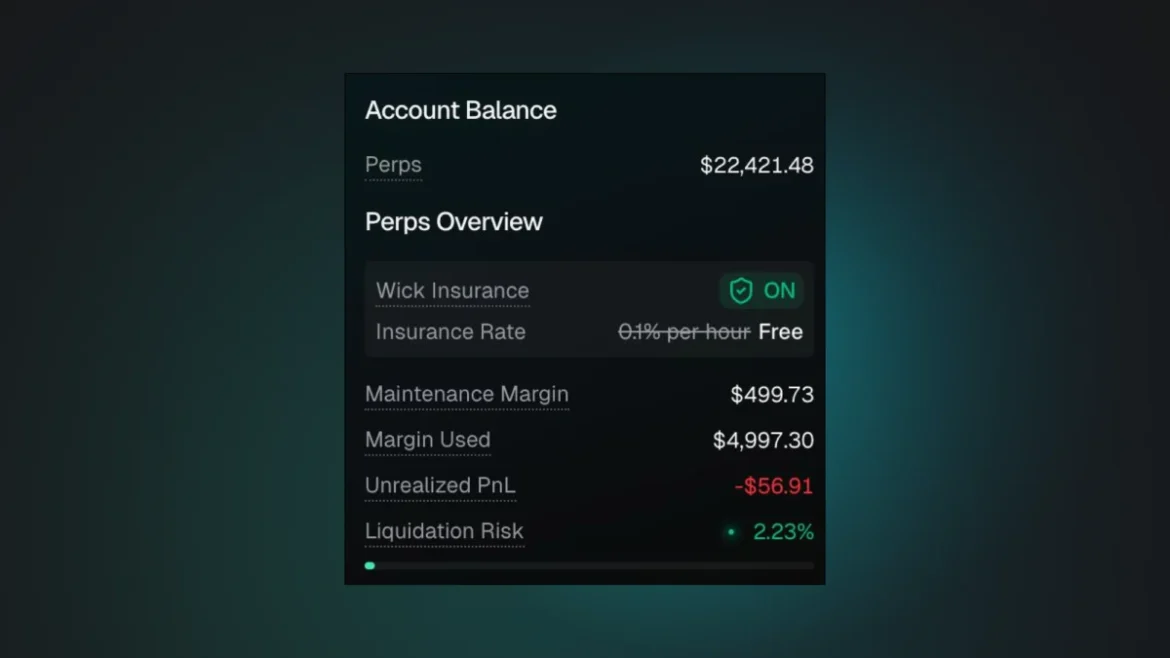
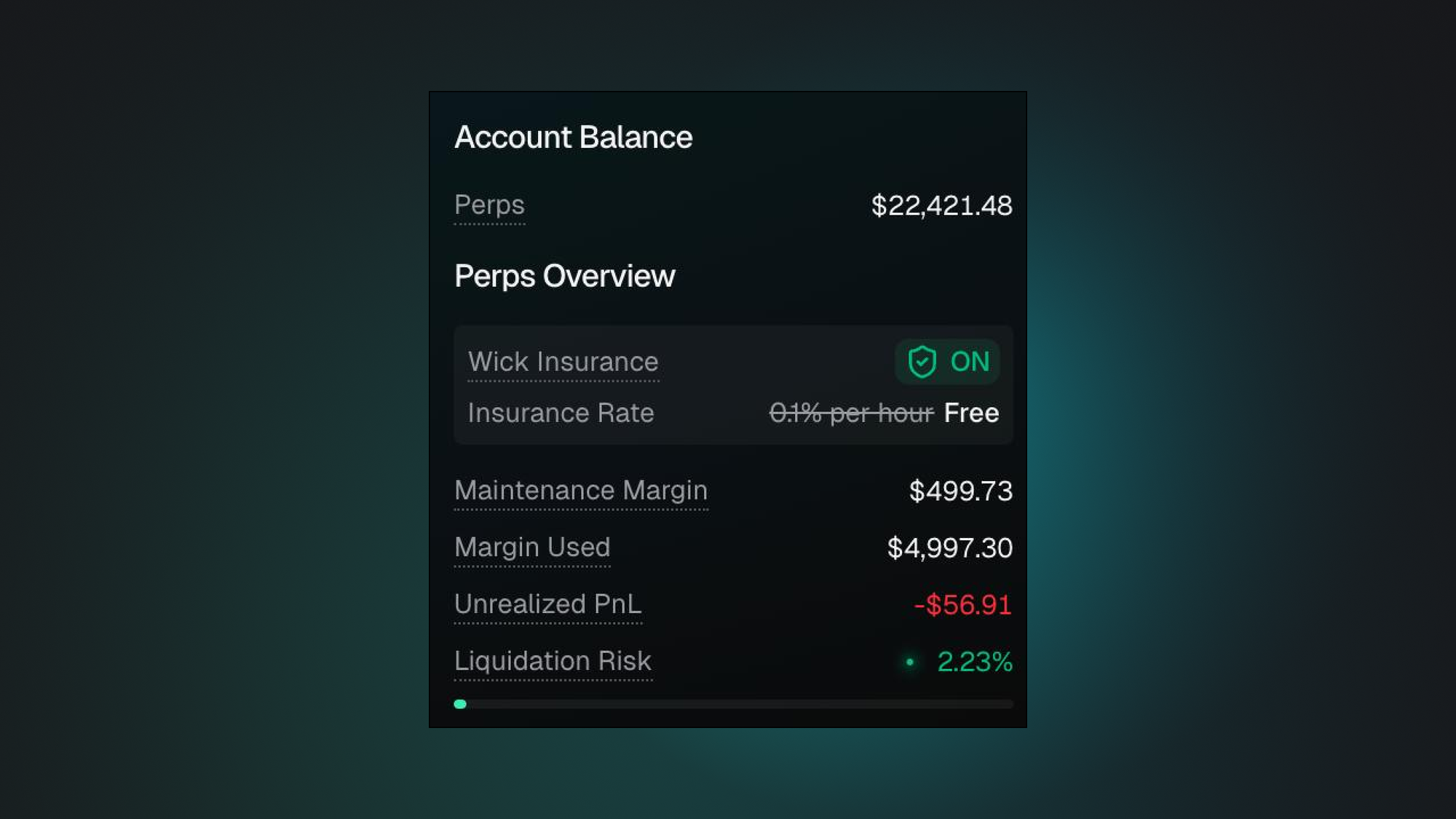
Synthetix’s Wick Insurance re-engineers this sequence. By opting into the feature, traders receive a predefined, configurable grace period during which instant liquidations are temporarily disabled. Instead of erasing the account the moment the liquidation threshold is crossed, the protocol pauses liquidations for a short window, effectively granting the market a brief period to substantiate whether the price movement represents a genuine structural shift or merely a momentary liquidity vacuum—a wick.

If market prices rebound and the account’s margin health returns to acceptable parameters within the allotted timeframe, the position is unfrozen, allowing the trader to continue managing the trade without interruption. Conversely, if the downward or upward price pressure proves sustained and the market trend is confirmed, standard liquidation procedures resume after a delay of only a few minutes.

Wick Insurance: Protect Your Trades From Scam Wicks

Market analysts point out that this mechanism bridges a critical gap in decentralized finance (DeFi) risk architecture. Rather than treating all margin breaches with uniform finality, Wick Insurance introduces contextual awareness into the liquidation engine, differentiating between systemic liquidations and fleeting execution anomalies.

Anatomy of a Flash Crash: The October 10 Market Stress Test

The necessity for such structural safeguards was underscored during one of the most violent single-day liquidation events in modern cryptocurrency history. On October 10, the broader digital asset ecosystem experienced a ferocious cascading sell-off that unfolded during the Asian trading session.

In a compressed span of less than 45 minutes, liquidity vanished from order books, triggering an aggressive chain reaction of automated liquidations across major perpetual swap platforms. Billions of dollars in leveraged long positions were systematically wiped out as asset prices plunged precipitously. Major large-cap and altcoin trading pairs suffered anomalous downward wicks that defied immediate macroeconomic justification, catching institutional and retail market participants alike off guard.

Despite the extreme severity of the intraday drawdown, the subsequent market behavior defied conventional bear market patterns. Within hours of the initial cascade, prices began a dramatic recovery. Bitcoin (BTC) mounted an aggressive rebound, clawing its way back above the $112,000 threshold by the conclusion of the trading day. Simultaneously, various altcoin assets registered sharp recoveries, bouncing between 10% and 33% from their respective session lows.

The rapid price action transformed what initially threatened to become a protracted, multi-week market bloodbath into a brief, albeit brutal, leverage shakeout. Nevertheless, the temporary nature of the price collapse provided no relief to thousands of traders whose positions had already been liquidated at the absolute lows due to the immediate execution protocols of traditional exchanges.

Had Wick Insurance been active during this session—specifically on high-volume pairs such as ETH-USDT—the outcome for a significant subset of market participants would have been markedly different. Analysts evaluating the event noted that October 10 did not signify a fundamental structural breakdown of the underlying bull market, but rather a classic liquidity-driven wick event. The incident highlighted the vulnerability of automated market makers and order-book perps to momentary liquidity deficits, emphasizing the practical utility of delay-based safety nets.

Operational Framework and Risk Management

Developing a safety net for hyper-leveraged derivative trading introduces significant counterparty and protocol-level risks that must be carefully managed. To ensure systemic stability, Synthetix has engineered Wick Insurance as an economically sound, mathematically backed product rather than an unsubsidized subsidy.

Wick Insurance: Protect Your Trades From Scam Wicks

The protection provided by the feature is priced dynamically through advanced risk-modeling algorithms. Similar to traditional insurance underwriting, the cost of securing a position against malicious wicks scales proportionally with the underlying asset’s volatility and the degree of leverage employed by the trader. Highly volatile altcoins and high-leverage configurations command higher insurance premiums, ensuring that the risk pool remains adequately capitalized.

To protect the broader protocol from insolvency or excessive tail risk, the system incorporates strict internal guardrails. These include hard caps on total insurable exposure, automated deleveraging backstops, and mandatory cooldown periods designed to prevent strategic gaming or abuse by sophisticated market participants.

Protocol developers have emphasized that Wick Insurance is currently deployed as an experimental feature, undergoing rigorous real-world stress testing during Season 2 of the platform’s ongoing trading competition. Consequently, widespread integration into the primary public mainnet release remains subject to the results of these iterative trials.

Industry Implications and the Future of Leveraged Trading

The introduction of Wick Insurance marks a notable evolution in the ongoing effort to mature cryptocurrency market infrastructure. For years, the psychological toll of being "right on direction, wrong on execution" has been an accepted hazard for derivatives traders. The phenomenon has generated widespread industry frustration, often summarized colloquially by traders lamenting that they were structurally correct yet eliminated by localized market manipulation or thin liquidity.

By addressing this pain point, protocols like Synthetix are attempting to align decentralized trading experiences with the sophisticated risk-mitigation tools long standard in traditional legacy financial markets, such as circuit breakers and dynamic margin buffers.

As decentralized perps platforms compete for market share against centralized giants, user-centric innovations that directly mitigate structural unfairness may play a decisive role in attracting institutional and high-net-worth retail volume. While the feature remains in its experimental stages, its reception among participants in the October 10 post-mortem analysis suggests a strong latent demand for risk management solutions tailored specifically to the unique volatility profiles of digital assets.

As Synthetix continues its development roadmap toward a full mainnet rollout, the performance and adoption of Wick Insurance will likely be closely monitored by developers, market makers, and traders alike. If successful, the mechanism could establish a new baseline standard for how perpetual exchanges handle liquidity anomalies, permanently altering the risk-reward calculus of crypto leverage trading.

September 16, 2026 0 comment
0 FacebookTwitterPinterestEmail
Crypto Trading & Analysis

Chainalysis Integrates Real-Time Compliance and Investigation Tools for Arc Blockchain to Secure Institutional Stablecoin Infrastructure

by Nana Muazin September 16, 2026
written by Nana Muazin

Blockchain intelligence firm Chainalysis has officially announced comprehensive compliance and investigative support for Arc, a high-performance, EVM-compatible Layer 1 blockchain engineered specifically for stablecoin-driven finance and natively integrated into Circle’s robust full-stack infrastructure. The strategic development brings enterprise-grade transaction monitoring, entity screening, and forensic tracking to a network designed to process thousands of transactions per second with sub-second settlement finality. By incorporating Arc into its flagship analytical suites—including Chainalysis KYT and Reactor—the company aims to provide financial institutions, fintech enterprises, and regulatory bodies with the visibility required to safely navigate the rapidly expanding ecosystem of programmable, fiat-pegged digital assets.

The integration arrives at a pivotal juncture for the digital asset industry, as decentralized finance (DeFi) networks increasingly transition from experimental applications to mission-critical financial rails. Arc distinguishes itself within the congested Layer 1 landscape by leveraging stablecoins—spearheaded by Circle’s USD Coin (USDC)—as its native gas token, fundamentally redefining how network fees are paid and how liquidity flows across decentralized architectures. Designed to achieve a throughput exceeding 3,000 transactions per second paired with sub-second finality, Arc addresses historical bottlenecks that have traditionally hindered blockchain adoption in high-frequency commercial environments.

Immediate Technical Integration and Automated Token Coverage

Under the terms of the new deployment, Chainalysis has established automated coverage protocols for all newly minted fungible and non-fungible tokens deployed on the Arc network that conform to industry-standard ERC-20 and ERC-721 protocols. Rather than relying on manual additions or delayed updates, the intelligence platform is engineered to ingest newly created assets automatically on a daily basis. This continuous ingestion model ensures that compliance officers and risk management teams experience zero latency when tracking newly launched financial instruments within the Arc environment.

The support spans the breadth of Chainalysis’s enterprise product ecosystem. Customers can now utilize Chainalysis KYT (Know Your Transaction) to execute real-time transaction monitoring augmented by actionable alerts and continuous risk assessment. Furthermore, the integration extends to the firm’s advanced entity screening solutions and its premier forensic investigation software, Reactor. Through Reactor, compliance professionals and law enforcement agencies can map complex fund flows, trace transactional pathways across the Arc network, visualize the velocity and destination of capital movements, and flag indicators of potentially illicit financial activity with unprecedented precision.

Background Context and the Rise of Purpose-Built Financial Blockchains

To understand the significance of the Chainalysis and Arc integration, it is necessary to examine the evolution of blockchain architecture over the past decade. Early distributed ledger networks, such as Bitcoin and Ethereum, were designed as generalized settlement layers intended to support a wide variety of decentralized use cases, ranging from smart contract execution to decentralized governance. While versatile, these general-purpose networks frequently suffer from scalability constraints, volatile native token gas pricing, and congestion during periods of peak market demand.

In response to these structural limitations, the blockchain engineering community initiated a shift toward application-specific and vertically integrated Layer 1 networks. Networks optimized for specific verticals—such as gaming, high-frequency trading, or enterprise supply chain management—began to emerge. Arc represents the maturation of this thesis, specifically tailored to the nuances of stablecoin finance. By removing the friction of acquiring a volatile native asset solely to pay for network transactions, Arc enables institutional users to interact with blockchain infrastructure using familiar, fiat-denominated units of account.

Circle’s deep involvement in the architecture of Arc underscores the convergence of traditional fintech and decentralized technology. As the issuer of USDC, one of the world’s leading dollar-backed stablecoins, Circle has consistently advocated for transparent, compliant, and interoperable digital asset rails. The integration of Arc directly into Circle’s broader technological stack creates a seamless environment where developers can deploy institutional-grade financial applications backed by robust regulatory compliance frameworks.

Chronology of Institutional Compliance in Digital Assets

The trajectory of blockchain intelligence has evolved in parallel with regulatory oversight and institutional participation. Tracing this timeline highlights the necessity of tools such as those provided by Chainalysis:

  • 2014–2016: The foundational era of blockchain analytics. Early firms emerge primarily to assist law enforcement agencies in tracking illicit Bitcoin transactions on darknet marketplaces.
  • 2017–2020: The institutional awakening and regulatory formalization. Financial regulators globally begin issuing guidance on virtual asset service providers (VASPs), prompting compliance software providers to develop real-time transaction monitoring tools like Chainalysis KYT.
  • 2021–2022: The multi-chain expansion. As decentralized finance (DeFi) and alternative Layer 1 networks proliferate, blockchain intelligence firms race to support non-EVM and cross-chain bridging architectures to prevent blind spots in compliance frameworks.
  • 2023–2024: The mainstreaming of stablecoins. Stablecoins solidify their utility as global cross-border settlement instruments, driving the development of specialized payment networks and demanding automated, high-throughput compliance monitoring.
  • 2025 and Beyond: The era of purpose-built financial infrastructure. Platforms like Arc emerge, natively integrating stablecoins for gas, which in turn requires advanced compliance frameworks capable of handling high-speed, automated asset creation and complex institutional fund flows.

Market Data and the Proliferation of Stablecoin Economics

Statistical indicators underscore why comprehensive monitoring tools are urgently required for networks like Arc. According to recent industry data, the total market capitalization of stablecoins has consistently hovered near historic highs, frequently surpassing $150 billion to $170 billion globally. Monthly on-chain settlement volume across major stablecoin rails regularly rivals or exceeds the daily transaction volumes of legacy payment giants like Visa and Mastercard, illustrating a profound structural migration toward tokenized fiat.

Furthermore, academic and financial research indicates that institutional adoption of blockchain technology hinges heavily on predictable fee structures and instantaneous settlement capabilities. Arc’s capacity to process upwards of 3,000 transactions per second with sub-second finality directly addresses the operational requirements of enterprise treasury management, cross-border business-to-business (B2B) payments, and automated programmatic settlement. However, this high velocity also presents unique challenges for compliance officers, who must process vast quantities of data without introducing operational friction. Automated solutions like the daily ingestion of ERC-20 and ERC-721 tokens on Arc are therefore vital to maintaining systemic integrity.

Industry Implications and Analytical Perspective

From a strategic standpoint, the integration of Chainalysis compliance tools into the Arc ecosystem signals a maturation of the stablecoin economy. Historically, compliance in the decentralized finance sector has often been viewed as a reactive measure—implemented after a protocol launches and vulnerabilities or illicit activities are identified. By baking advanced analytical support directly into a Layer 1 network designed around Circle’s infrastructure from its inception, stakeholders are signaling a proactive commitment to regulatory alignment.

Financial analysts note several key implications arising from this development:

  1. Lowered Barriers to Institutional Entry: Traditional financial institutions, including commercial banks and asset managers, are heavily constrained by regulatory mandates regarding anti-money laundering (AML) and know-your-customer (KYC) compliance. The presence of robust, automated monitoring via Chainalysis mitigates compliance risk, potentially accelerating institutional participation in Arc-based applications.
  2. Enhanced Forensic Capabilities for Law Enforcement: As digital finance scales, illicit actors frequently seek out high-throughput networks to obscure the origins of funds through rapid layering. The integration of Arc data into Chainalysis Reactor provides investigative agencies with the granular visibility required to trace illicit flows across complex, multi-token environments.
  3. Standardization of Compliance Infrastructure: The automated daily ingestion of new ERC-20 and ERC-721 tokens establishes a precedent for how Layer 1 networks must interact with compliance providers. Future blockchain designs will likely incorporate compliance-readiness as a foundational architectural requirement rather than an afterthought.

Ultimately, the collaboration between Chainalysis and the Arc network marks a significant milestone in the harmonization of high-speed blockchain engineering and regulatory compliance. As stablecoins continue to cement their role as the premier digital cash medium for the internet economy, the availability of transparent, real-time investigative and monitoring tools will remain an indispensable pillar of a secure and trusted financial future.

September 16, 2026 0 comment
0 FacebookTwitterPinterestEmail
Newer Posts
Older Posts

Recent Posts

  • Orderly Network Surpasses $100 Billion In Cumulative Trading Volume
  • Ethereum Network Upgrade Glamsterdam Prepares for Sepolia Activation to Advance Layer 1 Scalability
  • Lido DAO Executes Vote 206: A Deep Dive Into Ethereum Staking Infrastructure Maintenance And Operational Refinements
  • Synthetix Launches Native Multicollateral Margin on Ethereum Mainnet, Enabling Traders to Use Ether as Collateral Without Selling Their Holdings
  • Maxon Integrates Third-Party AI Chatbots Like ChatGPT and Claude into Cinema 4D via Model Context Protocol

Recent Comments

No comments to show.
  • Facebook
  • Twitter

@2021 - All Right Reserved. Designed and Developed by PenciDesign


Back To Top
Crypto Gohan
  • Home

We are using cookies to give you the best experience on our website.

You can find out more about which cookies we are using or switch them off in .

Crypto Gohan
Powered by  GDPR Cookie Compliance
Privacy Overview

This website uses cookies so that we can provide you with the best user experience possible. Cookie information is stored in your browser and performs functions such as recognising you when you return to our website and helping our team to understand which sections of the website you find most interesting and useful.

Strictly Necessary Cookies

Strictly Necessary Cookie should be enabled at all times so that we can save your preferences for cookie settings.