Perpetual futures trading in the cryptocurrency market has long been defined by extreme volatility, round-the-clock price discovery, and high leverage. For digital asset traders, being directionally correct on a market thesis is often insufficient to guarantee profitability. Across decentralized and centralized trading venues alike, market participants frequently encounter a uniquely punishing phenomenon: the "scam wick."
A sudden, malicious price spike, a localized flash crash on a thin order book, or an accidental fat-finger sell order on a low-liquidity trading pair can drive a derivative asset past a trader’s liquidation threshold in milliseconds. Seconds later, the market frequently reverses course, restoring equilibrium and proceeding in the trader’s originally anticipated direction. Yet, for the liquidated account, the recovery offers no solace; the position has already been zeroed out.
Industry veterans have long accepted this dynamic not as a failure of individual risk management, but as an inescapable structural hazard of hyper-leveraged, 24/7 digital asset markets. However, a new financial primitive introduced by decentralized liquidity protocol Synthetix aims to fundamentally alter this paradigm. Entitled Wick Insurance, the novel feature introduces a configurable grace period designed to shield leveraged traders from the market’s most volatile and short-lived anomalies.
Deconstructing the Mechanics of Wick Insurance
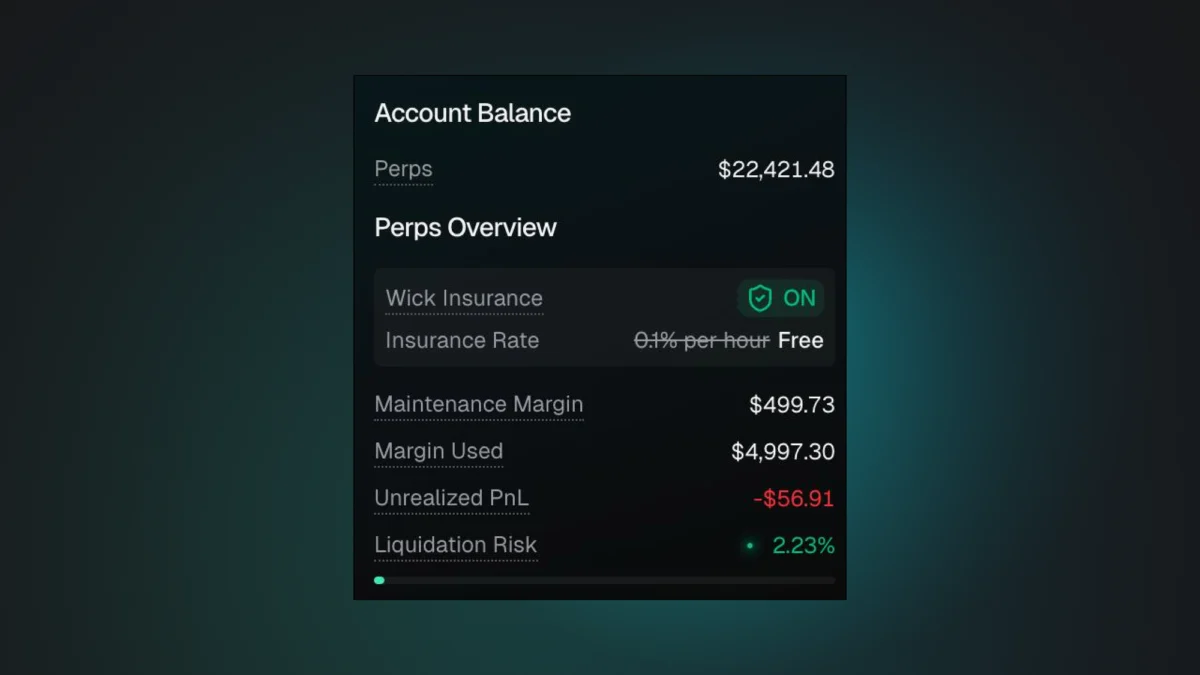
At its core, Wick Insurance functions as a localized circuit breaker tailored specifically to the structural mechanics of perpetual futures contracts. When extreme market volatility temporarily breaches a trader’s predetermined liquidation level, traditional protocols immediately execute a forced liquidation, crystallizing losses and seizing remaining margin.
Synthetix’s Wick Insurance re-engineers this sequence. By opting into the feature, traders receive a predefined, configurable grace period during which instant liquidations are temporarily disabled. Instead of erasing the account the moment the liquidation threshold is crossed, the protocol pauses liquidations for a short window, effectively granting the market a brief period to substantiate whether the price movement represents a genuine structural shift or merely a momentary liquidity vacuum—a wick.
If market prices rebound and the account’s margin health returns to acceptable parameters within the allotted timeframe, the position is unfrozen, allowing the trader to continue managing the trade without interruption. Conversely, if the downward or upward price pressure proves sustained and the market trend is confirmed, standard liquidation procedures resume after a delay of only a few minutes.
Market analysts point out that this mechanism bridges a critical gap in decentralized finance (DeFi) risk architecture. Rather than treating all margin breaches with uniform finality, Wick Insurance introduces contextual awareness into the liquidation engine, differentiating between systemic liquidations and fleeting execution anomalies.
Anatomy of a Flash Crash: The October 10 Market Stress Test
The necessity for such structural safeguards was underscored during one of the most violent single-day liquidation events in modern cryptocurrency history. On October 10, the broader digital asset ecosystem experienced a ferocious cascading sell-off that unfolded during the Asian trading session.
In a compressed span of less than 45 minutes, liquidity vanished from order books, triggering an aggressive chain reaction of automated liquidations across major perpetual swap platforms. Billions of dollars in leveraged long positions were systematically wiped out as asset prices plunged precipitously. Major large-cap and altcoin trading pairs suffered anomalous downward wicks that defied immediate macroeconomic justification, catching institutional and retail market participants alike off guard.
Despite the extreme severity of the intraday drawdown, the subsequent market behavior defied conventional bear market patterns. Within hours of the initial cascade, prices began a dramatic recovery. Bitcoin (BTC) mounted an aggressive rebound, clawing its way back above the $112,000 threshold by the conclusion of the trading day. Simultaneously, various altcoin assets registered sharp recoveries, bouncing between 10% and 33% from their respective session lows.
The rapid price action transformed what initially threatened to become a protracted, multi-week market bloodbath into a brief, albeit brutal, leverage shakeout. Nevertheless, the temporary nature of the price collapse provided no relief to thousands of traders whose positions had already been liquidated at the absolute lows due to the immediate execution protocols of traditional exchanges.
Had Wick Insurance been active during this session—specifically on high-volume pairs such as ETH-USDT—the outcome for a significant subset of market participants would have been markedly different. Analysts evaluating the event noted that October 10 did not signify a fundamental structural breakdown of the underlying bull market, but rather a classic liquidity-driven wick event. The incident highlighted the vulnerability of automated market makers and order-book perps to momentary liquidity deficits, emphasizing the practical utility of delay-based safety nets.
Operational Framework and Risk Management
Developing a safety net for hyper-leveraged derivative trading introduces significant counterparty and protocol-level risks that must be carefully managed. To ensure systemic stability, Synthetix has engineered Wick Insurance as an economically sound, mathematically backed product rather than an unsubsidized subsidy.
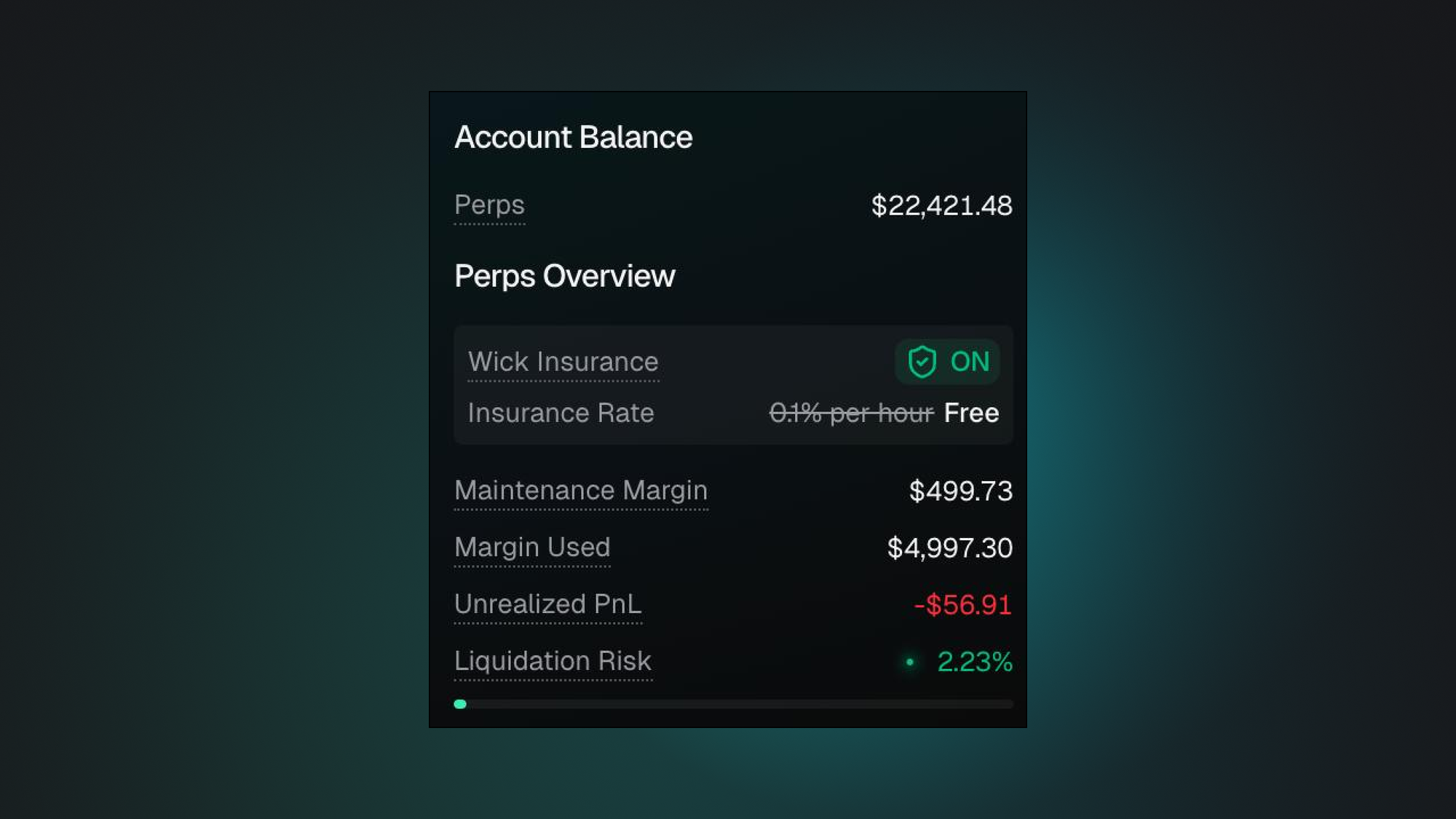
The protection provided by the feature is priced dynamically through advanced risk-modeling algorithms. Similar to traditional insurance underwriting, the cost of securing a position against malicious wicks scales proportionally with the underlying asset’s volatility and the degree of leverage employed by the trader. Highly volatile altcoins and high-leverage configurations command higher insurance premiums, ensuring that the risk pool remains adequately capitalized.
To protect the broader protocol from insolvency or excessive tail risk, the system incorporates strict internal guardrails. These include hard caps on total insurable exposure, automated deleveraging backstops, and mandatory cooldown periods designed to prevent strategic gaming or abuse by sophisticated market participants.
Protocol developers have emphasized that Wick Insurance is currently deployed as an experimental feature, undergoing rigorous real-world stress testing during Season 2 of the platform’s ongoing trading competition. Consequently, widespread integration into the primary public mainnet release remains subject to the results of these iterative trials.
Industry Implications and the Future of Leveraged Trading
The introduction of Wick Insurance marks a notable evolution in the ongoing effort to mature cryptocurrency market infrastructure. For years, the psychological toll of being "right on direction, wrong on execution" has been an accepted hazard for derivatives traders. The phenomenon has generated widespread industry frustration, often summarized colloquially by traders lamenting that they were structurally correct yet eliminated by localized market manipulation or thin liquidity.
By addressing this pain point, protocols like Synthetix are attempting to align decentralized trading experiences with the sophisticated risk-mitigation tools long standard in traditional legacy financial markets, such as circuit breakers and dynamic margin buffers.
As decentralized perps platforms compete for market share against centralized giants, user-centric innovations that directly mitigate structural unfairness may play a decisive role in attracting institutional and high-net-worth retail volume. While the feature remains in its experimental stages, its reception among participants in the October 10 post-mortem analysis suggests a strong latent demand for risk management solutions tailored specifically to the unique volatility profiles of digital assets.
As Synthetix continues its development roadmap toward a full mainnet rollout, the performance and adoption of Wick Insurance will likely be closely monitored by developers, market makers, and traders alike. If successful, the mechanism could establish a new baseline standard for how perpetual exchanges handle liquidity anomalies, permanently altering the risk-reward calculus of crypto leverage trading.