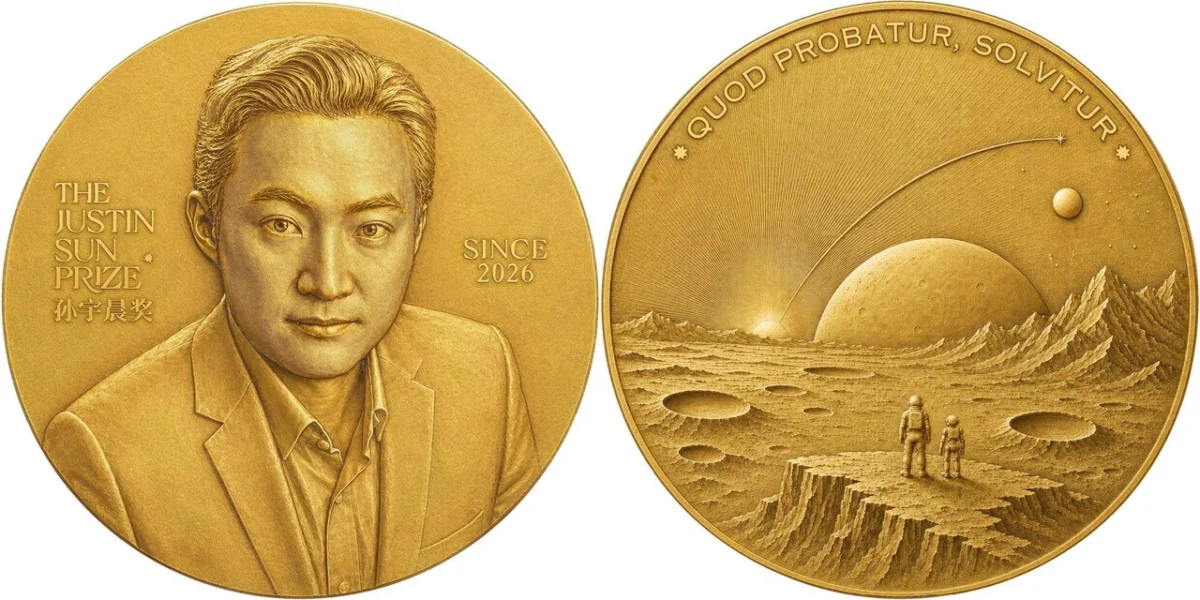
GENEVA, SWITZERLAND — In an ambitious move set to reshape how humanity incentivizes and rewards fundamental science, the Office of Justin Sun officially announced the establishment of the Justin Sun Prize on September 16, 2026. Designed as a zero-trust, decentralized academic bounty mechanism, the initiative pivots away from traditional credential-based honors, lifetime achievement awards, and bureaucratic nomination committees. Instead, it relies on a dynamic "problem list" where complex mathematical challenges and machine-verifiable formal proofs serve as the sole criteria for winning. Offering a top prize of up to $1 million for a single resolved problem, the initiative aims to catalyze human-AI collaboration and redefine scientific recognition for the artificial intelligence era.
The inauguration of the prize coincided with the announcement of its very first cohort of laureates. Recognizing solutions and formalized proofs across 66 distinct mathematical challenges, the inaugural awards committee handed its premier $1 million prize to the OpenAI research team. The award acknowledged the team’s groundbreaking solution and formalized proof regarding the Existence and Smoothness of the Three-Dimensional Navier–Stokes Equations. According to public technical disclosures released by OpenAI, the core mathematical proof was generated by an internal foundational model, while the subsequent Lean formalization and rigorous machine verification were successfully executed by GPT-6 Astra.
Historical Context and the Weight of the Millennium Problems
The Navier–Stokes equations—commonly abbreviated as the N–S equations—represent a cornerstone of classical physics, describing the motion of viscous fluid substances. Developed during the 19th century by French physicist Claude-Louis Navier and Irish-born British mathematician George Gabriel Stokes, these equations have puzzled mathematicians for approximately two centuries. Despite their ubiquity in modeling weather, ocean currents, and aerodynamic flow, a complete mathematical proof demonstrating that smooth, physically reasonable solutions always exist in three dimensions has remained elusive.
Recognizing the monumental difficulty of this challenge, the Clay Mathematics Institute designated the Navier–Stokes Existence and Smoothness problem as one of its seven Millennium Prize Problems in May 2000, attaching a $1.4 million bounty to its resolution. By leveraging machine-verifiable formal proofs, the Justin Sun Prize has now successfully incentivized a breakthrough on one of mathematics’ most notorious mountains, bridging the gap between historical theoretical physics and modern automated machine verification.
A Radical Paradigm Shift in Scientific Incentives
Unlike legacy academic awards that operate on rigid four-year cycles, require institutional nominations, or prioritize senior researchers near the ends of their careers, the Justin Sun Prize introduces an open-access, continuous-delivery model. There are no barriers to entry based on nationality, institutional affiliation, or human versus machine status. Any individual, collaborative group, or artificial intelligence system can claim a bounty as long as they are the first to publish a valid, machine-verified proof for any problem featured on the official registry.
The architecture of the prize registry is designed for permanent immutability and transparency. Problems can be added to the list over time, but once listed, they are permanently locked and cannot be removed. Furthermore, awarded prize funds are non-returnable under any circumstances, guaranteeing financial security for successful contributors.
The current problem list already features some of the most formidable unsolved riddles in mathematical history. These include formal verification pursuits for the Poincaré Conjecture, the Riemann Hypothesis, Goldbach’s Conjecture, and an extensive catalog of unsolved problems proposed throughout the lifetime of the late mathematician and Wolf Prize laureate Paul Erdős.
Ceremonial Honors and Core Operating Principles
Winners of the Justin Sun Prize receive more than just digital asset payouts; they are honored with a physical certificate and a custom-minted medal. Etched along the edge of each medal is the Latin phrase "Quod probatur, solvitur"—translating directly to "Proved, then paid." This motto encapsulates the philosophy of the initiative, emphasizing absolute empirical and logical certainty over subjective peer review or academic politics.
Operating under three foundational pillars—openness, public benefit, and open-source accessibility—the initiative maintains strict operational transparency. The problem lists, confirmation standards, complex proofs, and automated verification materials are publicly hosted on GitHub for global peer scrutiny. Meanwhile, all financial disbursements are recorded transparently on-chain, ensuring permanent traceability and immutability.
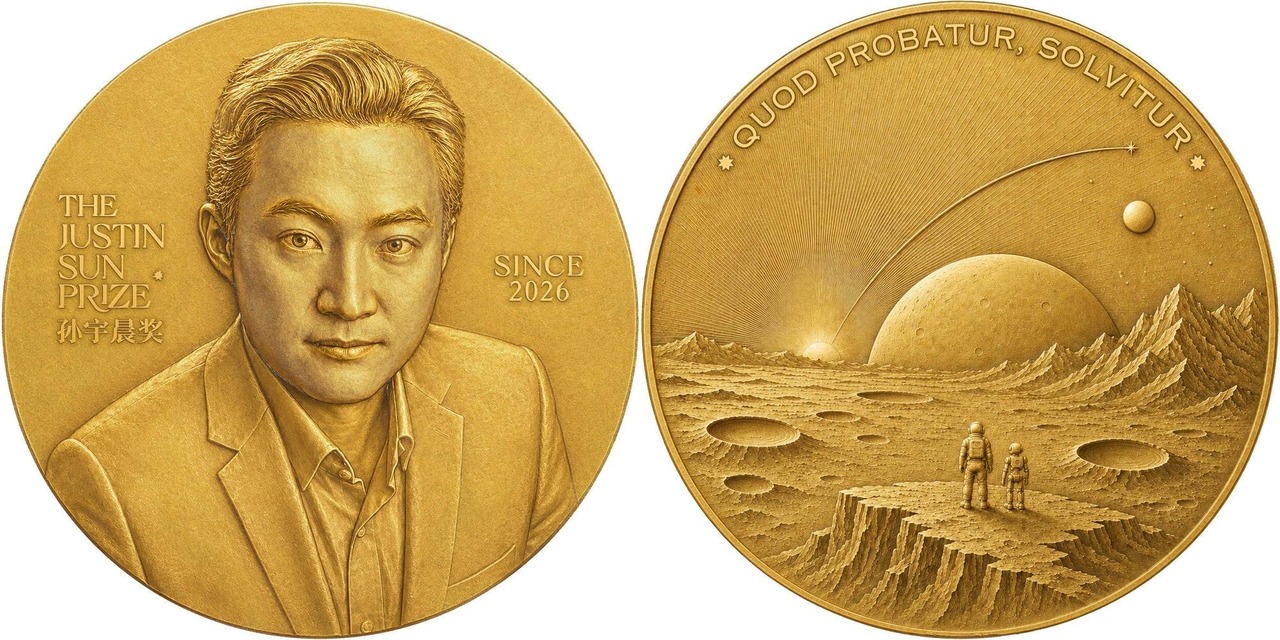
"An award named after a person is the least political thing in the world," remarked Justin Sun during the announcement. "More importantly, it gives me an answer to myself—my wealth is rooted in mathematics. It came from mathematics, and it will return to mathematics."
Public financial disclosures indicate that Sun has historically directed more than $45 million toward global philanthropic causes spanning advanced technology, environmental preservation, and disaster relief. The Justin Sun Prize is slated to become the central cornerstone of his ongoing philanthropic endeavors, providing a sustained mechanism to support foundational scientific breakthroughs through decentralized, verifiable frameworks.
Financial Mechanics and Global Accessibility
To ensure frictionless global distribution, prize payouts are executed digitally. Laureates can elect to receive their funds either as USDT natively issued on the TRON network (TRC-20) or as USDC operating on the Ethereum blockchain (ERC-20).
The launch of the prize has sparked considerable discussion among economists, computer scientists, and academic institutions regarding the future role of artificial intelligence in theoretical research. By demonstrating that advanced AI models—such as GPT-6 Astra—can successfully navigate and formally verify solutions to centuries-old mathematical dilemmas, the initiative signals a permanent shift in how scientific discoveries will be validated in the coming decades.
Broader Implications for AI-Driven Science
Industry analysts note that traditional academic publishing often suffers from prolonged peer-review bottlenecks, replication crises, and institutional gatekeeping. By decentralizing the verification process through machine-checked proof assistants like Lean, the Justin Sun Prize bypasses traditional systemic delays.
If successful, this model could inspire other philanthropic organizations and tech conglomerates to establish similar cryptographic, machine-verifiable bounty systems for other critical domains, such as materials science, quantum computing algorithms, and renewable energy physics. The immediate integration of blockchain-based accounting with automated formal logic sets a new operational standard for global scientific philanthropy.
About the Office of Justin Sun and the Founder
The Office of Justin Sun directs the global business ventures, technological investments, art acquisitions, space exploration initiatives, and philanthropic programs associated with its founder. Justin Sun is widely recognized as a prominent figure in the digital asset and blockchain sectors. Having previously served as the Ambassador and Permanent Representative of Grenada to the World Trade Organization, Sun is also the founder of TRON, a leading decentralized blockchain protocol that has processed over $13 trillion in transaction volume, heavily relied upon across emerging markets for stablecoin settlements.
A protégé of Alibaba Group founder Jack Ma, Sun’s career has garnered international media attention, including a cover profile in Forbes in April 2025 and multiple inclusions on the Forbes 30 Under 30 list. Expanding his reach beyond terrestrial technology, Sun participated in August 2025 as a crew member aboard Blue Origin’s NS-34 mission, making history as the 712th human to travel to space.
Through the Justin Sun Prize, Sun seeks to cement a lasting legacy that transforms mathematical inquiry, utilizing the wealth generated by digital technology to accelerate humanity’s deepest theoretical explorations.
For further details regarding the active problem registry, submission guidelines, and verification documentation, interested researchers and technologists can visit the official portal at www.hejustinsun.com/prize. Official inquiries can be directed to the prize administration via email at [email protected], or through the Office of Justin Sun at [email protected].