
Foundry, globally recognized as the operator of the largest Bitcoin mining pool by total computational power, has officially announced its strategic expansion into the privacy-centric cryptocurrency sector. The company plans to launch a dedicated, institutional-grade Zcash (ZEC) mining pool in April 2026. This development marks a significant milestone for the Zcash ecosystem, as it introduces enterprise-level infrastructure tailored specifically to institutional entities, publicly traded corporations, and large-scale digital asset miners.
The initiative aims to address a long-standing structural deficiency within the Zcash network: the lack of robust, compliant, and institutional-ready mining pools. By leveraging its extensive experience managing Foundry USA—the dominant player in the Bitcoin hashing ecosystem—Foundry intends to bring enterprise standards of reliability, transparency, and security to the Zcash mining landscape.
Background and Context of the Expansion
The decision by Foundry to branch out into Zcash mining comes at a transformative time for both the company and the broader digital asset industry. Foundry, a subsidiary of Digital Currency Group (DCG), has built its reputation on providing robust infrastructure for proof-of-work (PoW) networks. However, until now, its primary operational focus has remained tightly anchored to Bitcoin.
Zcash, launched in October 2016, occupies a unique niche in the cryptocurrency landscape. Operating as a decentralized, open-source blockchain, it utilizes advanced zero-knowledge cryptography—specifically zk-SNARKs—to offer optional transaction privacy. While foundational cryptocurrencies like Bitcoin and Ethereum maintain transparent public ledgers where transaction amounts and wallet addresses are openly visible, Zcash allows users to shield their transaction data while still maintaining network consensus.
Over the years, Zcash has grappled with a tension between its privacy-focused design and the demands of regulatory compliance. Proponents argue that the integration of selective disclosure mechanisms enables Zcash to bridge the gap between financial privacy and regulatory standards. However, the lack of institutional-grade infrastructure has historically deterred large, publicly traded corporations and regulated financial institutions from actively participating in Zcash network consensus through mining.

By introducing a US-based, highly compliant mining pool, Foundry aims to mitigate these concerns, offering institutional miners a secure and legally sound environment to contribute computing power to the Zcash network.
The Mechanics of Mining Pools and Zcash Tokenomics
To understand the significance of Foundry’s upcoming launch, it is necessary to examine the mechanics of mining pools and how Zcash operates under its proof-of-work consensus model.
A mining pool is a collaborative cooperative where individual miners from around the world pool their computational power—known as hashrate—over a decentralized network. Because the difficulty of solving cryptographic puzzles to mine a new block is exceptionally high, individual miners with modest equipment have a very low statistical probability of successfully earning block rewards independently. By combining hashrate, pool participants stabilize their earnings, receiving payouts proportional to the computational share they contribute toward solving blocks.
Zcash shares deep historical roots with Bitcoin. The protocol was originally launched using a modified version of Bitcoin’s codebase. Consequently, its core tokenomics closely mirror those of the world’s largest cryptocurrency:
- Maximum Supply Cap: Zcash has a hard-coded supply limit of 21 million ZEC tokens, protecting against inflationary devaluation.
- Block Rewards: New tokens are minted and distributed to miners as a reward for adding verified blocks to the blockchain.
- Halving Schedule: To control inflation, the Zcash block reward is cut in half approximately every four years through programmed halving events, mirroring Bitcoin’s monetary policy.
Despite these similarities, Zcash utilizes the Equihash proof-of-work algorithm rather than Bitcoin’s SHA-256, requiring specialized ASIC (Application-Specific Integrated Circuit) hardware designed specifically for memory-hard cryptographic computations.
Network Growth and Hashrate Boom
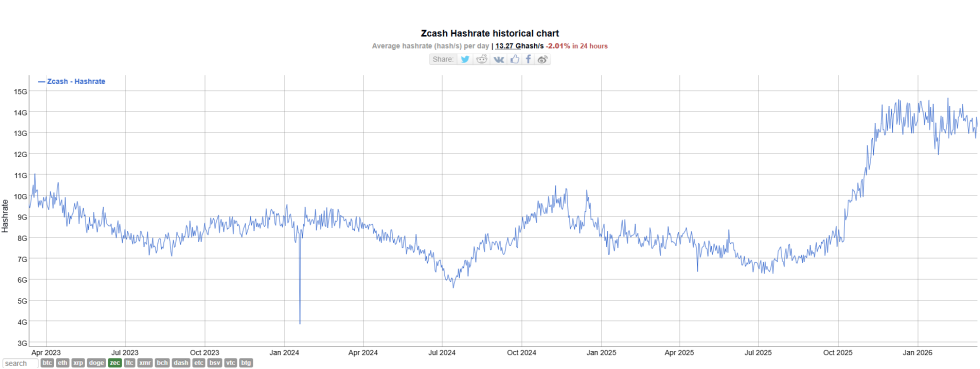
Foundry’s strategic entry into the Zcash ecosystem does not happen in a vacuum; it follows a profound technical resurgence within the Zcash network itself. Over the preceding months, the Zcash blockchain has experienced a substantial expansion in total network hashrate, reflecting renewed interest from industrial-scale miners.

Data compiled by analytics platform BitInfoCharts highlights this dramatic upward trajectory. In October of the previous year, the total computing power securing the Zcash blockchain languished below 8 gigahashes per second (Ghash/s). However, market conditions, hardware efficiencies, and shifting miner economics catalyzed a sharp reversal. By early 2026, the network hashrate climbed steadily, stabilizing at over 13 Ghash/s.
This surge in computational power indicates that industrial miners are increasingly allocating hardware resources to the Zcash network. Yet, this influx of enterprise-level hardware has outpaced the existing mining pool infrastructure, creating a market vacuum that Foundry’s new institutional-grade pool is explicitly designed to fill.
Official Responses and Industry Reactions
The announcement has garnered widespread support from key stakeholders across the cryptocurrency industry, particularly from organizations dedicated to the development and promotion of Zcash.
Zooko Wilcox, founder of Zcash and chief product officer at Shielded Labs—an independent Swiss-based support and development organization for the ZEC ecosystem—welcomed the news with great enthusiasm.
"We at Shielded Labs are delighted that Foundry—the largest Bitcoin mining pool, and one based in North America—is launching an enterprise-grade Zcash mining pool," Wilcox stated in the official press release. His remarks underscore the importance of securing backing from premier North American crypto infrastructure operators to bolster global confidence in the privacy coin.
Mike Colyer, Chief Executive Officer of Foundry, emphasized that the decision was driven by market maturation. "Zcash has matured into an institutional-grade asset, but the mining infrastructure supporting it hasn’t kept pace," Colyer noted, positioning Foundry’s upcoming pool as the natural bridge required to reconcile this discrepancy.
Market Context and Price Performance of ZEC
While network fundamentals and infrastructure developments point toward long-term network strengthening, the immediate market pricing of Zcash reflects the inherent volatility of the broader digital asset market.
At the time of writing, Zcash (ZEC) is changing hands at approximately $209 per token. The asset has experienced a downward correction of over 11% across the trailing seven-day period, retracing a portion of its earlier multi-month recovery rally. Technical analysts note that while macro price action remains subject to broader market liquidity cycles and regulatory headlines regarding privacy coins, foundational network improvements—such as the integration of institutional mining operators—frequently serve as structural tailwinds for long-term valuation.
Broader Impact and Industry Implications
The introduction of an institutional-grade Zcash mining pool by Foundry carries several broad implications for the cryptocurrency mining and privacy coin sectors:
- Legitimization of Privacy Assets: By extending its operational footprint to a prominent privacy-focused token, Foundry—a heavily regulated entity operating within North America—signals to the broader financial market that privacy technology can coexist within compliant corporate frameworks.
- Geographic and Corporate Distribution of Hashrate: As regulatory scrutiny surrounding cryptocurrency mining intensifies globally, the addition of a major US-based pool ensures that North American miners have access to localized, enterprise-grade infrastructure without needing to rely on overseas alternatives.
- Template for Future Multi-Asset Expansion: Foundry’s successful transition from a Bitcoin-exclusive operator to a multi-asset infrastructure provider may establish a blueprint for other dominant mining pools to diversify their operations across alternative proof-of-work networks.
As the April 2026 launch date approaches, market participants will closely monitor how institutional miners respond to the new offering and whether the enhanced infrastructure catalyzes further growth in the Zcash network’s computing power and asset liquidity.