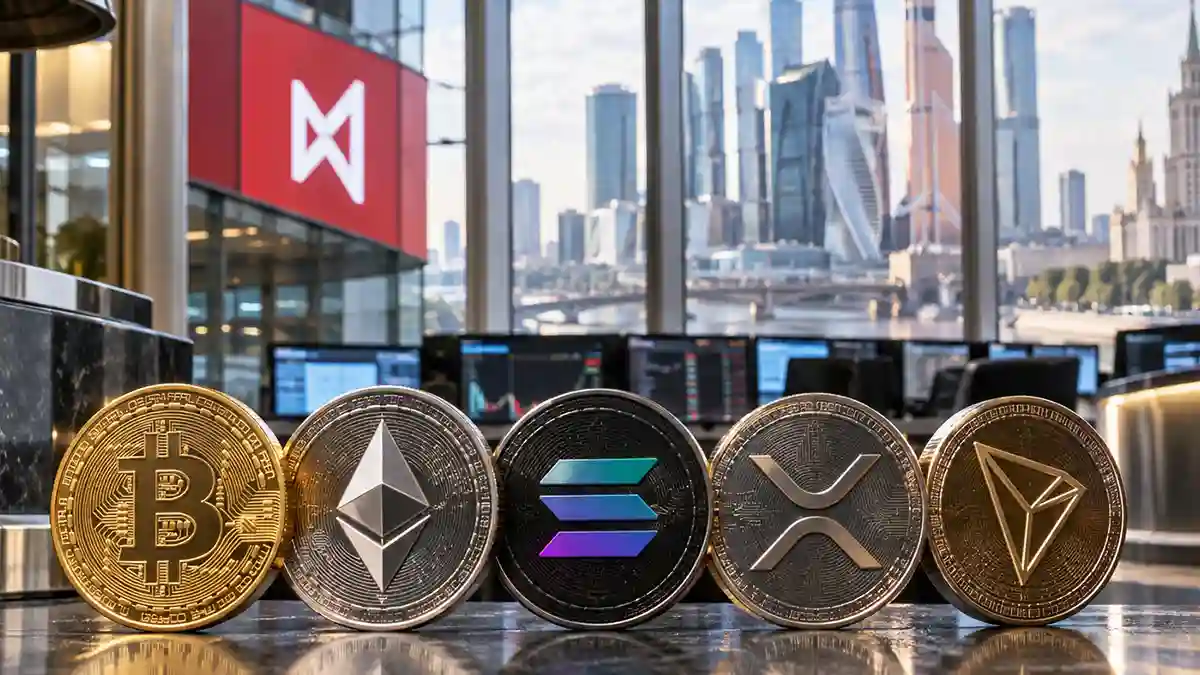
The Moscow Exchange (MOEX), Russia’s largest exchange group, has officially inaugurated a new segment dedicated to the trading of crypto derivatives, marking a significant milestone in the integration of digital assets into the nation’s traditional financial infrastructure. As of September 2026, the exchange has introduced derivative contracts linked to five prominent cryptocurrencies: Bitcoin (BTC), Ethereum (ETH), Solana (SOL), Ripple (XRP), and Tron (TRX). This development represents a calculated effort by the exchange to bridge the gap between institutional finance and the burgeoning digital asset economy, providing market participants with regulated, transparent, and secure instruments for exposure to cryptocurrency price movements.
Strategic Expansion into Digital Assets
The introduction of these derivatives follows months of rigorous internal testing and regulatory scrutiny. MOEX, which has long been the cornerstone of Russian equity and currency trading, is now positioning itself as a central hub for regulated crypto exposure. By offering derivative products, the exchange allows traders to speculate on price changes or hedge existing positions without the technical complexities associated with direct custody of digital tokens.
This move is particularly significant given the global trend of financial institutions seeking to bring digital assets into established regulatory frameworks. For the Moscow Exchange, the focus is on maintaining high standards of market integrity. The new instruments are designed to provide institutional and retail investors with a familiar trading environment, utilizing the same settlement mechanisms and clearing infrastructure that have supported the exchange’s stock and bond markets for years.
Chronology and Implementation Timeline
The rollout of these instruments occurred in phases throughout the third quarter of 2026. The initial announcement was made in mid-September, with the platform becoming fully operational for the public by September 22, 2026. This transition was preceded by a series of pilot programs involving select financial institutions, which tested the liquidity and stability of the clearinghouse systems.
The timeline for the project began in earnest in late 2025, when the exchange management signaled its intention to explore digital asset-linked products. Following the necessary technical infrastructure upgrades, the exchange began a series of soft launches in early 2026, initially focusing on smaller subsets of assets before expanding to the current list of five major cryptocurrencies. The systematic approach ensured that the clearinghouse, which manages the risk and settlement of these derivatives, could handle the volatility inherent in crypto markets without compromising the broader financial system.
Market Data and Instrument Specifications
The crypto derivatives offered by MOEX are structured as cash-settled contracts, meaning that upon the expiration of the contract, the difference between the contract price and the underlying asset’s market value is settled in fiat currency. This eliminates the need for the physical delivery of digital assets, simplifying the process for traditional investors.
Current market data indicates that the exchange has implemented tiered margin requirements, categorized as K1 and K2 levels, to manage systemic risk. For instance, initial margin requirements are adjusted based on the volatility of the underlying asset, with K1 set at 0% and K2 set at approximately 0.35% for certain contracts. These figures are subject to change based on market conditions, and the exchange utilizes real-time monitoring to adjust collateral requirements as needed.
Trading volume has shown a steady upward trajectory since the official launch. Early reports suggest a daily trading volume exceeding 7.2 billion rubles, with contract open interest surpassing 6,000 units (approximately 1.2 billion in underlying value). These figures demonstrate a strong initial appetite among market participants for regulated access to high-volatility assets.
Institutional Integration and Risk Management
A primary concern for the Moscow Exchange throughout this process has been the assurance of transparency and investor protection. To this end, the exchange has integrated these derivatives into its existing risk management framework. Every transaction is cleared through the MOEX clearinghouse, which provides a guarantee of settlement. This is a crucial distinction between the exchange-traded products and the unregulated, decentralized exchanges (DEXs) often found in the crypto space.
The exchange has also implemented stringent know-your-customer (KYC) and anti-money laundering (AML) protocols, ensuring that all participants are properly vetted. By requiring institutional-grade compliance, the exchange aims to attract larger financial players who were previously sidelined by the risks associated with less regulated offshore crypto platforms.
Industry Context and Competitive Landscape
The decision by MOEX to enter the crypto space arrives as other international financial hubs are similarly adjusting their offerings. For example, the Singapore Exchange (SGX) and several other major global entities have also moved toward providing crypto-linked derivatives to meet growing demand. However, MOEX’s approach is distinct in its focus on the specific liquidity needs of the Russian market and its efforts to integrate these assets directly into a national exchange ecosystem.
Industry analysts observe that this move is part of a broader shift in how central exchanges view digital assets. Rather than viewing them as a threat to traditional markets, exchanges like MOEX are treating them as a new asset class that requires formalization. By providing a platform for derivatives, the exchange is effectively commoditizing the underlying assets, making them as accessible as traditional equities.
Implications for Future Market Development
The long-term implications of this move are significant. By offering derivatives on BTC, ETH, SOL, XRP, and TRX, the Moscow Exchange is establishing a pricing benchmark for these assets within the domestic economy. This could lead to further innovations, such as the development of crypto-linked ETFs, mutual funds, or structured products that could be offered to retail investors through traditional banking channels.
Furthermore, the integration of these assets provides a hedge for companies that might be looking to diversify their treasury holdings or manage their exposure to the digital economy. While the current focus remains on derivative contracts, there is speculation that the exchange may eventually move toward providing spot market access or custody services, provided that the regulatory environment continues to favor such integration.
Official Responses and Outlook
Management at the Moscow Exchange has emphasized that the launch of these products is a measured step. They have maintained that the exchange will continue to evaluate the performance of these five assets and may expand the offering to include additional cryptocurrencies if demand persists and market conditions remain stable.
The sentiment among market observers is largely one of cautious optimism. While the volatility of the crypto market remains a challenge, the robust clearing infrastructure provided by MOEX offers a layer of security that is currently absent in many other crypto-trading venues. As the market matures, the role of established financial institutions in managing digital asset exposure is expected to grow, potentially setting a standard for how other jurisdictions approach the regulation and trading of cryptocurrencies.
In summary, the launch of crypto derivatives on the Moscow Exchange represents a maturation of the local financial market. By combining the security of a regulated clearinghouse with the growth potential of digital assets, MOEX is creating a bridge that will likely influence the financial strategies of both institutional and individual investors in the region for years to come. The coming months will be critical in determining whether these initial volume levels can be sustained and whether the exchange will successfully integrate additional digital assets into its portfolio of offerings.