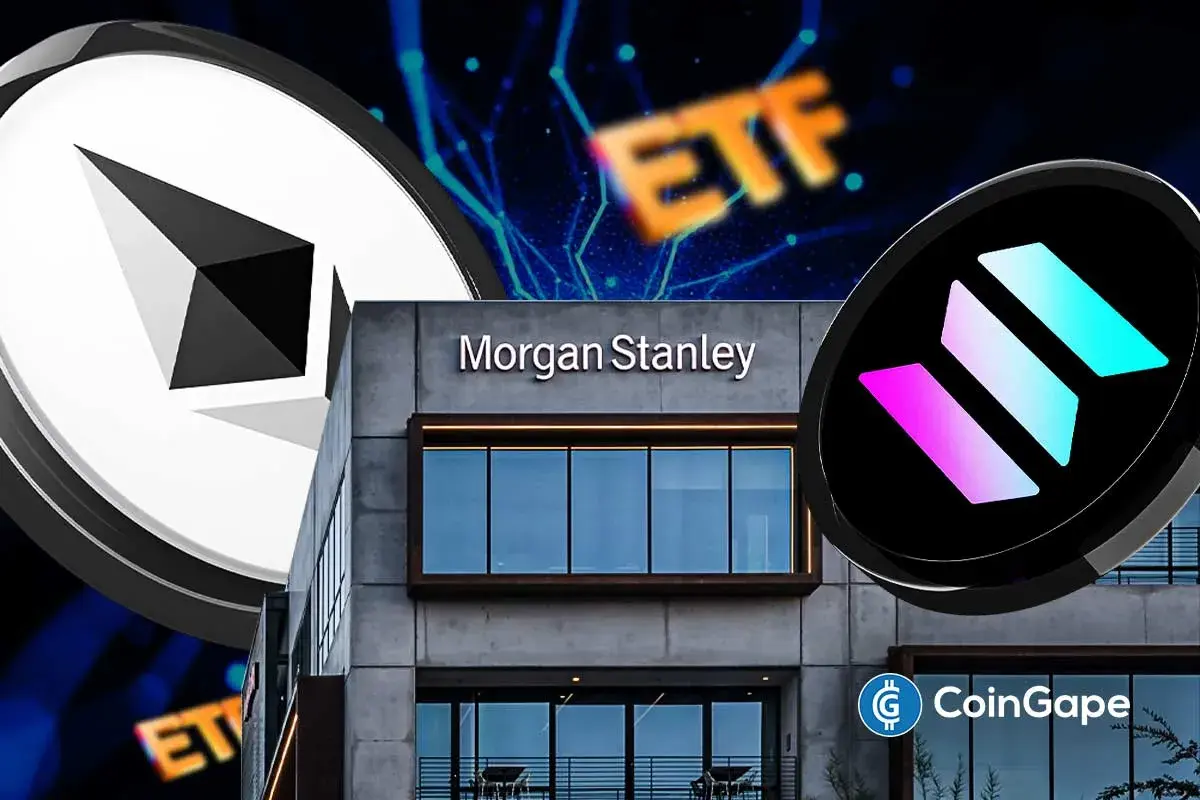
The global financial landscape is witnessing a pivotal transformation as Morgan Stanley, a titan of Wall Street with over $10 trillion in assets under management, moves to solidify its position in the digital asset sector. In a series of strategic regulatory maneuvers, the firm has secured approval to list and trade its spot Ethereum and Solana exchange-traded funds (ETFs) on NYSE Arca. This development follows the submission of Form 8-A and other critical filings with the United States Securities and Exchange Commission (SEC), signaling an imminent launch for these investment vehicles. Under the ticker symbols MSSE for Ethereum and MSOL for Solana, these ETFs represent a significant expansion of Morgan Stanley’s crypto-related offerings, potentially reshaping how institutional and retail investors access the two largest smart-contract platforms in the blockchain ecosystem.
The Regulatory Path: Form 8-A and 424B3 Filings
The transition from a theoretical financial product to a tradable security on a major exchange involves a complex web of regulatory hurdles. Morgan Stanley recently cleared a primary obstacle by filing Form 8-A with the SEC for both its Ethereum and Solana products. In the context of the U.S. securities market, Form 8-A is a registration statement used to register a class of securities for trading on a national exchange. This filing, combined with the 424B3 prospectus supplement, indicates that the products are moving toward the final stages of the "auto-effective" process under Section 12(b) of the Exchange Act.
While the filings have become effective, the specific trading dates remain contingent upon the final CERT filing, which provides the exchange’s certification to the SEC. This procedural step is often the final precursor to the "opening bell" for new ETFs. The speed at which these filings have progressed suggests a high level of coordination between Morgan Stanley, NYSE Arca, and the regulatory body, reflecting a maturing environment for digital asset regulation in the United States.
A New Benchmark for Fees and Staking Integration
One of the most striking aspects of Morgan Stanley’s foray into altcoin ETFs is the competitive fee structure and the innovative approach to staking. Both the Morgan Stanley Ethereum ETF (MSSE) and the Morgan Stanley Solana ETF (MSOL) will levy a sponsor fee of 0.14%. This aggressive pricing strategy positions Morgan Stanley at the lower end of the fee spectrum compared to existing crypto ETFs, many of which charge between 0.15% and 0.25%. By undercutting the competition, Morgan Stanley aims to attract large-scale capital that is particularly sensitive to management costs over long-term holding periods.
Furthermore, Morgan Stanley is breaking new ground by integrating staking mechanisms directly into the ETF structure—a move that has been a point of contention and debate within the SEC. According to the filings, the Ethereum ETF plans to stake between 50% and 80% of its ETH holdings. The Solana ETF takes this a step further, with plans to stake up to 100% of its SOL holdings. Staking is the process by which token holders participate in the validation of transactions on a proof-of-stake (PoS) blockchain, earning rewards in exchange for securing the network.
The distribution of these rewards is designed to favor the investor. Morgan Stanley Investment Management, acting as the delegated sponsor, has stated that it will not retain any portion of the staking rewards. Instead, 95% of the rewards will flow back to the investors, resulting in a "passive yield" that could significantly enhance the total return of the ETF relative to the spot price of the underlying asset. The remaining 5% will be allocated to staking service providers and custodians, including Figment, Galaxy Blockchain, and Coinbase Canada.
Institutional Infrastructure and Custodial Security
The success of a spot crypto ETF relies heavily on the robustness of its custodial and administrative framework. Morgan Stanley has assembled a "who’s who" of the financial and crypto-infrastructure worlds to manage these products. The Bank of New York Mellon (BNY Mellon), the world’s largest custody bank, will serve as the cash custodian, providing a bridge between traditional fiat systems and the digital realm.
On the digital side, Coinbase Custody and Coinbase Prime will handle the storage and execution of the underlying Ethereum and Solana tokens. The choice of Coinbase as a primary partner is significant, as the firm already serves as the custodian for the majority of the spot Bitcoin ETFs launched earlier this year. By leveraging BNY Mellon’s centuries of experience in asset servicing alongside Coinbase’s specialized crypto security, Morgan Stanley provides a dual-layer of protection that is essential for institutional risk management.
The Solana Frontier: Why MSOL Matters
While Ethereum ETFs have already seen a wave of approvals and launches from firms like BlackRock and Fidelity, the Solana ETF remains a relatively new frontier. Solana has emerged as a high-performance competitor to Ethereum, known for its rapid transaction speeds and lower costs. By filing for MSOL, Morgan Stanley is acknowledging Solana’s status as a top-tier institutional asset.
The inclusion of a 100% staking strategy for the Solana ETF is particularly noteworthy. Because Solana’s inflation and reward schedule are different from Ethereum’s, the ability to capture staking yields is a critical component of the asset’s value proposition. For many institutional investors, the technical complexity of managing a Solana validator or handling private keys is a barrier to entry. MSOL solves this by providing a regulated, liquid, and yield-bearing instrument that fits into a standard brokerage account.
Contextual Timeline: Morgan Stanley’s Crypto Evolution
The path to the MSSE and MSOL filings is part of a broader, multi-year strategy by Morgan Stanley to integrate digital assets into its wealth management and investment ecosystem.
- August 2024: Morgan Stanley authorized its fleet of 15,000 financial advisors to begin proactively offering spot Bitcoin ETFs (specifically BlackRock’s IBIT and Fidelity’s FBTC) to eligible clients.
- Late 2024: The firm’s own Bitcoin ETF, the Morgan Stanley Bitcoin ETF (MSBT), began gaining traction. Recent data shows MSBT holds over $391 million in total assets, maintaining steady inflows even during periods of broader market volatility.
- *ETRADE Integration:* Morgan Stanley’s retail brokerage arm, ETRADE, completed a full rollout of spot Bitcoin, Ethereum, and Solana trading. This allowed retail clients to hold crypto in accounts linked via Zerohash, creating a seamless user experience between traditional stocks and digital assets.
- Current Phase: The filing of 8-A and 424B3 forms for MSSE and MSOL represents the "third wave" of the firm’s crypto strategy—moving from offering third-party products to launching its own specialized, yield-enhanced altcoin instruments.
Market Implications and Professional Analysis
The entry of Morgan Stanley into the Ethereum and Solana ETF space carries profound implications for the broader market. First, it serves as a massive validation of the "Appchain" and "Smart Contract" thesis. By offering these ETFs, Morgan Stanley is telling its global clientele that Ethereum and Solana are not just speculative tokens, but foundational layers of a new financial internet.
From a liquidity perspective, the launch of MSSE and MSOL is expected to provide a significant "bid" for the underlying assets. Institutional portfolios, which often operate under strict mandates requiring regulated vehicles, will finally have a way to gain exposure to the growth of decentralized finance (DeFi) and non-fungible tokens (NFTs) through the Ethereum and Solana ecosystems.
Furthermore, the 0.14% fee structure could trigger a "race to the bottom" among ETF issuers. As Morgan Stanley leverages its massive scale to offer lower fees, other issuers may be forced to reduce their own management costs, ultimately benefiting the end investor. The focus on staking rewards also introduces a new competitive dimension: "Yield-Bearing ETFs." If Morgan Stanley successfully navigates the regulatory requirements to pass staking yields to investors, it may set a new standard that forces other issuers to reconsider their "non-staking" models.
Potential Challenges and Risks
Despite the optimism, several challenges remain. The SEC has historically been cautious regarding the "staking-as-a-service" model, and while the filings are moving toward effectiveness, the final implementation of the staking component will be closely monitored by regulators. There is also the matter of market volatility. Unlike Bitcoin, which is often viewed as "digital gold," Ethereum and Solana are utility-driven assets. Their prices are more closely tied to network activity, developer adoption, and the success of decentralized applications.
Additionally, the concentration of custodial services within a few firms like Coinbase and BNY Mellon remains a point of discussion regarding systemic risk. However, for the majority of Wall Street investors, the trade-off between the risks of a centralized custodian and the risks of self-custody (loss of keys, hacking) heavily favors the institutional model provided by Morgan Stanley.
Conclusion: A Milestone for Digital Finance
The approval for Morgan Stanley to list MSSE and MSOL on NYSE Arca marks a watershed moment for the cryptocurrency industry. It represents the bridge between the "Wild West" era of digital assets and the era of regulated, institutional-grade finance. As the $10 trillion giant prepares to launch these products, the focus shifts from whether institutional adoption will happen to how fast it will accelerate.
For investors, the arrival of MSSE and MSOL offers a simplified, cost-effective, and yield-enhanced way to participate in the technological shift toward blockchain-based systems. As the trading dates approach, the market will be watching closely to see if Morgan Stanley’s foray into altcoin ETFs will mirror the success of the Bitcoin ETFs, potentially bringing billions of dollars in new capital into the Ethereum and Solana ecosystems.