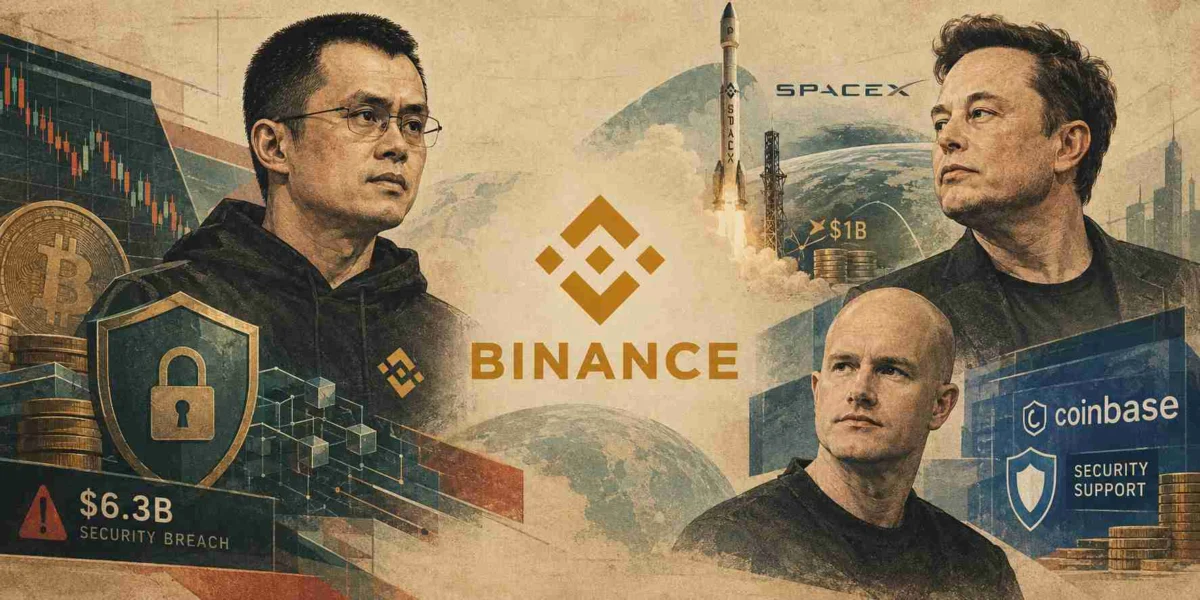
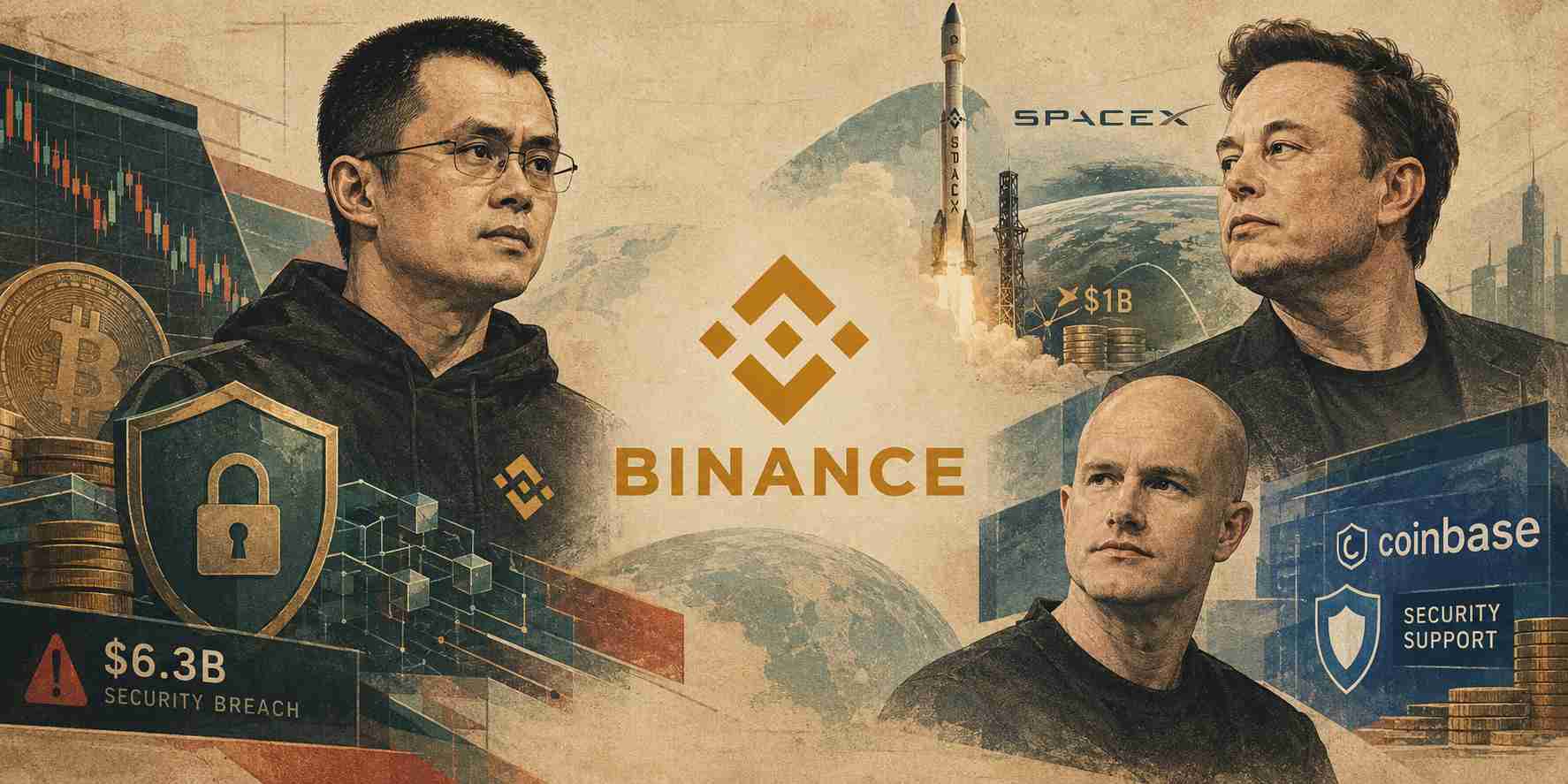
The cryptocurrency industry faced an unprecedented test of resilience following a massive security breach on Binance, which resulted in the unauthorized outflow of approximately $6.3 billion in digital assets. As the world’s largest cryptocurrency exchange scrambled to contain the crisis, freeze compromised funds, and reassure a rattled market, an unexpected public dispute erupted on social media between Binance founder Changpeng Zhao, widely known as CZ, and billionaire tech entrepreneur Elon Musk. The exchange, while dealing with the operational fallout, also received crucial cross-industry assistance from competitors like Coinbase, highlighting a rare moment of solidarity amidst high-stakes corporate tension.
The Timeline of the October 29 Attack and Immediate Response
The sequence of events began unfolding on October 28, when Zhao issued a sudden security advisory on X, formally known as Twitter. He strongly urged users to exercise extreme caution regarding suspicious email links and unsolicited file attachments, warning that even messages originating from seemingly trusted contacts could be vectors for sophisticated phishing or malware attacks. Little did the public know at the time, this warning preceded a catastrophic operational breach.
On October 29, the security incident materialized into a devastating reality. According to data from prominent blockchain intelligence firms including TRM Labs and Chainalysis, approximately $6.36 billion was systematically siphoned from Binance wallets across multiple blockchain networks. The vast majority of these unauthorized transfers occurred within a shockingly brief window of roughly 20 minutes, paralyzing normal operations and thrusting the platform into the most severe crisis in its history.
In response, Binance swiftly initiated emergency protocols. The exchange temporarily suspended both deposits and withdrawals to halt the bleeding, reviewed its security infrastructure, and mobilized its engineering teams to trace the outflow. Crucially, Binance leadership pledged full transparency and committed to utilizing corporate reserves and the Secure Asset Fund for Users (SAFU) to ensure that affected customers would be fully compensated down to the exact original tokens, rather than receiving mere dollar-equivalent payouts.
The Public Clash Between CZ and Elon Musk
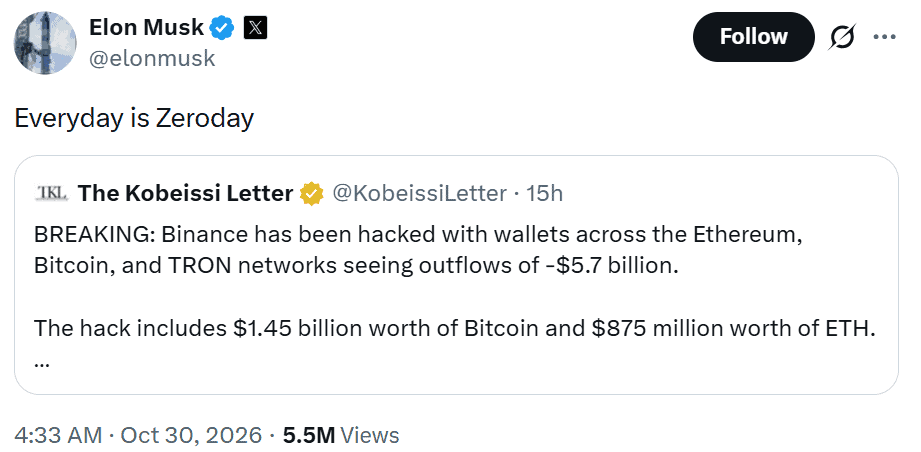
As news of the staggering hack circulated across social media, public figures and industry leaders weighed in on the incident. Elon Musk reacted to Zhao’s earlier cybersecurity warning and the subsequent breach reports by posting fire and laughing emojis, followed by a pointed remark stating, "Everyday is Zeroday." Musk’s comment was a reference to zero-day vulnerabilities—critically dangerous, previously unknown software flaws that malicious actors exploit before developers have any opportunity to patch or defend against them.
For an exchange grappling with a multi-billion-dollar security breach and racing to protect client funds, Musk’s lighthearted reaction and commentary were met with frustration. As details of the complex cyberattack emerged, Zhao publicly addressed Musk, asking him to halt the public mockery while Binance navigated the immense financial and operational consequences.
"Elon, have a lot of respect for you, but bad time to troll. Please stop," Zhao wrote on X.
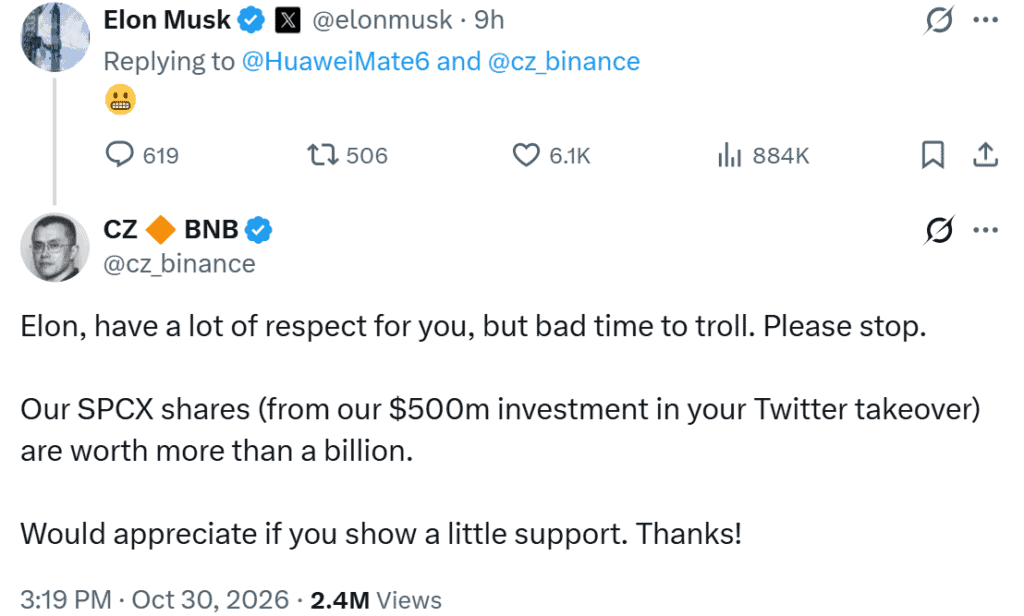
Seeking to contextualize Binance’s financial standing and remind Musk of existing corporate ties, Zhao pointed to the exchange’s significant financial stake in Musk’s business ecosystem. Specifically, Zhao referenced Binance’s historical $500 million investment toward Musk’s acquisition of Twitter in 2022, noting that the resulting SpaceX (SPCX) shares held by the exchange had grown substantially in value, comfortably exceeding $1 billion.
The SpaceX Holdings and Internal Financial Calculations
Zhao’s invocation of Binance’s SpaceX holdings quickly drew questions and scrutiny from commentators on X, prompting the Binance founder to clarify that he was merely illustrating the exchange’s deep well of financial liquidity and resources when assessing its capability to absorb the massive shock.
To break down the math publicly, Zhao outlined a preliminary financial assessment: the estimated impact of the security breach stood at roughly $6.3 billion. Against this liability, Binance had successfully collaborated with blockchain partners, stablecoin issuers like Tether and Circle, and law enforcement to freeze approximately $3 billion in compromised assets. Furthermore, the exchange held over $1 billion in its dedicated Secure Asset Fund for Users (SAFU).
This left a theoretical funding gap of approximately $2 billion. While Zhao described this remaining sum as a severely painful financial blow, he maintained that it was entirely manageable for an enterprise of Binance’s scale.
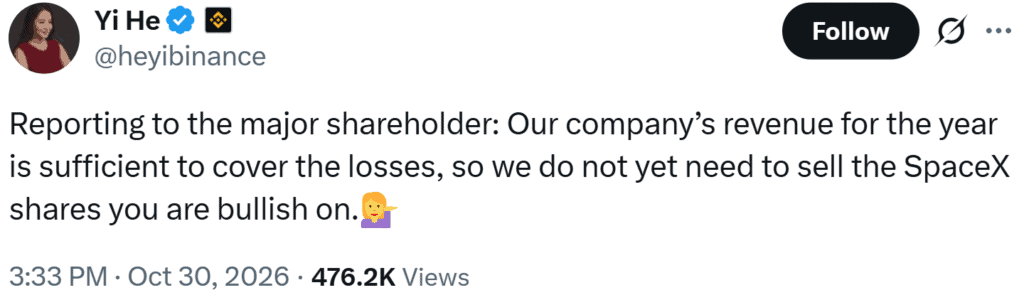
However, Binance co-CEO Yi He quickly clarified the company’s immediate strategy regarding these assets. In a post addressing Zhao, she confirmed that Binance’s robust annual revenue generated throughout the year was more than sufficient to cover the remaining losses entirely. Consequently, she stated that the exchange had no immediate need to liquidate its SpaceX shares, a position that Zhao subsequently endorsed, reiterating that he had never intended to sell the holdings but merely sought to demonstrate the firm’s overarching balance sheet strength.
By October 30, Binance updated its remediation plan, revealing that it had officially reserved approximately $6.34 billion in corporate funds to resolve the incident. Of this total, the exchange already held roughly $5 billion in the specific cryptocurrencies affected by the hack, while actively acquiring the remaining $1.34 billion through strategic market transactions and over-the-counter (OTC) channels to restore exact token balances to impacted users.
Industry Solidarity: Coinbase, Tether, and Circle Stepping In
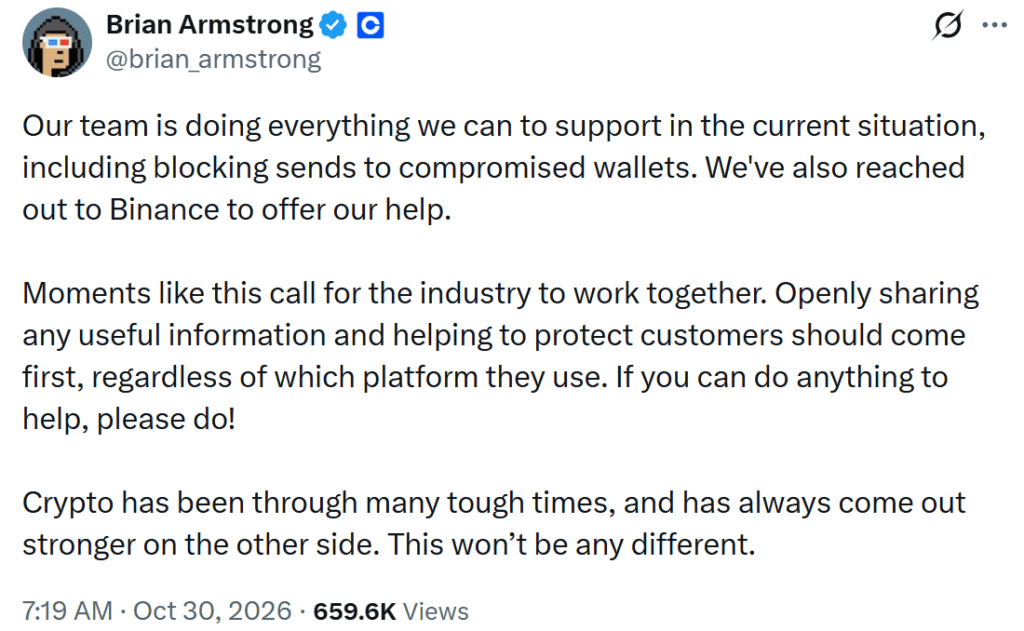
While the dispute between Zhao and Musk dominated social media headlines, the broader cryptocurrency ecosystem demonstrated an unprecedented level of operational coordination. Coinbase CEO Brian Armstrong stepped forward to offer direct, proactive assistance to its primary global competitor.
"Our team is doing everything we can to support in the current situation, including blocking sends to compromised wallets," Armstrong announced via X. He added a sentiment that resonated across the digital asset community, stating, "Moments like this call for the industry to work together."
Coinbase’s security apparatus immediately began tracking and blocking transactions directed toward addresses flagged in connection with the Binance breach. This collaborative defense was bolstered by major stablecoin issuers Tether and Circle, both of which swiftly blacklisted and froze millions of dollars worth of digital assets attempting to move through their respective networks. This rapid multi-institutional response played a vital role in locking down the stolen funds and preventing the perpetrators from easily liquidating their ill-gotten gains.
Investigation and Attribution of the Cyberattack
In the wake of the breach, Binance’s preliminary internal investigations pointed toward a compromised DevOps engineer’s laptop. According to initial findings, the compromised device allowed an unauthorized external actor to access a service container and initiate the massive wave of withdrawal transactions. Binance repeatedly emphasized that there was no evidence indicating that core wallet private keys had been compromised or leaked.
Independent forensic analysis by prominent blockchain intelligence entities, including TRM Labs and Chainalysis, painted a broader picture of the attack’s sophistication. Investigators attributed the operation to advanced persistent threat (APT) groups linked to North Korea, specifically pointing to cybercriminal syndicates such as TraderTraitor, which have increasingly targeted cross-chain bridges and centralized exchange infrastructure. While Binance did not formally confirm the specific identity of the attackers, the exchange confirmed it was working closely with international law enforcement agencies, cybersecurity experts, and intelligence firms to track down the perpetrators.
Broader Market Implications and Economic Sentiment
The sheer magnitude of a $6.3 billion security breach inevitably sent shockwaves through the broader digital asset economy. Financial markets reacted swiftly to the news, with Bitcoin and major altcoins experiencing notable selling pressure. Market sentiment soured as retail and institutional investors raised concerns regarding the security postures of centralized financial intermediaries. Consequently, Bitcoin prices experienced a sharp downward correction, briefly touching six-week lows near the $76,000 threshold before stabilizing as recovery updates reassured participants.
For everyday users and traders, the operational restrictions implemented by Binance were a primary source of anxiety. While deposits were brought back online relatively quickly following security audits, withdrawal services remained temporarily paused as the engineering team executed a comprehensive security overhaul across all system gateways. Binance assured its user base that withdrawal capabilities would be fully restored within 48 hours of its October 30 update, accompanied by a pledge to publish a complete, transparent technical post-mortem report once investigations concluded. Furthermore, the exchange committed to updating its publicly verifiable Proof of Reserves data to reflect the post-incident balance sheet accurately.
Conclusion: A Defining Moment for Corporate Governance and Crypto Resilience
The collision of corporate high finance, public social media spats, and historic cybercrime has made the October 2026 Binance breach a watershed moment for the cryptocurrency sector. The public disagreement between Changpeng Zhao and Elon Musk underscored the immense psychological pressure resting on industry leaders during a catastrophic corporate crisis. Yet, juxtaposed against the levity of the online dispute was the profound seriousness of the industry’s response.
Through the decisive intervention of competing exchanges like Coinbase, the rapid blacklisting capabilities of stablecoin issuers, and Binance’s aggressive mobilization of multi-billion-dollar corporate reserves to make users whole, the event proved that the digital asset ecosystem possesses deeply ingrained defensive mechanisms. As Binance works to finalize its security upgrades, restore complete operational normality, and bring the perpetrators to justice, the episode will likely serve as a permanent case study in crisis management, systemic risk, and cross-industry cooperation within the global financial technology landscape.