The decentralized finance landscape has witnessed dramatic shifts over the past several years, testing the resilience of foundational protocols and their native assets. Among the oldest surviving digital assets in the decentralized finance sector, sUSD—the primary stablecoin of the Synthetix ecosystem—stands as a testament to both longevity and adaptation. Having navigated three distinct market cycles since its inception in 2018 under the initial moniker eUSD before transitioning to nUSD, the asset now faces its most critical strategic juncture. Following a transformative 2025 protocol redesign that involved phasing out Layer 2 operations, modifying core staking mechanics, revamping governance structures, and launching a high-performance perpetual decentralized exchange on the Ethereum Mainnet, leadership has detailed a comprehensive roadmap to secure the future of sUSD. This strategy centers on anchoring the stablecoin to the newly deployed Synthetix Perps ecosystem, introducing delta-neutral basis trade vaults, and implementing aggressive monetary adjustments designed to restore the asset’s long-standing price parity.
Historical Evolution and the 2025 Protocol Redesign
The origins of sUSD trace back to the early developmental phases of the Synthetix protocol, when the broader decentralized finance ecosystem was in its relative infancy. As the protocol matured, the asset evolved to facilitate liquidity and trading across various synthetic assets. However, the mechanism governing its creation presented structural challenges. For years, the minting of sUSD directly against SNX collateral generated complex debt management hurdles, including systemic debt overhangs and inflated protocol overhead that strained the system during periods of high market volatility.
Recognizing these vulnerabilities, core contributors implemented a sweeping protocol overhaul in 2025. A cornerstone of this survival strategy was the permanent deprecation of sUSD minting against SNX. While this decisive action successfully insulated the protocol from structural insolvency and long-term systemic risk, it triggered an arduous transition period. Decoupling the asset from its traditional minting pathway left a void in supply dynamics, making the maintenance of the United States dollar peg significantly more difficult than initially anticipated. Over the preceding year, sUSD experienced prolonged periods of trading below its intended par value, dropping as low as $0.70 in secondary markets. This depegging phenomenon complicated broader platform operations and prompted leadership to formulate a multi-pronged recovery plan to restore market confidence ahead of the protocol’s Mainnet expansion.
The Turning Point: Ethereum Mainnet Perpetuals and Structural Integration
The multi-year investment in rebuilding and restructuring the protocol is now culminating in the deployment of core infrastructure on the Ethereum Mainnet. Central to this new era is the successful launch of Synthetix Perps, a high-performance perpetual exchange designed to capture significant market share in the decentralized derivatives sector.
Within this new architecture, sUSD has been assigned a vital, multifaceted role. Rather than functioning as a peripheral asset, sUSD now serves as the foundational capital backing the Synthetix Liquidity Provider Vault (SLP). Operating as the community market-making vault for Synthetix Perps, the SLP acts as the enshrined liquidator, liquidity provider, and collateral manager for the entire derivatives platform. Industry analysts have noted that the value proposition of such integrated liquidity vaults—evidenced by comparable models like HLP and LLP in other ecosystems—provides a robust foundation for sustainable yield generation. Furthermore, the integration of multi-collateral management frameworks is projected to optimize returns for SLP depositors.
To foster broader adoption across the decentralized finance economy, the circulating supply of sUSD must expand alongside total value locked. To achieve this, the protocol is introducing innovative minting mechanisms tied to delta-neutral basis trade vaults. By operating both a stablecoin issuer and a perpetual exchange simultaneously, Synthetix occupies a unique market position. This dual capability enables the protocol to design sophisticated meta-vaults that generate sustainable yields for depositors while issuing a stable digital representation of the underlying trading strategies.
Innovative Yield Generation Through Basis Trade Vaults
To accelerate adoption and enhance capital efficiency, Synthetix is preparing to deploy meta-basis trade vaults powered by its Mainnet perpetual exchange. These products are designed to capitalize on market inefficiencies inherent in perpetual futures markets, capturing funding rate yields and basis opportunities while maintaining minimal directional exposure.
Participants will be able to mint sUSD against their positions within delta-neutral basis trade strategies. These vaults are engineered to optimize yield collection by executing sophisticated trading strategies across the Synthetix Perps order books. The operational mechanics establish a self-reinforcing economic loop: higher yields attract increased capital deposits; subsequent growth in collateralization strengthens the market peg; and a stable peg further enhances the long-term resilience and utility of sUSD across external decentralized finance protocols. Market participants and liquidity providers are expected to view these structured yield products as an attractive alternative to traditional fixed-income decentralized finance offerings, thereby driving organic demand for the stablecoin.
Emergency Staking Adjustments and Peg Restoration Measures
While long-term structural integrations are designed to secure permanent stability, protocol leadership emphasized that restoring the sUSD peg in the near term is an absolute prerequisite for the success of the Mainnet Perps launch. Extended depegging periods undermine confidence and hinder the protocol’s ability to scale effectively.
Responsibility for the health and stability of the sUSD peg rests primarily with SNX stakers. Although the previously introduced debt jubilee mechanism was designed to alleviate the legacy overhang of years of debt inflation, persistent trading pressures have necessitated further intervention. Consequently, protocol governance has approved a series of immediate adjustments to the 420 pool parameters.
Under the new guidelines, the sUSD staking requirement is being raised to 50% of a participant’s initial debt incurred during the debt jubilee. To ensure steady progress toward price parity, this requirement will be subject to progressive increases of 10% every two weeks. These increments will continue until either the staking requirement reaches 100% or sUSD successfully re-establishes a market price above $0.98.
Protocol developers noted that this mechanism is fully reversible. Once structural solutions—such as the meta-basis trade vaults and Mainnet Perps volume—take full effect and alleviate downward pricing pressure, reductions to the sUSD staking requirement will be formally evaluated by governance.
To ease the transition for stakers navigating these modified parameters, an early exit option has been introduced. Stakers who have reached the 65% jubilee threshold may elect to burn 35% of their initial sUSD debt, receiving 65% debt relief alongside unlocked SNX tokens in return. Previously, early exits carried punitive penalties ranging from 50% to 100%. Participants who have not yet reached the 65% jubilee benchmark will gain access to this burn option immediately upon qualifying. These policy adjustments prioritize systemic health and peg recovery above all else, establishing a sustainable foundation for the long-term appreciation of both sUSD and SNX.
Broader Industry Implications and Outlook
The revitalization of sUSD marks a critical milestone not only for the Synthetix community but for the broader decentralized finance sector. Over the past several years, algorithmic and synthetic stablecoins have faced intense regulatory scrutiny and market skepticism following several high-profile failures across the industry. By transitioning away from vulnerable minting models and anchoring sUSD directly to revenue-generating protocol activity on Ethereum Mainnet, Synthetix is pioneering a more resilient framework for decentralized currency issuance.
Financial analysts monitoring the sector suggest that the success of the Synthetix Perps integration and the forthcoming delta-neutral basis vaults could serve as a blueprint for other derivatives platforms seeking to issue native settlement assets. By aligning stablecoin demand directly with platform utility and organic trading volume, the protocol mitigates reliance on inflationary reward incentives that historically plagued early-stage decentralized finance projects.
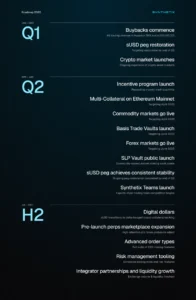
Looking forward, leadership anticipates that the combination of Mainnet deployment, active token buybacks, high-yield community vaults, and upcoming basis trade products will successfully drive sUSD back to its intended parity. Current projections indicate that the asset is well-positioned to re-peg by early in the second quarter, with sustained market stability expected by mid-2026. As the protocol steps into this new era, the transformation of sUSD from a challenged legacy asset into an integrated pillar of the modern Synthetix ecosystem highlights the capacity of decentralized autonomous organizations to execute complex economic repairs in real time.