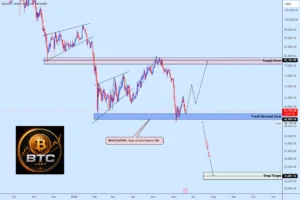
The global cryptocurrency market is currently navigating a significant structural shift as Bitcoin, the industry’s primary benchmark, demonstrates signs of cooling following a period of intense volatility. Market analyst Justcryptopays recently highlighted that Bitcoin’s breach below a critical long-term trendline may serve as a harbinger for a broader market transformation. This technical breakdown suggests that the overwhelming dominance Bitcoin has exerted over the past several months may be yielding to a more diversified investment landscape. As capital begins to rotate out of the flagship digital asset, investors are increasingly eyeing altcoins, signaling the potential commencement of a much-anticipated "altcoin season."
The transition comes at a pivotal moment for the digital asset industry. After a challenging 2025 characterized by bearish sentiment and macroeconomic headwinds, the start of 2026 has brought a renewed sense of optimism, albeit tempered by caution. Bitcoin’s struggle to maintain its footing above the $90,000 psychological threshold—a level that has served as both a beacon for bulls and a barrier for bears—is currently the focal point of market analysis. While the asset was recently observed trading at approximately $90,525, its inability to decisively clear and hold higher support levels has prompted a strategic reallocation of portfolios toward alternative assets like Ethereum, Solana, and emerging decentralized finance (DeFi) protocols.
The Mechanics of Capital Rotation in Crypto Markets
In the lifecycle of a cryptocurrency bull market, capital typically follows a predictable path, often referred to by traders as the "money flow cycle." This cycle generally begins with Bitcoin, which attracts the initial wave of institutional and retail liquidity due to its perceived status as "digital gold." Once Bitcoin achieves a significant price peak or enters a phase of consolidation, investors often seek higher returns by moving their profits into "Large Cap" altcoins, such as Ethereum and Solana.
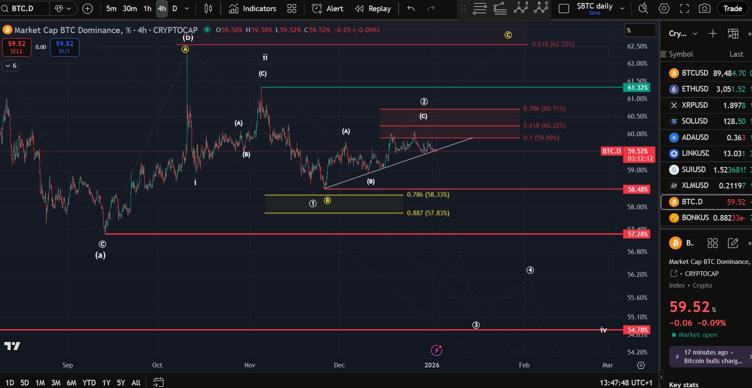
The current market data suggests we are entering the secondary phase of this cycle. Bitcoin dominance, a metric that measures Bitcoin’s share of the total crypto market capitalization, has begun to plateau. When this dominance wanes while the total market cap remains stable or grows, it indicates that altcoins are outperforming the market leader. The breach of the trendline identified by Justcryptopays is a technical confirmation of this phenomenon. By slipping below this support, Bitcoin is no longer the sole driver of market momentum, allowing liquidity to "trickle down" into the broader ecosystem.
Technical Analysis: The $90,000 Psychological Barrier
The $90,000 price point for Bitcoin is more than just a numerical milestone; it represents a significant psychological and technical "line in the sand." Historically, round numbers act as magnets for buy and sell orders. For much of the latter half of 2025, $90,000 acted as a formidable resistance level. The fact that Bitcoin is currently hovering around $90,525 after dipping below its primary trendline suggests a period of "distribution," where long-term holders may be offloading their positions to new buyers, or moving that capital into higher-beta assets.
Technical indicators, including the Relative Strength Index (RSI) and moving averages, suggest that while Bitcoin’s long-term trajectory remains a subject of debate, its short-term momentum has slowed. This stagnation in Bitcoin often provides the necessary stability for altcoins to rally. When Bitcoin moves sideways (consolidates), it reduces market-wide fear of a sudden "flash crash," giving traders the confidence to take on more risk in smaller-cap assets.

A Chronology of Market Sentiment: From 2025 Bearishness to 2026 Awakening
To understand the current shift, one must look at the trajectory of the market over the previous twelve months. The year 2025 was marked by a series of regulatory hurdles and a tightening of global monetary policy, which suppressed the "risk-on" appetite required for altcoins to thrive. During this period, Bitcoin was the primary beneficiary of "flight to safety" capital within the crypto space.
- Q1-Q2 2025: Bitcoin dominance rose as investors exited speculative altcoin positions amid regulatory uncertainty in major jurisdictions.
- Q3-Q4 2025: Bitcoin tested the $80,000 and $85,000 levels multiple times, but altcoins remained largely stagnant, failing to recover from their yearly lows.
- January 2026: Bitcoin finally breached the $90,000 mark but immediately faced heavy selling pressure. The subsequent break of the ascending trendline marked the first major signal of a potential trend reversal in favor of altcoins.
As we move further into the first quarter of 2026, the "Altcoin Awakening" is becoming visible in the trading volumes of platforms like Binance and Coinbase. Assets such as Ethereum (ETH), XRP, Solana (SOL), and Cardano (ADA) have begun to show decoupled price action, gaining value even on days when Bitcoin remains flat or slightly down.
Spotlighting the Altcoin Leaders: ETH, SOL, and Beyond
The potential resurgence of altcoins is not a monolithic event; different sectors of the market are responding to different catalysts.
Ethereum (ETH) and the DeFi Ecosystem
As the foundational layer for the majority of decentralized applications, Ethereum remains the primary beneficiary of any altcoin rally. Investors are closely watching Ethereum’s "Pectra" upgrade, which aims to improve scalability and user experience. If Ethereum can regain its momentum against Bitcoin (the ETH/BTC pair), it often serves as the "green light" for the rest of the altcoin market.
Solana (SOL) and High-Performance Scaling
Solana continues to position itself as a faster, cheaper alternative to Ethereum. Its ecosystem has seen a surge in active addresses and DEX (Decentralized Exchange) volume in early 2026. The rotation of capital into SOL is often driven by retail interest in memecoins and NFT projects that thrive on its high-speed network.
XRP and Regulatory Clarity
Following years of legal scrutiny, XRP has emerged as a favorite for institutional cross-border payments. Any shift in capital toward XRP is often viewed as a sign of growing institutional comfort with assets outside of Bitcoin.
The Role of Memecoins
While often dismissed by traditional analysts, memecoins serve as a vital indicator of retail liquidity. A surge in memecoin trading activity typically suggests that "new money" is entering the market and that investors are willing to move further down the risk curve.
Broader Implications and Market Risks
The rotation of capital from Bitcoin to altcoins carries several implications for the broader financial ecosystem. First, it suggests a maturing market where investors are becoming more discerning, choosing assets based on utility and technological merit rather than just brand recognition. Second, it highlights the increasing influence of decentralized finance (DeFi) and Web3, which rely on altcoin ecosystems to function.
However, this shift is not without risk. Altcoins are notoriously more volatile than Bitcoin. While they offer the potential for higher percentage gains, they are also prone to sharper corrections. The "bearish momentum of 2025," as noted in the original analysis, has not been entirely erased. Should Bitcoin experience a sudden and violent drop below the $85,000 support level, it could trigger a "liquidity crunch" that would likely see altcoins lose value at an even faster rate than the flagship coin.
Furthermore, the macroeconomic environment in 2026 remains a wildcard. If central banks pivot back toward higher interest rates to combat stubborn inflation, the "risk-on" sentiment fueling the altcoin rally could evaporate overnight.
Strategic Outlook for Investors
For market participants, the current environment demands a high degree of vigilance. The break of Bitcoin’s trendline is a signal to re-evaluate portfolio allocations. Strategic positioning in 2026 involves balancing the relative stability of Bitcoin with the high-growth potential of established altcoins.
Market analysts suggest that the coming months will be defined by "selective rallies." Unlike the 2021 bull run, where almost every digital asset saw gains, the 2026 market appears more fragmented. Success will likely depend on identifying projects with strong developer activity, real-world partnerships, and sustainable tokenomics.
As Bitcoin continues its dance around the $90,000 mark, the crypto community remains divided. Some see the current trendline break as a temporary setback before a push to $100,000, while others—like Justcryptopays—view it as the definitive start of a new chapter where altcoins take center stage. Regardless of the outcome, the rotation of capital is a clear sign that the digital asset market is evolving into a more complex and multi-faceted financial frontier.