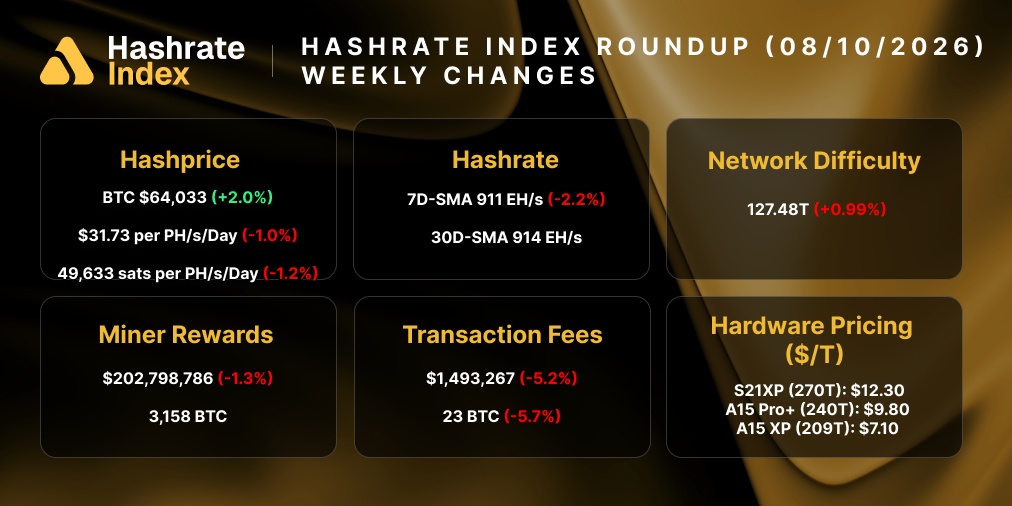
The Bitcoin mining sector faced a challenging week as of August 10, 2026, characterized by a complex interplay of rising asset prices and contracting mining profitability. While the price of Bitcoin appreciated by 2.0%, climbing from $62,775 to $64,033, the underlying economic indicators for network participants remained under pressure. Miners navigated a landscape marked by a decrease in total hashrate, a slight increase in network difficulty, and a notable contraction in hashprice—the primary metric used to quantify the daily revenue earned per unit of computing power.
Network Performance and Hashrate Dynamics
Over the past seven days, the Bitcoin network experienced a moderate decline in total hashrate. The seven-day simple moving average (SMA) for network hashrate fell by 2.3%, sliding from 932 EH/s to 911 EH/s. This contraction suggests a temporary reduction in the aggregate computational power dedicated to securing the network, likely driven by older, less efficient hardware being powered down as operational costs outpace daily rewards.
The network’s difficulty adjustment mechanism, which automatically recalibrates to ensure consistent block production times, saw an upward shift of 0.99% on August 8, 2026, reaching 127.48T. This adjustment reflects the high competition among miners despite the thinning margins. With current block times averaging approximately 10 minutes and 19 seconds, the network is operating within its intended parameters, though analysts are already anticipating a reversal in the next cycle. Projections currently estimate a negative difficulty adjustment of 3.07% for the next cycle, expected around August 23, 2026. While early-cycle predictions remain subject to volatility due to short-term variance in block discovery, a negative adjustment would provide a necessary reprieve for miners currently struggling with the rising cost of energy per terahash.
Economic Implications for Mining Operations
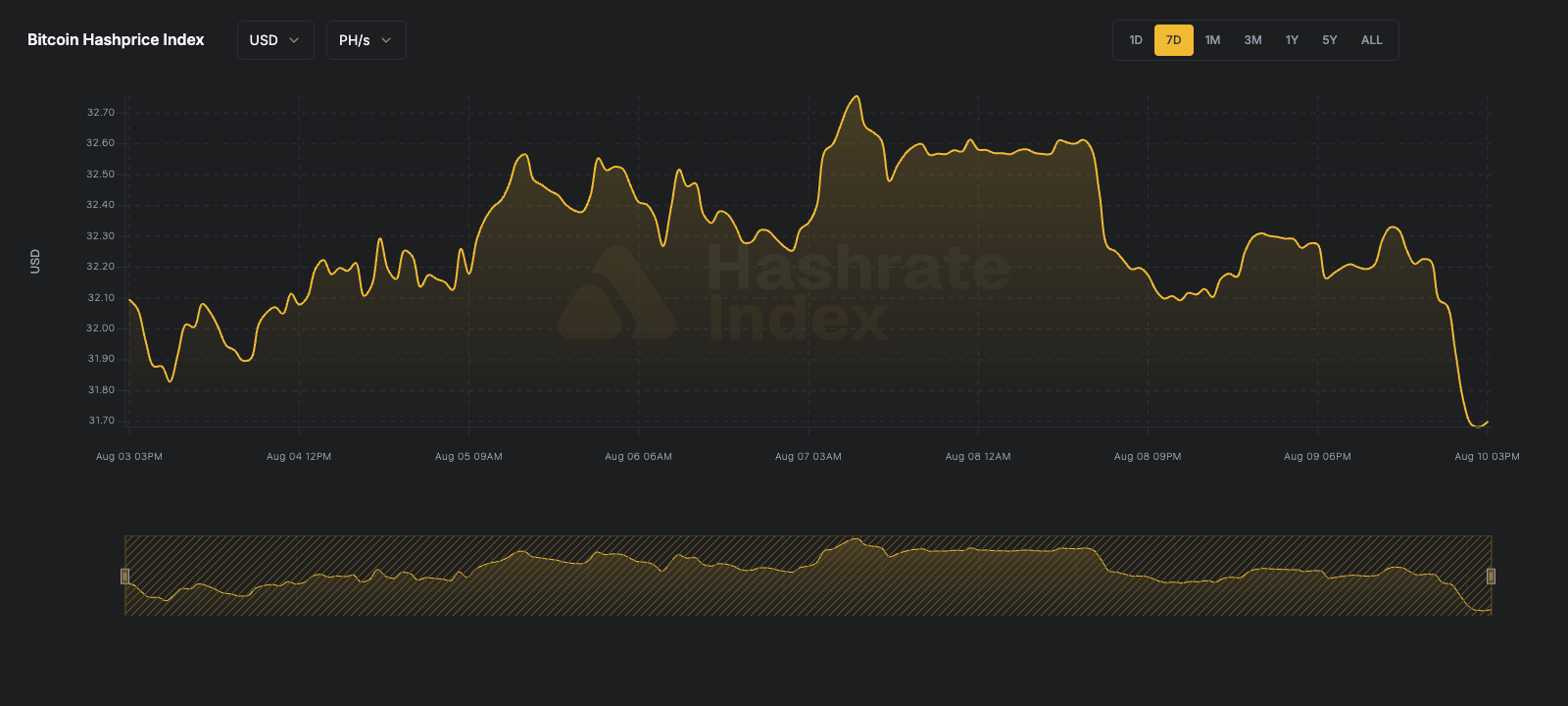
The financial health of the mining industry is currently defined by the "hashprice," which serves as a barometer for revenue generation. As of the week ending August 10, the USD hashprice saw a 1.1% decline, dropping from $32.07 per PH/s/Day to $31.73 per PH/s/Day. This figure is particularly critical, as it sits at or near the breakeven point for many mid-tier mining operations that have not yet optimized their fleets with high-efficiency hardware.
The total revenue captured by miners during this period amounted to approximately 3,158 BTC, valued at roughly $202 million. Of this total, only 23 BTC—or 0.74% of the total block rewards—originated from transaction fees. This low contribution from fees, totaling approximately $1.49 million, highlights the current reliance on block subsidies rather than on-chain activity to sustain profitability. When transaction fees remain stagnant, the volatility of the spot price of Bitcoin becomes the sole driver of miner solvency, placing smaller operations at higher risk during market dips.
Comparative Analysis of Market Performance
The broader financial market for Bitcoin mining equities mirrored the struggles of the mining sector. Mining stocks largely trended downward throughout the week, reflecting investor caution regarding the sector’s profitability. Companies such as Cipher Mining (CIFR) and CleanSpark (CLSK) experienced significant pullbacks, with weekly drops of 32.4% and 20.9%, respectively. Similarly, industry stalwarts like Marathon Digital (MARA) and Riot Platforms (RIOT) saw declines of 18.6% and 9.4%.
These market movements suggest that institutional investors are closely tracking the hashprice and the impact of the recent block reward halving. As miners face the dual pressures of fixed operational costs and variable revenue, the equity markets are recalibrating their valuations based on the efficiency of individual fleets and the ability of mining firms to secure low-cost energy agreements. Notably, some smaller players, such as CAN (Canaan), saw a modest increase of 11.1%, suggesting that market sentiment is highly segmented based on company-specific fundamentals rather than a singular industry trend.
The Role of Technological Optimization
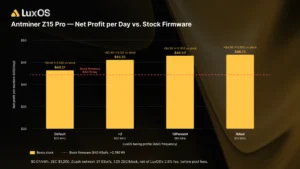
In response to the current market environment, the emphasis on fleet efficiency has reached a new peak. The adoption of custom firmware, such as that provided by Luxor, has become a standard strategy for operators looking to extend the life of their S19 and S21 series rigs. By maximizing the compute-per-watt ratio, miners can effectively lower their operational threshold, allowing them to remain active even when the market-wide hashprice falls below their standard cost of production.
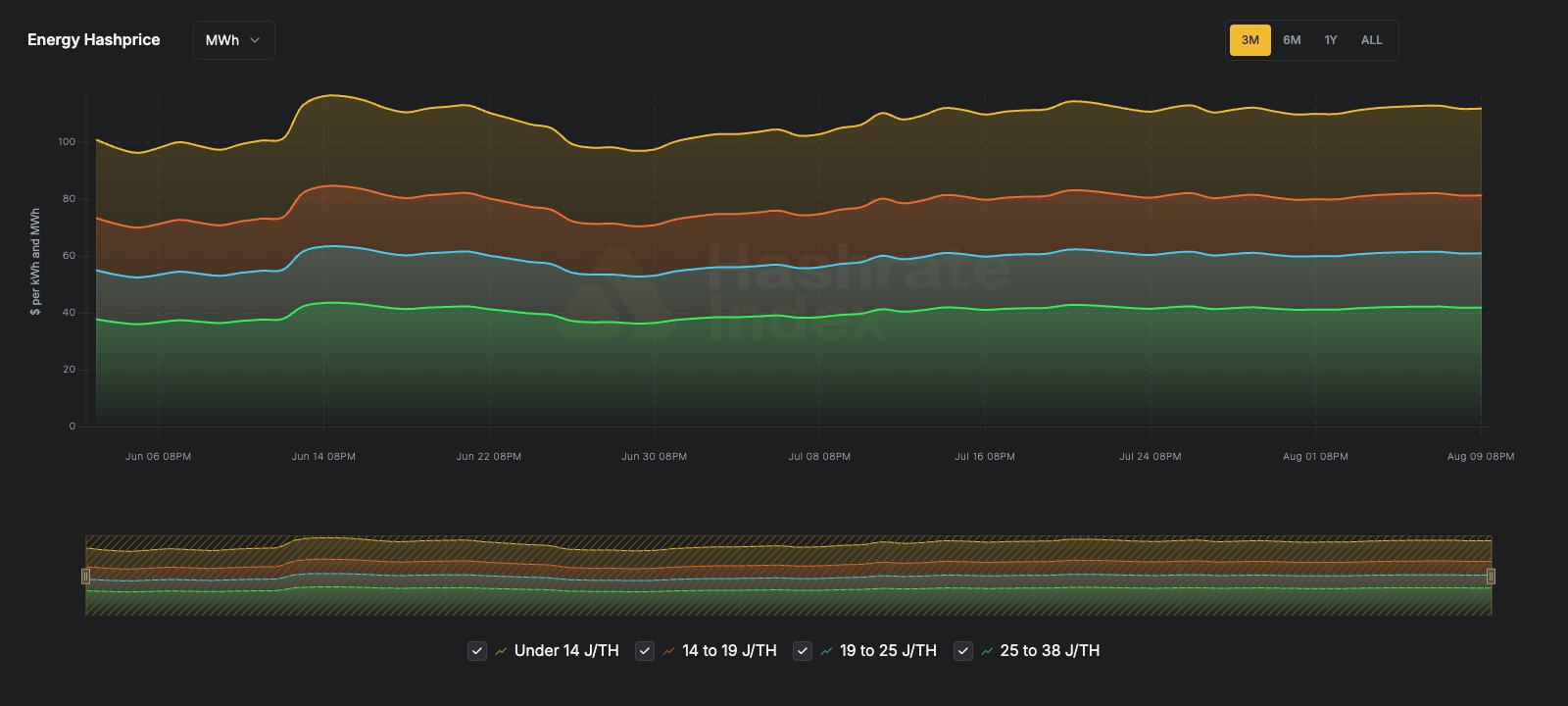
The energy hashprice index over the past three months confirms that operators who fail to optimize their power consumption are the first to be squeezed out of the market. The current environment demands a lean approach, where the "cost of hash" is treated with the same analytical rigor as the spot price of Bitcoin itself.
Looking Ahead: The Forward Market
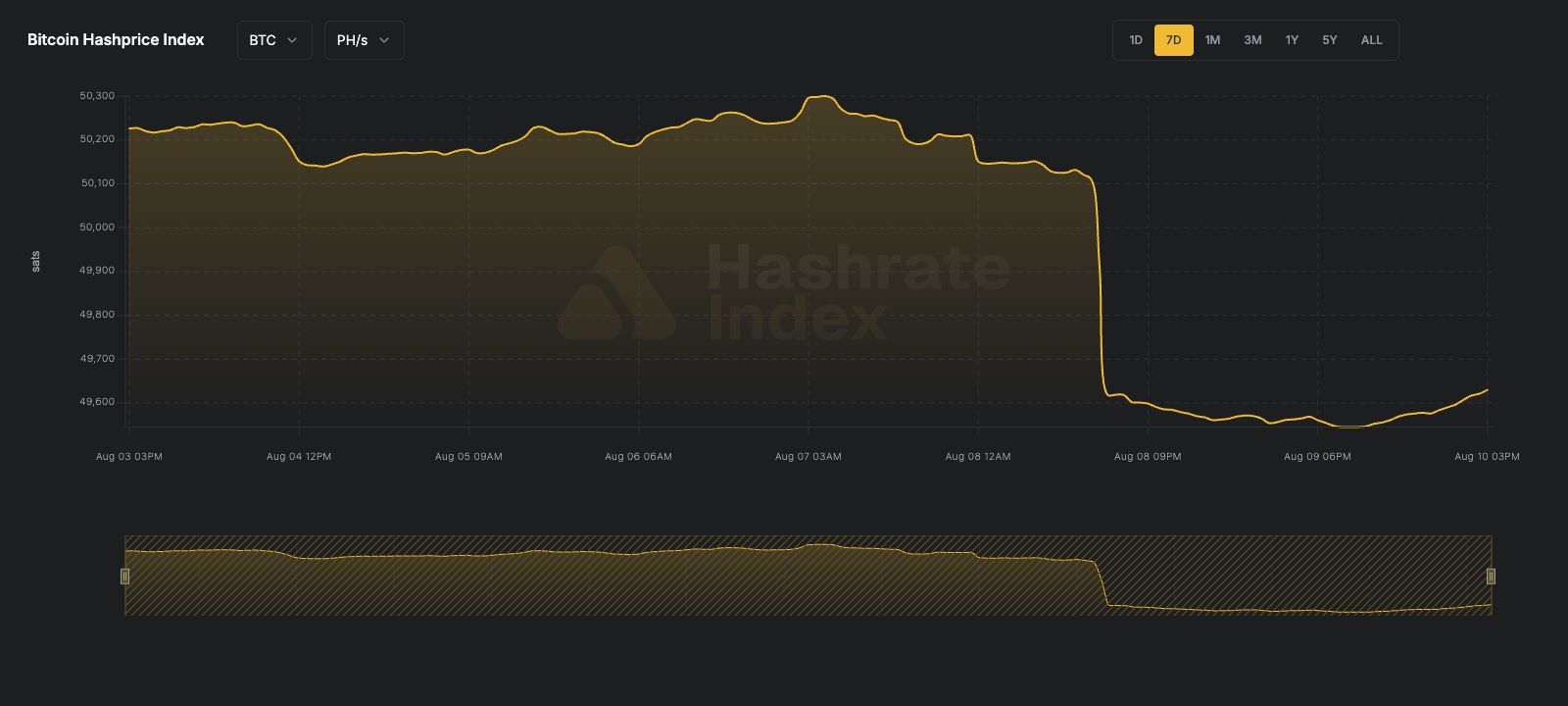
The forward market provides a window into institutional expectations for the mining industry over the coming months. Luxor’s Hashrate Forward Market is currently pricing in an average hashprice of $30.86, or approximately 0.00048 BTC, for the next six months. This pricing indicates that the market anticipates a relatively stable, albeit competitive, environment for the remainder of the year.
The slight disconnect between current spot prices and forward-looking expectations suggests that while participants remain cautious, they are not anticipating a catastrophic collapse in mining profitability. Instead, the industry appears to be entering a period of consolidation where the most efficient, well-capitalized firms will likely increase their market share at the expense of those unable to manage the thin margins of a post-halving environment.
Conclusion
The week of August 10, 2026, serves as a microcosm of the current state of Bitcoin mining. The industry is in a delicate transition phase where the primary challenge is not just the price of Bitcoin, but the efficiency of the infrastructure underlying the network. With network difficulty remaining high and transaction fees providing minimal support to overall revenues, the onus remains on individual miners to optimize their hardware and secure sustainable energy contracts.
As the network approaches its next difficulty adjustment in late August, industry observers will be watching to see if the projected 3% drop in difficulty provides the necessary relief to stabilize the hashrate. Until then, the sector is likely to continue its trend of consolidation, with mining stocks remaining sensitive to both the spot price of Bitcoin and the realized hashprice. For the ecosystem at large, this cycle of tightening margins is a test of resilience, separating sustainable, high-efficiency operations from those reliant on historical bull-market conditions. The coming weeks will be pivotal in determining whether the current downward pressure on mining equities and hashprice is a temporary correction or the beginning of a more prolonged period of structural adjustment within the global Bitcoin mining industry.