The global Bitcoin mining landscape entered the final day of August 2026 with a nuanced performance profile, characterized by a modest recovery in asset pricing juxtaposed against stagnant transaction fee revenue and rising network competition. As the industry navigates the post-halving macroeconomic environment, miners continue to grapple with tight margins, evidenced by a slight contraction in hashprice—the primary metric for measuring the daily revenue potential of one petahash per second of computing power. For the week ending August 31, 2026, the Bitcoin network saw a 2.1% increase in the price of the underlying asset, yet the sector remains down 10.1% year-to-date, reflecting a broader consolidation period for publicly traded mining entities.
Chronology of Network Performance and Market Dynamics
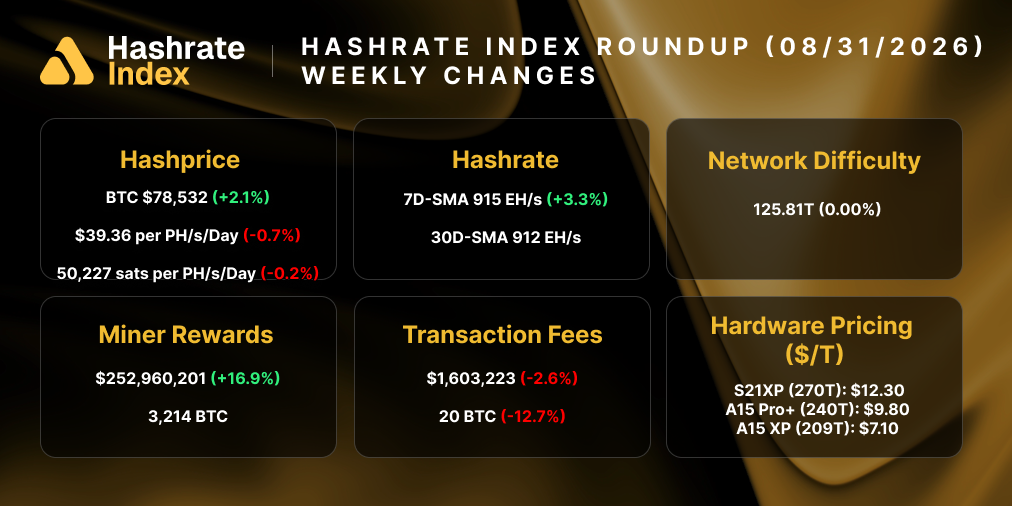
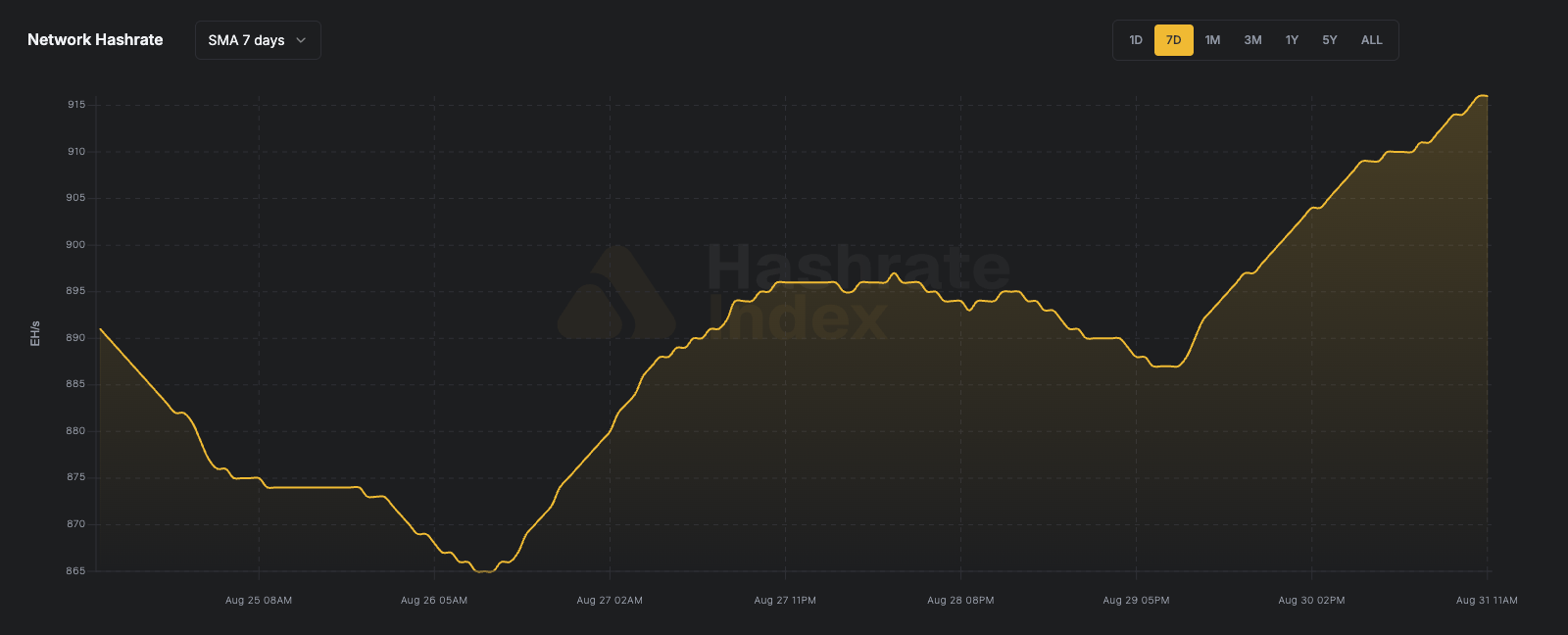
The week began with Bitcoin trading at approximately $76,933, climbing to a closing spot price of $78,563. This upward movement in price offered a degree of relief to mining operations, although the gains were partially offset by the continued expansion of the network’s total hashrate. The seven-day simple moving average (SMA) for network hashrate surged by 3.3%, climbing from 886 EH/s to 915 EH/s. This consistent growth in computing power indicates that despite the competitive pressure on hashprice, infrastructure deployment remains aggressive, likely driven by the integration of more efficient application-specific integrated circuit (ASIC) hardware into existing fleets.
The most recent network difficulty adjustment, which occurred on August 23, 2026, saw a downward correction of 1.31%, settling the difficulty at 125.81T. This adjustment provided a temporary reprieve for miners, allowing for higher profit margins on a per-unit basis. However, with block times averaging approximately 9 minutes and 56 seconds over the past 24 hours, the network is trending toward a slight increase in difficulty for the upcoming epoch. Projections estimate a positive adjustment of 0.67% by September 5, 2026, which would once again tighten the operational margins for those relying on older or less efficient mining rigs.
Revenue Streams and Economic Indicators
Miners collectively secured approximately 3,214 BTC in block rewards over the past seven days, representing a total gross revenue of roughly $253 million. A critical component of this revenue, transaction fees, accounted for only 0.64% of the total, amounting to approximately 20 BTC or $1.60 million. This significant decline in fee-based revenue—a 21% drop compared to the previous week’s average of 0.0248 BTC per block—highlights a period of reduced on-chain activity. In the absence of high-volume transaction spikes, miners remain heavily dependent on the block subsidy, which underscores the vulnerability of the mining business model to price volatility and network difficulty shifts.
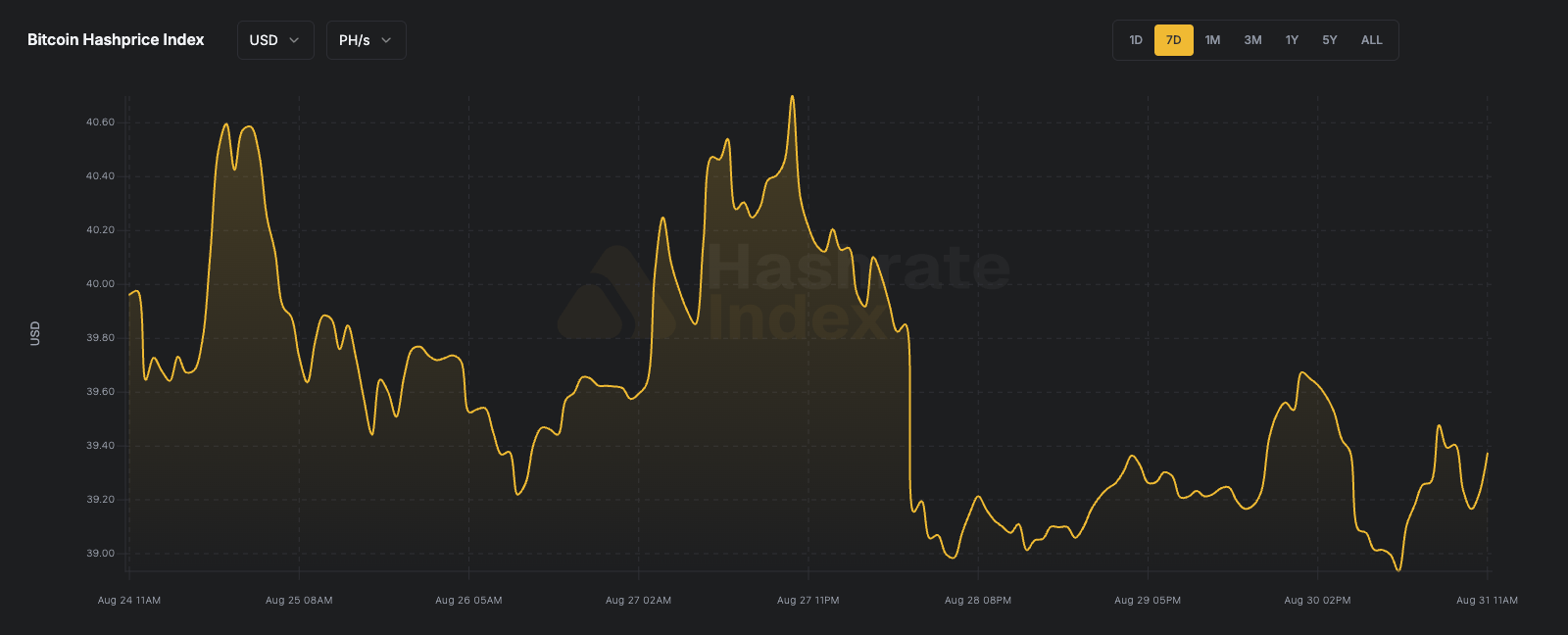
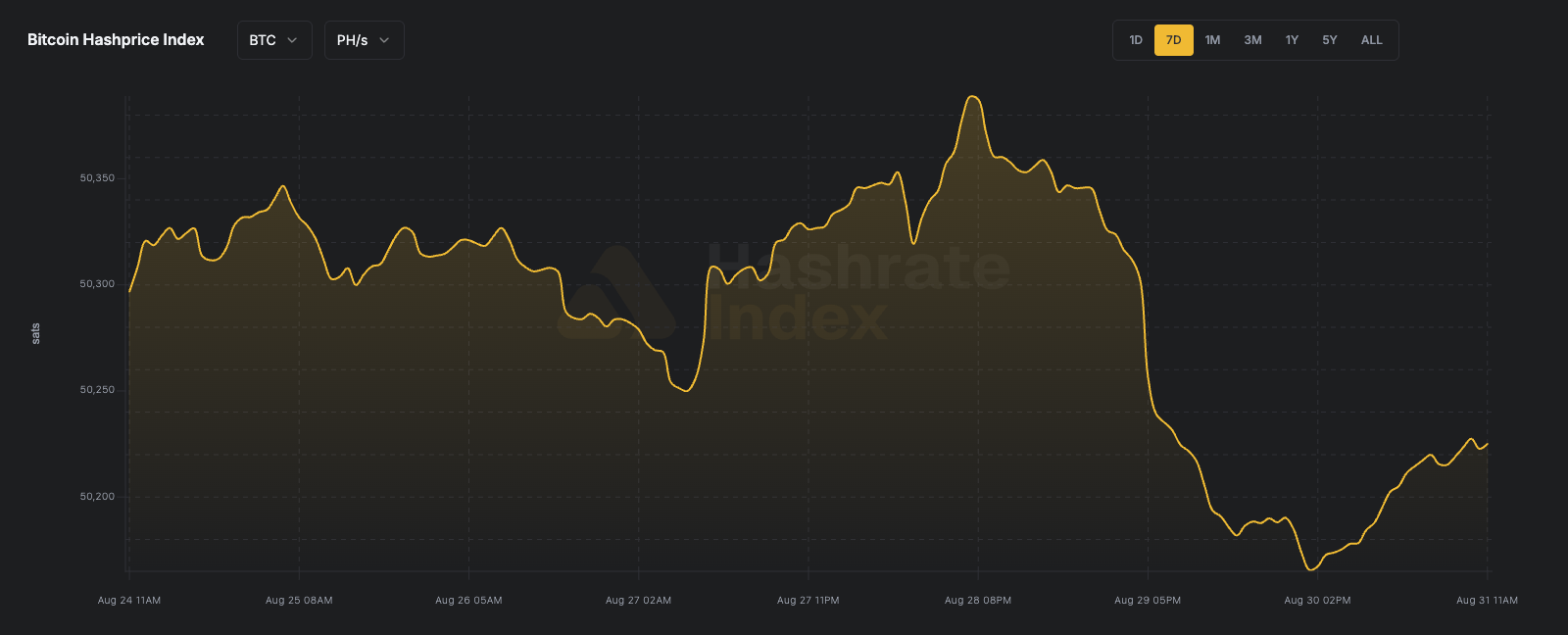
The hashprice, which acts as the industry’s barometer for profitability, reflected these conflicting forces. The USD-denominated hashprice declined by 0.7%, moving from $39.64 to $39.36 per PH/s/Day. Meanwhile, the BTC-denominated hashprice saw a marginal decrease of 0.2%, ending the week at 0.00050227 BTC per PH/s/Day. While the 30-day average hashprice has shown a 13.6% improvement in USD terms, the short-term stagnation suggests that the market is in a state of equilibrium, waiting for either a significant move in Bitcoin’s spot price or a decrease in network hashrate to push profit margins into more favorable territory.
Analysis of Publicly Traded Mining Equities
The equity markets mirrored the cautious sentiment observed in the mining sector. Bitcoin mining stocks faced a challenging week, with nearly all major tickers reporting negative performance as of the market close on August 31. This trend suggests that investors are increasingly sensitive to the thinning margins caused by high hashrate competition and stagnant transaction fee environments.
Key industry players experienced notable pullbacks. For instance, IREN saw its stock price decline by 9.2%, while Riot Platforms (RIOT) and Marathon Digital Holdings (MARA) registered losses of 8.6% and 6.4%, respectively. CleanSpark (CLSK) and Core Scientific (CORZ) also saw declines of 5.0% and 7.2%. The broad-based downward trend in mining equities indicates a reassessment of valuation models, as analysts pivot away from pure hashrate growth metrics toward operational efficiency and energy procurement costs. Investors appear to be prioritizing companies with lower power costs and more robust balance sheets, rather than those simply scaling their raw computational capacity.
Broader Implications and Future Outlook
The current data from the Luxor Hashrate Forward Market provides a glimpse into industry expectations for the coming months. The forward market is pricing in an average hashprice of $37.59 or 0.00048 BTC for the next six months. This forward-looking data suggests that the market does not anticipate a significant breakout in mining profitability in the immediate future, pointing toward a sustained period of high competition.
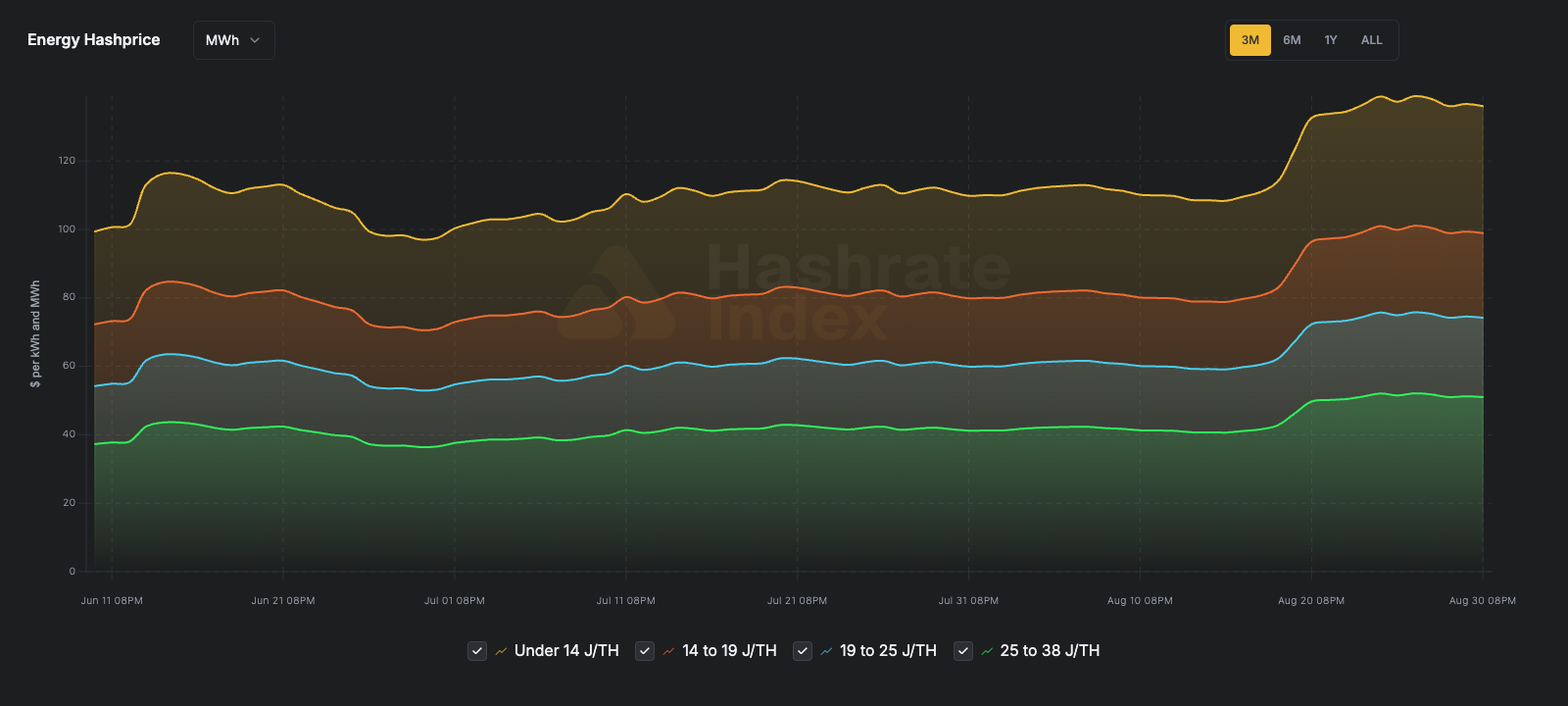
The infrastructure economics that define the current climate are twofold: the continuous race for energy efficiency and the strategic positioning of mining data centers. With network hashrate approaching 915 EH/s, the barrier to entry has never been higher. Smaller operators are increasingly facing the choice of either upgrading to next-generation hardware to maintain their share of the network or exiting the market in favor of hosted solutions.
Furthermore, the rise of the artificial intelligence (AI) compute market is beginning to influence how mining firms view their infrastructure. Many firms are now diversifying their revenue streams by exploring hybrid models that leverage their power capacity for both Bitcoin mining and high-performance computing (HPC) tasks. This strategic pivot may prove essential in the coming year, as it allows miners to hedge against the inherent volatility of Bitcoin’s price and the periodic fluctuations in network difficulty.
Industry experts observe that the current mining cycle is fundamentally different from those of the past. The institutionalization of the mining industry, combined with the integration of complex derivative markets like the Hashrate Forward Market, has created a more sophisticated financial ecosystem. However, this sophistication also demands greater transparency and risk management from mining firms.

As we move into September 2026, the industry remains focused on the upcoming difficulty adjustment and the potential for increased transaction volume to bolster fee revenues. For mining operations, success in the current climate is no longer just about the volume of hash produced; it is about the cost of energy, the efficiency of the machine fleet, and the ability to navigate the complex interplay of financial derivatives and volatile spot markets. While the headline numbers for the week show a slight dip, the underlying resilience of the Bitcoin network continues to support a robust, albeit highly competitive, global mining industry. The path forward for these operators will likely be defined by their ability to optimize energy costs and capitalize on emerging compute-sharing technologies, ensuring their survival and growth in an increasingly crowded and technically demanding environment.