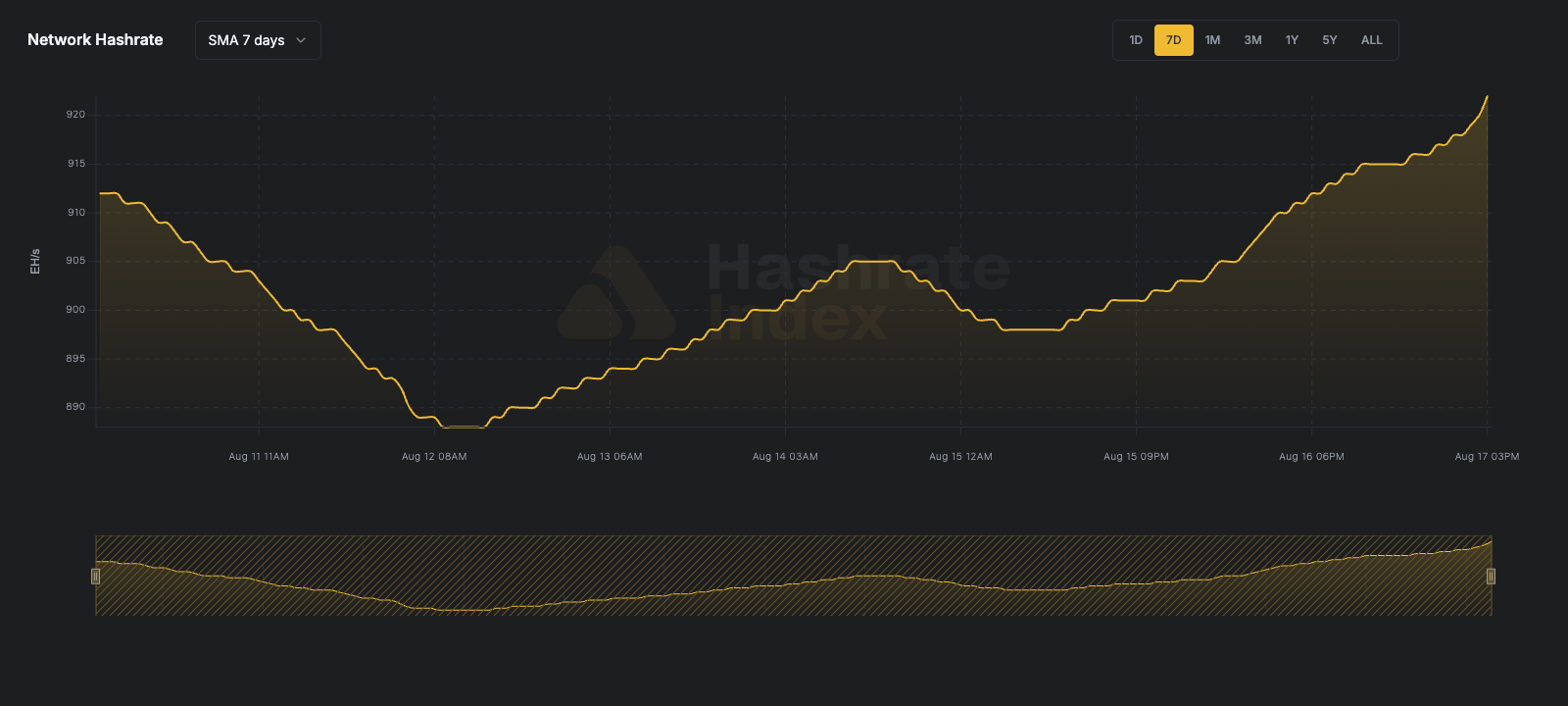
The global Bitcoin mining sector navigated a period of marginal volatility during the week ending August 17, 2026, as the industry balanced a slight decline in asset pricing against steady growth in network participation. While the spot price of Bitcoin retreated by approximately 1.0% to settle at $64,259, the total network hashrate continued its climb, reaching a seven-day simple moving average (SMA) of 920 EH/s. This divergence—where hashrate increases despite downward price pressure—highlights the ongoing commitment of industrial-scale operators to infrastructure expansion, even as profitability margins remain compressed.
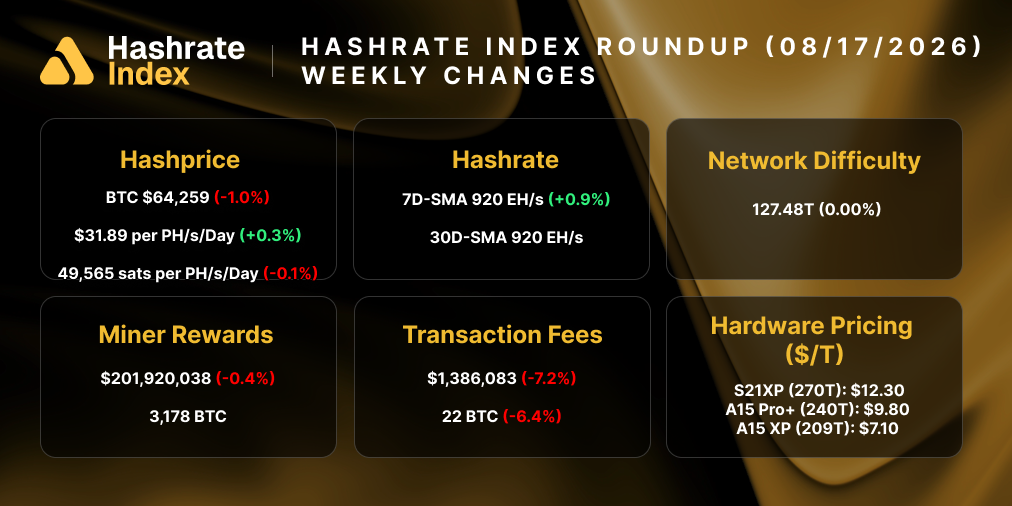
Miners collectively earned approximately 3,178 BTC in block rewards over the past seven days, a figure representing roughly $201 million in gross revenue. However, the contribution of transaction fees to this total remained modest, accounting for only 0.69% of the aggregate reward, or 22 BTC (approximately $1.39 million). This low fee environment continues to place the burden of profitability squarely on the issuance of new block rewards and the operational efficiency of individual mining fleets.
The State of Hashprice and Profitability
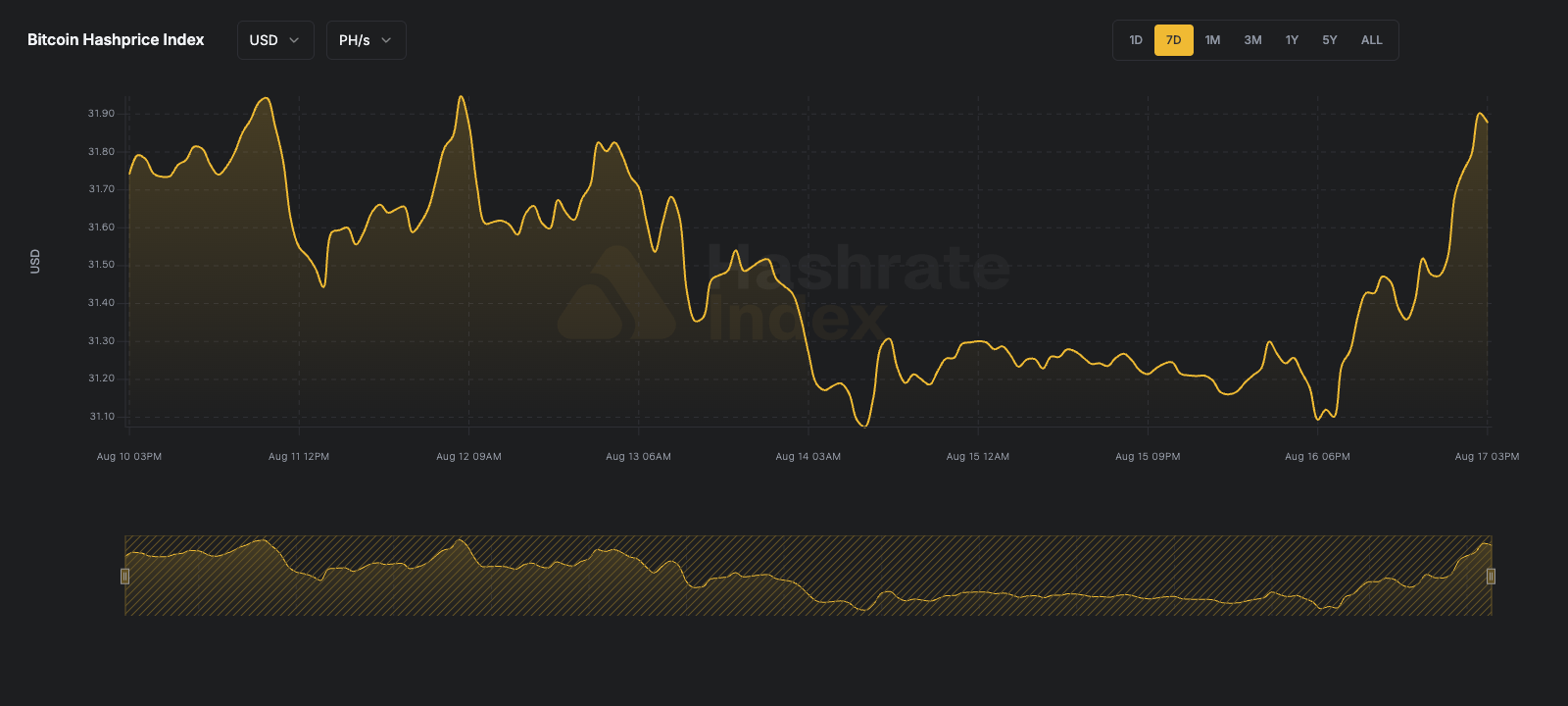
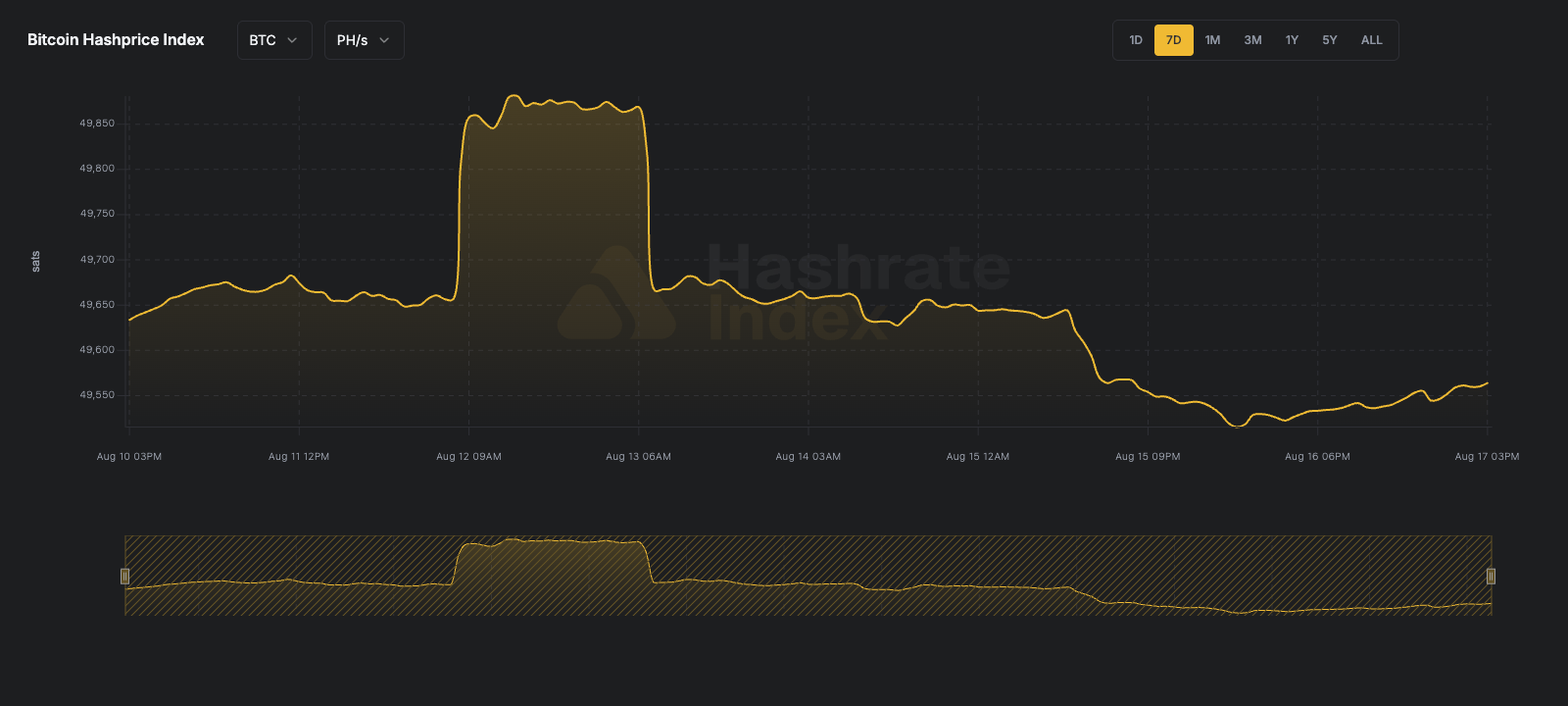
Hashprice, the key metric representing the daily revenue expected from one petahash per second (PH/s) of computing power, saw a slight uptick of 0.3% to reach $31.89 per PH/s/day. This recovery follows a challenging period where many operators faced margins at or near their operational breakeven points. When measured in BTC terms, however, hashprice experienced a marginal contraction of -0.1%, settling at 0.00049565 BTC per PH/s/day.
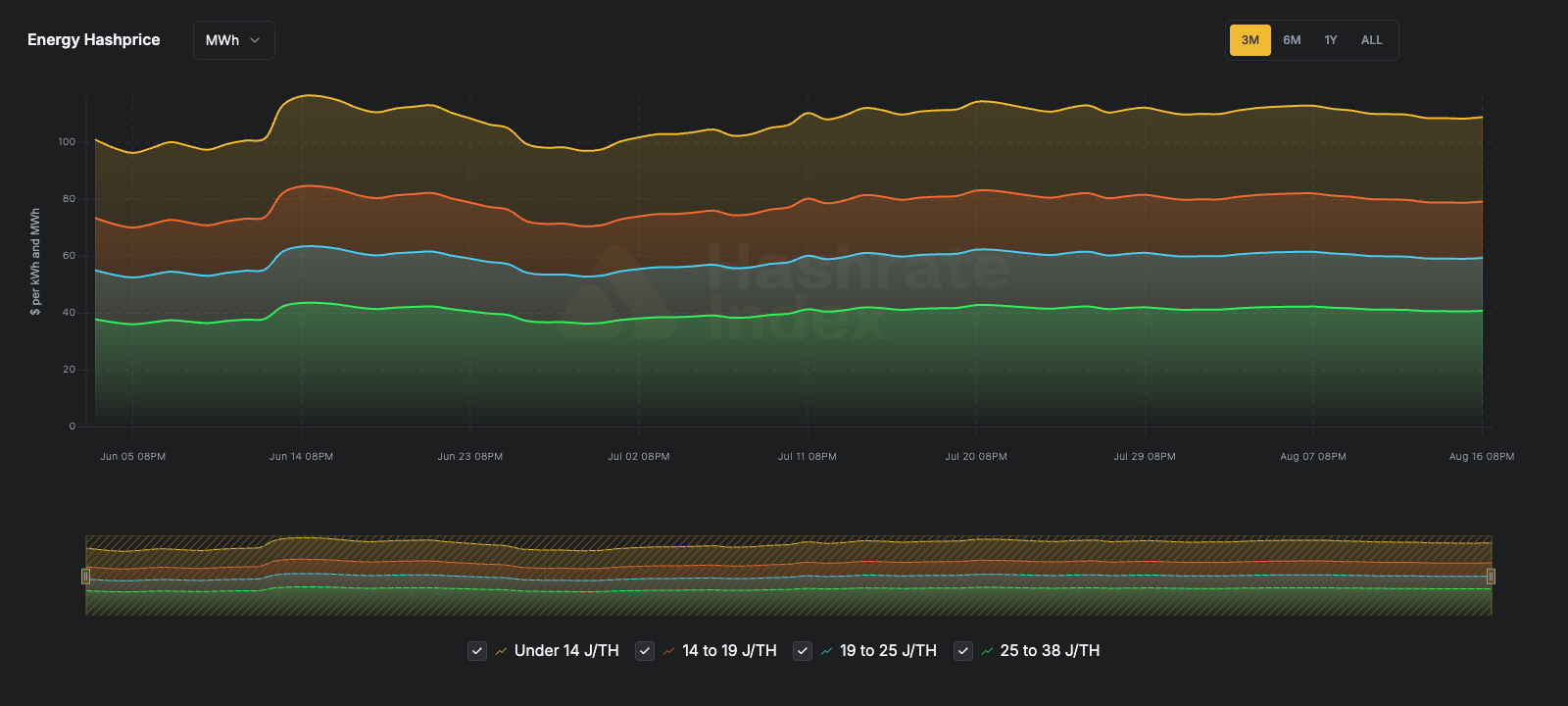
The discrepancy between the USD and BTC-denominated hashprice underscores the sensitivity of mining economics to the underlying market price of Bitcoin. For many firms, the current hashprice environment necessitates a relentless focus on hardware efficiency. Operators utilizing legacy equipment, such as various S19 iterations, are increasingly turning to third-party firmware solutions to optimize energy consumption and squeeze additional terahash output from their existing assets. Without such optimizations, the tightening margins—compounded by the recent network difficulty increases—threaten to render less efficient operations obsolete in the current high-energy-cost environment.
Network Hashrate and Difficulty Adjustments
The Bitcoin network continues to exhibit robust growth in computational security, with the seven-day SMA for the network hashrate rising from 912 EH/s to 920 EH/s. This 0.9% increase indicates that despite the reduction in block subsidy rewards following the most recent halving, mining firms are continuing to deploy capital toward newer, more efficient hardware, such as the S21 series.
The network’s difficulty, which automatically adjusts to maintain a target block production time of 10 minutes, last shifted on August 8, 2026, with an upward adjustment of 0.99% to 127.48T. With block times currently averaging 9 minutes and 54 seconds, the network is operating slightly faster than its nominal pace. Analysts project that the next difficulty adjustment will occur on August 22, 2026, with an estimated further increase of 1.01%. This continued upward pressure on difficulty serves as a double-edged sword: while it enhances the immutability and security of the Bitcoin blockchain, it simultaneously raises the barrier to entry for smaller, less capitalized miners who cannot benefit from economies of scale.
Transaction Fee Dynamics and Revenue Models
Transaction fees remained depressed throughout the week, with an average of 0.0210 BTC collected per block. This represents a 7% decline compared to the previous week’s figures. For long-term mining sustainability, the industry has historically looked toward a transition where transaction fees eventually replace the diminishing block subsidy as the primary incentive for miners. Current data suggests that the network is not yet at a stage where fee-based revenue can sustain the current global hashrate, leaving the sector highly dependent on the market price of BTC to cover operational expenditures (OPEX).
The persistent lack of significant fee pressure, despite periodic interest in Layer 2 scaling solutions and ordinals, means that miners remain in a "subsidy-dependent" cycle. Market participants are closely watching for any sustained increase in on-chain activity that could bolster fee revenue, as this would provide a necessary buffer against potential price volatility.
Institutional Mining Equities and Market Sentiment
Equity markets responded positively to the sector’s resilience, with major publicly traded mining companies seeing broad-based gains over the five-day trading period. Notable performers included BTBT, which rose by 23.1%, and DMGI, which saw a 22.0% increase. Larger cap entities also experienced upward momentum, with IREN reaching a market capitalization of $16.58 billion after a 15.9% gain, and WULF showing an 8.6% increase to reach a market cap of $8.82 billion.
The strength in mining stocks suggests that investors are increasingly viewing these companies not merely as Bitcoin proxies, but as specialized infrastructure providers with diversified revenue streams. Many of these firms have begun pivoting toward high-performance computing (HPC) and artificial intelligence (AI) data center hosting to hedge against the inherent cyclicality of Bitcoin mining. This diversification strategy is intended to provide a more stable cash flow, as hosting for AI workloads typically commands higher margins and longer-term contracts than pure-play proof-of-work mining.
Looking Forward: The Hashrate Forward Market
The forward market, which allows miners to hedge their future production, is currently pricing in an average hashprice of approximately $30.67 over the next six months. This forward-looking sentiment suggests that institutional players expect the current price environment to remain relatively stable, with little expectation for a major breakout or collapse in the short-to-medium term.
This stability provides a baseline for corporate budgeting, allowing mining firms to forecast their revenues with a higher degree of confidence. However, the market remains susceptible to exogenous shocks, particularly regarding energy policy shifts and regulatory developments in key mining jurisdictions. As the industry matures, the use of these derivative instruments is becoming standard practice, allowing firms to move away from speculative models toward more traditional treasury management.
Broader Implications for the Industry
The current state of the Bitcoin mining industry is defined by an era of professionalization and consolidation. As smaller operators exit the market due to rising difficulty and tightening margins, larger, publicly traded firms are absorbing the market share. This trend toward centralization in terms of corporate ownership is an inevitable byproduct of the maturation of the sector, but it remains a point of discussion regarding the decentralized ethos of the Bitcoin network.
Furthermore, the integration of Bitcoin mining with energy infrastructure—specifically through demand-response programs and the utilization of stranded gas—continues to be a critical development. By acting as a flexible load for power grids, miners are positioning themselves as essential partners for energy providers. As we move into the latter half of 2026, the success of mining operations will likely be measured by their ability to achieve the lowest possible cost per kilowatt-hour, rather than just the highest hash density.
In conclusion, the week ending August 17, 2026, serves as a microcosm of the current mining landscape: persistent growth in network infrastructure, cautious optimism in the equities market, and a relentless focus on efficiency as the primary driver of survival. With the upcoming difficulty adjustment on the horizon, the pressure on miners to optimize their fleets remains higher than ever. As the industry continues to navigate these economic headwinds, the focus remains on long-term sustainability and the integration of mining operations into the global energy fabric. The coming months will be pivotal in determining which firms possess the operational resilience to thrive in this increasingly competitive and capital-intensive environment.