The global Bitcoin mining landscape displayed a complex interplay of divergent metrics during the second week of July 2026, characterized by a notable increase in miner profitability despite a cooling broader market. While the spot price of Bitcoin and the total network hashrate experienced downward pressure, the "hashprice"—a critical measure of mining revenue—saw a resilient uptick. This paradox was primarily driven by a substantial negative adjustment in network difficulty, which provided a much-needed reprieve for operators navigating a challenging fiscal year. Over the seven-day period ending July 13, 2026, the mining community successfully extracted approximately 2,914 BTC in block rewards, generating a total estimated revenue of $184 million.
Macroeconomic Context and Bitcoin Price Action
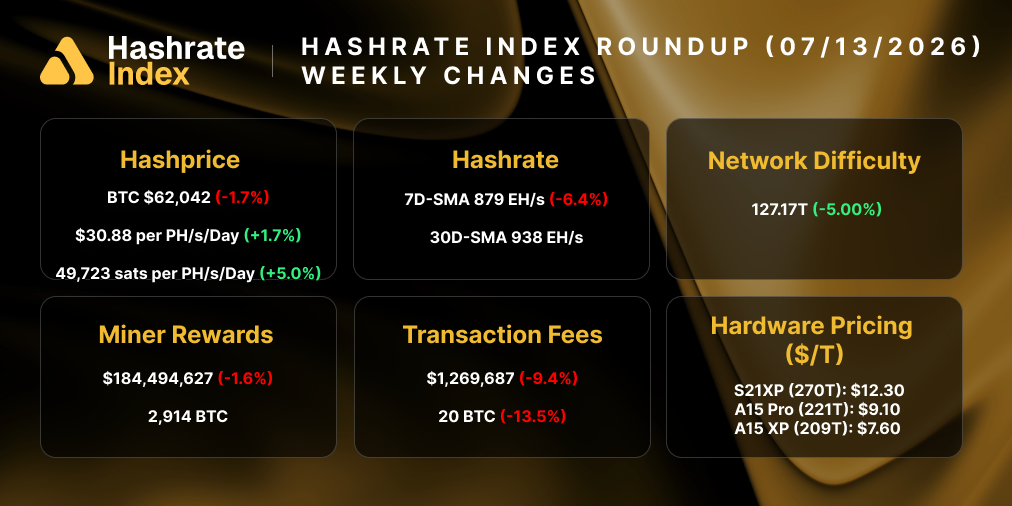
The digital asset market continued to face headwinds as Bitcoin’s price retreated by 1.7% over the week. Starting the period at approximately $63,140, the premier cryptocurrency slipped to a closing price of $62,042. This movement reflects a broader trend of volatility that has defined the 2026 fiscal year. On a Year-to-Date (YTD) basis, Bitcoin’s performance remains significantly suppressed, currently standing at -29.1%.
Institutional sentiment, as reflected in the Chicago Mercantile Exchange (CME) futures market, remains cautious. While the spot price hovered around the $62,000 mark, 24-hour previous spot prices reached as high as $63,740, indicating a sharp short-term rejection of higher price levels. Analysts attribute this stagnation to a combination of macroeconomic uncertainty in traditional markets and a lack of immediate catalysts within the crypto-native ecosystem. For miners, the price decline typically signals a tightening of margins, but the concurrent drop in network competition has altered the traditional correlation between price and profitability this week.
Hashprice Resilience and Revenue Analysis
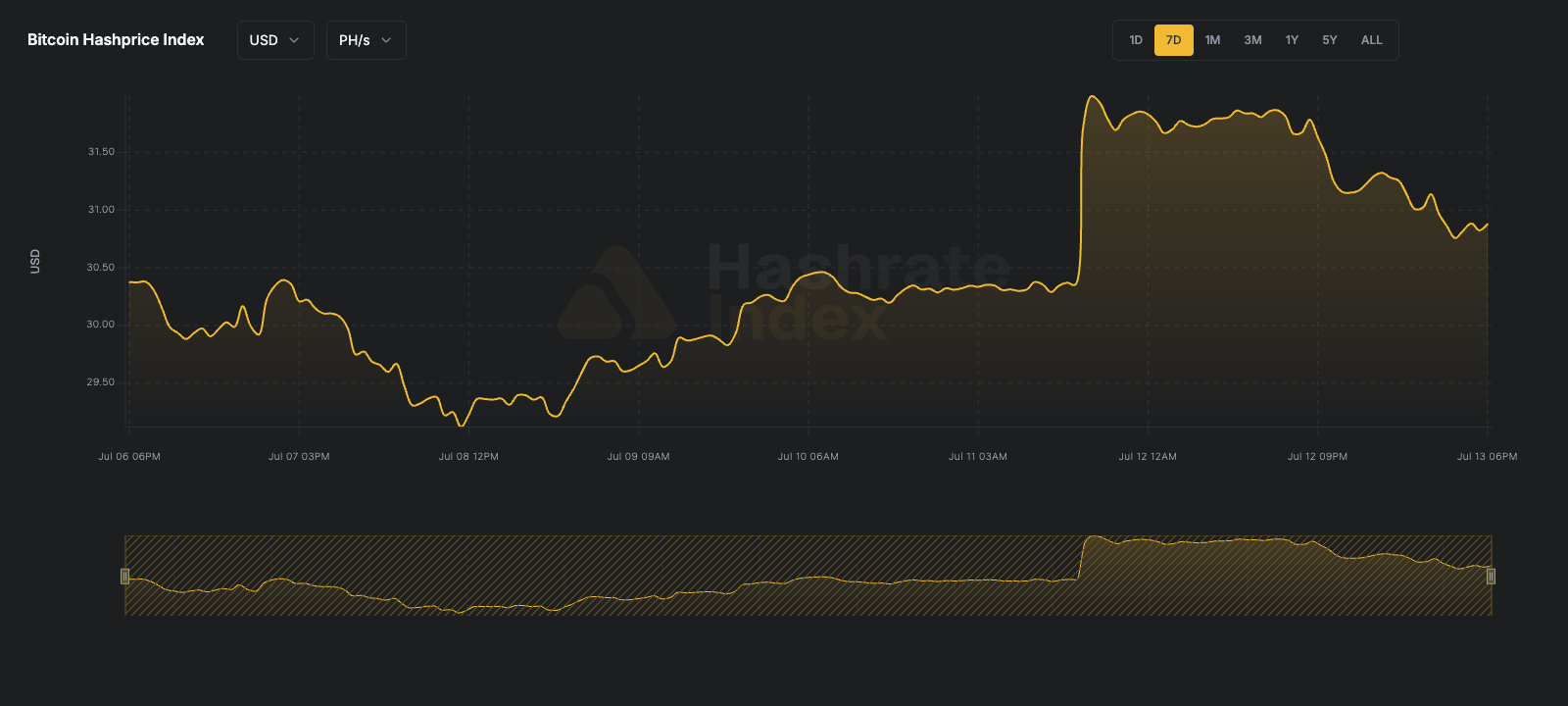
In a surprising turn for market participants, the USD hashprice—the expected value of 1 Petahash per second (PH/s) of hashing power per day—rose by 1.7%, climbing from $30.36 to $30.88. This metric is the primary indicator of mining profitability, and its rise during a period of falling Bitcoin prices is a rare occurrence that highlights the impact of network difficulty on the bottom line.
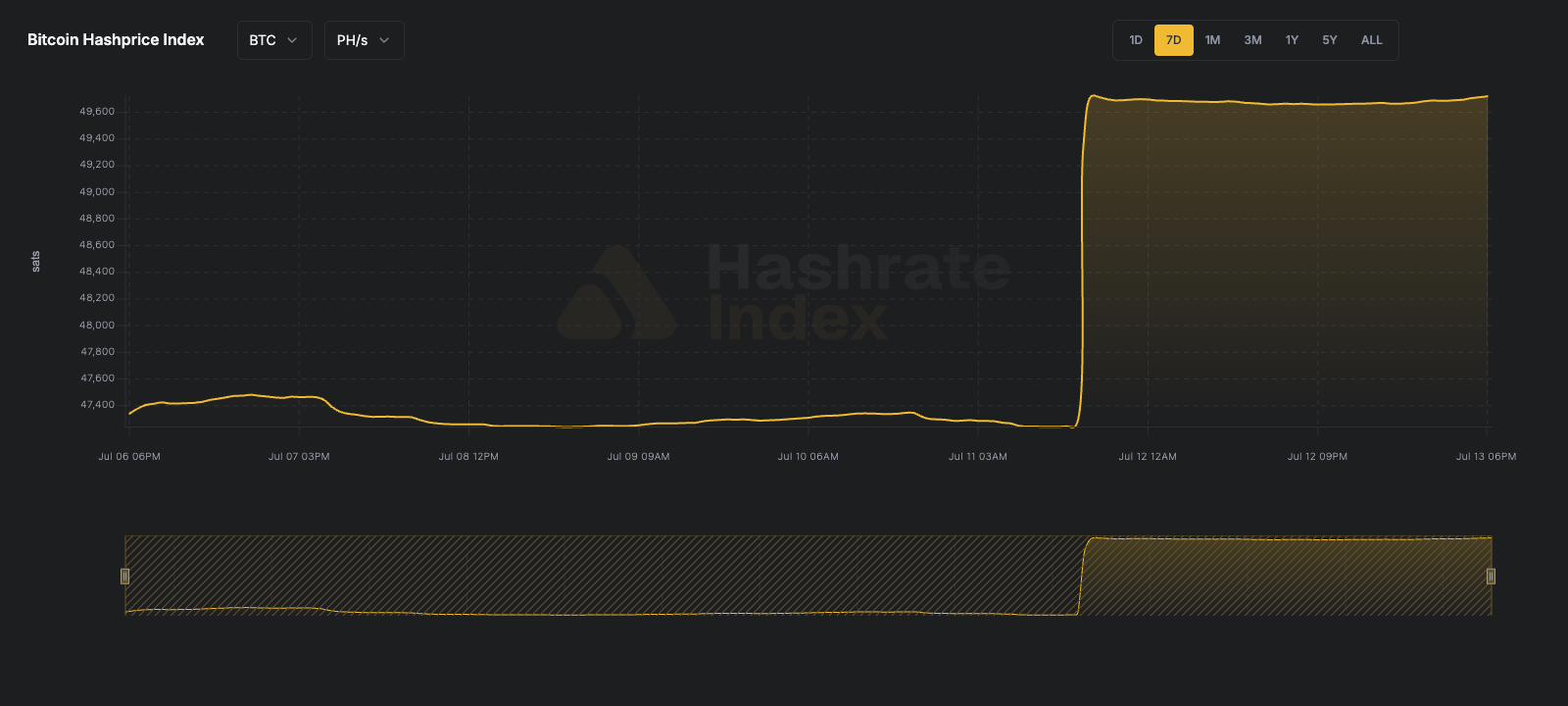
The BTC-denominated hashprice showed even more significant strength, surging by 5.0% to reach 0.00049723 BTC per PH/s/Day. This suggests that for those who measure their success in "Sats" rather than dollars, the current environment is becoming increasingly favorable. The 30-day average hashprice now sits at $30.64, indicating that while the weekly jump was sharp, the long-term trend is one of stabilization following the extreme volatility seen earlier in the year.
The revenue composition for the week revealed a continued reliance on the block subsidy rather than transaction fees. Total transaction fees accounted for only 0.69% of total block rewards, amounting to roughly 20 BTC or $1.27 million. This represents an 18% decline in fee revenue compared to the previous week, where miners collected an average of 0.0244 BTC per block. The current average has settled at 0.0200 BTC per block, suggesting a period of low network congestion and a temporary lull in the high-fee activities, such as inscription-based protocols or decentralized finance applications on the Bitcoin layer.
Network Dynamics: Hashrate and the Difficulty Pivot
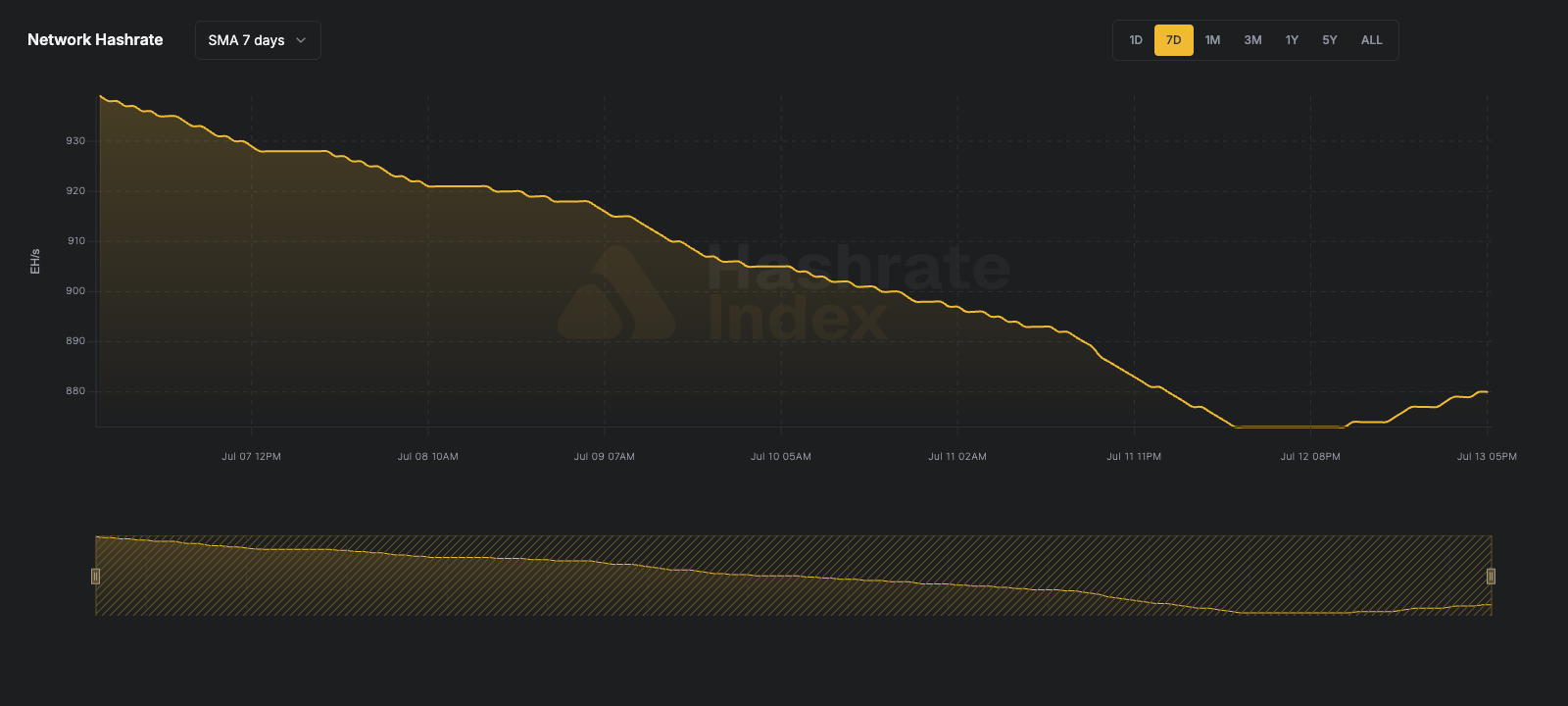
The most significant driver of the week’s metrics was the massive shift in network hashrate and the subsequent difficulty adjustment. The network hashrate, measured as a 7-day simple moving average (SMA), plummeted by 6.4%, dropping from 939 EH/s to 879 EH/s. This contraction in computing power suggests that several large-scale operations may have temporarily powered down units due to localized energy price spikes or maintenance cycles.
In response to the slowing hashrate, the Bitcoin protocol executed a downward difficulty adjustment on July 11, 2026. The network difficulty decreased by 5.00%, bringing the current difficulty level to 127.17T. This is one of the more significant negative adjustments in recent months, effectively making it 5% easier for the remaining active miners to find blocks.
The immediate impact of this adjustment is visible in block times, which averaged 9 minutes and 44 seconds over the last 24 hours—slightly faster than the targeted 10-minute interval. Looking ahead, early estimates for the next adjustment, scheduled for July 25, 2026, suggest a potential rebound of +2.74%. However, analysts caution that these early-epoch estimates are subject to high variance as only 16% of the current 2,016-block epoch has been completed.
Publicly Traded Mining Sector and Equity Performance
The performance of Bitcoin mining stocks was characterized by extreme divergence, reflecting specific corporate developments rather than a unified sector trend. While the underlying commodity and network metrics were relatively stable, equity investors reacted sharply to individual company news.
One of the most anomalous movements was seen in LMFA, which recorded a staggering 1846.7% increase in stock price, likely due to a corporate restructuring or a technical adjustment such as a reverse stock split. Conversely, Applied Digital (ABTC) saw its share price crater by 37.7%, ending the week at $5.29. Other major players also faced downward pressure:
- Iris Energy (IREN): Declined by 11.2% to $38.98, though it maintains a dominant market capitalization of $13.93 billion.
- Riot Platforms (RIOT): Fell by 11.7% to $20.19, with a market cap of $7.63 billion.
- CleanSpark (CLSK): Dropped 8.5% to $12.36.
- TeraWulf (WULF): Slipped 5.9% to $20.89, maintaining a $10.35 billion market cap.
The mixed performance in the equity markets highlights the growing divide between "low-cost" miners and those struggling with high debt loads or inefficient hardware. With hashprice lingering near the $31 mark, many operations are operating at or near their breakeven points. Industry experts suggest that the current market phase is one of "forced efficiency," where only those with access to ultra-low-cost power and the latest generation of hardware—such as the S21XP series—can maintain healthy margins.
The Forward Curve and Future Outlook
The Hashrate Forward Market provides a window into institutional expectations for the remainder of 2026. Current pricing on the Luxor Hashrate Forward Curve indicates a market consensus that hashprice will average approximately $30.00 (or 0.00048 BTC) over the next six months. This suggests that the market does not expect a significant "bull run" in mining profitability in the immediate future, but rather a sustained period of consolidation.
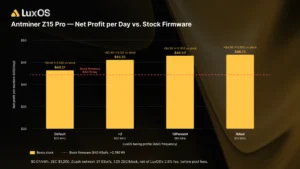
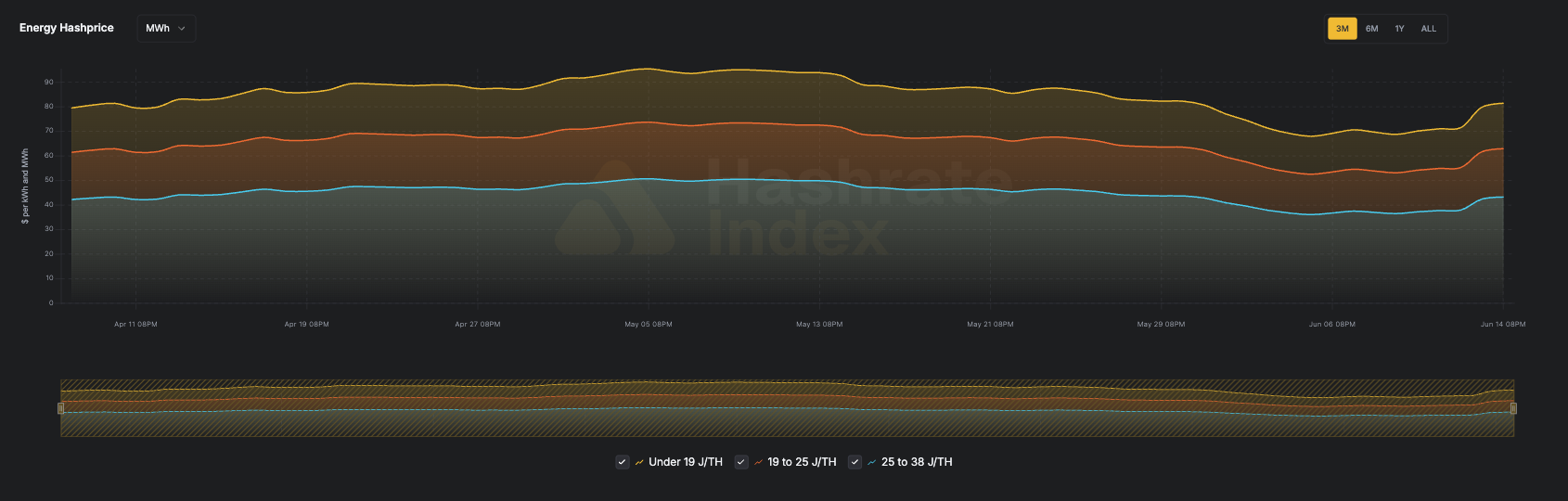
For miners, the primary strategy moving forward involves mitigating the risks of low hashprice through firmware optimization and hedging. At $31 per PH/s/Day, the margin for error is razor-thin. Software solutions like LuxOS are becoming industry standards as they allow miners to underclock machines for better efficiency or overclock them during periods of low energy costs to maximize output.
Implications for the Global Mining Industry
The data from the week of July 13, 2026, underscores a maturing industry that is increasingly sensitive to network difficulty as a balancing mechanism. The 5% drop in difficulty acted as a pressure valve, preventing a wider exodus of miners following the Bitcoin price dip. However, the 29.1% YTD decline in Bitcoin’s price continues to cast a shadow over the sector’s long-term capital expenditure plans.

The broader implication is that the "hashrate war" has entered a phase of attrition. The reduction in 7-day SMA hashrate to 879 EH/s indicates that even the most robust operations are finding it necessary to optimize their fleets. As the industry looks toward the end of the year, the focus will likely remain on power-purchase agreement (PPA) negotiations and the integration of AI-compute services to diversify revenue streams—a trend already being explored by firms like Core Scientific (CORZ) and IREN.
In conclusion, while the weekly headlines might suggest a "mixed bag," the underlying narrative is one of a resilient network that continues to self-correct. The increase in hashprice provides a temporary buffer for operators, but the looming threat of a difficulty rebound on July 25 means that efficiency remains the only sustainable path to survival in the 2026 mining environment. Happy Hashing.