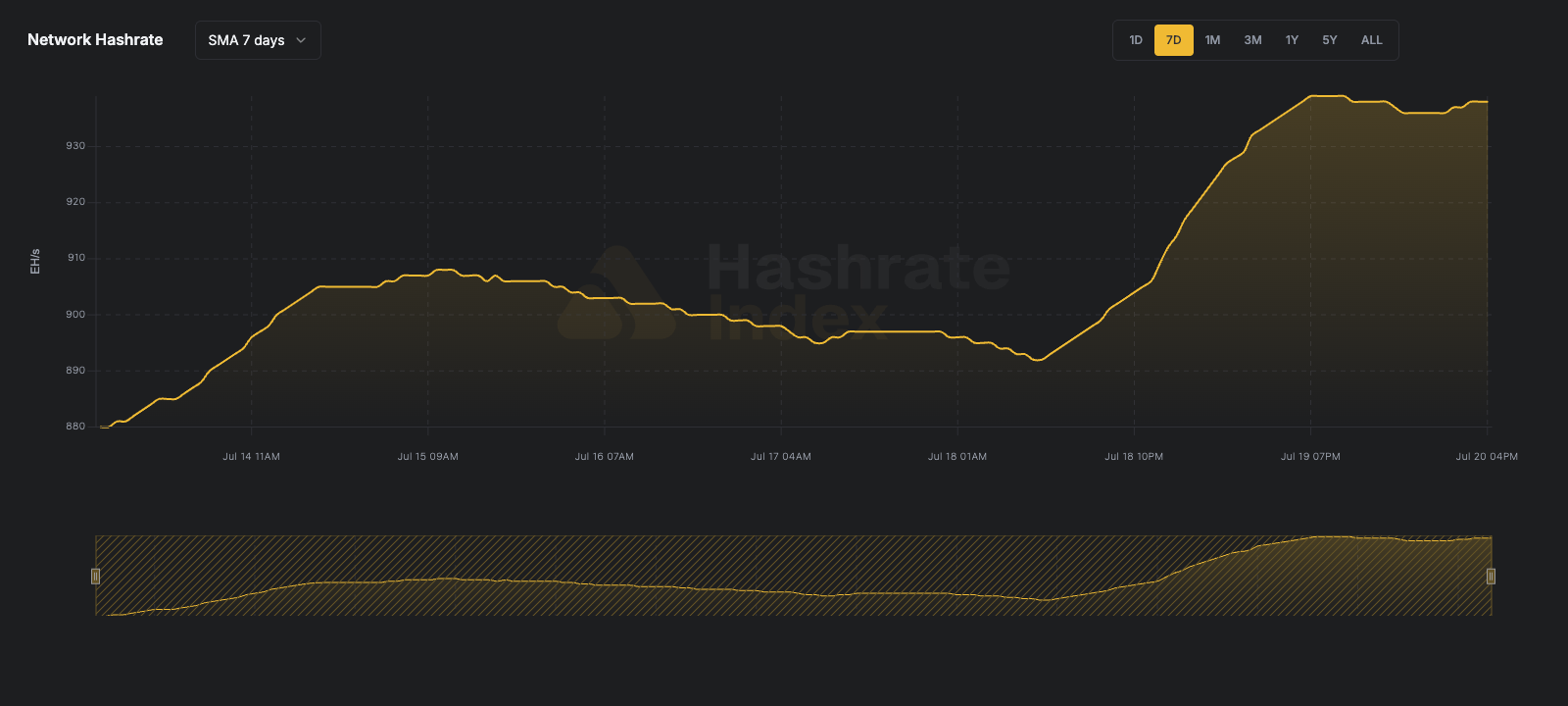
The global Bitcoin mining landscape witnessed a significant period of growth during the week ending July 20, 2026, as a "green" market sentiment took hold across the sector’s primary metrics. During this seven-day window, Bitcoin’s spot price experienced a 4.1% appreciation, climbing from approximately $62,759 to a week-ending price of $65,330. This price recovery provided a much-needed tailwind for mining operations, which have faced compressed margins throughout the 2026 fiscal year. Accompanying the price surge was a notable 6.5% increase in the network’s 7-day simple moving average (SMA) hashrate, which climbed to 937 EH/s, signaling a robust deployment of new-generation hardware and a possible return to operation for miners previously sidelined by high energy costs.
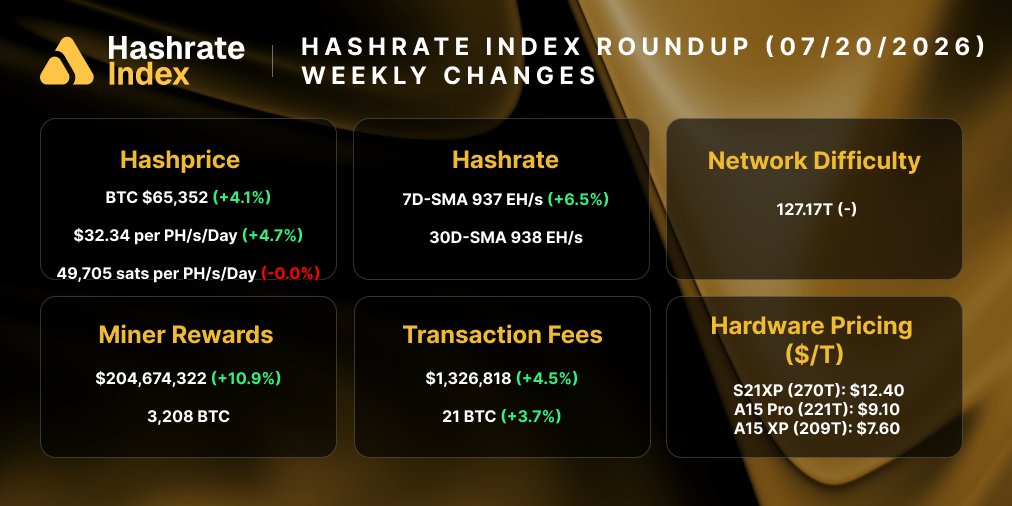
Total miner revenue for the week reached approximately 3,208 BTC, which translates to a fiat value of roughly $204 million. Of this total, transaction fees contributed 21 BTC, or about $1.33 million. While transaction fees represented a modest 0.65% of the total block rewards, the 4% week-over-week increase in fee volume suggests a subtle uptick in on-chain activity. This revenue boost is particularly critical as the industry continues to navigate the post-2024 halving environment, where block subsidies remain at 3.125 BTC per block, making every marginal increase in hashprice and transaction fees vital for long-term sustainability.
The State of Network Difficulty and Hashrate Dynamics
The Bitcoin network’s computational power showed remarkable resilience over the past week. The 7-day SMA hashrate reached 937 EH/s, while the 30-day SMA stood even higher at 938 EH/s. This proximity between the short-term and long-term moving averages suggests that the network is finding a new baseline of stability at nearly one zettahash per second. The increase in hashrate follows a significant downward difficulty adjustment that occurred on July 11, 2026. During that adjustment, the network difficulty decreased by 5.00%, settling at 127.17T.
This reduction in difficulty effectively lowered the barrier to entry for miners, allowing for higher block production efficiency. Current data indicates that block times have averaged 9 minutes and 45 seconds over the last 24 hours, running slightly faster than the targeted 10-minute interval. Consequently, the network is currently 66% of the way through its current difficulty epoch. Projections for the upcoming adjustment, slated for July 25, 2026, estimate a 2.56% increase in difficulty. If this trend holds, the network will reclaim some of the "easiness" granted by the July 11 drop, reflecting the rapid onboarding of hashpower in response to the improved price action.
The interplay between hashrate and difficulty remains the primary lever for miner profitability. Analysts suggest that the recent surge in hashrate is likely driven by large-scale public miners fulfilling multi-year hardware procurement contracts, specifically involving high-efficiency models like the Antminer S21 and Whatsminer M60 series. As these machines come online, the global hashrate is expected to continue its upward trajectory, potentially testing the 1,000 EH/s (1 ZettaHash) milestone before the end of the third quarter.
Hashprice Recovery and Operational Breakeven Points
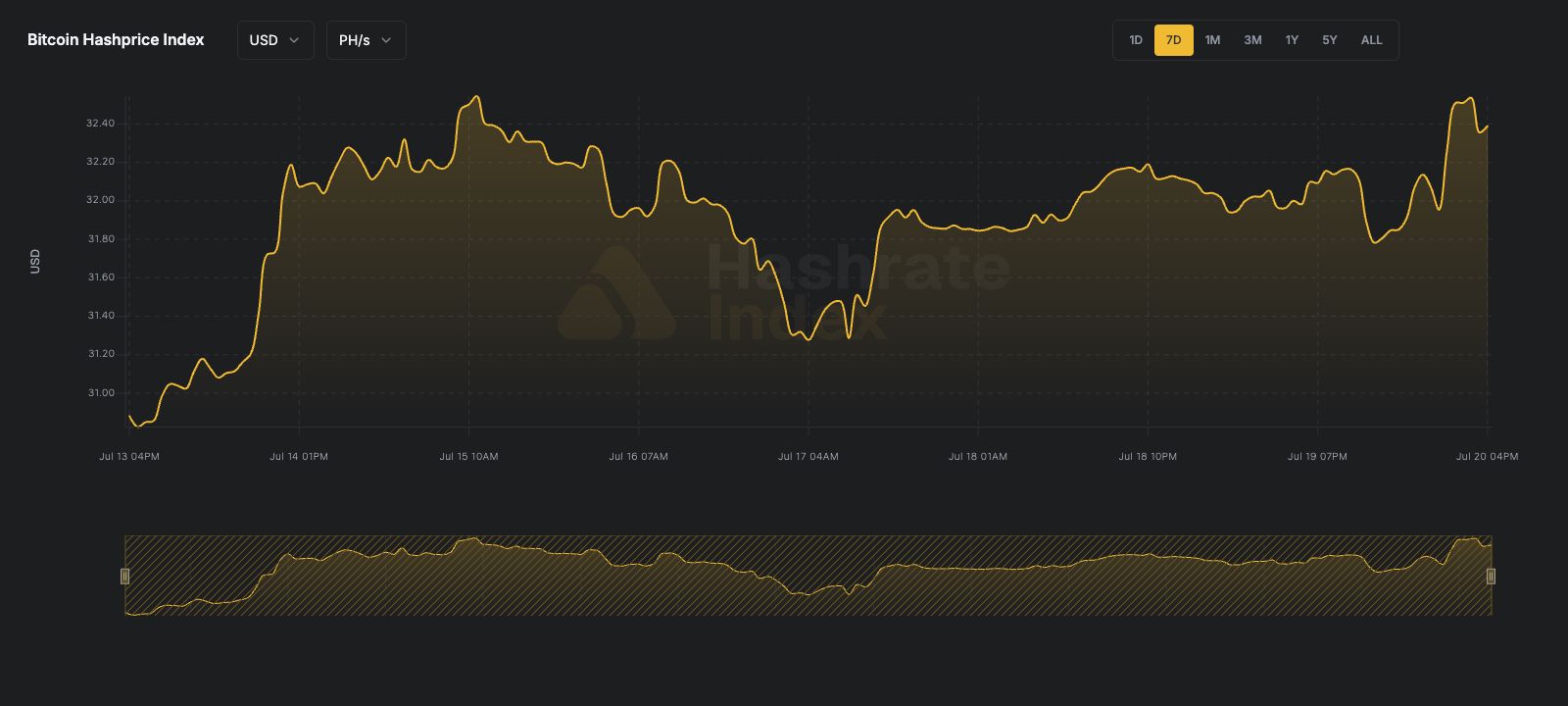
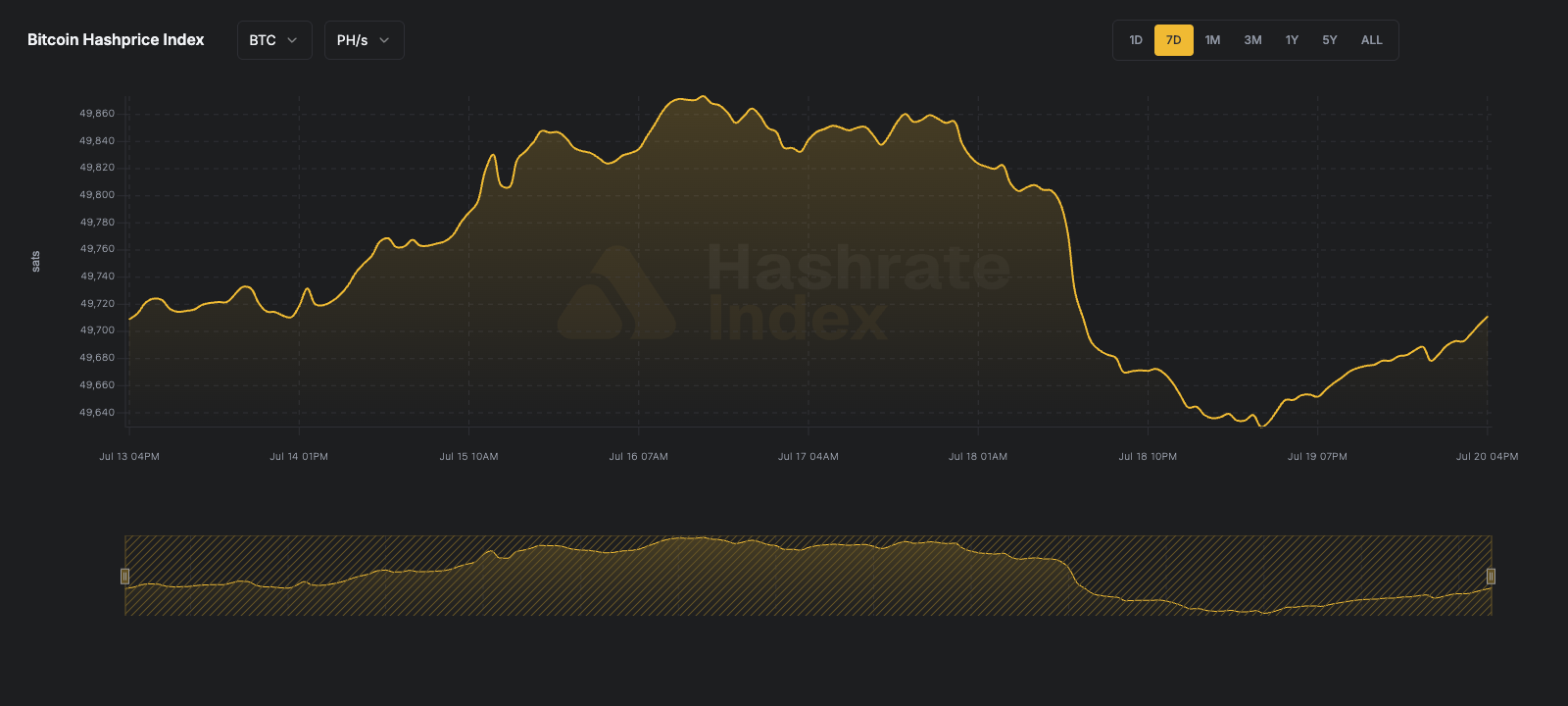
The most vital metric for mining profitability, the USD Hashprice, saw a positive move of 4.7% over the week. Starting at $30.88 per PH/s/Day, the hashprice rose to $32.34 by July 20. This metric represents the expected value of 1 petahash of hashing power per day and is influenced by Bitcoin’s price, network difficulty, and transaction fees. While the USD-denominated hashprice rose due to Bitcoin’s price appreciation, the BTC-denominated hashprice remained virtually flat, moving from 0.00049707 BTC to 0.00049705 BTC per PH/s/Day.
At the current level of $32.34, many miners are operating near their breakeven points. For a miner using hardware with an efficiency of 20 J/TH, an electricity cost of $0.06/kWh results in a breakeven hashprice of approximately $28.80. This leaves a slim but manageable margin. However, older fleets or those with higher power costs—exceeding $0.07/kWh—are likely finding themselves underwater or operating at zero margin. This economic reality has led to an increased adoption of third-party firmware solutions, such as LuxOS, which allow miners to underclock machines for better efficiency or overclock them during periods of high hashprice to maximize revenue.
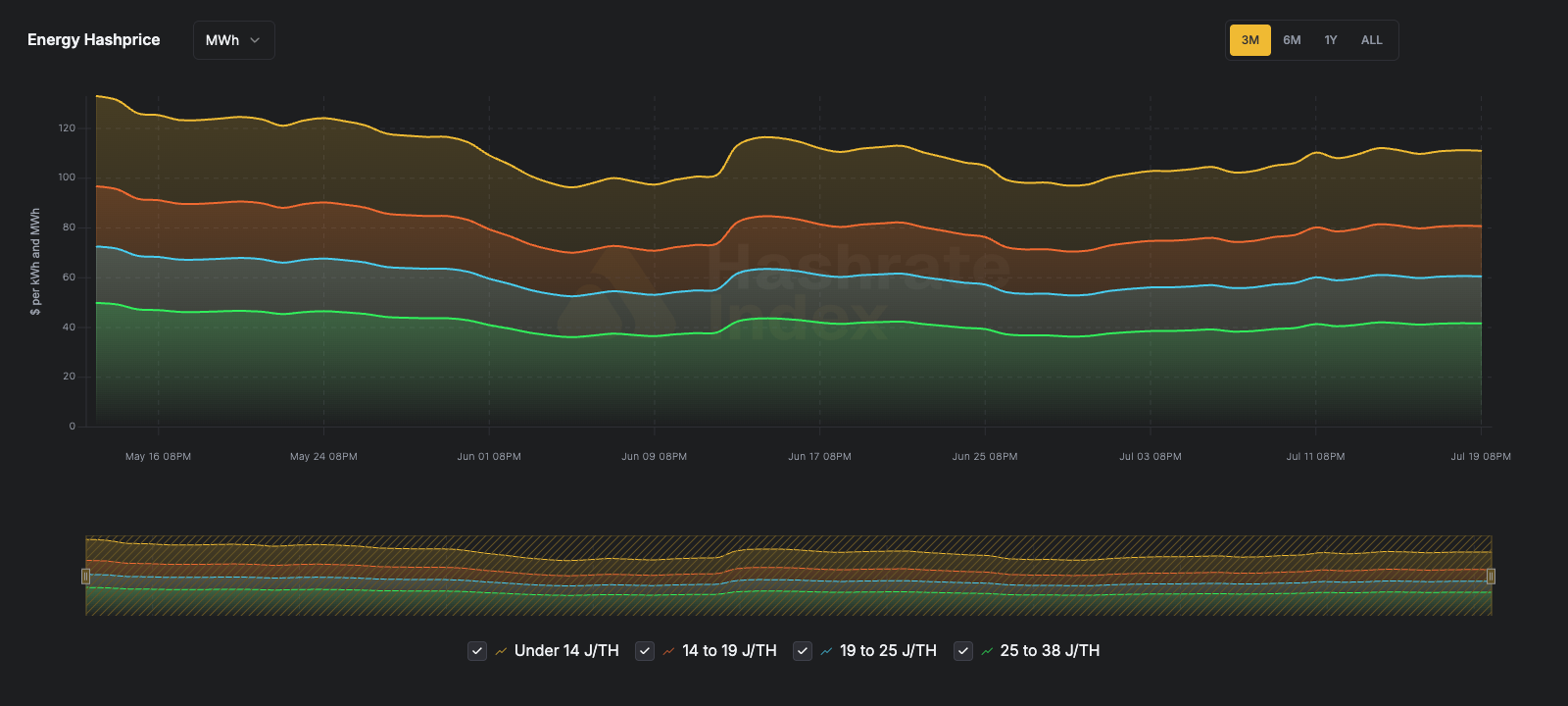
The Energy Hashprice Index, which measures compute revenue per megawatt-hour (MWh), has also shown signs of stabilization. This metric is increasingly used by industrial-scale miners to compare Bitcoin mining returns against alternative uses of energy, such as selling power back to the grid during peak demand or pivoting toward High-Performance Computing (HPC) and Artificial Intelligence (AI) workloads.
Divergent Performance in Bitcoin Mining Equities
The equity markets for Bitcoin mining companies reflected a week of mixed sentiment and idiosyncratic volatility. While the underlying asset (Bitcoin) rose by 4.1%, individual stock performances varied wildly based on company-specific news, debt restructuring, or expansion announcements.
Soluna Holdings (SLNH) emerged as the week’s top performer, posting a 21.4% gain to reach a share price of $1.36. CleanSpark (CLSK) also saw a significant rally, jumping 16.7% to $14.42, buoyed by its reputation for high operational uptime and aggressive fleet upgrades. On the other end of the spectrum, Alset Inc. (AIBZ) plummeted by 18.7%, and LM Funding America (LMFA) dropped 16.1%.
Institutional interest in the sector appears to be concentrating on "Tier 1" miners with large market capitalizations and diversified revenue streams. Iris Energy (IREN), for instance, maintains a massive market cap of $14.37 billion, reflecting investor confidence in its hybrid Bitcoin-AI data center model. Similarly, TeraWulf (WULF), with a market cap of $9.35 billion, continues to be a favorite among ESG-focused investors due to its utilization of zero-carbon nuclear energy. The divergence in stock performance highlights a maturing market where investors are no longer treating all miners as a monolith, instead rewarding those with the lowest power costs and the most robust balance sheets.
Forward Market Projections and Industry Implications
Looking ahead, the Hashrate Forward Market provides a glimpse into industry expectations for the remainder of 2026. The forward curve is currently pricing in an average hashprice of $30.77 (or 0.00048 BTC) over the next six months. This suggests that the market anticipates a slight cooling of the current $32.34 level, likely due to expected increases in network difficulty as more hashrate joins the network.
The implications of these figures are twofold. First, the industry is entering a phase of consolidation. Smaller, less efficient miners who cannot hedge their production via forward contracts or secure sub-$0.05/kWh power may be forced to sell their assets to larger, publicly traded entities. Second, the "hashrate war" shows no signs of slowing. As long as Bitcoin’s price remains above the $60,000 threshold, the incentive to deploy more hardware remains high, even if it results in higher difficulty for the entire network.
The modest role of transaction fees (0.65% of rewards) remains a point of long-term concern for the network’s security budget. While the "Inscriptions" and "Runes" craze of 2024 and 2025 provided temporary spikes in fee revenue, the current environment shows a return to a subsidy-heavy revenue model. Industry analysts argue that for the network to remain secure in future halving cycles, transaction fees must eventually account for a significantly larger portion of the total block reward.
Conclusion
The week ending July 20, 2026, was a period of cautious optimism for the Bitcoin mining sector. With the spot price of Bitcoin reclaiming the $65,000 level and the USD hashprice moving upward, miners have gained a temporary reprieve from the "hashprice floor" that threatened operations earlier in the year. However, with network difficulty poised for a positive adjustment and hashrate continuing its climb toward historical highs, the competitive pressure remains intense.

As the industry moves into the late summer months, the focus will likely shift toward energy curtailment strategies and the integration of next-generation 3-nanometer ASIC chips. For now, the "green bag" of higher prices and increased revenue has provided the liquidity necessary for the world’s largest miners to continue their expansion, further securing the Bitcoin network while raising the stakes for all participants in the global arms race for hashrate.