
In one of the most staggering security incidents in the history of digital finance, cryptocurrency exchange Binance is currently managing the fallout from a devastating $6.3 billion security breach. The exploit, which unfolded rapidly on October 29, forced the global trading platform to suspend withdrawals, trigger emergency asset-freezing protocols across multiple blockchains, and rely heavily on decentralized network validators and centralized stablecoin issuers to mitigate the damage.
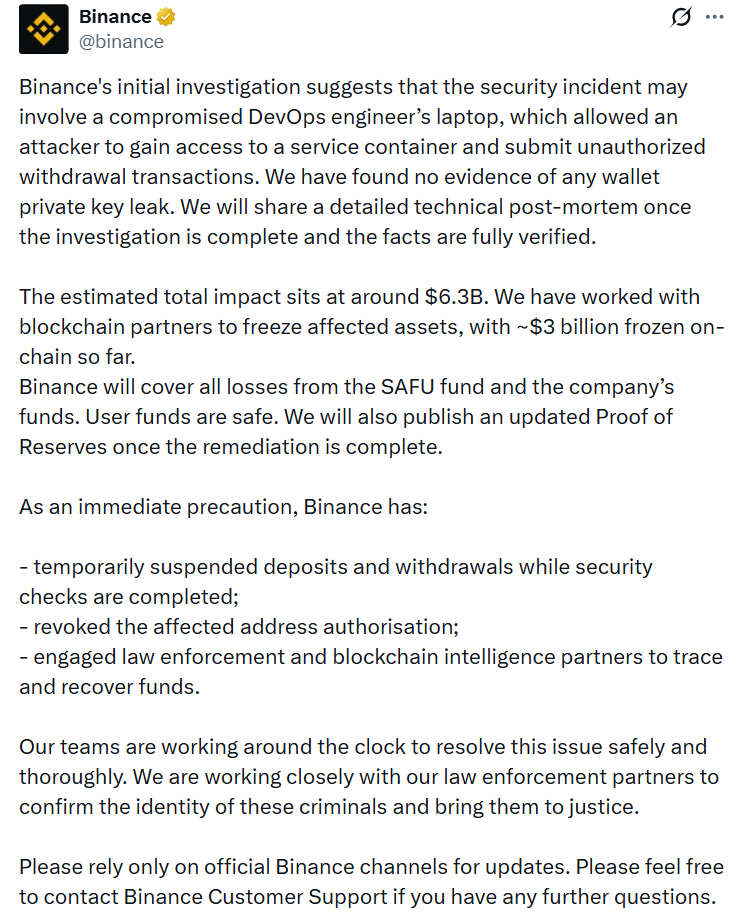
According to preliminary updates released by Binance on October 30, the multi-chain compromise stemmed from a compromised laptop belonging to a DevOps engineer. Unauthorized actors purportedly leveraged this single point of internal access to infiltrate a service container, bypass standard security perimeters, and submit a barrage of fraudulent withdrawal transactions. While the exchange has maintained that no wallet private keys were directly exposed or compromised during the attack, the vulnerability exposed a critical flaw in operational security: the systems authorized to automatically validate and process outgoing funds were insufficiently insulated from internal access risks.
This catastrophic event has sent shockwaves through the global cryptocurrency ecosystem, eclipsing all previous digital asset heists by a significant margin. As regulatory scrutiny mounts and users grapple with trading disruptions, the incident serves as a stark reminder of the persistent vulnerabilities inherent in centralized custody models, even for industry giants with advanced security frameworks.

A Rapid Chronology of the October 29 Multi-Chain Exploit
The scale and speed of the October 29 attack underscore a high degree of sophistication by the perpetrators. On-chain data gathered by independent blockchain intelligence firm TRM Labs reveals that the entire sequence of unauthorized transfers occurred within an astonishingly brief window of approximately 20 minutes.
During this compressed timeframe, malicious actors drained assets from Binance hot wallets across 10 distinct layer-1 and layer-2 blockchains. The impacted networks included high-volume chains such as Ethereum, Bitcoin, Tron, the XRP Ledger, Solana, Arbitrum, Avalanche, Optimism, Base, and Polygon. Because the attacker successfully triggered legitimate withdrawal pathways via the compromised DevOps infrastructure, the network validators processed the transactions as authentic user requests, complicating immediate automated detection.
Upon identifying abnormal outbound transaction volumes, Binance’s emergency response teams mobilized overnight, initiating a temporary halt on all withdrawals to stem the bleeding. Security personnel swiftly revoked the compromised authorization credentials, isolated the affected internal service containers, and launched a comprehensive forensic audit of the exchange’s withdrawal routing architecture.
Simultaneously, Binance reached out to external stakeholders, including foundational blockchain protocols, security councils, law enforcement agencies, and major stablecoin issuers. This rapid coordination triggered emergency defensive measures, leading to the freezing of billions of dollars in stolen assets before they could be laundered through decentralized mixing services.
The Scale of the Theft and Blockchain-Wide Recovery Efforts
With an estimated total impact of $6.36 billion, the Binance breach shatters previous records for cryptocurrency theft. To put the magnitude of the attack into perspective, it is more than four times larger than the $1.5 billion Bybit hack recorded in February 2025, which was previously considered one of the most destructive centralized exchange breaches in history.
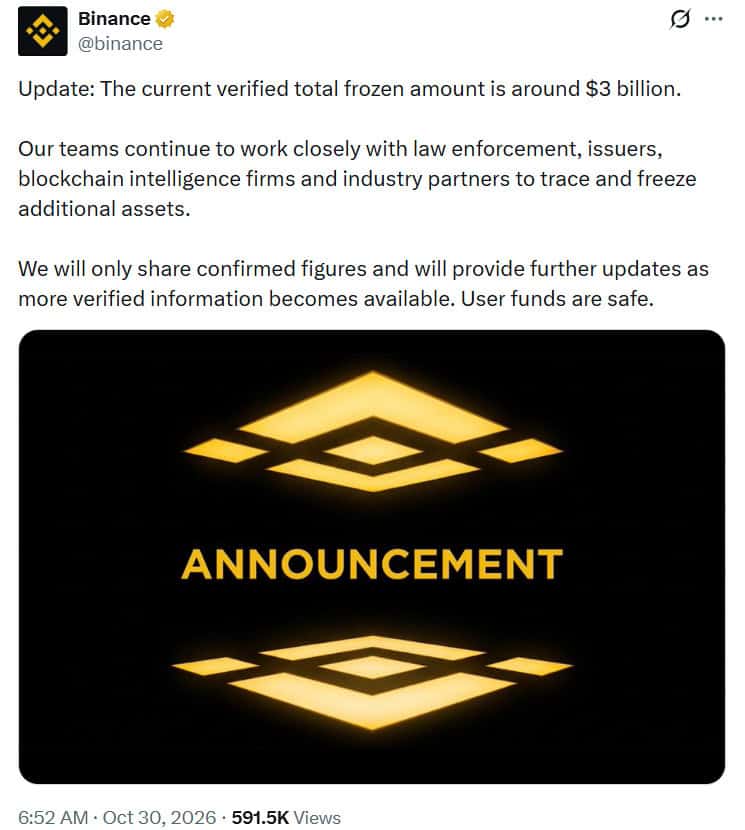
Despite the initial devastation, rapid intervention by industry partners yielded substantial results. TRM Labs and Binance both confirmed that approximately $3 billion in digital assets had been successfully frozen across the multi-chain ecosystem. The success of this recovery phase relied heavily on the centralized control mechanisms embedded within major stablecoins and the rapid governance actions of layer-2 networks.
Prominent stablecoin issuers played a pivotal role in intercepting the stolen funds. Tether led the defensive effort by freezing approximately $1.57 billion in USDT connected to the exploit addresses. Concurrently, Circle restricted the movement of more than $800 million in USDC. Furthermore, Binance Co-CEO Yi He reported that Ripple had intervened to freeze roughly $200 million in associated XRP ledger assets, while the Arbitrum Security Council executed emergency protocols to lock down funds bridging across its network.
However, security analysts emphasize that freezing assets does not equate to immediate recovery or restitution. TRM Labs estimated that despite these widespread freezes, the attackers still maintained control over roughly $2.4 billion in unconstrained cryptocurrency at the time of assessment—primarily consisting of native assets like Bitcoin and Ether. These remaining funds present a significantly higher tracking challenge, as bad actors typically attempt to obfuscate ownership by routing them through decentralized exchanges (DEXs), automated market makers (AMMs), cross-chain bridges, and privacy-centric protocols.

Attribution and Global Intelligence Assessments
As forensic investigations continue, third-party blockchain intelligence firms have begun attributing the attack to sophisticated state-sponsored threat actors. TRM Labs, utilizing both on-chain tracking and proprietary off-chain intelligence, attributed the $6.3 billion breach to "TraderTraitor," a notorious North Korean-linked hacking collective renowned for targeting the cryptocurrency industry.
While TRM Labs expressed high confidence in its attribution assessment, Binance has yet to publicly endorse or confirm the specific group responsible for the breach. The involvement of North Korean cyber operatives aligns with historic patterns observed by international law enforcement agencies, wherein highly targeted social engineering or malware campaigns are deployed to compromise internal employee credentials at major fintech and crypto enterprises. The ability of the threat actor to navigate internal DevOps architecture points toward a meticulously planned and executed persistent threat campaign.
Operational Disruptions and User Impact
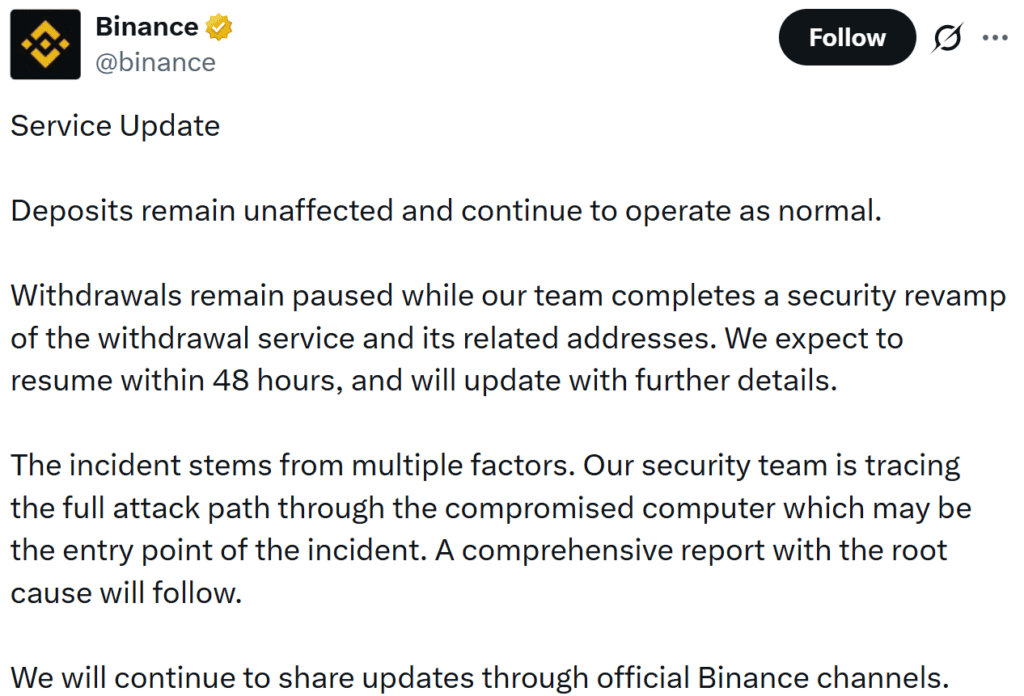
The immediate security response necessitated freezing withdrawal channels, leaving millions of Binance customers temporarily unable to access their funds or execute timely trades. While Binance confirmed that deposit channels remained fully operational, the prolonged suspension of withdrawals created acute friction for traders navigating volatile market conditions.
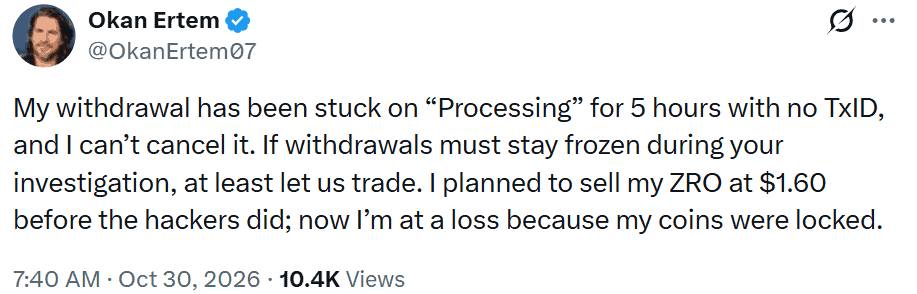
Social media channels quickly filled with complaints from stranded users. For instance, a trader posting under the handle @OkanErtem07 reported that a withdrawal request for ZRO tokens became permanently stuck in a "Processing" status due to the security freeze. The user stated that the inability to cancel the transaction or liquidate holdings prevented a planned sale near the $1.60 price threshold, resulting in substantial unrealized losses as the token’s market value subsequently declined.
Although individual user grievances of this nature require independent verification, they highlight the broader systemic risks associated with centralized exchange lockouts. When platform-wide security freezes occur, customers are effectively stripped of their liquidity management tools. Even if an exchange ultimately guarantees that account balances are safe, sudden access restrictions can cause severe collateral damage for active traders seeking to rebalance portfolios or exit positions during periods of heightened market volatility.
In response to these concerns, Binance leadership emphasized that the temporary operational pause was a necessary evil to ensure long-term platform integrity. Company executives praised the hundreds of engineers and security personnel who worked around the clock to overhaul the exchange’s transaction infrastructure and prevent further unauthorized outflows.
Binance Pledges Full Financial Compensation and Structural Overhauls
To restore market confidence and quell panic among its massive user base, Binance leadership issued firm guarantees that no customer would suffer financial losses as a result of the breach. The exchange pledged to cover the entire deficit using a combination of corporate treasury resources and its Secure Asset Fund for Users (SAFU)—an emergency insurance fund established specifically to protect customer assets against unforeseen security failures.
Despite these reassuring commitments, industry watchdogs and financial analysts have pointed out a distinct lack of granular technical transparency in Binance’s initial communications. The exchange has yet to publish a comprehensive post-mortem detailing the exact vector of the DevOps laptop compromise, the specific vulnerabilities within the service container architecture, or the exact accounting mechanisms that will govern the SAFU fund’s deployment.
To address lingering doubts regarding solvency and asset backing, Binance has promised to release an updated Proof of Reserves audit immediately following the completion of its security remediation phase. While cryptographic proofs of reserves are valuable for demonstrating that customer liabilities are backed by actual on-chain holdings, industry experts note that such audits do little to evaluate the underlying strength of internal access controls, administrative privileges, and withdrawal monitoring systems.
Broader Implications for Centralized Crypto Exchanges
The $6.3 billion Binance breach represents a watershed moment for the cryptocurrency industry, forcing a rigorous re-evaluation of security postures across all centralized trading platforms. For years, the primary focus of exchange security has been the hardening of cold storage infrastructure and the implementation of multi-signature wallet schemes designed to prevent direct key theft.
However, the Binance incident demonstrates that perimeter defenses built around cold and hot wallets can be entirely circumvented if internal operational security is compromised. When a DevOps engineer’s local machine can be weaponized to interact with internal service containers and trigger legitimate withdrawal pipelines, traditional private key security becomes secondary to the integrity of internal software supply chains and endpoint management.
Moving forward, regulatory bodies and institutional investors are expected to demand stricter operational security standards for custodial exchanges. Key areas slated for mandatory review include zero-trust network architectures, multi-person authorization loops for automated withdrawal systems, rigorous endpoint device monitoring, and enhanced anomaly detection algorithms capable of flagging anomalous multi-chain transaction spikes within seconds.
For Binance, the path forward involves a dual mandate: successfully recovering the remaining $2.4 billion in untracked stolen assets in cooperation with international law enforcement, and rebuilding trust through radical transparency. While the exchange’s swift financial commitments and multi-billion-dollar freeze efforts have averted immediate insolvency, the ultimate test will lie in its ability to deliver a thorough technical post-mortem, restore seamless withdrawal functionality, and prove that its infrastructure has been permanently fortified against future internal-vector attacks.