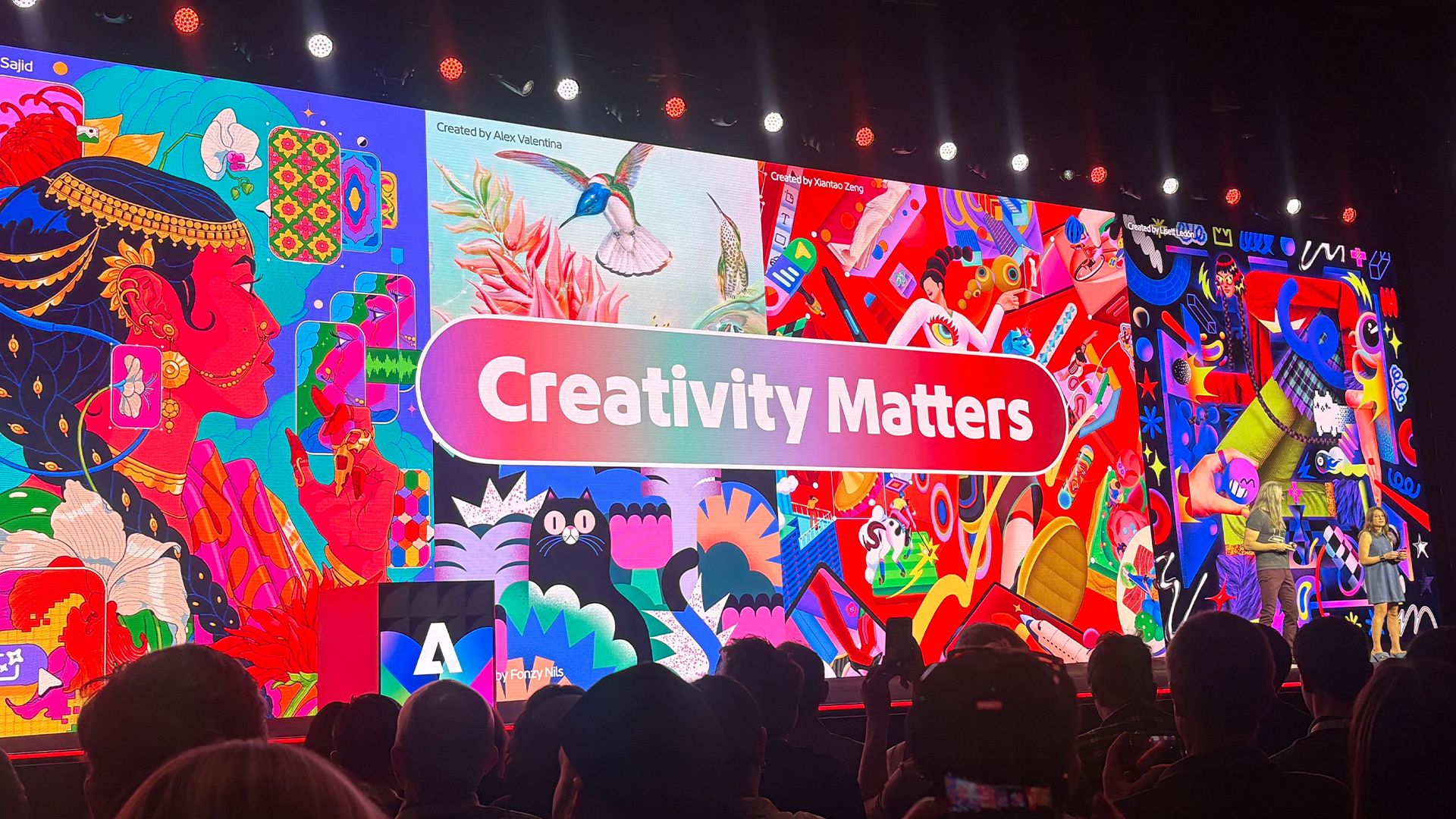
Adobe MAX 2026 has officially opened its doors, and true to tradition, the annual innovation showcase has kicked off with a wave of experimental technologies designed to redefine digital creativity. Among the most talked-about reveals at this year’s conference is a groundbreaking research initiative dubbed Project Link Up. Aimed squarely at vector illustrators, concept artists, and graphic designers, the new tool promises to eliminate one of the most tedious, time-consuming chores in digital design: manually redrawing and adjusting objects to fit new perspectives and scenes.
The unveiling took place during the highly anticipated "Sneaks" presentation, a segment of Adobe MAX where researchers and engineers pull back the curtain on early-stage prototypes. While these projects are not guaranteed to ship in the immediate commercial release of Adobe Creative Cloud apps, they provide a vital glimpse into the future trajectory of software development at the tech giant. Project Link Up stands out even among this year’s wild slate of innovations because it addresses a fundamental mechanical friction in vector workflows: the physical act of positioning an object within a complex scene.
The Problem with Placement: Rethinking the Drag Gesture
To understand the scale of the problem Project Link Up seeks to solve, one must look at how traditional design software handles user input. For decades, the standard drag-and-drop gesture has been treated as a simple command of location. When a designer drags an asset—such as placing an illustrated vehicle into a parking space or positioning a character in a dynamic landscape—the software registers only where the object lands.
Consequently, all the heavy lifting falls back on the creator. The designer must manually break down the vector paths, adjust the perspective grid, scale the object down, warp it to match the horizon line, and meticulously tweak the lighting and shadows to ensure it visually belongs in its new environment. For complex illustrations with multiple focal points, this iterative trial-and-error loop can consume hours of precise, tedious labor before the artist can even evaluate whether the composition works.
Project Link Up introduces a paradigm shift by transforming the simple drag gesture into a context-aware fusion engine. Developed by a team of researchers led by Mohit and supervised by Hailin Jin, senior principal scientist and research lead for imaging and design at Adobe, the technology analyzes the intent behind the movement. As an object is dragged across a canvas, the underlying AI evaluates the surrounding scene’s geometry, perspective lines, and stylistic properties, automatically morphing the incoming vector asset to integrate seamlessly into its new spatial and visual context.
Behind the Scenes: Insights from Adobe Research
In an exclusive behind-the-scenes breakdown, Hailin Jin shed light on the conceptual origins of the tool and the engineering philosophy driving its development. The project was born from a simple yet profound observation of everyday creative gestures.
"Mohit and the team started with an observation about an everyday gesture: dragging an object," Jin explained. "Design tools usually interpret that as an instruction about placement, but there’s much more intent in what a designer moves, where they move it, and how they move it."
By questioning whether a single gesture could communicate multiple layers of creative direction, the research team built a system that bridges the gap between raw placement and intelligent adaptation. Crucially, however, the engineering team prioritized the preservation of designer agency. Unlike destructive automated generators that output flattened raster images, Project Link Up operates entirely within the vector domain. The resulting artwork remains fully editable, allowing artists to dive back into anchor points, paths, and gradients after the automated transformation occurs.
Granular Control and the Creativity Slider
One of the primary concerns among professional designers regarding AI-driven automation is the loss of fine-tuned control. Automated systems often make sweeping changes that look impressive at a glance but fail to meet the rigorous standards of commercial design, leaving creators with rigid, unyielding assets.
Project Link Up addresses this bottleneck through parametric control features embedded directly into the prototyping interface. Among these is a dedicated "creativity slider," a utility that empowers designers to dictate the exact degree of visual adaptation applied during the drag-and-drop process.
According to Jin, this slider acts as a dial between literal preservation and expressive interpretation. "A creativity slider lets the designer guide how subtle or expressive the adaptation should be, from preserving more of the original form to exploring a more dramatic transformation," Jin noted.
This level of customizability extends to stylistic clashes. When two vector elements featuring fundamentally opposed artistic styles are brought together, the system does not simply force a blunt, homogeneous merge. Instead, it reads the creator’s explicit intent. Designers can utilize prompt guidance or contextual toggles to specify instructions such as "match the scene’s illustration style" or "keep this character’s unique style, but adapt its perspective and lighting." This ensures that stylistic juxtaposition remains a deliberate artistic choice rather than an algorithmic accident.
Broader Implications for the Creative Industry
The introduction of Project Link Up arrives at a critical juncture for the digital design industry. As generative AI tools have matured over the past several years, the software landscape has experienced an ongoing debate regarding the balance between productivity and human craftsmanship. Many early AI implementations faced pushback from professionals who felt displaced by black-box generators that offered little room for manual refinement.
Adobe’s recent research initiatives, highlighted prominently at MAX 2026, signal a strategic pivot toward "intent-aware" software design. Rather than replacing the human creator with text prompts, tools like Project Link Up are engineered to amplify human intent, automating the tedious mechanical chores that drain creative energy while leaving high-level aesthetic decisions firmly in the hands of the artist.
Industry analysts suggest that if technologies like Project Link Up successfully transition from research prototypes into commercial software updates over the next few years, they could fundamentally alter productivity metrics across multiple creative sectors. Concept artists working in entertainment design, UI/UX illustrators building complex wireframes, and commercial graphic designers assembling multi-layered marketing assets stand to save countless hours of repetitive manual labor.
Looking Ahead: The Five-Year Horizon
As Adobe MAX 2026 continues to unfold—showcasing concurrent updates such as the newly unveiled features in Photoshop 2027—the broader roadmap for creative software becomes increasingly clear. The ultimate goal of Adobe’s research division is to foster an ecosystem where applications truly understand the semantic meaning of the content they house.
Looking five years into the future, Jin envisions a working environment where software interactions are deeply conversational and contextually intelligent. "A major direction in our research is helping tools understand creative content and the relationships within it," Jin stated. "That understanding can make interactions more meaningful: moving an object into a scene could communicate an intention about perspective or composition, rather than simply a new position."
For experienced professionals, this evolution represents an opportunity to express creative judgment more directly. By removing the friction of mechanical execution, tools of the future aim to let designers spend less time wrestling with perspective grids and more time exploring the ideas that bring their visions to life. While Project Link Up remains in the prototyping phase, its reception at Adobe MAX 2026 underscores a promising reality: the future of vector design is intuitive, editable, and deeply intelligent.