The official deployment of protocol version 24 on the IOTA Mainnet marks a significant milestone in the evolution of distributed ledger technology, introducing the Starfish consensus mechanism to a production-grade environment. Following the initial rollout of the Starfish mainnet architecture, core contributors and researchers within the IOTA Foundation have released an in-depth technical analysis outlining the foundational design choices, synchronization frameworks, and empirical metrics observed during the network’s early operational phase. While release notes typically summarize protocol upgrades through functional changes, the structural engineering behind Starfish addresses long-standing challenges in directed acyclic graph (DAG)-based Byzantine Fault Tolerant (BFT) consensus—specifically, the complex interplay between data dissemination, network latency, and operational variance.
Background Context and the Synchronization Challenge
Historically, consensus protocols have been conceptualized primarily as agreement problems. Within this traditional framework, a decentralized group of validators must reach a unified consensus regarding a single, immutable history of state transitions, even under adverse network conditions characterized by message delays and potentially malicious or Byzantine actors. While mathematically sound, this traditional framing often overlooks a critical operational dependency: a validator cannot effectively vote on a block it has not received, it cannot certify data it cannot independently reconstruct, and it cannot facilitate network progress if vital informational inputs arrive after consensus deadlines have passed.
Beneath the abstract layer of agreement lies a fundamental synchronization problem. Ensuring that the correct data reaches the designated nodes rapidly enough to maintain protocol momentum has historically been treated as basic network plumbing. However, the architectural design of DAG-based protocols brings this dissemination challenge to the forefront. A directed acyclic graph functions not merely as a structural arrangement of blocks, but as a dynamic record of mutual knowledge. Each newly minted block references antecedent blocks observed by the validator, creating a verifiable web of shared awareness. When multiple validators converge on identical block references, the network demonstrates cohesive information sharing; conversely, missing references expose immediate synchronization gaps. Consequently, the DAG operates simultaneously as a commitment structure and a synchronization structure.
To address dissemination within the protocol itself rather than delegating it to external broadcast layers, modern distributed systems literature has increasingly turned to the concept of cordial dissemination. Formalized in recent academic research such as the Cordial Miners paper presented at DISC 2023 by Keidar, Naor, and Shapiro, cordial dissemination requires network participants to actively forward information believed to be necessary for honest peers to maintain synchronization, moving beyond simple self-centric gossiping.
Architectural Trade-Offs: Push vs. Pull Strategies
Prior to the deployment of Starfish, DAG architectures primarily relied on either pull-based or naive push-based strategies to manage information flow, each carrying distinct operational drawbacks.
The pull-based strategy dictates that a validator requests missing blocks only after identifying a synchronization deficit. While this approach is bandwidth-efficient during quiescent periods—transmitting data strictly on demand—it introduces severe latency penalties. Every missing block necessitates an additional request-response round trip, placing data recovery directly on the critical execution path. Furthermore, under heavy network congestion, pull mechanisms can trigger systemic degradation: slower validators issue a higher volume of requests, forcing faster peers to allocate disproportionate bandwidth to answering them. This creates a counterproductive dynamic where the network experiences peak communication overhead precisely when it requires maximum stability.
Conversely, proactive push strategies dictate that validators forward anticipated information to peers without waiting for requests. This substantially improves latency metrics because data is typically available locally before the recipient recognizes a need for it. However, naive push architectures scale poorly; if every validator continuously broadcasts full transaction payloads to every other node, bandwidth consumption grows exponentially relative to the size of the validator set.
To resolve this persistent tension between lean-but-slow pull models and fast-but-heavy push models, the IOTA Foundation engineered Starfish around two core design innovations: the structural separation of consensus metadata from transaction payloads, and the implementation of Reed-Solomon data erasure coding.
Core Innovations: Metadata Separation and Erasure Coding
The first major architectural shift in Starfish involves isolating consensus-critical metadata from the underlying transaction payload. Traditional DAG designs frequently coupled payloads tightly along the primary consensus path. While this approach yields high performance in small-scale test environments, it introduces severe bandwidth bottlenecks as transaction throughput scales.
Starfish maintains a lightweight consensus path by restricting block headers to consensus-relevant structures—such as topological references, votes, acknowledgments, timing parameters, and payload commitments—while handling transaction data through a dedicated, decoupled mechanism. This allows validators to aggressively push lightweight headers across the network without flooding peers with heavy raw payloads.
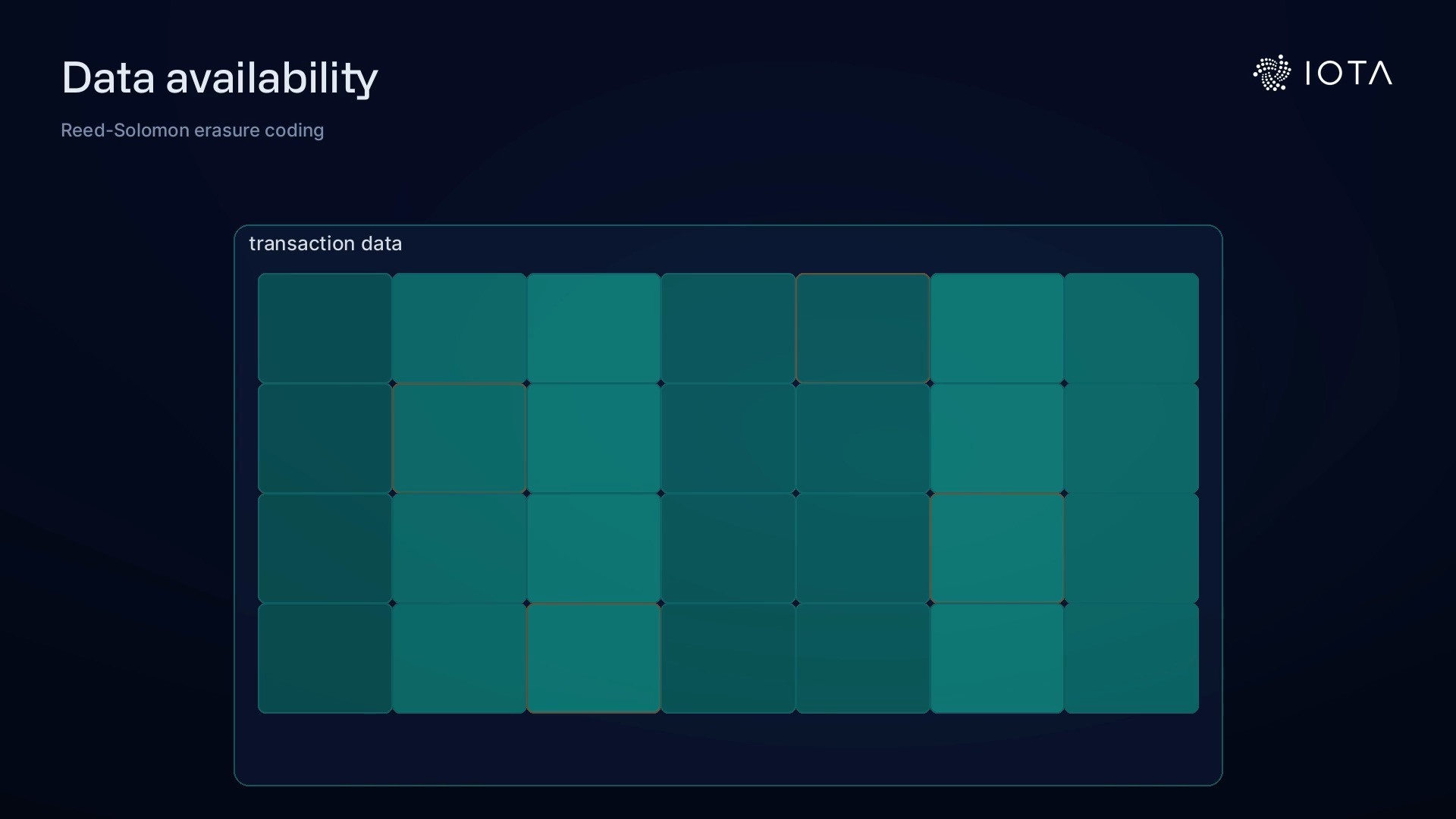
The second innovation integrates Reed-Solomon encoding into the data availability layer. Similar to the error-correction technology utilized in QR codes and optical storage media, Reed-Solomon coding fragments transaction data into redundant constituent pieces distributed across the validator set. The mathematics of the protocol ensure that the original payload can be fully reconstructed from any sufficient subset of valid fragments, even if a significant fraction of pieces remains missing or delayed.
Crucially, the reconstruction threshold within Starfish is engineered such that any $f+1$ valid fragments are sufficient to recover the complete payload, where $f$ represents the maximum number of tolerated Byzantine validators. This architectural distinction underpins the Data Availability Certificate (DAC). Rather than enforcing a rigid requirement that every node possess the full raw data simultaneously, the network verifies that sufficient valid fragments exist for honest validators to reconstruct it. A validator acknowledges verified payloads within its own header, and once $2f+1$ such acknowledgments accumulate within the causal history of a committed block, that block functions as an overarching availability certificate. This eliminates the need for a separate, bolted-on availability round, embedding recoverability directly into the natural growth of the DAG.
Addressing Liveness and the Push Pacemaker
Uncertified DAG protocols—such as Mysticeti—achieve exceptionally low latency by avoiding per-block quorum certificates, yet they have historically remained vulnerable to subtle liveness failures. Recent academic analysis has identified desynchronization vulnerabilities in uncertified architectures, demonstrating scenarios where honest nodes could advance through operational rounds without generating local blocks, thereby leaving structural gaps in the DAG. When cumulative gaps surpass critical thresholds, the protocol loses the necessary topological structure to commit leaders, causing consensus stalls even after underlying network connectivity stabilizes.
Starfish mitigates this vulnerability through the integration of a Push Pacemaker. Under this protocol rule, consensus cannot advance through empty rounds; validators are required to generate and propose local blocks before transitioning to subsequent operational phases. A lagging node can catch up upon observing a quorum of current-round blocks from its peers. This mechanical enforcement prevents validators from drifting ahead without contributing the foundational blocks required for subsequent voting and certification, ensuring structural health and predictable liveness across the network.
Empirical Performance Metrics and Variance Control
Industrial engineering principles dictate that operational reliability is defined primarily by the control of variance rather than optimization around averages. While distributed ledger benchmarks frequently emphasize peak throughput and median latency, real-world production environments demand rigorous predictability, particularly regarding tail latency, jitter under load, and recovery behavior during transient network degradation.
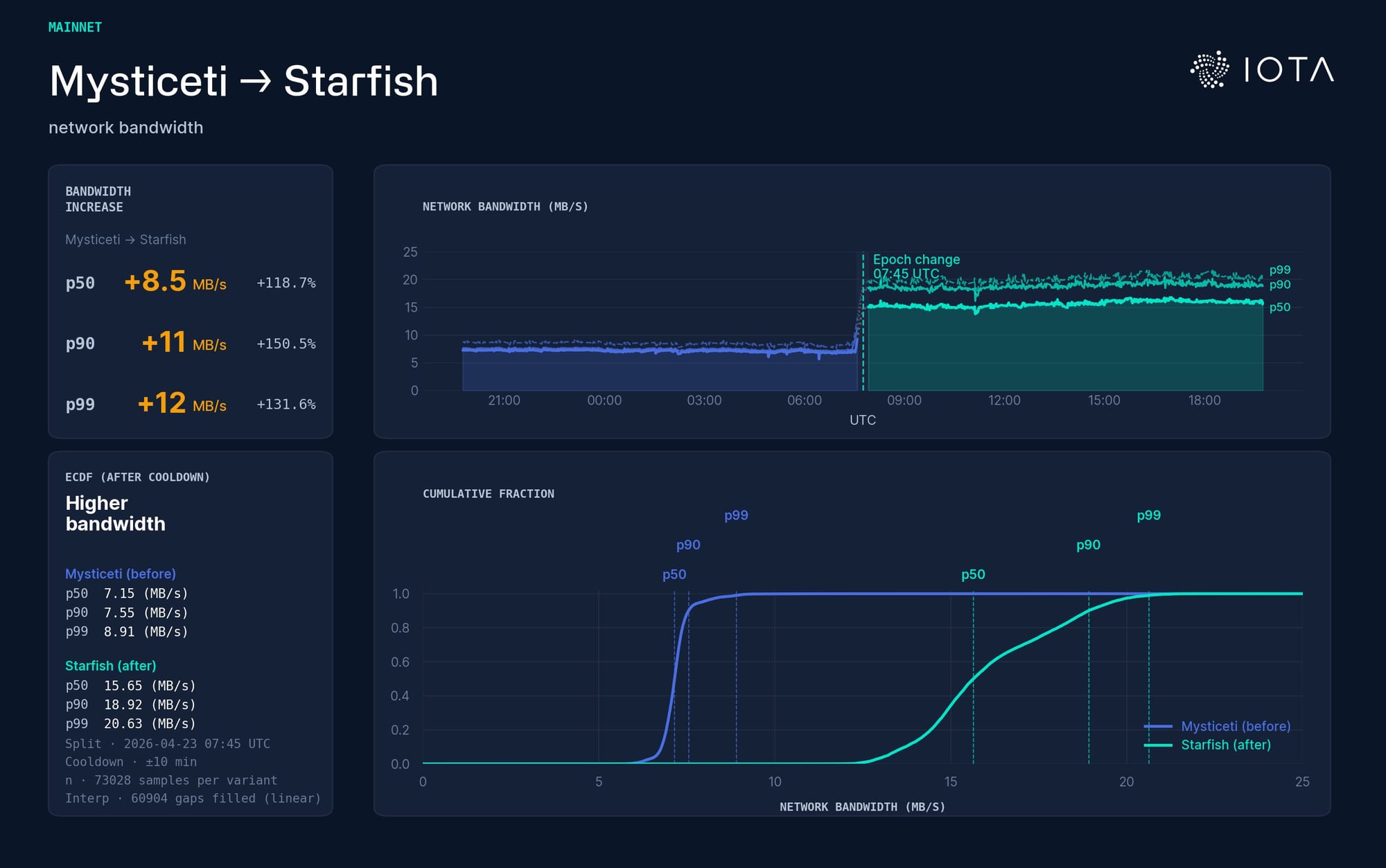
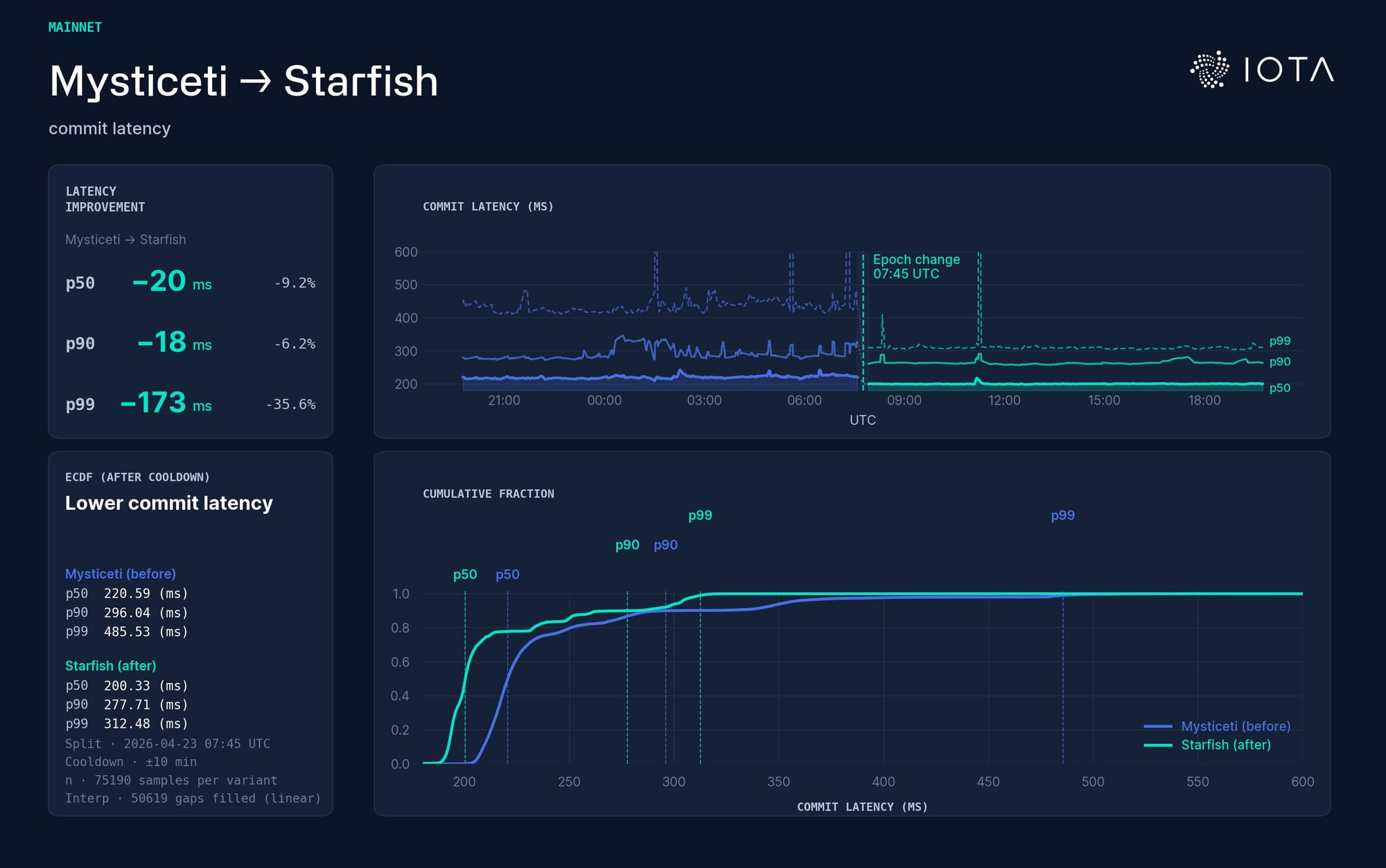
Early mainnet metrics recorded following the activation of Starfish demonstrate substantial improvements across distribution tails. Comparative performance telemetry against legacy uncertified configurations highlights several key findings:
- Tail Latency Reduction: While median commit latencies experience a modest normalization due to the added availability verification step, 99th percentile (p99) latency improves significantly. Observed p99 commit times dropped from approximately 486 milliseconds down to 312 milliseconds, confirming a marked reduction in outlier delays.
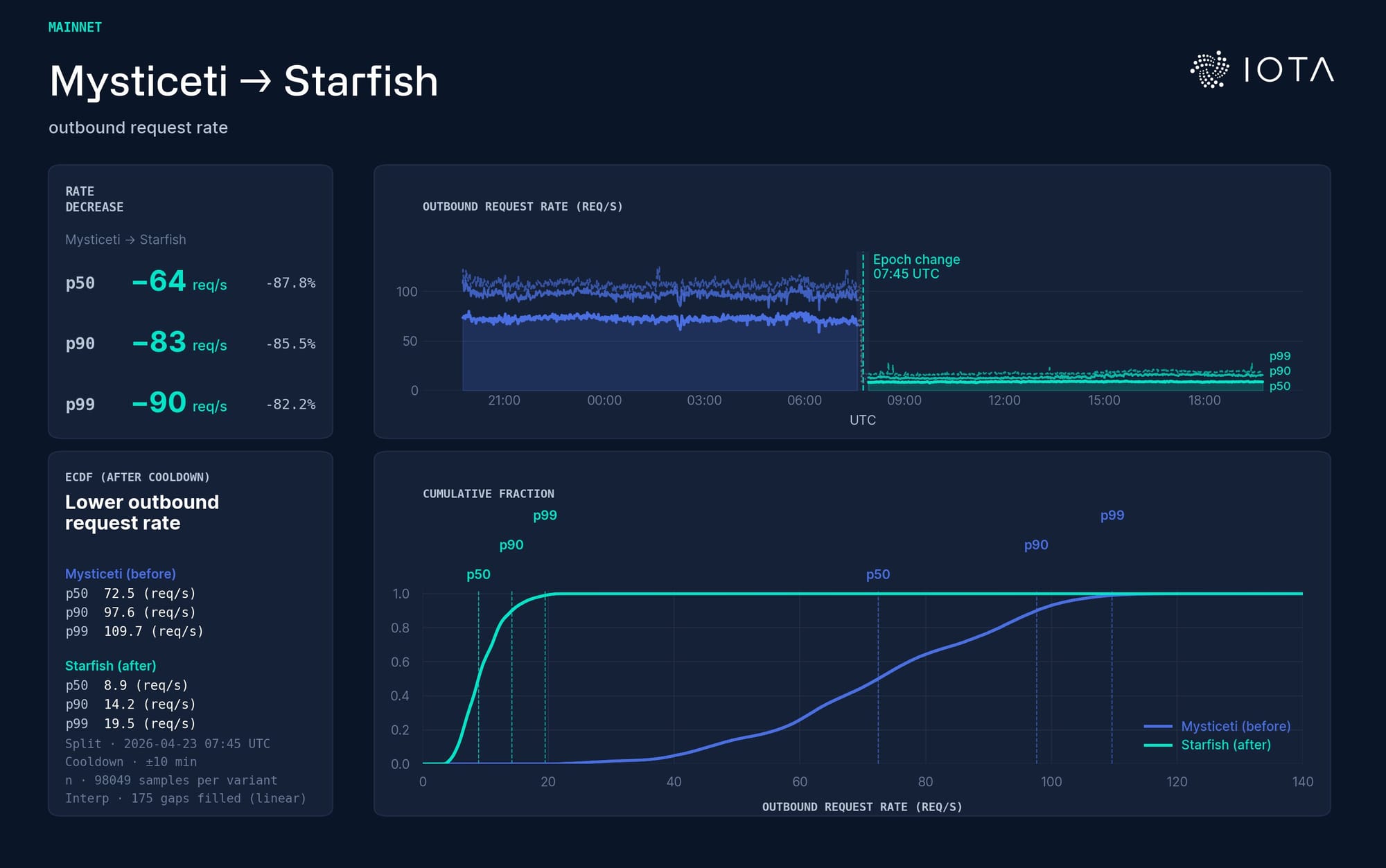
- Outbound Request Suppression: Outbound request rates—the primary telemetry signal for the pull recovery path—decreased by an order of magnitude. By utilizing structured upfront communication rather than reactive recovery paths, validators spend substantially less bandwidth resolving historical gaps.
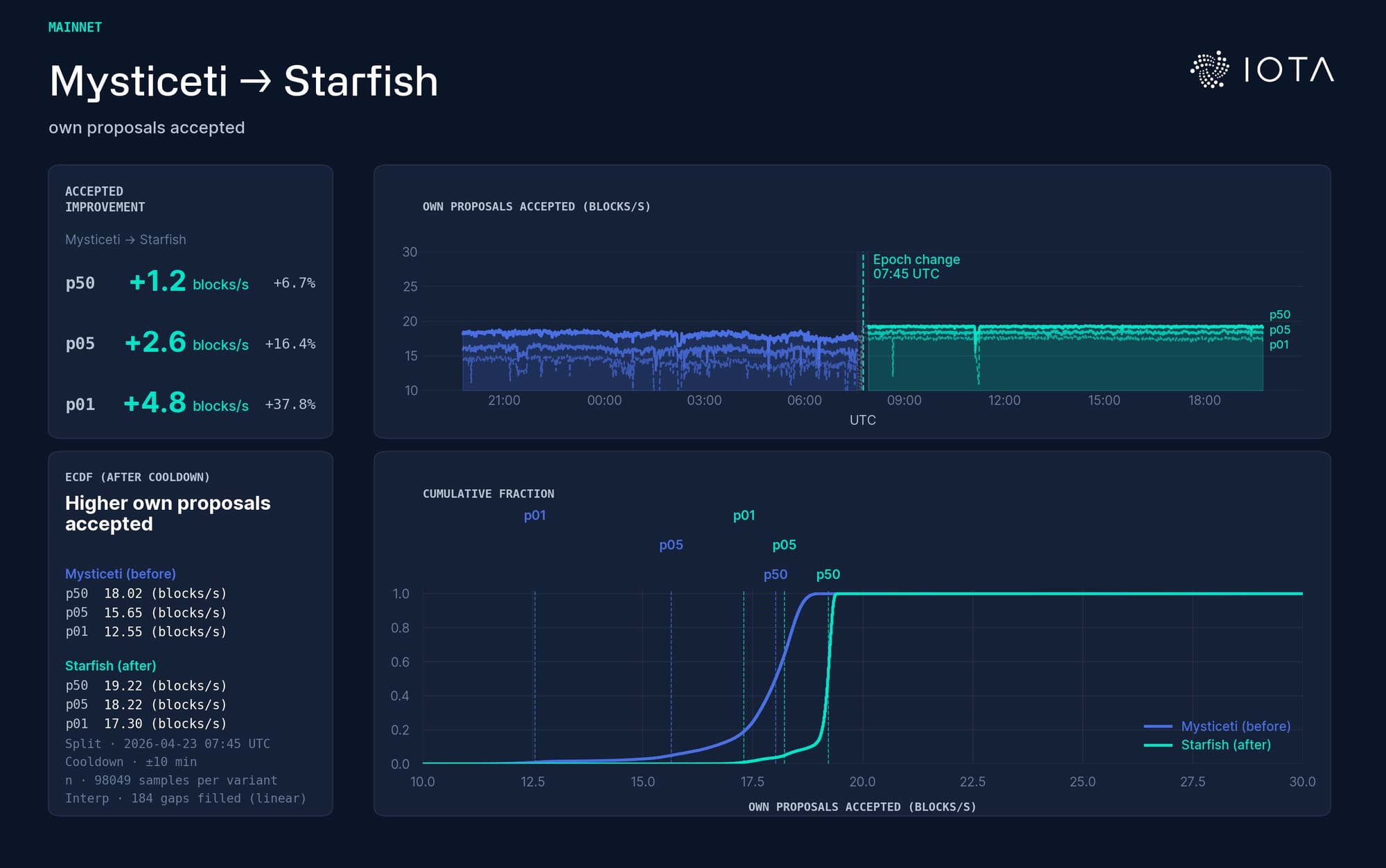
- Acceptance Rate Stability: The variance in proposal acceptance rates among validators dropped sharply, demonstrating improved resilience against transient network jitter and heterogeneous machine performance.
These empirical outcomes indicate that the foundational trade-offs embedded within Starfish—trading a minor increase in mean latency for a significantly compressed distribution curve—successfully yield a more robust and predictable consensus engine suited for heterogeneous, globally distributed production environments.
Broader Implications and Industry Reactions
The successful deployment of Starfish on the IOTA Mainnet represents a conceptual bridging of historical distributed ledger paradigms and modern BFT engineering. By re-evaluating data dissemination as an active component of consensus safety rather than a passive implementation detail, the IOTA Foundation has established a rigorous framework for addressing network-level heterogeneity.
Industry observers and decentralized systems researchers have noted that the architectural emphasis on low variance and deterministic liveness sets a new benchmark for DAG-based ledgers. As decentralized networks increasingly confront real-world challenges—including regional internet partitions, hardware diversity, and intermittent congestion—protocols designed to gracefully handle worst-case distributions will likely displace systems optimized exclusively for benchmark conditions.
Mainnet operational continuity confirms that Starfish has successfully transitioned from theoretical research to practical execution. By ensuring that dissemination, availability, and ordering operate as a unified system, the protocol provides a scalable foundation for high-throughput decentralized applications requiring strict determinism and predictable performance.