In the early hours of November 2, the Latin American cryptocurrency landscape experienced one of its most sophisticated security incidents to date when Mercado Bitcoin, the largest digital asset exchange in Brazil, fell victim to a massive cyberattack. The breach resulted in the unauthorized extraction of approximately $49 million in digital assets. Spanning 17 distinct blockchains and executed in calculated waves, the multi-chain heist targeted major cryptocurrencies like Bitcoin and Ethereum while simultaneously draining smaller networks, including Base, Tron, and Polygon. However, swift mobilization by blockchain analytics firm Chainalysis—acting in its capacity as a security partner—alongside international law enforcement and prominent stablecoin issuers, prevented the total loss from escalating. Through a coordinated global response involving multi-continent digital war rooms, investigators successfully traced, intercepted, and froze nearly $10 million of the stolen funds within the critical opening hours of the breach.
The Anatomy of the Multi-Chain Breach
The attack on Mercado Bitcoin highlights a growing trend among sophisticated threat actors: the exploitation of multi-chain infrastructure. Rather than focusing on a single blockchain ledger, the perpetrators systematically targeted assets distributed across 17 different networks. While the largest financial tranches originated from high-value stores of value like Bitcoin and Ethereum, the attackers demonstrated technical proficiency by simultaneously sweeping liquidity pools and user holdings across alternative layers and scaling solutions such as Base, Tron, and Polygon.
Cybersecurity experts note that multi-chain exploits present unique challenges for centralized exchanges and forensic investigators alike. Navigating diverse consensus mechanisms, varying transaction finality times, and disparate token standards requires immense coordination. In this instance, the attackers executed their plan in rapid succession, aiming to disperse the stolen capital quickly before automated security protocols or manual intervention could halt the outflow. The sheer scale and velocity of the operation necessitated an equally agile and highly coordinated defense mechanism, bringing the global blockchain forensics community into immediate action.
Chronology of the Incident and Immediate Response
The success of any cryptocurrency recovery operation hinges heavily on the actions taken during the first few hours following a security breach—often referred to by investigators as "Hour 0." During this narrow window of opportunity, analytics firms and exchanges have the best chance of collaborating with centralized stablecoin issuers to blacklist illicit addresses before funds can be swapped into privacy coins, decentralized exchanges (DEXs), or harder-to-track native assets like BTC and ETH.
At approximately 2:30 a.m. Eastern Time, a director at Mercado Bitcoin placed an urgent phone call to an in-country solutions expert at Chainalysis, delivering the news of the breach. The exchange representative provided a preliminary ledger of unauthorized transactions, initiating a rapid-response protocol. Within 30 minutes of receiving the data, Chainalysis analysts deployed a digital war room connecting professionals across three continents to map the illicit flow of funds and formulate an intervention strategy.
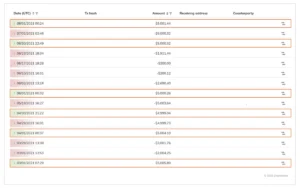
As dawn broke, the multi-continental team achieved significant milestones. By engaging directly with law enforcement agencies and major stablecoin operators—including Tether, Circle, Paxos, Anchorage Digital, and Ripple—investigators relayed critical intelligence regarding freezable addresses. By the morning hours, the coalition had successfully locked down $4 million in stablecoins. As the day progressed, continued tracing and escalation pushed the total frozen amount to nearly $10 million.
A prominent example of this operational efficiency involved stolen funds denominated in Tether (USDT). Chainalysis investigators rapidly tracked the movement of the tainted USDT to specific receiving addresses capable of being frozen. Leveraging established communication channels with Tether and international law enforcement agencies, the team supplied the necessary evidentiary support and technical mapping, enabling Tether to swiftly freeze over $4 million in illicitly acquired assets.
The Mechanics of Blockchain Intervention
Recovering funds from a decentralized, immutable ledger is rarely a straightforward process of merely watching transactions unfold. As industry experts emphasize, successful interventions require a blend of advanced software analytics, legal frameworks, and corporate cooperation.
When a centralized stablecoin issuer—such as Tether or Circle—receives verifiable proof that funds passing through their network are linked to criminal activity, they possess the technical capability to freeze tokens at the smart contract level. This essentially halts the movement of those specific tokens, trapping them within the attacker’s wallet and preventing conversion into fiat currency or untraceable privacy-focused cryptocurrencies.
However, achieving this requires a sophisticated tripartite alliance:
- Advanced Forensics: Analytics firms like Chainalysis must ingest on-chain data, deanonymize pathways, and identify the exact destination wallets controlled by the threat actors.
- Law Enforcement Integration: Official bodies must validate the findings, issue emergency preservation requests, and maintain the legal chain of custody.
- Industry Cooperation: Issuers of centralized tokens must act decisively upon receiving actionable intelligence to execute the freeze mechanism.
Without this synchronized triad, stolen digital assets typically vanish into mixing services, cross-chain bridges, and decentralized liquidity pools within minutes, rendering recovery virtually impossible.
Broader Implications for the Latin American Crypto Ecosystem
The security incident at Mercado Bitcoin serves as a watershed moment for the digital asset industry in Latin America. As the region experiences exponential growth in cryptocurrency adoption, trading volumes, and institutional participation, it simultaneously becomes a more lucrative target for advanced persistent threat (APT) groups and sophisticated cybercriminal syndicates.
Mercado Bitcoin has long positioned itself as a regulatory-compliant, secure gateway for Brazilian investors entering the crypto economy. While the breach demonstrates that even heavily fortified platforms face risks from determined attackers, the subsequent recovery operations underscore the maturity of the modern blockchain security ecosystem. The ability to freeze nearly 20 percent of the stolen funds within hours illustrates a level of cross-border and cross-industry collaboration that was largely non-existent during earlier eras of cryptocurrency history.
Nevertheless, the incident highlights persistent vulnerabilities associated with multi-chain asset management. As decentralized finance (DeFi) protocols and alternative layer-1 and layer-2 networks proliferate, exchanges face the monumental task of securing vastly expanded digital perimeters. Security analysts anticipate that centralized platforms will increasingly invest in real-time monitoring tools, automated circuit breakers, and proactive threat intelligence sharing to mitigate similar multi-vector assaults in the future.
Next Steps and Long-Term Outlook
As the immediate crisis subsides, the focus of the investigation shifts from emergency triage to sustained, long-term tracking and asset recovery. Chainalysis and associated forensic partners have confirmed that their involvement does not conclude with the initial asset freezes.
Investigations teams are continuing to monitor the remaining unrecovered funds as they attempt to navigate various mixing protocols, peer-to-peer platforms, and cross-chain bridges. By continuously labeling addresses tied to the Mercado Bitcoin breach, forensic firms ensure that the broader crypto economy remains informed. This ongoing transparency equips exchanges, OTC desks, and liquidity providers with the real-time data needed to flag and reject tainted deposits should the perpetrators attempt to cash out remaining balances down the line.
While the loss of approximately $49 million remains a significant blow to Mercado Bitcoin and a stark reminder of the persistent threats facing digital asset custodians, the successful defense and recovery operations led by industry partners offer a measure of resilience. As regulatory frameworks tighten and inter-agency cooperation improves, the margin for error for cybercriminals operating within the blockchain space continues to narrow, reinforcing the foundational security of the global financial network.