North America retained its position as the most influential region for the global cryptocurrency markets during the 12-year period ending July 1, 2026. Backed by the deep investor base of the United States, progressive updates to domestic regulatory frameworks, the widespread integration of stablecoins as a transactional currency, and traditional finance institutions bridging the gap with digital assets, the region’s internal dynamics continue to project outward to the rest of the world. According to comprehensive market metrics, the United States and Canada topped the international "big-money index"—an unweighted measure of national crypto-economic power—with their combined digital economies reaching a staggering $3.02 trillion.
Despite this immense scale, the figures represented a modest 1.9% contraction compared to the previous reporting period. Market analysts attribute this regional dip primarily to a localized slowdown within the United States. The U.S. crypto economy contracted by 2.2% period-over-period to finish at $2.78 trillion, a performance widely viewed as resilient given the broader macroeconomic headwinds of a brutal bear market. Crucially, the world’s single largest crypto economy managed to preserve nearly the entirety of the near-double growth it achieved during the 2025 period. This stabilization was largely sustained by institutional maturation, such as the rapid rise of crypto exchange-traded funds (ETFs), accelerating tokenization projects, and the continuous proliferation of stablecoins.

Industry leaders point to a maturing ecosystem as the underlying driver of these trends. Hoolie Tejwani, Head of Coinbase Ventures, noted that the conceptual building blocks established throughout 2025 successfully transitioned into commercial products boasting active users, robust liquidity, and functioning markets by 2026. This chapter of digital asset development highlights three U.S.-incubated products driving massive domestic and international activity: artificial intelligence-driven commerce, stablecoins, and tokenized real-world assets. Meanwhile, Canada charted a different path, registering a 2.3% expansion in its $250 billion digital economy, driven heavily by its unique demographic profile and peer-to-peer resilience.
The United States Leads the Emerging AI On-Chain Economy
The global dominance of the United States in artificial intelligence development is rapidly reshaping adjacent sectors, most notably cryptocurrency. Researchers studying x402—one of the most widely adopted digital payment rails enabling autonomous AI agents to transact independently—have gained unprecedented visibility into how machine-to-machine commerce is taking shape. As autonomous software increasingly handles on-chain financial transactions, cornerstone American enterprises have emerged as foundational supporters. Companies such as Circle, issuer of the leading agent currency USDC, and Coinbase, the developer of the x402 protocol, are actively building out the infrastructure required for this emerging vertical.

Traditional financial giants are also taking notice. Will Su, Head of Digital Assets Research at BlackRock, noted that the firm is monitoring agentic commerce closely, emphasizing that autonomous AI agents have the potential to generate meaningful demand for frequent, low-value payments around the clock. By the close of the 2026 reporting period, cumulative x402 transactions on Base—the leading blockchain network for agentic commerce—surpassed 138 million.
On-chain settlement layers enable economic activities that remain entirely unfeasible on legacy payment rails. Traditional credit card networks cannot process micro-transactions valued at fractions of a cent without incurring unsustainable overhead costs. However, stablecoin infrastructure, which often settles for less than a cent per transaction, makes pay-as-you-go commercial models economically viable. This unlocks entirely new operational paradigms, such as instantaneous micro-payments for individual application programming interface (API) data calls. Circle executives describe a clean division of labor materializing across the financial landscape: traditional credit card rails remain optimized for consumer-prompted agent payments, while stablecoin rails handle machine-to-machine settlements that are fundamentally too small for conventional card economics.
Data from the 16-month observation window ending in September 2026 reveals that the vast majority of x402 activity consists of micro-payments. Over 87% of these transactions ranged between one-hundredth of a cent and ten cents, with the highest concentration falling between one and ten cents. Although agentic commerce remains in an experimental phase, quantitative metrics indicate a clear trajectory toward market maturation. Early interactions were largely characterized by one-off users executing test trades before abandoning the protocol; however, retention metrics have since inverted dramatically.

Stickiness and Purposeful Adoption in AI Payments
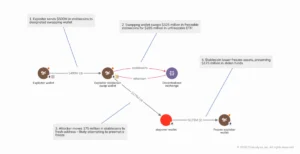
A longitudinal analysis of wallet activity demonstrates that successive cohorts of users are increasingly committed to the platform. When grouping wallets by the quarter in which they were first funded, the percentage that secured a secondary funding deposit within 30 days rose from 70.6% for wallets activated in the third quarter of 2025 to 89.3% for those funded in the second quarter of 2026. In the on-chain ecosystem, topping up a depleted wallet functions as the digital equivalent of renewing a software subscription. Filtering out single-use experimenters reveals an expanding base of users finding genuine, enduring utility in agentic payment rails.
Furthermore, users of the x402 protocol have grown increasingly purposeful over time. In late 2025, wallets possessed a median age of 73 days before initiating their first x402 transaction. By the third quarter of 2026, that latency dropped to a mere 18 minutes. The proportion of wallets executing a payment within their first hour of funding climbed from 4% in Q3 2025 to 67% in Q3 2026. This temporal compression indicates that modern wallets are purposely provisioned to execute pre-planned computational tasks rather than held speculatively.

When examining what AI agents are purchasing on-chain, data indicates an evolution past speculative fads like early memecoin experiments. The ecosystem has shifted toward information-based services, including code review platforms, financial intelligence feeds, and automated search APIs. Autonomous agents require continuous access to machine-readable data, making blockchain-based micro-settlements an ideal delivery mechanism. Additional high-volume expenditure categories include model inference, gaming and gambling services, token issuance, and developer tooling frameworks.
Geographic Concentration in AI-to-AI Commerce
Geolocated data highlights striking geographic concentrations in the utilization of agentic payment protocols. American-funded AI agents dominate global transactions on the x402 network, commanding approximately 30% of all geolocated agent-to-services commerce. U.S.-linked wallets account for 88.1% of all AI model inference payments, 41.8% of expenditures on agent frameworks and developer tool catalogs, and 23.2% of payments directed toward data and search APIs.

Conversely, Chinese-attributed wallets concentrate heavily in cybersecurity and digital infrastructure verticals. Approximately nine out of ten transactions directed toward security and code analysis originated from Chinese-linked wallets, flowing predominantly into AgentLISA, an advanced language model designed to audit Solidity smart contracts. Chinese operators also captured significant market share in market intelligence (46.7%) and settlement rails (35%). However, Chinese-funded agents accounted for a negligible 0.1% of model inference transactions. Analysts attribute this disparity to economic and national preferences: Chinese developers frequently rely on domestic open-weight models like DeepSeek and Qwen, which are often free to deploy, whereas U.S. markets heavily utilize metered, proprietary models such as ChatGPT and Claude.
The United States as an Exporter of Digital Dollars and Importer of Digital Gold
The legislative passage of the GENIUS Act in mid-2025 formalized the United States’ status as the preeminent global exporter of digital sovereign debt via stablecoins. By transforming U.S. government debt into the preferred transactional currency for cross-border businesses and peer-to-peer economies, American financial entities have generated billions of dollars in economic activity.

Concurrently, the U.S. has experienced a marked increase in Bitcoin accumulation. Following the regulatory approval and launch of spot Bitcoin exchange-traded funds (ETFs) in January 2024, the U.S. share of global Bitcoin trading and network activity expanded steadily across every subsequent reporting period. In contrast, stablecoins represent a progressively smaller share of domestic American crypto activity relative to international markets. While global users adopt dollar-denominated stablecoins to bypass local banking limitations or inflation, domestic U.S. participants lean heavily into Bitcoin as a scarce monetary alternative. This trend is amplified by institutional accumulation and the ongoing political discussions surrounding a potential U.S. Strategic Bitcoin Reserve.
Cross-border data indicates that the United States became a net importer of Bitcoin in 2026 for the first time since 2022. While retail-sized transfers under $10,000 remained net outbound, institutional-grade transfers exceeding $10 million registered substantial net inflows, with the highest bracket accounting for over 53,200 accumulated coins. Meanwhile, stablecoin issuance continues to expand, with prominent issuers like Circle reporting billions in circulation backed by short-dated U.S. Treasury bills. Despite international regulatory efforts—such as the European Union’s Markets in Crypto-Assets (MiCA) regulation establishing frameworks for euro-denominated stablecoins—alternative fiat-pegged tokens struggle to capture meaningful order book volume, representing a fraction of a percent compared to dollar-pegged assets.
The Proliferation of Tokenized Real-World Assets

The tokenization of real-world assets (RWAs) experienced explosive growth during the 2026 reporting period, with the global market expanding 135% period-over-period to finish the second quarter at $36.07 billion. U.S. financial instruments anchor this sector, led by tokenized U.S. Treasury bonds, which represented the single largest asset class at $15.42 billion—accounting for 42.8% of all tokenized RWA value.
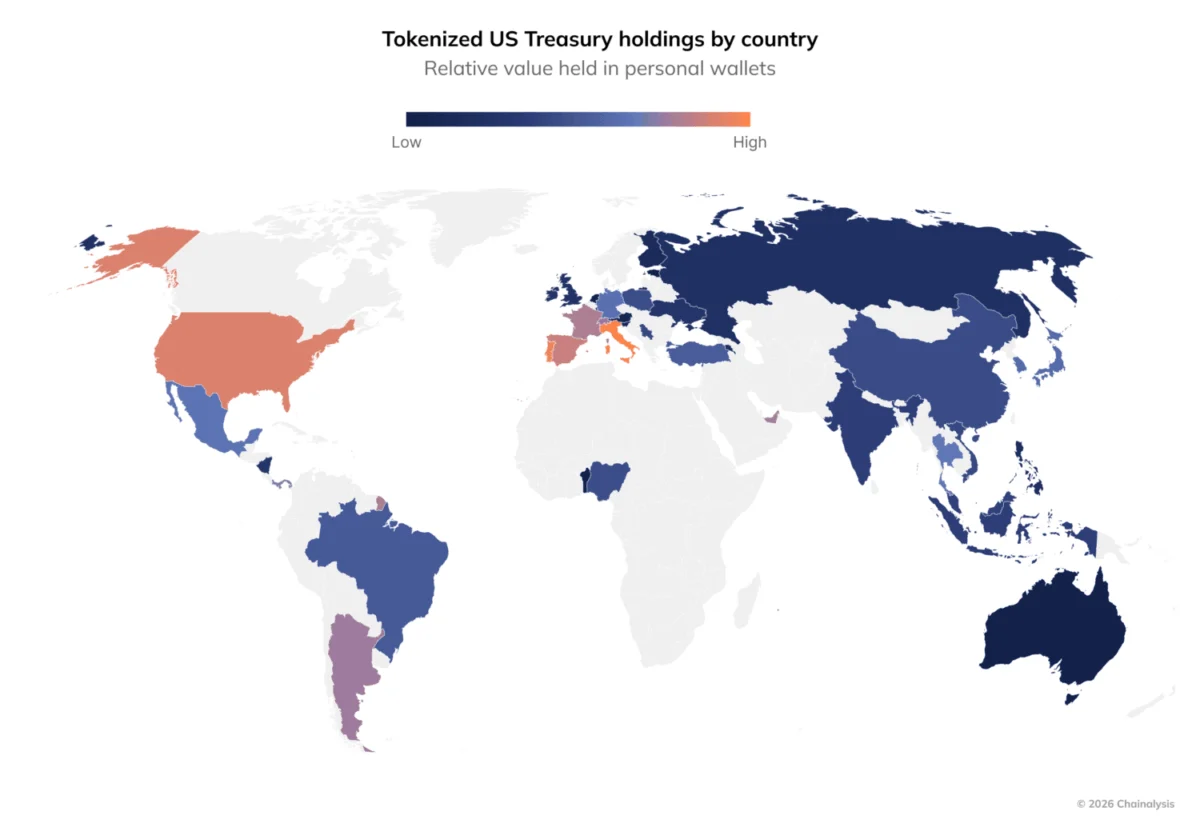
While U.S. entities pioneered the infrastructure, international participation in tokenized Treasuries is remarkably high. Geolocated data indicates that Italy accounts for 29.9% of tokenized Treasury holdings by value, followed by Portugal at 18.8% and Singapore at 18.2%, with the United States representing 10.5%. Asset managers emphasize that tokenization is ultimately dismantling the friction between traditional finance and blockchain infrastructure, allowing institutional and retail investors globally to access programmatic liquidity, speed, and cross-border interoperability without requiring direct domestic brokerage accounts.
Canada’s Resilient Peer-to-Peer Economy and Cross-Border Remittances

Canada demonstrated significant financial resilience, with its digital economy growing 2.3% to reach $247.7 billion by mid-2026. Notably, Canada boasts the most robust peer-to-peer (P2P) crypto economy among G7 nations, ranking seventh globally in domestic and cross-border settlement flows. Stablecoins comprise 44% of Canadian dollar-denominated order book volumes, with USDC capturing the overwhelming majority of market share.
A primary driver of Canada’s active P2P and cross-border remittance sectors is its exceptionally high foreign-born population, which accounts for roughly 23% of the total populace—the highest share within the G7. Remittance corridors connecting Canada to India, China, the Philippines, Nigeria, and Pakistan have expanded rapidly. During the 2026 period, crypto-based remittance transfers from Canada to India, China, and the Philippines alone reached $2.36 billion across 3.56 million transactions, boasting an average transfer size of $663. By offering settlement costs a fraction of the 6.7% global average charged by traditional legacy wire services, stablecoins have become an indispensable financial tool for immigrant populations managing cross-border family and business obligations.
Furthermore, statistical analysis reveals a direct correlation between Canada’s domestic P2P transaction volumes and fluctuations in its temporary visa and study permit populations. As immigration policy shifts have altered temporary resident numbers since 2021, domestic crypto volumes have tracked these demographic changes synchronously. Anecdotal evidence confirms that Canadian residents increasingly utilize digital assets for day-to-day economic activities, including rent and utility payments.

Implications for the Global Financial Architecture
The overarching narrative of North America’s crypto economy in 2026 centers on infrastructure development versus international utilization. American institutions and developers provide the underlying rails—ranging from tokenized Treasuries and dollar-pegged stablecoins to autonomous AI payment architectures—while global user bases drive operational demand.
As international jurisdictions continue to implement localized regulatory frameworks—such as Singapore’s stablecoin licenses, Hong Kong’s digital asset policies, and Canada’s newly enacted Stablecoin Act—policymakers worldwide face the challenge of competing with entrenched dollar dominance. The regulatory guidelines and legislative frameworks adopted throughout the remainder of 2026 will ultimately dictate the speed at which traditional financial systems and decentralized blockchain architectures converge on a global scale.