Sub-Saharan Africa has positioned itself as a focal point of global digital asset evolution. Despite remaining the smallest regional crypto economy by total absolute value, the region has demonstrated remarkable resilience and momentum, expanding by 13.4% to reach an aggregate valuation of $101 billion between July 1, 2025, and June 30, 2026. This growth trajectory stands in stark contrast to broader macroeconomic headwinds, fueled primarily by structural challenges within traditional banking systems that have historically left large segments of the population unbanked or underbanked.
For individuals across the continent, cryptocurrencies have evolved far beyond speculative financial instruments or novel investment assets. Instead, they serve as vital economic lifelines, offering practical, day-to-day utilities such as alternative wealth management, cross-border remittances, and frictionless commercial settlements. For enterprises, digital assets mitigate the persistent friction of traditional cross-border payments, bypassing fragmented regional financial architectures and costly legacy institutions.

As Mercy Emmanuel, Stablecoin and Blockchain Commercial Lead at Nigerian fintech company Flutterwave, observes, the most commercially viable innovations in African markets are those that successfully reduce friction in existing financial activities rather than introducing unnecessary technological complexity. This practical utility has reshaped how millions interact with money, setting the stage for a transformative period across the region’s financial ecosystem.
Divergent Trajectories: South Africa and Nigeria Lead the Regional Landscape
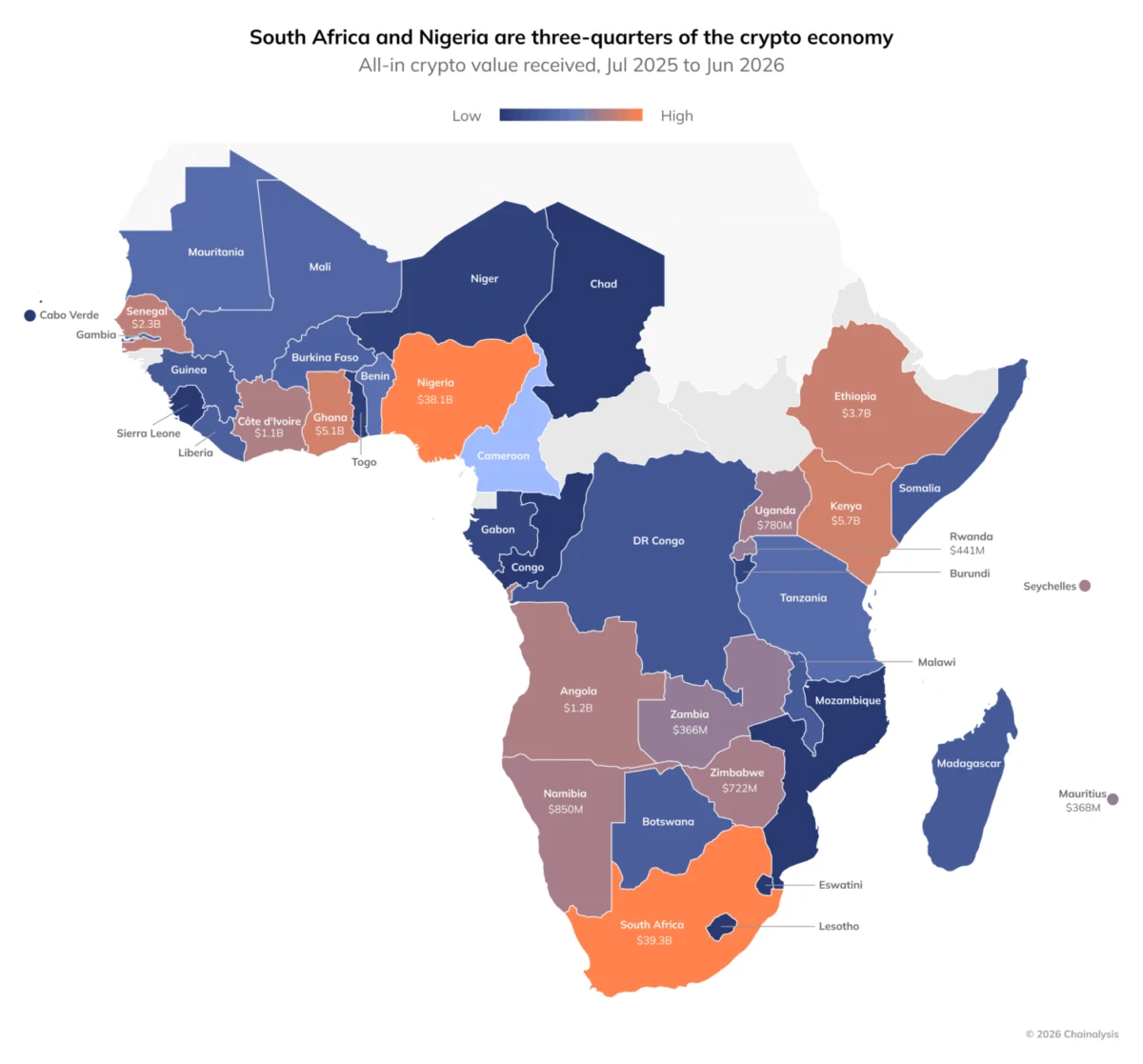
The Sub-Saharan crypto ecosystem is heavily anchored by two economic powerhouses: South Africa and Nigeria. Together, these two nations account for more than three-quarters of the entire regional crypto economy. However, despite their shared dominance, their internal market trajectories have diverged significantly over the reporting period.
South Africa experienced a stellar expansion, with its crypto economy surging 52% year-over-year to reach $39.3 billion. This robust growth occurred despite a prevailing global bear market and was characterized by broad-based increases across all measured categories. Cross-border peer-to-peer (P2P) stablecoin flows and professional service flows served as the primary catalysts for this expansion.

Conversely, Nigeria’s crypto economy contracted slightly by 3% year-over-year, settling at $38.1 billion. While overall service usage and centralized exchange (CEX) activity demonstrated resilience, they were ultimately outweighed by a steep 45% decline in decentralized exchange (DEX) activity and a 17% drop in cross-border P2P flows. Despite this localized contraction, Nigeria retained its position as third globally on grassroots adoption indices, demonstrating deep underlying engagement among retail users.
Smaller regional markets exhibited similarly mixed dynamics. Ghana’s crypto economy grew by an impressive 80% to reach $5.1 billion, propelled by concurrent increases in both CEX and DEX activity. Senegal witnessed an explosive 215% surge, scaling to $2.3 billion driven by strong centralized exchange adoption. In contrast, Ethiopia recorded an 8% decline down to $3.7 billion, largely attributed to reduced decentralized exchange volumes. These contrasting paths underscore an uneven adoption landscape where emerging markets possess immense growth potential while remaining highly sensitive to regulatory shifts and local market volatility.
Self-Custody and Personal Wallets Dominate Regional Architecture
A defining characteristic of Sub-Saharan Africa’s crypto market is the outsized role played by personal wallets. During the 2026 reporting period, personal wallets accounted for 32.3% of the total value received across the region—the highest share recorded globally. This trend indicates that regional adoption is fundamentally consumer-driven, with individuals preferring to retain direct control over their assets rather than relying on custodial intermediaries or traditional financial institutions.

Cross-border P2P transfers comprise the vast majority of this personal wallet activity, capturing 70.9% of total value received, followed by domestic P2P transactions at 18.5% and service-to-wallet transfers at 10.7%.
This heavy reliance on self-custody is heavily influenced by historical regulatory uncertainty and limited access to reliable custodial services. For instance, Nigeria’s central bank enforced restrictions preventing banks from servicing cryptocurrency exchanges between 2021 and 2023, followed by subsequent regulatory tensions involving major international platforms. Such regulatory friction frequently drives users toward self-custodial solutions to insulate themselves against sudden market disruptions or institutional freezes.
The Stablecoin Revolution: Overtaking Bitcoin in Remittances and Trade
Between 2022 and 2026, the regional market underwent a fundamental structural shift characterized by the explosive growth of stablecoins. The value of stablecoins received via P2P channels multiplied more than sixfold, soaring from $2.3 billion to $14.6 billion. Concurrently, Bitcoin receipts fell by 60%, dropping from $36 billion to $14.6 billion.

This pivot reflects an essential use case: stablecoins enable individuals and enterprises to securely hold value denominated in U.S. dollars without needing access to traditional foreign-currency bank accounts. In economies plagued by local currency volatility, foreign exchange restrictions, and high inflation, stablecoins provide a secure medium of exchange, a store of value, and an efficient settlement tool.
Philip Kwaw Sebuabe, Head of the Virtual Assets Department at the Bank of Ghana, notes that stablecoin interest has expanded far beyond basic trading, finding vital utility in cross-border payments, remittance settlements, and foreign-currency preservation. Similarly, Gillian Darko, Vice President of Strategy at stablecoin infrastructure provider Yellow Card, identifies stablecoins as the region’s premier growth opportunity, bridging the gap between everyday payment systems and formal savings.
The utility of stablecoins is perhaps most visible in remittance channels. Stablecoin remittance values more than doubled year-over-year from $235 million to $492 million, while Bitcoin remittances remained stagnant. Furthermore, cross-border stablecoin transfer volumes grew nearly fivefold, signaling genuine transactional utility rather than mere speculative holding.

Furthermore, local-currency stablecoins are emerging across jurisdictions like South Africa, Ghana, Kenya, and Tanzania. The Bank of Ghana, for instance, has actively explored cedi-backed models designed to facilitate instant trade settlements while ensuring end recipients receive local fiat via traditional bank accounts or mobile money wallets without holding crypto assets directly. Additionally, unlike traditional banking systems constrained by operating hours, weekends, and public holidays, stablecoin transactions operate on a continuous 24/7 basis.
Expanding Intra-Regional Corridors and Remittance Inflows
Traditional intra-African trade and business payments have historically suffered from severe logistical frictions, high compliance costs, and regulatory barriers. According to International Monetary Fund (IMF) data, only a small fraction of intra-continental payments are cleared directly within Africa, resulting in substantial annual economic leakage.
Faced with these structural hurdles, businesses have increasingly turned to crypto payment corridors. Active intra-regional payment corridors nearly doubled during the reporting period, expanding from 80 to 152 routes, with 95 recording active bidirectional flows. Total transaction volume across these corridors more than tripled, rising from $34.3 million to $116.5 million, while average volume per corridor climbed from $429,000 to $766,000.

Beyond commerce, remittances remain a vital macroeconomic pillar for Sub-Saharan Africa, accounting for over 20% of GDP in nations like The Gambia and Lesotho, and totaling $41 billion across the region in 2025. However, traditional remittance services to the region remain exceptionally costly; World Bank figures indicate an average fee of 7.9% for a $200 transfer—the highest of any region globally.
Crypto-based remittances have emerged as a disruptive, cost-effective alternative. Remittance inflows from Western nations reached $888 million during the reporting period, representing a 36% year-over-year increase, while total transaction counts climbed 43% to exceed one million transactions. North America remained the dominant sending source at $645 million, supported by extensive diaspora communities from Nigeria, Ghana, and Ethiopia. Meanwhile, inflows from Australia and New Zealand recorded the fastest growth, nearly tripling from $48 million to $143 million.
An analysis of diaspora demographics reveals fascinating behavioral patterns. North America and Australia generated crypto remittance volumes significantly higher than population size alone would predict, whereas Western Europe lagged considerably. Despite hosting 64% of Sub-Saharan-born residents in surveyed countries, Western Europe accounted for just 10% of crypto remittances. For instance, France, which hosts a diaspora population comparable to the United States, recorded just $5.4 million in crypto remittances compared to $223 million originating from the U.S. Per-capita metrics further highlighted Canada as the leading sender, rising to $736 per diaspora resident.

Real-World Merchant Adoption and South Africa’s Hub Status
South Africa has cultivated a robust real-world crypto economy characterized by active retail and merchant spending. Domestic service-like payments—encompassing commercial contracts, professional fees, and everyday retail transactions capped at $50,000—reached $8.34 billion during the 2026 period. Quarterly volumes demonstrated consistent upward momentum, with Q2 2026 outperforming Q3 2025 by over $1 billion, outpacing institutional inflows which stood at $1.29 billion.
This retail expansion was catalyzed by strategic infrastructure rollouts. In 2025, QR-code payment provider Scan to Pay partnered with cryptocurrency platform MoneyBadger to enable seamless Bitcoin spending at merchant locations. By August 2026, this retail network expanded to encompass nearly 700,000 store locations. MoneyBadger CEO Carel van Wyk noted that Q2 2026 data revealed 50% of transactions were valued under $13 and 87% under $60, with e-commerce representing 48% of total payment value, confirming that digital assets are deeply embedding into consumer spending habits.
Functioning as Africa’s primary financial gateway, South Africa also serves as a central conduit for international and regional crypto flows. Overlaps between South African cross-border crypto payments and traditional foreign direct investment (FDI) footprints into nations like Nigeria, Kenya, the Democratic Republic of the Congo, Tanzania, Namibia, and Zimbabwe suggest that digital asset corridors frequently mirror established economic trade routes.

However, this regional hub status faces regulatory recalibration. In August 2026, the South African National Treasury and the South African Reserve Bank (SARB) published a draft Crypto Asset Manual for Cross-Border Activities aimed at integrating digital assets into the national capital flow management framework. Initial drafts proposed strict limitations restricting individuals to authorized local providers and barring corporate cross-border crypto movements. Following significant industry pushback, the SARB announced a comprehensive revision of the rules to eliminate mandatory pre-approvals, ensuring regulatory frameworks accommodate market realities.
Nigeria’s Shift Toward Domestic Exchanges and P2P Bitcoin Activity
In Nigeria, the crypto ecosystem has evolved through a strong focus on centralized services and domestic platforms. Nigerian users routed $25.2 billion to crypto services during the reporting period, representing a 172% increase over four years. Domestic exchanges captured $6.22 billion—equivalent to half of all centralized exchange inflows—marking a dramatic surge from a 27% market share in 2025 and just 7% in 2022.
This pivot toward domestic platforms was accelerated by regulatory friction with major international exchanges, including temporary access restrictions imposed by authorities in 2024 amid currency depreciation concerns. In response to these dynamics, the Nigerian government established a structured regulatory environment. In July 2026, President Bola Tinubu signed an Executive Order on Virtual Asset Coordination, establishing a specialized council chaired by the Central Bank to harmonize virtual asset regulations, facilitate stablecoin frameworks, and establish controlled sandbox environments.

Concurrently, the Nigerian Securities and Exchange Commission (SEC) introduced updated operational guidelines and enhanced capital requirements for digital asset custodians and exchanges ahead of a June 2027 compliance deadline. While these rigorous standards aim to protect consumers and lend institutional legitimacy to local platforms, compliance costs may favor well-funded incumbents, reshaping the competitive landscape.
Despite the formalization of service providers, peer-to-peer activity remains vital to the Nigerian market, distinguished by an unusual reliance on Bitcoin for smaller transactions. Bitcoin accounted for 92% of small domestic wallet transfers under $10,000—totaling $923 million out of $1 billion—compared to an average of just 22% across the rest of Sub-Saharan Africa. This highlights a persistent consumer preference for decentralized, direct value transfers alongside regulated exchange services.
Outlook: Regulatory Clarity as the Catalyst for Sustainable Growth
As Sub-Saharan Africa’s cryptocurrency market navigates its next phase of maturity, the trajectory of adoption will depend heavily on the interplay between grassroots demand, commercial innovation, and regulatory evolution. From South Africa’s merchant-driven retail economy to Nigeria’s resilient P2P and domestic exchange ecosystem, digital assets are successfully addressing foundational deficiencies in traditional financial infrastructure.

Regulatory frameworks will ultimately determine whether this momentum translates into permanent financial inclusion. Legislative milestones, such as Ghana’s and Kenya’s virtual asset service provider acts enacted in late 2025, provide crucial legal certainty for stablecoins and digital assets. As Rob Downes, Head of Digital Assets at Absa Corporate and Investment Banking (CIB), summarizes, regulation serves as the critical enabler across Africa.
If regulatory harmonization successfully bridges digital assets with traditional banking architecture, Sub-Saharan Africa’s crypto economy is primed to evolve from an alternative financial experiment into an indispensable pillar of the continent’s mainstream commercial and economic infrastructure.