
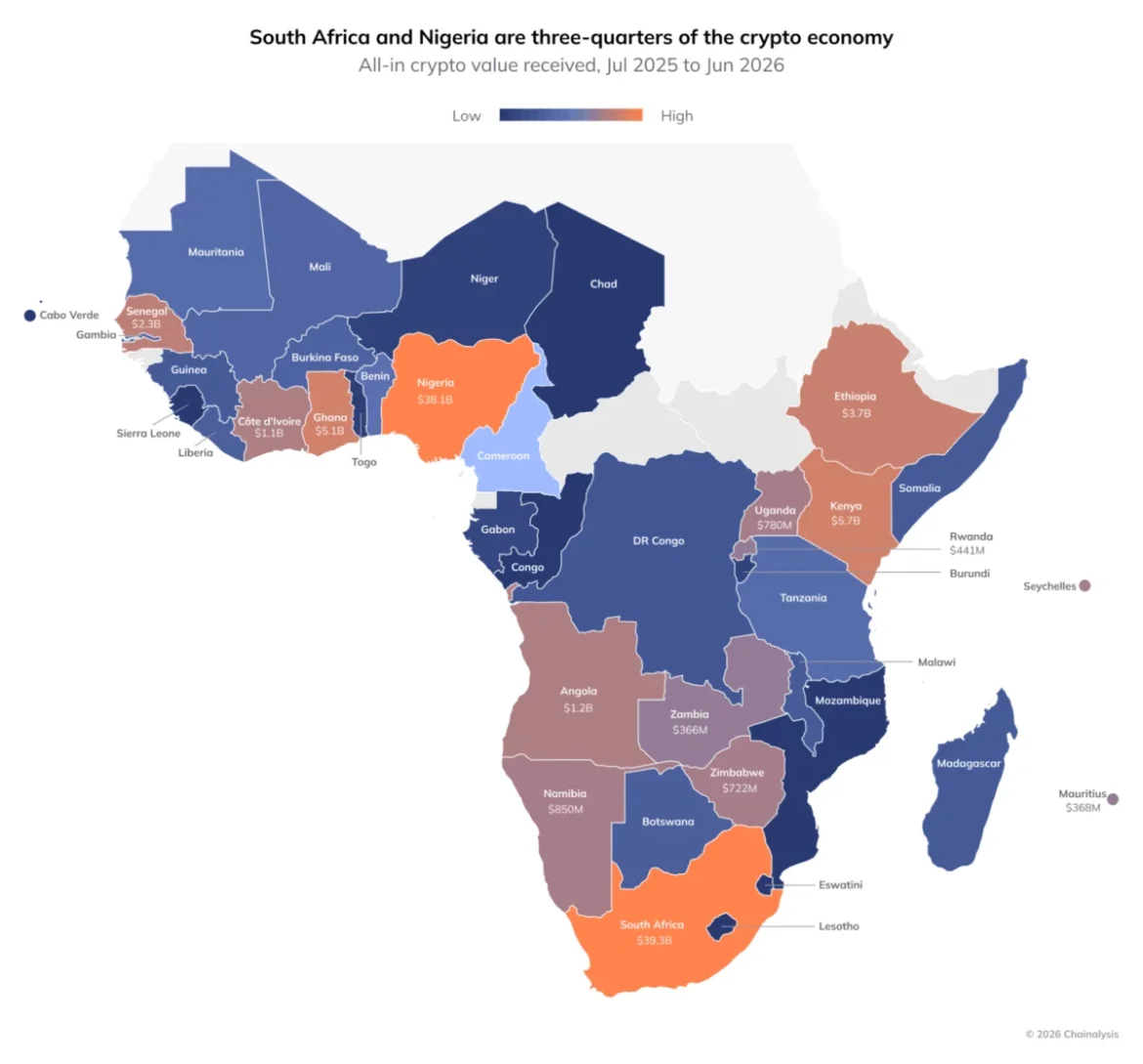
Sub-Saharan Africa has cemented its status as the world’s fastest-growing cryptocurrency economy, even as it remains the smallest by absolute market value. According to newly released data tracking activity between July 1, 2025, and June 30, 2026, the region’s crypto economy expanded by 13.4% year-over-year to reach a landmark $101 billion. This growth is predominantly organic, propelled by pressing structural realities: individuals and commercial enterprises across the continent continue to confront systemic barriers to affordable, reliable, and frictionless traditional financial services.

Rather than serving as a speculative playground for complex financial engineering, cryptocurrency in Sub-Saharan Africa has firmly evolved into a practical utility tool. For everyday citizens, decentralized networks and digital assets provide viable alternatives for personal wealth management and domestic transfers. For enterprises, blockchain solutions streamline cross-border payments, mitigating the exorbitant fees and delays characteristic of traditional intra-African banking corridors. Industry experts emphasize that the commercial viability of blockchain in this region hinges strictly on its capacity to remove friction from existing economic activities rather than introducing superfluous complexity.
Regional Divergence: South Africa and Nigeria Set the Pace
The vast majority of this regional expansion is concentrated in two major economies—South Africa and Nigeria—which together account for more than 75% of all crypto activity in Sub-Saharan Africa. However, the trajectories of these two powerhouses diverged notably over the 2025–2026 reporting period, highlighting a shifting landscape of user preferences, regulatory interactions, and market maturity.

South Africa experienced a remarkable surge, with its crypto economy expanding by 52% year-over-year to reach $39.3 billion despite broader macroeconomic headwinds. This growth was notably broad-based, touching every measured category of digital asset activity and spearheaded by cross-border peer-to-peer (P2P) stablecoin flows and institutional service inflows. South Africa’s sophisticated financial infrastructure and deep-seated role as an intra-continental trade conduit have established it as the primary regional hub for digital asset liquidity.
Conversely, Nigeria’s crypto economy contracted slightly by 3% to $38.1 billion, though it maintained its position as the second-largest market in the region and placed third globally in grassroots adoption indices. While centralized exchange (CEX) and general service activities displayed underlying resilience, overall figures were pulled down by a 45% contraction in decentralized exchange (DEX) volumes and a 17% decline in cross-border P2P transfers. This cooling off in certain segments coincides with a shifting domestic regulatory framework and historic tensions between federal authorities and major international cryptocurrency exchanges.

Smaller markets across the region displayed high volatility coupled with explosive growth potential. Ghana’s crypto economy surged 80% to $5.1 billion, driven by robust centralized and decentralized exchange volumes. Senegal witnessed an astronomical 215% increase to $2.3 billion, heavily reliant on centralized exchange expansion. In contrast, Ethiopia recorded an 8% contraction down to $3.7 billion, largely due to a dip in DEX activity. These contrasting figures underscore an uneven pace of adoption where smaller economies can scale rapidly but remain acutely sensitive to regulatory shifts and local market dynamics.
The Dominance of Personal Wallets and Self-Custody
A defining structural characteristic of the Sub-Saharan African crypto market is the outsized role played by personal wallets. During the 2026 tracking period, personal wallets accounted for 32.3% of the total value received across the region—the highest share recorded globally. This metric highlights an adoption paradigm where individual users prefer to directly manage and transfer their own funds rather than relying on institutional custodians or centralized intermediaries.

Within this self-custody segment, cross-border P2P transfers dominated, capturing 70.9% of the value received. Domestic P2P transactions accounted for 18.5%, while service-to-personal-wallet transfers represented 10.7%. Analysts attribute this heavy reliance on personal wallets to a combination of limited access to traditional custodial banking services and widespread regulatory uncertainty.
The regulatory climate in key markets has historically been volatile. Nigeria, for instance, implemented strict bans on banks servicing crypto-exchange accounts between 2021 and 2023, followed by high-profile legal disputes with major international trading platforms. These regulatory interventions have naturally incentivized users to embrace self-custody solutions as a precautionary measure against sudden market disruptions, asset freezes, or banking restrictions.

The Stablecoin Revolution and the Decline of Bitcoin
Between 2022 and 2026, the structural composition of Sub-Saharan Africa’s crypto market underwent a profound transformation, marked by the meteoric rise of stablecoins and a concurrent retreat in Bitcoin transaction values. P2P stablecoin inflows multiplied more than sixfold, soaring from $2.3 billion to $14.6 billion. Over the same timeframe, the value of Bitcoin received dropped by 60%, falling from $36 billion down to $14.6 billion.
This pivot reflects an acute macroeconomic need: stablecoins enable individuals and businesses to hold value denominated in U.S. dollars without the requirement of maintaining foreign-currency bank accounts. Across a region plagued by chronic local currency depreciation, strict foreign exchange controls, and expensive cross-border wire transfers, stablecoins offer a dependable store of value and an efficient medium of exchange.

Institutional voices have taken note of this structural shift. Philip Kwaw Sebuabe, Head of the Virtual Assets Department at the Bank of Ghana, observed that stablecoins are increasingly attracting interest for cross-border payments, remittance settlements, and foreign-currency preservation rather than mere speculative trading. Similarly, Gillian Darko, Vice President of Strategy at stablecoin infrastructure firm Yellow Card, identifies stablecoins as the region’s single greatest commercial opportunity, bridging the gap between everyday payment systems and long-term savings.
The utility of stablecoins is perhaps most pronounced in remittances. Regional stablecoin remittance values more than doubled year-over-year from $235 million to $492 million, while Bitcoin remittance metrics remained flat. Furthermore, the operational advantages of stablecoins—such as 24/7/365 settlement availability that bypasses traditional banking holidays and operating hours—have made them indispensable for modern international commerce.

Intra-Regional Payment Corridors and Remittance Inflows
Traditional intra-African trade and financial flows have historically suffered from severe fragmentation, with the International Monetary Fund (IMF) noting that only a fraction of continental payments are cleared locally. High fees, correspondent banking bottlenecks, and restrictive regulatory frameworks have historically cost the continent billions annually.
Cryptocurrency payment corridors are rapidly filling this infrastructure gap. Active intra-regional business payment corridors nearly doubled during the reporting period, climbing from 80 to 152, with 95 of those recording bilateral flows. Total transaction volumes across these corridors more than tripled, leaping from $34.3 million to $116.5 million, while average volume per corridor grew from $429,000 to $766,000. This expansion demonstrates that crypto is successfully linking businesses and consumers across borders where legacy financial systems fall short.

Beyond intra-regional trade, remittances from the global diaspora remain a lifeline for many Sub-Saharan economies, where funds account for up to one-fifth of the GDP in nations like The Gambia and Lesotho. According to World Bank data, sending money to Sub-Saharan Africa remains globally expensive, averaging 7.9% for a standard $200 transfer.
Crypto-based remittances are undercutting these prohibitive costs. Western nations accounted for the vast majority of crypto-remittance inflows into the region, reaching $888 million—a 36% year-over-year increase—with transaction counts rising 43% to over one million. North America led the inflows at $645 million, supported by substantial diaspora communities from Nigeria, Ghana, and Ethiopia. Meanwhile, inflows from Australia and New Zealand recorded the fastest growth, nearly tripling from $48 million to $143 million.

An analysis of diaspora sending patterns reveals fascinating anomalies. While Western Europe hosts approximately 64% of Sub-Saharan-born residents in analyzed destination countries, it accounted for just 10% of crypto remittances, sending a modest $100 million compared to North America’s dominance. On a per-capita basis, Canada recorded the highest outflow per migrant at $736, dwarfing the U.S. average of $143 and Western Europe’s meager $17.90. These disparities reflect divergent local economic conditions, migrant financial health, and the maturity of domestic crypto infrastructure in the sending countries.
Real-World Retail Adoption and Institutional Hub Dynamics
South Africa’s domestic economy demonstrates how deeply cryptocurrency has penetrated daily commerce. In the 2026 period, South Africa recorded $8.34 billion in domestic "business-like" payments—defined as transfers under $50,000 resembling retail purchases or service payments. These transactions grew faster than the country’s institutional crypto inflows, which stood at $1.29 billion.

This real-world adoption has been heavily supported by expanding retail infrastructure. Partnerships between mainstream payment aggregators like Scan to Pay and crypto platforms such as MoneyBadger have enabled consumers to spend Bitcoin effortlessly using QR codes at nearly 700,000 retail locations across South Africa as of August 2026. Data from MoneyBadger indicates that retail usage is characterized by small, frequent transactions—50% of payments were under $13 and 87% were under $60—proving that digital assets are cementing themselves in everyday consumer spending habits.
As a regional financial capital equipped with Africa’s largest stock market and robust banking networks, South Africa also functions as the primary conduit for international crypto flows into neighboring states. Overlaps between South African crypto payments and traditional Foreign Direct Investment (FDI) footprints in nations like Nigeria, Kenya, the Democratic Republic of the Congo, Tanzania, Namibia, and Zimbabwe suggest that digital asset corridors frequently mirror established trade routes.

However, this hub status faces potential regulatory friction. In August 2026, the South African National Treasury and the South African Reserve Bank (SARB) published a draft Crypto Asset Manual for Cross-Border Activities. The initial proposal sought to strictly regulate offshore crypto movements via authorized local providers while barring corporate cross-border crypto transactions. Following immediate industry backlash, the SARB announced a comprehensive revision of the framework to pivot away from rigid pre-approval requirements, signaling an ongoing dialogue between regulators and the burgeoning digital asset sector.
Nigeria’s Regulatory Maturation and Domestic Exchange Boom
In Nigeria, market dynamics have been heavily influenced by regulatory actions regarding international platforms. Following temporary restrictions on major global exchanges in 2024 amid currency depreciation concerns, domestic Nigerian platforms experienced historic growth. During the reporting period, Nigerian users directed $25.2 billion to crypto services—a 172% increase over four years.

Domestic exchanges drove nearly all of this expansion, capturing $6.22 billion, which equates to half of Nigeria’s total centralized exchange inflows. This represents a dramatic market share leap from just 7% in 2022 and 27% in 2025. With international platforms facing continuous compliance hurdles and dwindling naira trading pairs, local exchanges have stepped into the vacuum.
This domestic consolidation is occurring alongside formal regulatory institutionalization. In July 2026, Nigerian President Bola Tinubu signed an Executive Order on Virtual Asset Coordination, establishing a specialized council chaired by the Central Bank to harmonize virtual asset oversight and foster sandbox testing environments. Furthermore, the Nigerian Securities and Exchange Commission (SEC) has introduced rigorous new operating rules and capital requirements slated for full implementation by June 2027. While these heightened standards are expected to favor well-capitalized domestic firms and enhance market integrity, they also threaten to introduce compliance costs that could reshape the competitive landscape.

Uniquely, Nigeria’s grassroots market continues to maintain a heavy reliance on Bitcoin for smaller peer-to-peer transfers. Bitcoin accounted for 92% of small domestic wallet transfers under $10,000 (totaling $923 million out of $1 billion) during the 2026 tracking period, contrasting sharply with the stablecoin dominance observed across the rest of Sub-Saharan Africa.
Outlook: Regulation as the Catalyst for Future Financial Inclusion
As Sub-Saharan Africa’s crypto economy moves past its initial exploratory phase, its long-term trajectory will be dictated by the interplay between institutional adoption, consumer demand, and regulatory harmonization. Industry leaders overwhelmingly agree that regulatory clarity serves as the paramount enabler. Establishing transparent, predictable legal frameworks will provide commercial banks, institutional investors, and fintech operators with the requisite confidence to fully integrate blockchain infrastructure into the formal financial system.

The fundamental promise of cryptocurrency in Sub-Saharan Africa remains tied to its ability to solve tangible socioeconomic challenges. By bridging fragmented payment systems, lowering remittance costs, and bypassing legacy banking limitations, digital assets are successfully transitioning from speculative novelties into core components of the continent’s financial and commercial architecture. Whether this momentum can fully translate into enduring financial connectivity for millions of unbanked citizens will remain one of the most compelling economic narratives to watch in the coming years.
