The landscape of ASIC mining underwent a significant shift this week as Luxor Technology announced the expansion of its proprietary firmware, LuxOS, to include support for the Antminer Z15 Pro. Historically restricted to Bitcoin’s SHA-256 algorithm, this marks the company’s maiden foray into the Equihash ecosystem, providing Zcash (ZEC) miners with the same granular control, performance tuning, and health-monitoring capabilities previously reserved for Bitcoin fleets. This technological upgrade arrives at a critical juncture for the Zcash network, which is currently seeing robust activity with a network hashrate hovering around 31 GSol/s and a market price for ZEC nearing the $1,200 threshold.
A New Era for Equihash Efficiency
For operators of the Antminer Z15 Pro, the transition from stock firmware to third-party solutions like LuxOS represents a fundamental change in hardware management. Under stock configurations, the Z15 Pro operates as a fixed-output unit, limited to a baseline performance of 840 KSol/s. Manufacturers typically lock these devices to ensure stability and warranty compliance, preventing users from adjusting frequency or voltage. This "sealed box" approach often leaves significant potential performance on the table, as it fails to account for the specific electrical infrastructure or cooling environments of individual mining facilities.
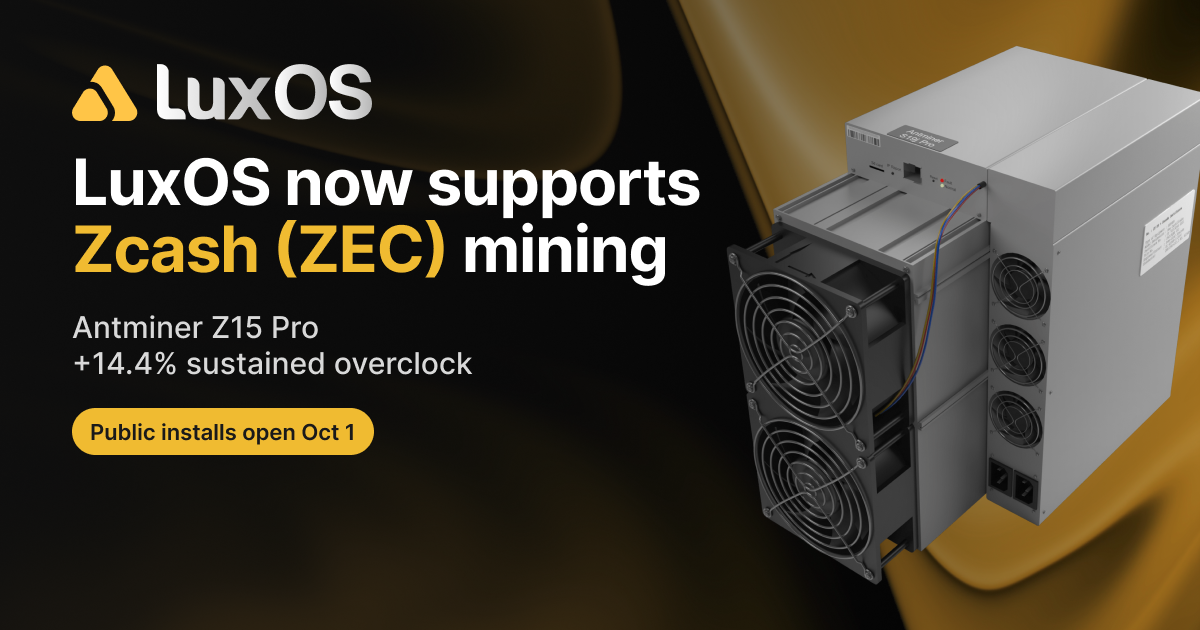
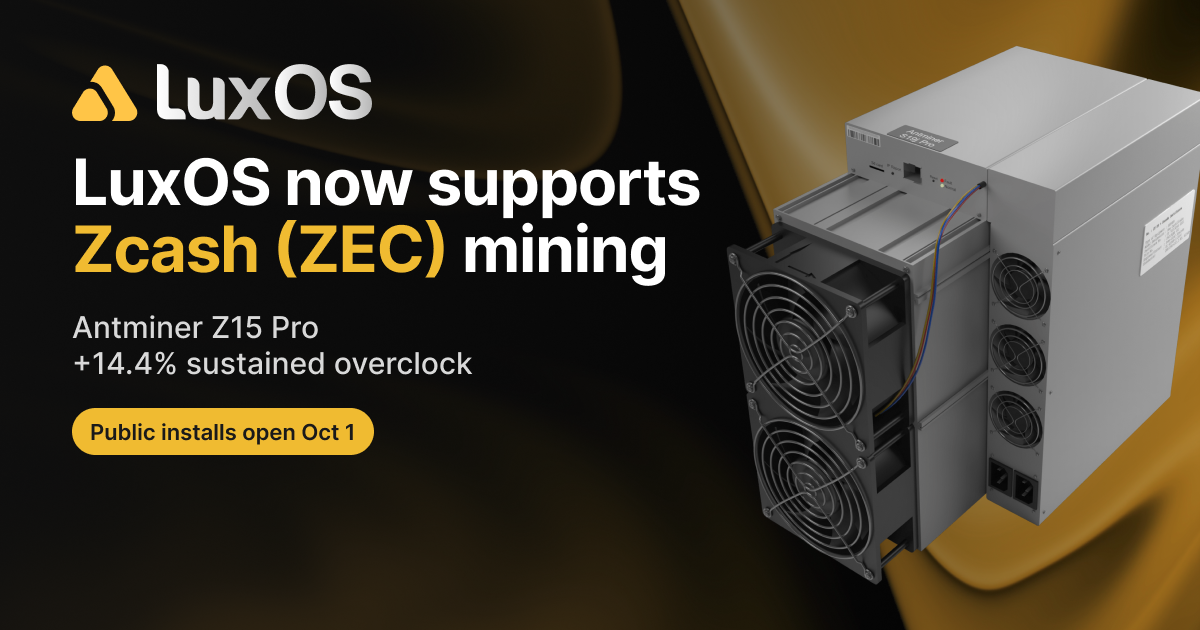
LuxOS effectively removes these constraints, transforming the Z15 Pro into a highly tunable asset. By integrating advanced thermal management, per-chip monitoring, and voltage control, Luxor’s software allows operators to optimize their machines based on their unique power costs and environmental conditions. Testing conducted on September 23, 2026, demonstrated that with LuxOS installed, the Z15 Pro could sustain a hashrate of 961 KSol/s, representing a substantial performance increase over the stock standard.
Chronology of the Integration
The development process for this firmware update involved months of rigorous testing to ensure stability across varying power loads. Luxor Technology confirmed that the public release of the firmware is scheduled for October 1, 2026. This release follows a period of private beta testing where selected mining operators were given early access to the firmware stack.
The integration timeline is designed to align with the current profitability cycle of the Zcash network. By providing operators with the tools to shorten their hardware payback periods, Luxor aims to capture a larger share of the Equihash market. As of late September 2026, the company’s internal benchmarks showed that the firmware provides a clear path for miners to increase their daily revenue, even when accounting for the software’s 2.8% fee.
Comparative Performance and Economic Impact
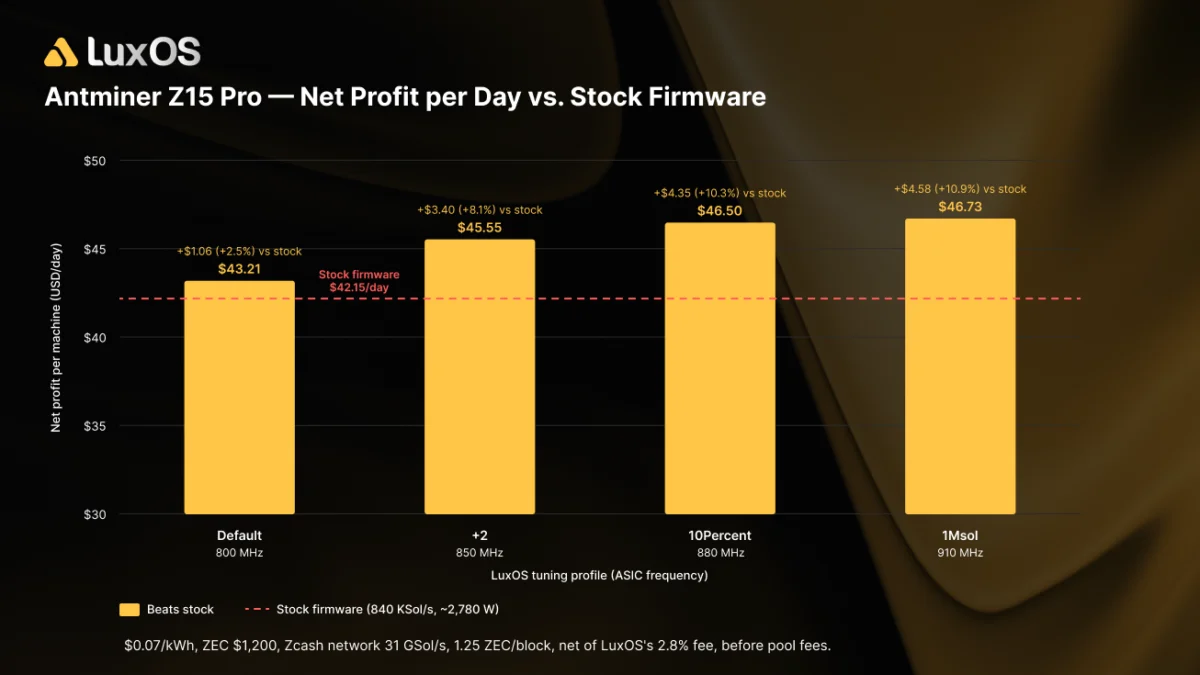
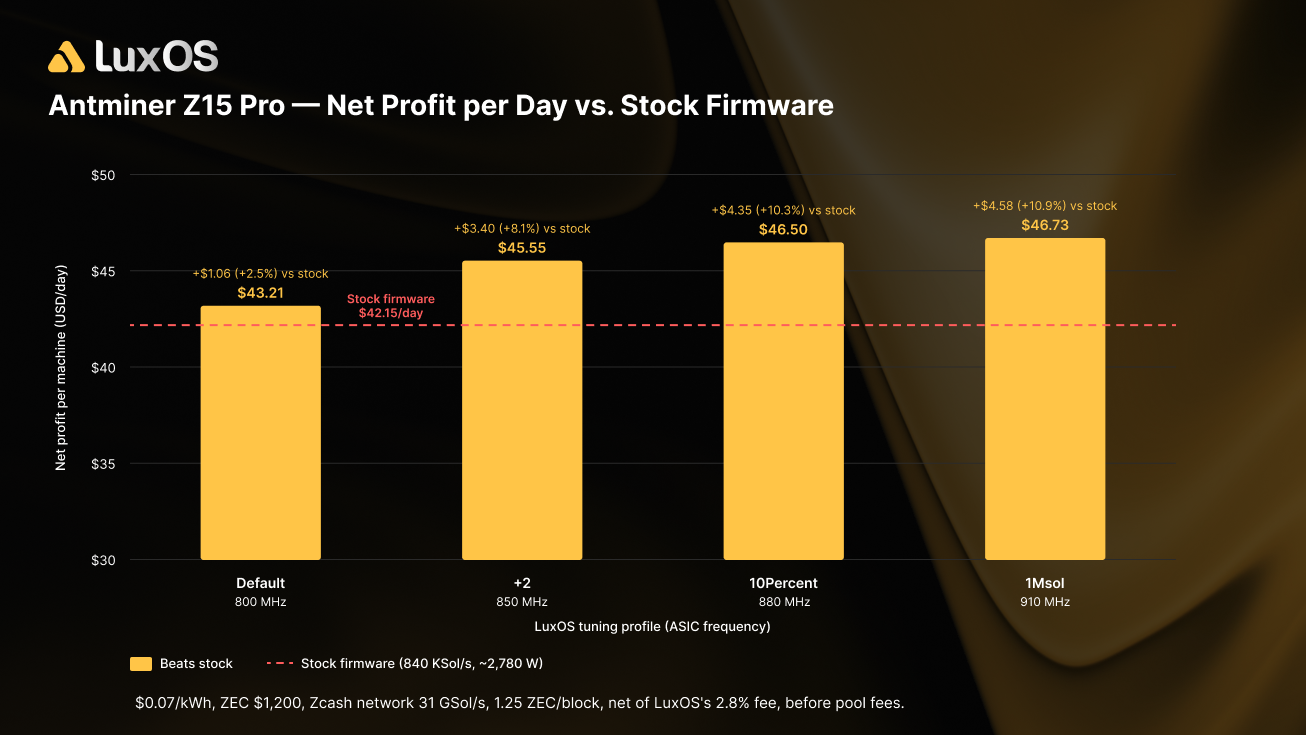
The economic implications of the firmware transition are best illustrated through a comparative analysis of revenue streams. At current market conditions—defined by a $1,200 ZEC price, 31 GSol/s network hashrate, and a 1.25 ZEC block reward—the stock Z15 Pro generates approximately $42 per day at a power cost of $0.07/kWh. In contrast, the LuxOS-enabled unit, accounting for the 2.8% fee and the additional power required for the overclocked state, nets approximately $47 per day.
Over a 90-day operational window, this performance gap results in an additional $429 of net profit per machine. For large-scale mining operations, these incremental gains compound significantly. A fleet of 100 units, for example, would see an increase of roughly $47,700 in net earnings over the same 90-day period. Furthermore, the payback period for new hardware—estimated at $7,475 per unit—is reduced from 177 days on stock firmware to approximately 159 days with LuxOS.
Technical Deep Dive: The Overclocking Trade-off
The core of the LuxOS value proposition lies in the optimization of the efficiency-to-output ratio. Every overclocking endeavor necessitates a trade-off: higher hashrate comes at the cost of increased energy consumption. The Z15 Pro, when pushed from 840 KSol/s to 961 KSol/s, increases power draw from 2,780 W to roughly 4,032 W.
Whether this transition is profitable is highly sensitive to local electricity rates. Luxor’s analysis indicates that the firmware remains gross-margin positive for the vast majority of grid-connected operators, with the overclocking benefits only beginning to diminish at power costs exceeding $0.23/kWh. Below this threshold, the marginal revenue gained from the increased ZEC production outweighs the marginal cost of the additional electricity.
Market volatility also plays a pivotal role. The breakeven point for the LuxOS overclock is estimated at $370 per ZEC. Should the price of ZEC fall below this level, the additional power required to maintain the higher hashrate would result in a net loss compared to the stock configuration. However, at current valuations, the financial incentives strongly favor the adoption of optimized firmware.
Operational Transparency and Fleet Management
Beyond raw hashrate increases, the primary value for large-scale enterprise miners is the transition to comprehensive fleet management. Stock firmware often limits visibility into chip health, making it difficult for operators to diagnose individual component failures or optimize cooling for specific segments of a rack.
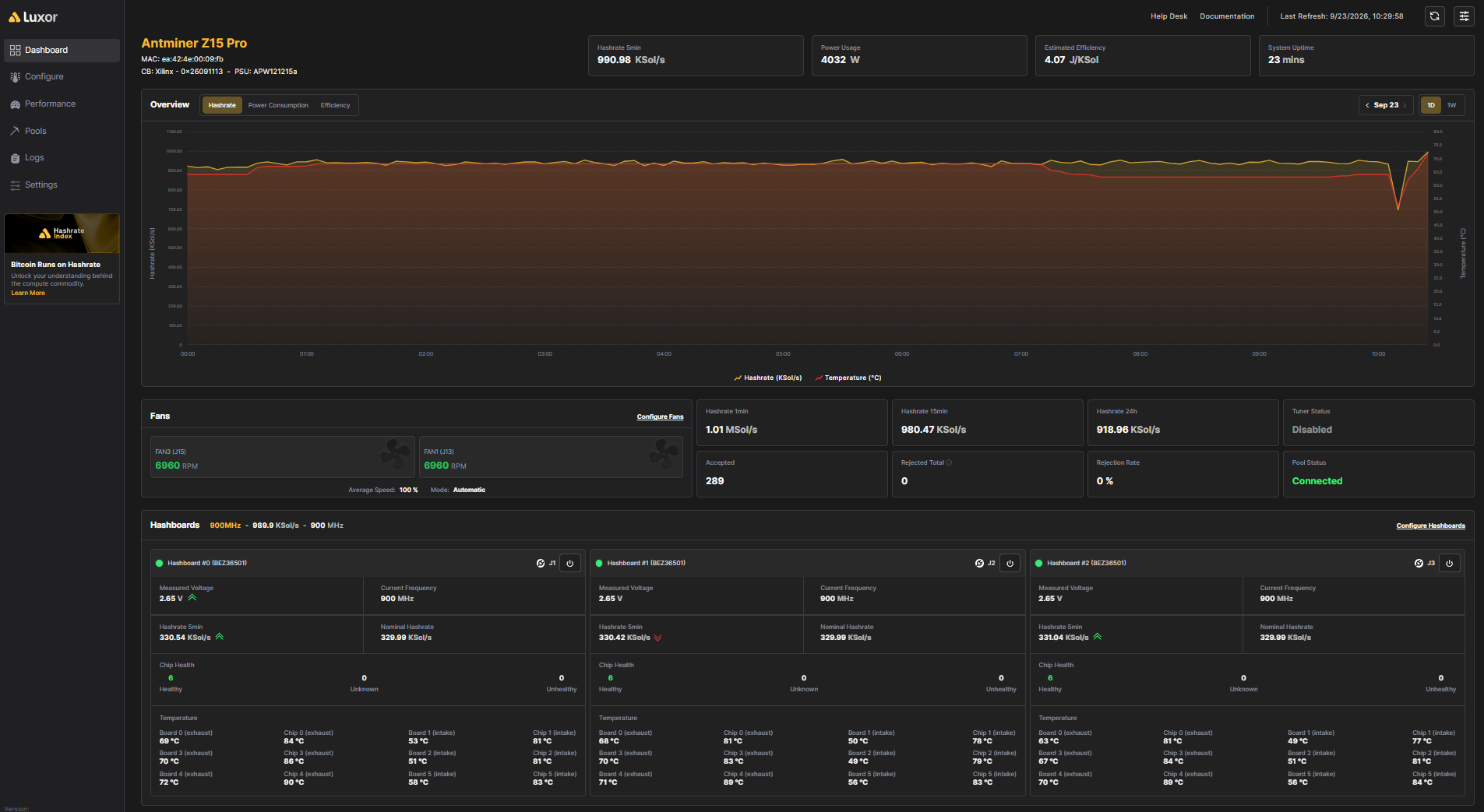
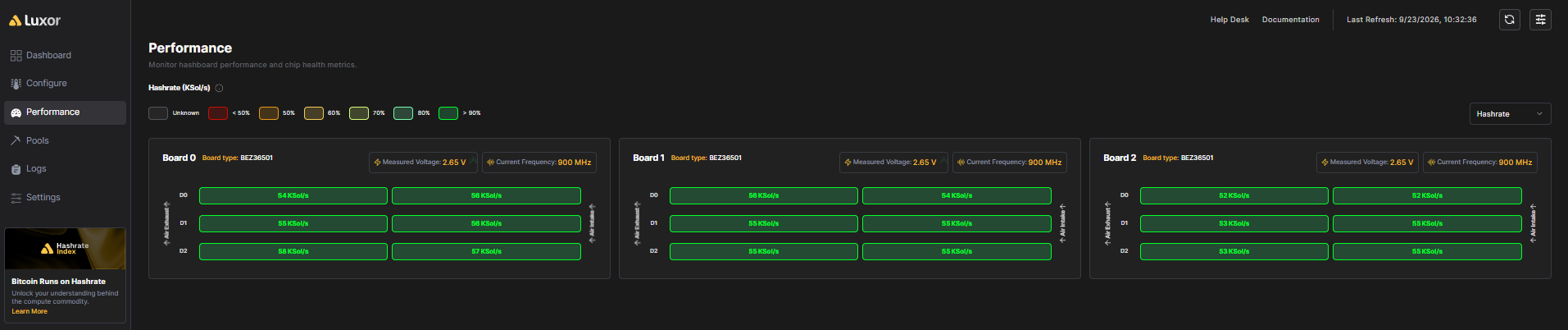
LuxOS provides a dashboard that displays per-chip hashrate and health scores, allowing for targeted maintenance. This visibility is critical for reducing downtime. If a single chip begins to degrade or if a specific hashboard encounters thermal issues, the software notifies the operator immediately. This level of granular monitoring is an industry standard for Bitcoin mining but has been notably absent for many Equihash-based operations. By bringing this infrastructure to the Z15 Pro, Luxor is effectively professionalizing the management layer for Zcash mining.
Broader Industry Implications
The introduction of Equihash support into the Luxor ecosystem signals a broader trend toward the professionalization of alternative coin mining. As the Bitcoin mining industry matures, companies like Luxor are increasingly looking to diversify their service offerings by applying proven software solutions to other high-performance algorithms.
This move also highlights the competitive nature of the ASIC firmware market. Manufacturers like Bitmain have long held dominance by controlling both the hardware and the software, but the rise of third-party firmware providers is forcing a shift in how mining hardware is perceived. The ability to "unlock" or "tune" hardware has become a competitive advantage, as mining profitability becomes increasingly tied to the ability to operate at the margins of energy efficiency.
Future Outlook
Looking ahead, the success of the Z15 Pro firmware release will likely dictate the speed at which Luxor expands into other Equihash hardware, such as the Z15 or Z15K models. The company has already indicated that it is monitoring demand for these machines. Furthermore, the firmware is built to be pool-agnostic, meaning operators are not locked into the Luxor mining pool, a feature that has been well-received by the broader mining community.
As the mining sector moves toward the end of 2026, the combination of high hardware costs and shifting network difficulty will continue to pressure operators to seek efficiency gains wherever possible. For those running Zcash operations, the deployment of optimized firmware is no longer just an elective upgrade but a strategic necessity to remain competitive in a landscape where every megasol and every kilowatt matters. With the official rollout set for October, the industry will be watching to see how quickly the Z15 Pro fleet migrates to this new standard and what impact this will have on the overall network hashrate and the profitability of Zcash miners globally.