After experiencing two consecutive quarters of contraction, the Bitcoin network’s computational power has finally achieved a state of equilibrium. As of the fourth quarter of 2026, the global hashrate stands at approximately 941 exahashes per second (EH/s), effectively matching the figures recorded at the end of the second quarter. While this headline figure suggests stability, a granular analysis of regional activity reveals a period of intense volatility and geographic relocation. The network is no longer shrinking at a systemic level, but the distribution of where that power resides is undergoing its most significant transformation since the start of the year.
The current landscape represents a departure from the sustained decline observed throughout the first half of 2026. At its peak in November 2025, the network operated at a significantly higher capacity, reaching roughly 1,100 EH/s. The subsequent slide, driven by shifting hashprice economics and a difficult mining environment, led to a roughly 15% reduction from that peak. However, the data for Q4 2026 indicates that the market has reached a floor. Marginal, less efficient mining hardware has largely been retired, and the network difficulty has recalibrated, allowing the remaining operators to sustain operations under current market conditions.
The Dynamics of Geographic Redistribution
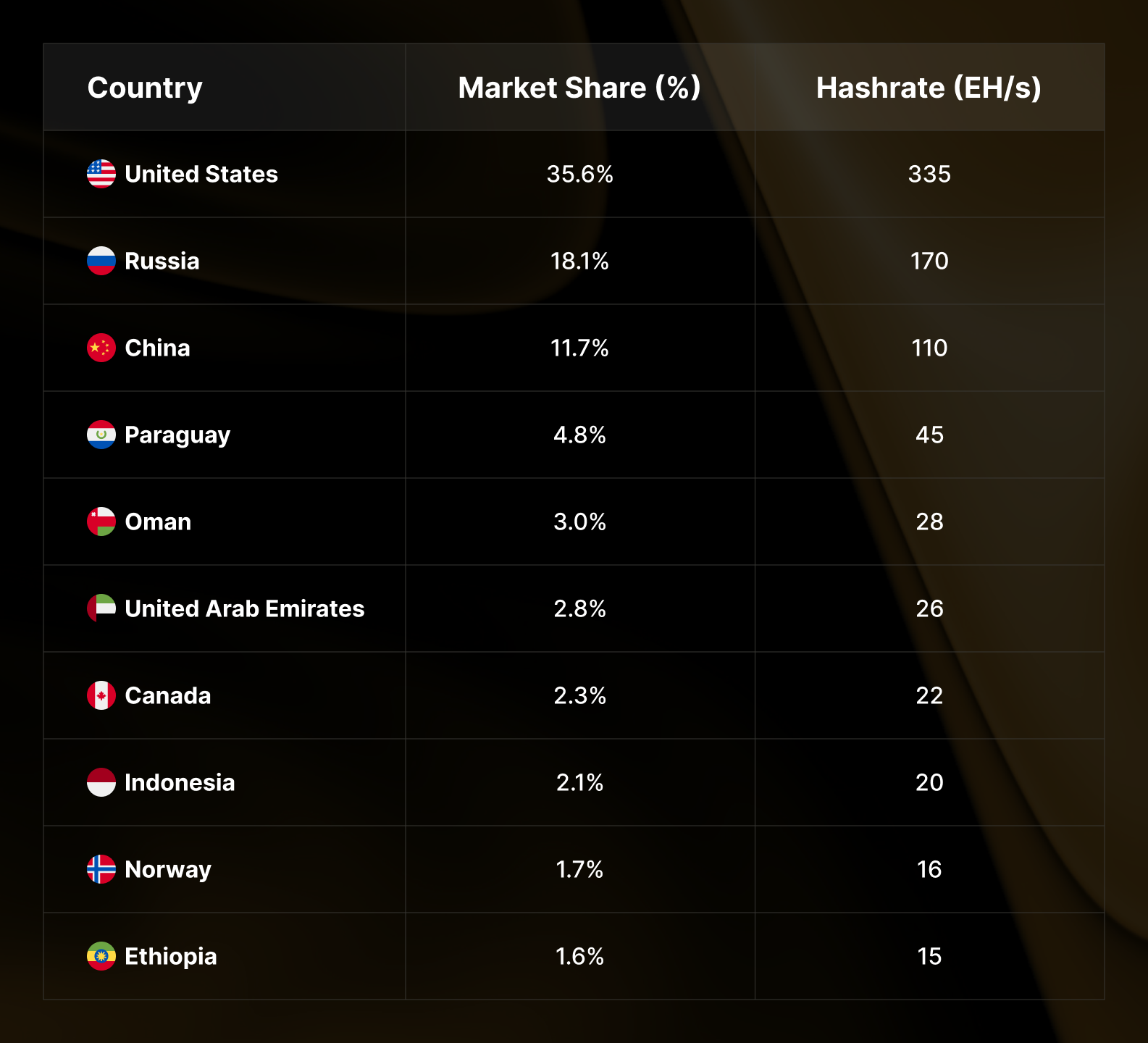
While the global total remained flat, the underlying regional movements were substantial. In a display of pure market redistribution, five major countries shifted their hashrate by more than 4 EH/s, signaling that the network is actively flowing toward jurisdictions with more favorable economic or energy profiles.
The United States, long the dominant force in Bitcoin mining, shed another 10 EH/s during the quarter. This decline is not merely a product of market sentiment but reflects a broader trend among Western miners: the pivot toward high-performance computing (HPC) and artificial intelligence (AI) infrastructure. As demand for AI-ready data centers surges, energy-rich mining facilities are increasingly repurposed for more lucrative, non-mining compute workloads.
Conversely, Russia expanded its footprint, adding 8 EH/s to its total. Other emerging markets, such as Pakistan and Venezuela, saw significant growth, collectively adding nearly 9.5 EH/s—a figure that effectively neutralized the losses seen in the North American market.
Concentration and the Top-Tier Shift
Despite the ongoing redistribution, Bitcoin mining remains highly concentrated. The top three nations continue to command roughly 65.4% of the global hashrate. However, this concentration is slowly eroding; the Q4 figure is down from 66.2% in the previous quarter, marking the second consecutive decline.
The rankings of the top ten nations have seen significant turbulence. Oman has overtaken the United Arab Emirates to secure the fifth position, while Indonesia has climbed to eighth place, demonstrating a 3 EH/s gain. Ethiopia, which had been a rising star in the mining sector, faced a notable setback, sliding from eighth to tenth place. Kazakhstan, maintaining a steady 15 EH/s, remains tethered to the edge of the top-ten list, effectively tied with Ethiopia as the industry enters the first quarter of 2027.
The AI Pivot: A Structural Change in Mining Economics
The year-over-year decline in developed markets—specifically Canada and the United Arab Emirates—provides a clear case study in changing capital allocation. Unlike previous periods where high electricity prices forced miners to shutter operations, the recent exodus from these regions is driven by opportunity cost.
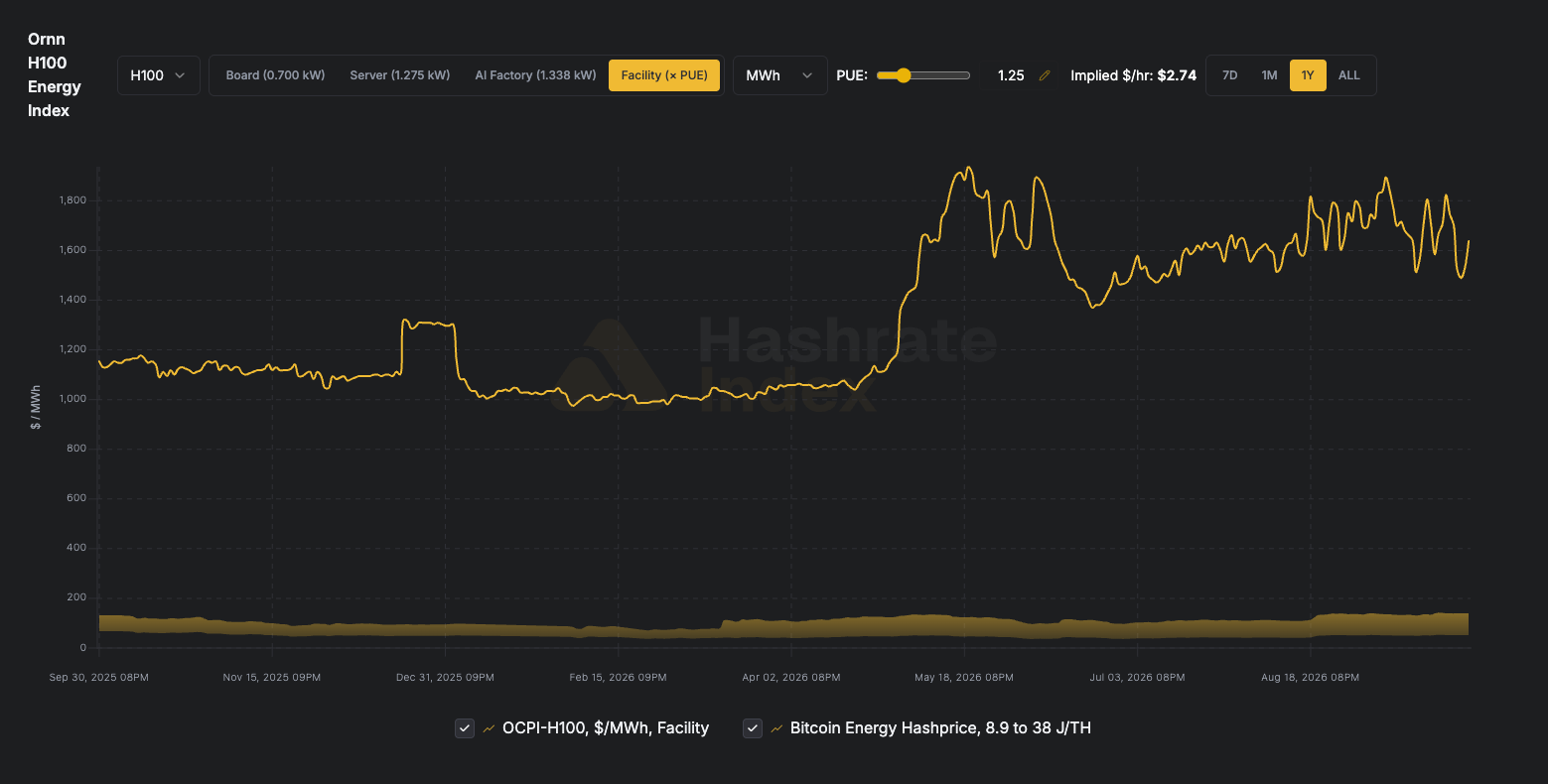
Data from the Ornn Compute Price Index indicates a widening gap between Bitcoin mining revenue and AI/HPC profitability. In the current market, AI compute can generate between $1,500 and $3,500 per megawatt-hour (MWh), compared to the $50 to $150 range typically yielded by Bitcoin mining. For operators with the technical capability to switch, the decision to migrate power to AI infrastructure is a rational business calculation rather than a distress sale. Consequently, this power is essentially "locked" away from the Bitcoin network for the foreseeable future, making the recent decline in North American hashrate a permanent structural shift rather than a temporary cyclical dip.
The Ethiopia Energy Crisis: A Cautionary Tale
The most significant reversal of the quarter occurred in Ethiopia. After scaling to a peak of 27.5 EH/s in Q1 2026, the country’s hashrate has dropped to 15 EH/s—a 45% decrease over nine months. The primary driver of this decline was an environmental and policy collision in mid-September.
As reported by Bloomberg, Ethiopian Electric Power (EEP) curtailed electricity supply to Bitcoin mining operations to just 23% of contracted levels. This drastic reduction was necessitated by a 20% drop in reservoir inflows, attributed to El Niño-induced drought conditions. The incident highlighted a critical vulnerability in the country’s mining model: a high reliance on hydroelectricity without the buffer of diversified energy storage or backup power. For investors, the Ethiopian experience serves as a reminder that even in low-cost jurisdictions, the climate-dependency of renewable energy sources remains a primary risk factor for large-scale mining operations.
Frontier Markets and Re-acceleration
As established regions grapple with energy constraints and AI competition, frontier markets have begun to fill the void. Pakistan’s growth from 2.5 EH/s to 8 EH/s represents a fundamental shift in the nation’s mining capacity, moving it well beyond its previous peak.
Similarly, Venezuela has reached a significant milestone, exceeding 10 EH/s, a 122% year-over-year increase. This growth is particularly notable given the country’s ongoing official prohibition of mining activities, suggesting that the expansion is occurring within the informal sector. The resilience of the Venezuelan mining ecosystem indicates that where low-cost energy is abundant, the network will find ways to manifest, even in the face of restrictive regulatory environments.
Regional Outlook and Future Implications
The regional breakdown of Q4 2026 reveals a world fractured by varying economic incentives:
- North America: The US remains the leader with 335 EH/s, but its downward trend is persistent, down 14% year-over-year. Canada’s 27% annual decline underscores the rapid transition toward AI-focused data centers.
- Europe & Central Asia: Russia’s status as the leading absolute gainer highlights the resilience of its infrastructure, while Kazakhstan’s stabilization suggests a period of relative calm following years of aggressive regulatory overhaul.
- Asia-Pacific: China continues its slow, systematic decline, down 24% year-over-year, as Southeast Asian nations like Indonesia and Malaysia continue to capture regional demand.
- Latin America: Paraguay remains the regional anchor, while Venezuela’s unexpected growth defines the quarter. Argentina, meanwhile, continues to struggle due to persistent macroeconomic instability.
Summary of Key Developments
The Bitcoin mining sector in Q4 2026 is defined by a dichotomy: while the network’s hashrate has stabilized, the players behind that hashrate are fundamentally changing. The "flight to quality" is being replaced by a "flight to utility," where energy is increasingly being diverted toward high-margin AI services.
For stakeholders, the primary takeaway is that the era of unfettered, centralized growth in traditional mining hubs is facing a hard ceiling. The future of the network will likely be determined by three distinct categories of miners: those who can successfully pivot to AI/HPC to maximize revenue per watt; those who operate in ultra-low-cost, stranded-power jurisdictions; and those who navigate the volatility of frontier markets.
As we move into 2027, the focus will shift to how these regions manage energy scarcity and regulatory shifts. With the total network hashrate holding steady at 941 EH/s, the focus for the industry has shifted from raw growth to the efficiency of energy utilization. The infrastructure that remains committed to Bitcoin will be the most resilient, having survived a year of intense competition for both electricity and capital. The global hashrate map is not just moving; it is hardening, adapting to a new economic reality where compute power is the world’s most contested resource.