In the evolving landscape of digital security, threat actors are continuously seeking architectural advantages to evade detection, bypass traditional mitigation strategies, and ensure the operational longevity of their malicious campaigns. A rapidly growing cohort of adversaries—ranging from financially motivated cybercriminal syndicates to advanced state-sponsored agents linked to Iran and North Korea—has found an increasingly resilient sanctuary: public, decentralized blockchains. Rather than relying on traditional, centralized web servers that remain perpetually vulnerable to law enforcement seizures, domain name takedowns, and corporate hosting disruptions, modern attackers are anchoring their operations directly onto distributed ledgers through a technique termed "blockchain dead drops" (BDDs).
This paradigm shift in cyber threat infrastructure represents a fundamental adaptation in how malware communicates with its operators. By leveraging the permanent, censorship-resistant nature of blockchains, threat campaigns can maintain continuous command-and-control (C2) capabilities without fear of single-point-of-failure infrastructure takedowns. As open-source artificial intelligence coding tools lower the technical barriers to entry, the frequency of BDD attacks has surged by more than 400 percent over a recent twelve-month observation period, complicating the work of cybersecurity defenders globally.

Understanding the Mechanics of Blockchain Dead Drops
To comprehend the severity of the threat, security professionals must examine how BDDs function in the wild. While malicious actors utilize varying implementations depending on their specific operational objectives, the core architecture generally involves storing malware payloads, dynamic C2 configuration parameters, or infrastructure routing pointers within immutable on-chain locations.
These implementations typically manifest in two primary forms:

- Transaction-based storage: Operators embed encoded instructions, payload references, or IP addresses directly into transaction fields—such as the Bitcoin OP_RETURN data field, transaction input data on the Binance Smart Chain (BSC), or memo fields across various networks.
- Contract-based storage: Attackers deploy smart contracts that serve as programmable, decentralized data repositories. Infected endpoints periodically query these contracts to retrieve the latest operational addresses, allowing threat actors to update their infrastructure seamlessly without altering the core malware binary distributed to victims.
Once an infected machine retrieves its updated instructions from the blockchain, the malicious operation transitions off-chain for the actual compromise. Depending on the campaign, subsequent activities range from deploying information-stealing malware to harvest cryptocurrency wallet credentials to installing remote access trojans (RATs) that grant adversaries persistent, unauthorized control over enterprise networks. Furthermore, researchers have uncovered lightweight variations, such as "phantom wallets"—addresses lacking private key pairs—where attackers encode C2 server IP addresses into the wallet address bytes themselves, prompting malware to decode and connect following zero-value transactions.
A Chronology of Evolution: From Bitcoin Forks to EtherHiding
The integration of distributed ledger technology into malicious operational frameworks is not entirely novel, tracing its origins back more than a decade. However, the sophistication, scale, and cross-chain execution of these tactics have matured exponentially in recent years.

The earliest historical antecedents date back to 2013, when variants of the Necurs botnet utilized Namecoin—an early Bitcoin fork—to store C2 domain configurations away from traditional DNS oversight. Throughout 2019, various criminal groups refined these methodologies. Operators of banking trojans encoded routing IP addresses into the exact quantities of Satoshis transferred during transactions, while the Glupteba crypto-mining botnet began writing update instructions directly into Bitcoin’s OP_RETURN fields.
A major inflection point occurred in mid-2023 with the emergence of "EtherHiding" on the Binance Smart Chain. When Cloudflare and webhosting providers cracked down on traditional infrastructure utilized by ClearFake infostealer operators, these actors migrated their malicious code delivery mechanisms into BSC smart contracts. Because the blockchain cannot be taken offline by any single corporate entity or government agency, the campaign persisted indefinitely. Within months, diverse criminal factions adopted similar methodologies, culminating in advanced botnets like Smargaft leveraging smart contract C2 frameworks by the end of 2023.
By late 2024 and early 2025, advanced persistent threat (APT) groups realized the strategic value of these techniques. Iranian intelligence-linked actors began embedding C2 configuration data into Bitcoin transactions, while North Korean operators integrated EtherHiding protocols into sophisticated social engineering campaigns targeting cryptocurrency developers through fraudulent job recruitment ruses.

The Catalyst: Open-Source AI and Surging Adoption Rates
The dramatic escalation in BDD deployment is closely correlated with the democratization of advanced software development capabilities. Historically, constructing reliable, multi-chain BDD infrastructures required deep, specialized expertise in both offensive cybersecurity and blockchain engineering.
However, the widespread proliferation of open-source, open-weight large language models (LLMs)—particularly unconstrained models capable of generating complex smart contracts and parsing scripts—fundamentally lowered the barrier to entry. Empirical threat intelligence data indicates that malicious writes to public blockchains escalated sharply following the release of these high-capacity coding models, jumping from a baseline of approximately 2.06 malicious writes per day to more than 11.1 daily writes—representing a surge exceeding 440 percent in less than a year.

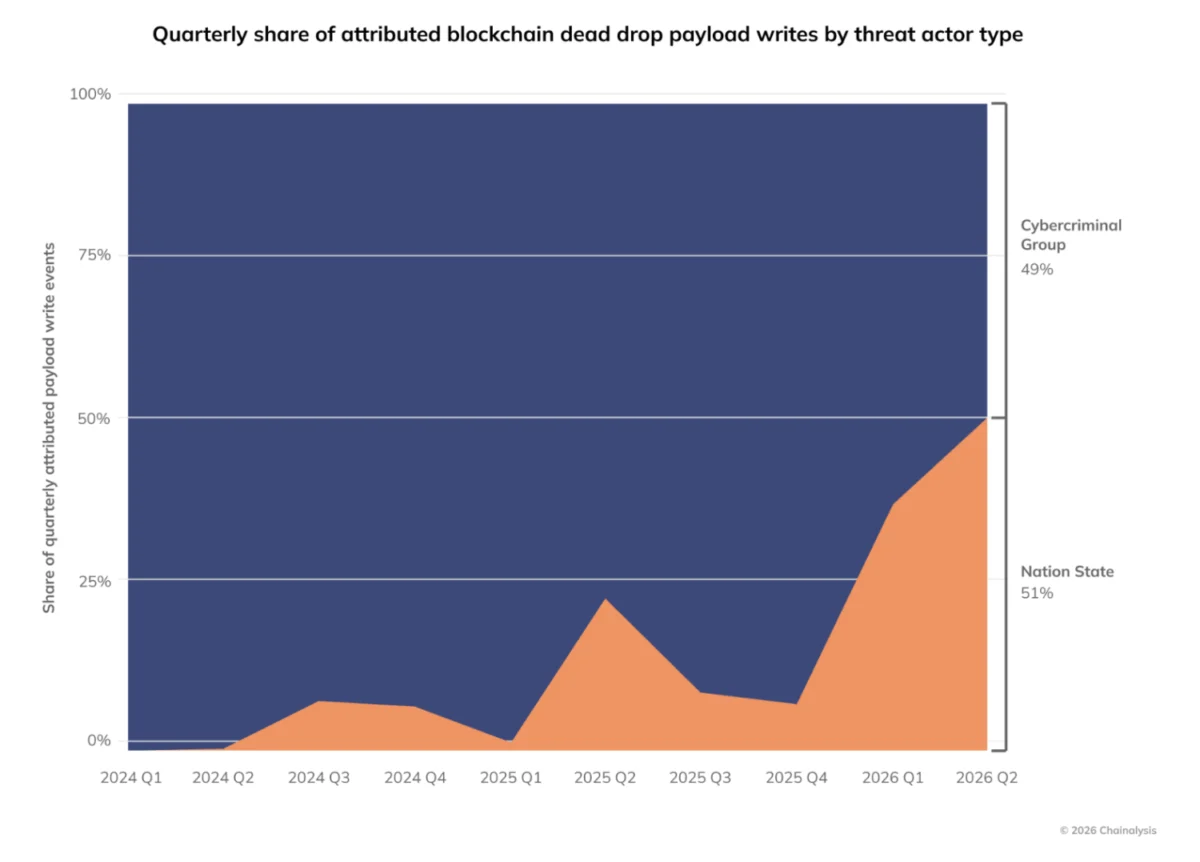
By mid-2026, security analysts were tracking active BDD operations spanning at least five major blockchain networks and more than a dozen distinct malware families. Statistical breakdowns of this activity reveal a significant shift in actor demographics: while cybercriminals pioneered the space, state-sponsored entities rapidly assumed a dominant role. By the second quarter of 2026, state-linked threat groups accounted for roughly two-thirds of newly initiated BDD activities each quarter and approximately half of cumulative historical volume.
Case Studies in Cross-Chain Redundancy and Nation-State Deployment
Recent threat intelligence investigations highlight how sophisticated nation-state actors and cybercriminal cooperatives operationalize BDD frameworks to secure their infrastructure against disruption.

Case Study 1: DPRK Multi-Chain Redundancy
Attributed threat clusters linked to the Democratic People’s Republic of Korea—such as the group tracked by Google Threat Intelligence Group as UNC5342—have evolved beyond single-chain deployments. Investigators uncovered a complex, multi-chain architecture designed to maximize campaign resilience. Utilizing a combination of the TRON, Aptos, and Binance Smart Chain networks, these operators embedded encoded pointers within TRON and Aptos transactions that resolved to a primary BSC transaction. If an infected machine’s query to the TRON network failed, it automatically defaulted to the Aptos route, ultimately retrieving encrypted malware instructions housed on BSC. This multi-layered redundancy ensures that disrupting the adversary’s infrastructure requires coordinated enforcement actions across three distinct blockchain ecosystems simultaneously.
Case Study 2: Iranian Intelligence Operations via Bitcoin OP_RETURN
Threat actors assessed to be operating on behalf of Iranian state interests have leveraged the Bitcoin blockchain for persistent C2 configuration updates. Rather than deploying custom smart contracts—which are natively unsupported on the foundational Bitcoin layer—these operators utilize small-value transactions directed toward historical, highly visible addresses, such as those historically associated with pseudonymous creator Satoshi Nakamoto. The financial transfers themselves are nominal and functionally irrelevant; the core utility lies in the data encoded within the OP_RETURN transaction outputs. Malware deployed on victim endpoints is programmed to parse these specific public records to discover current infrastructure routing pointers, combining operational obscurity with absolute permanence.
Case Study 3: Russian-Language Malware-as-a-Service (MaaS) Frameworks
In the commercial cybercriminal underground, Russian-language syndicates have packaged BDD capabilities into Malware-as-a-Service subscription models. Documented frameworks like the ErrTraffic toolkit leverage Polygon smart contracts as decentralized resolvers. Primary operator wallets control fleets of storage contracts rented out to downstream affiliates. This architecture allows a single MaaS provider to manage numerous independent criminal campaigns through centralized on-chain control panels, enabling rapid updates whenever individual C2 servers are identified and blocked by enterprise defensive tools.

Implications for Cybersecurity and Strategic Defense
The proliferation of blockchain dead drops presents a profound structural challenge to traditional enterprise security models. Conventional threat intelligence platforms and perimeter defenses, which rely heavily on domain name blacklisting, IP reputation scoring, and standard web traffic monitoring, frequently miss on-chain communication entirely.
Furthermore, network administrators cannot effectively mitigate BDD risks by simply blocking public blockchain traffic. Restricting access to standard Ethereum or multi-chain RPC endpoints—such as those operated by infrastructure providers like Infura, Alchemy, and Cloudflare—would inadvertently cripple legitimate decentralized finance (DeFi) applications, cryptocurrency wallets, and web3 development environments utilized by corporate engineering teams. Moreover, determined adversaries possess the technical capability to deploy and query private, dedicated blockchain nodes if public RPC access is restricted.

Consequently, cybersecurity experts emphasize that defense strategies must adapt to leverage blockchain intelligence itself. The inherent immutability and transparency that make distributed ledgers attractive to threat actors also render their operations uniquely observable. By employing specialized infrastructure identification and blockchain analytics tools, defenders can map operator wallets, track funding pathways, analyze smart contract deployment histories, and connect seemingly disparate malware campaigns to unified threat actors.
For security operations centers (SOCs) and incident responders, integrating on-chain telemetry with endpoint monitoring—specifically tracking outbound JSON-RPC queries to public blockchain nodes from high-risk internal endpoints—provides a vital, scalable early-warning indicator. As adversaries continue to innovate at the intersection of web2 malware and web3 infrastructure, proactive blockchain visibility will increasingly become an indispensable component of comprehensive enterprise cyber defense.