The landscape of modern cybersecurity is undergoing a radical shift as threat actors increasingly bypass traditional web hosting in favor of public blockchains. By embedding malicious code, command-and-control (C2) pointers, and dynamic routing configurations directly into decentralized networks, cybercriminals and nation-state groups are establishing censorship-resistant operations that are virtually immune to standard web takedowns.

According to recent threat intelligence data from blockchain analytics firm Chainalysis, this methodology—collectively referred to as "blockchain dead drops" (BDDs)—has surged exponentially. Malicious on-chain activity has spiked by 420 percent over a recent twelve-month tracking period, jumping from an average of roughly two daily malicious writes to more than eleven per day following the widespread availability of unconstrained open-source artificial intelligence coding tools.
The evolution of these tactics highlights a fundamental challenge for digital defenders: while traditional threat-intelligence platforms excel at monitoring conventional web traffic, they frequently possess a severe visibility gap regarding on-chain activity. Because blockchains are designed to be permanent, transparent, and immutable, they provide threat actors with an unprecedented layer of campaign durability.

The Mechanics and Evolution of Blockchain Dead Drops
To understand the severity of the BDD threat, security professionals must examine how traditional espionage tradecraft has been digitized. In physical espionage, a "dead drop" is a pre-arranged location where agents can leave materials for one another without meeting face-to-face. In the digital realm, a blockchain dead drop serves an identical purpose: threat actors deposit malicious payloads, infrastructure configurations, or server IP pointers onto public blockchains, allowing infected endpoint devices to retrieve instructions on demand.

The technique typically manifests in two distinct forms:
- Transaction-based storage: Attackers use specific transaction fields—such as Bitcoin’s OP_RETURN data carrier or input calldata on Ethereum Virtual Machine (EVM) chains—to publish encoded routing configurations and payload references.
- Contract-based storage: Threat actors deploy programmable smart contracts that act as dynamic storage locations. Malware on an infected machine queries the smart contract to find the current active C2 server, enabling operators to rotate their infrastructure simply by updating the contract state.
The historical trajectory of BDDs dates back more than a decade, initially appearing in primitive forms on alternative cryptocurrency networks. In 2013, variants of the Necurs botnet utilized Namecoin—a Bitcoin fork—to store C2 domains. Throughout 2019, various banking Trojans and crypto-mining botnets like Glupteba encoded server IP addresses directly into Bitcoin transaction amounts and metadata fields.

However, a major technological leap occurred in mid-2023 with the emergence of "EtherHiding" on the Binance Smart Chain (BSC). Facing aggressive crackdowns by content delivery networks like Cloudflare against traditional web servers, operators of the ClearFake infostealer migrated their delivery mechanisms into immutable smart contracts. Within months, diverse criminal factions adopted the strategy, culminating in the deployment of complex DDoS botnets leveraging decentralized infrastructure.
Chronology and Escalation: From Cybercrime to Nation-State Espionage

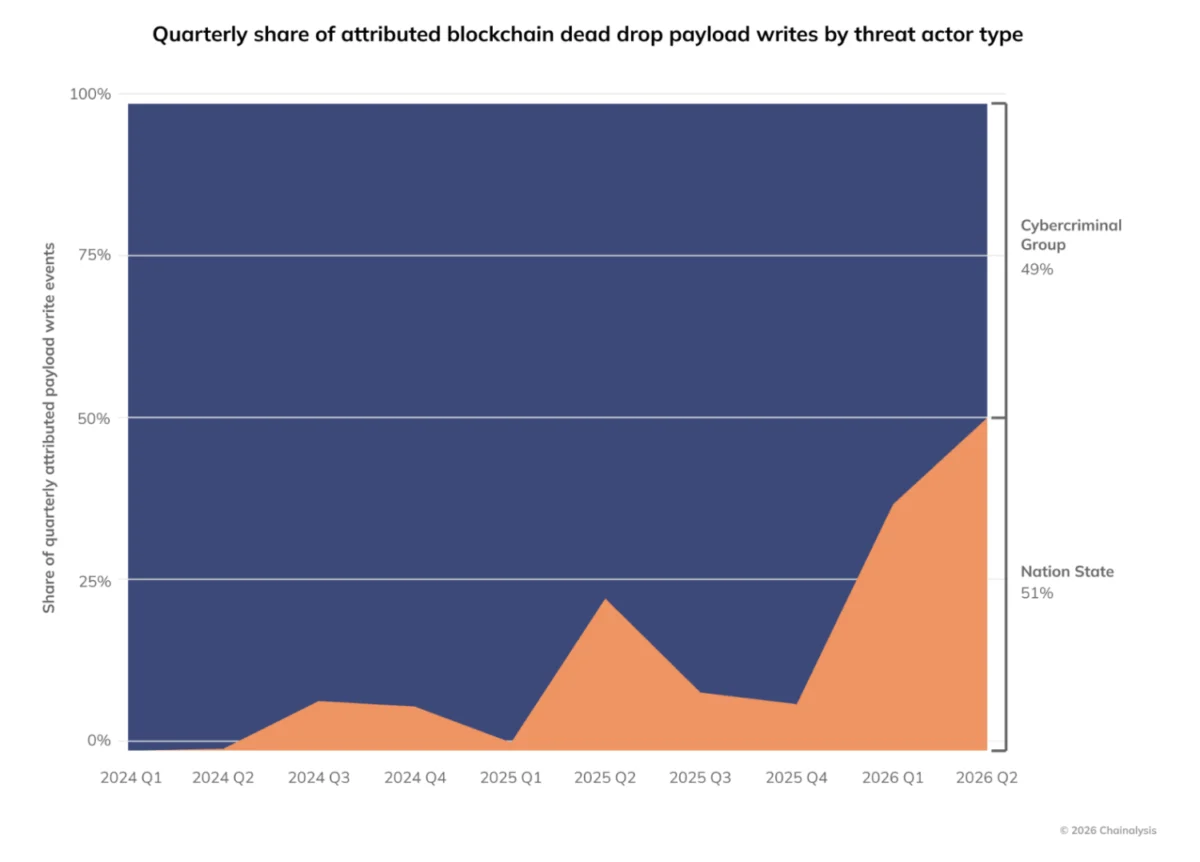
While financially motivated cybercriminals initially drove the adoption of blockchain-based C2 infrastructure, nation-state actors quickly recognized the strategic value of decentralized resilience. By mid-2024, state-sponsored groups began deploying sophisticated BDD campaigns, eventually accounting for roughly half of all total BDD activity and up to two-thirds of newly initiated campaigns by early 2026.
A detailed chronological overview highlights the rapid expansion of BDD operations across multiple nation-state actors:

- September 2013: Early experiments emerge as the Necurs botnet variant utilizes Namecoin to securely store command-and-control domains outside traditional DNS infrastructure.
- September 2019: Threat actors encode C2 IP addresses for banking malware into Bitcoin transaction values, and operators of the Glupteba botnet write malicious configuration data into Bitcoin’s OP_RETURN fields.
- August 2023: EtherHiding debuts on the Binance Smart Chain as ClearFake operators migrate away from vulnerable Web2 hosting providers following Cloudflare enforcement actions.
- Late 2023 to Early 2024: Cybercriminal adoption accelerates rapidly, with MaaS frameworks and DDoS botnets like Smargaft integrating smart contract C2 mechanisms.
- Late 2024: Iranian threat actors linked to intelligence services begin embedding C2 routing data into Bitcoin transactions, utilizing Satoshi-era addresses as neutral reference points.
- Early 2025: North Korean state-sponsored groups (such as UNC5342) adopt EtherHiding methodologies to bolster fraudulent cryptocurrency job-interview schemes targeting digital asset developers.
- Mid-2025: The public release of high-capacity, unconstrained open-source AI coding models drastically lowers the technical barrier to entry. Malicious blockchain writes surge by 440 percent, expanding across five major blockchains and dozens of malware families.
- Q2 2026: State-linked entities account for the majority of new BDD deployments, demonstrating advanced multi-chain redundancy and automated Malware-as-a-Service integration.
Case Studies in Cross-Chain Redundancy and State-Sponsored Operations
Recent forensic investigations by cybersecurity firms and blockchain analysts have uncovered specific operational frameworks deployed by North Korean, Iranian, and Russian-language threat actors.

North Korean Redundancy Tactics (UNC5342)
North Korean state-linked groups, notably tracked by Google Threat Intelligence Group as UNC5342, have significantly evolved their targeting of cryptocurrency developers. Beyond single-chain EtherHiding contracts, investigators have uncovered advanced multi-chain redundancy frameworks. In these campaigns, threat actors utilize TRON and Aptos blockchain transactions to host encoded pointers that resolve to a central transaction on the Binance Smart Chain. Compromised endpoint devices execute queries sequentially across multiple networks; if one query fails, the malware falls back to an alternative chain. Ultimately, all paths lead to an encrypted payload on BSC containing C2 instructions, credential-stealing routines, and secondary staging frameworks. Disrupters face a formidable obstacle, as neutralizing the campaign requires simultaneous intervention across three entirely distinct blockchain ecosystems.
Iranian Intelligence Operations via Bitcoin OP_RETURN
Attribution evidence points to operators aligned with Iranian intelligence leveraging the Bitcoin blockchain for persistent communication. Instead of hosting malicious smart contracts, these threat actors utilize attacker-controlled wallets to broadcast nominal micro-transactions to well-known, historically significant Bitcoin addresses—such as those associated with pseudonymous creator Satoshi Nakamoto. The financial value of the transaction is irrelevant; the critical asset is the encoded metadata carried within the OP_RETURN field. Malware installed on targeted enterprise or government networks regularly decodes these public transactions to discover current infrastructure endpoints. This approach minimizes the attacker’s operational footprint while enabling seamless infrastructure rotation through simple broadcast updates.

Russian-Language Malware-as-a-Service (MaaS) Frameworks
Commercial cybercrime ecosystems operating within Russian-language forums have industrialized BDD technology through Malware-as-a-Service subscription models. Documented frameworks like the ErrTraffic toolkit leverage Polygon smart contracts to manage extensive fleets of resolver contracts. In these subscription-based operations, a primary operator maintains a central deployer wallet that provisions and updates multiple resolver contracts on behalf of downstream affiliates. On-chain analysis has successfully mapped these deployer wallets to broader illicit operations, including fraudulent stablecoin tokens, clipboard-hijacking utilities targeting crypto asset holders, and dozens of standardized resolver scripts. By correlating wallet-level funding chains and contract bytecode, blockchain intelligence reveals interconnected criminal enterprises that traditional endpoint-centric investigations might otherwise categorize as isolated incidents.
Implications for Enterprise Defense and Cybersecurity Strategy

The mainstream adoption of blockchain dead drops presents a profound dilemma for enterprise security teams and network administrators. Traditional defensive mitigations—such as implementing perimeter firewalls, executing domain-name system (DNS) sinkholing, or seizing malicious web hosting servers—are fundamentally ineffective against decentralized on-chain infrastructure.
Furthermore, attempting to mitigate the risk by blocking outbound traffic to public blockchain RPC (Remote Procedure Call) endpoints is operationally unviable for modern organizations. Restricting access to infrastructure providers like Infura, Alchemy, or Cloudflare would inadvertently cripple legitimate financial technology applications, decentralized finance (DeFi) protocols, and internal blockchain development operations. Moreover, advanced threat actors can easily bypass blocked public endpoints by querying their own self-hosted blockchain nodes.

Consequently, cybersecurity experts emphasize that defense strategies must evolve beyond traditional network blocking. Organizations must pivot toward integrated threat intelligence that bridges traditional endpoint detection and response (EDR) telemetry with on-chain analytics. By monitoring outbound JSON-RPC calls from enterprise endpoints, security analysts can establish early-warning signals for unauthorized blockchain queries. Additionally, leveraging blockchain intelligence tools allows defenders to profile adversary infrastructure, track wallet funding mechanisms, and anticipate infrastructure rotations before campaigns successfully exfiltrate sensitive data.
As artificial intelligence tools continue to lower technical barriers and threat actors refine their multi-chain resilience, public blockchains will remain a cornerstone of advanced cyberattacks. Mitigating this evolving threat requires unprecedented collaboration between traditional cybersecurity investigators, blockchain analytics providers, and law enforcement agencies worldwide.