In the high-stakes environment of organ transplantation, every second counts. When a donor heart becomes available, a race against time begins, as a viable heart can survive outside the human body for only a matter of hours. During this narrow window, a complex network of medical professionals, provincial coordinators, and national authorities must act in absolute synchronicity. Every medical record, authorization, and consent form must be verified instantly and flawlessly. A single lost document, a misplaced form, or an unverified signature can mean the difference between life and death.
To eliminate these vulnerabilities, Argentina has taken a monumental step forward in public health infrastructure. The nation’s central authority for organ and tissue donation, the Instituto Nacional Central Único Coordinador de Ablación e Implante (INCUCAI), alongside Latin American decentralized identity firm Extrimian, has successfully deployed a live, publicly verifiable digital identity and document-signing system on the IOTA mainnet. This technological integration covers INCUCAI and its 24 provincial procurement agencies, creating an immutable backbone for the country’s entire transplant network.
The Challenge of National Medical Coordination
INCUCAI operates as the nerve center for Argentina’s organ, tissue, and cell transplantation ecosystem. Managing the national waiting list requires continuous collaboration with 24 jurisdictional procurement agencies—encompassing every Argentine province alongside the Autonomous City of Buenos Aires—as well as a sprawling network of public and private hospitals.
Coordinating life-or-death decisions across decentralized regional entities historically posed logistical and administrative hurdles. Traditional paper-based workflows and conventional centralized databases are susceptible to friction, delays, and administrative bottlenecks. Recognizing that modern public health governance requires absolute transparency, security, and cryptographic certainty, INCUCAI initiated a modernization effort to overhaul its digital infrastructure.
The goal was clear: establish a tamper-proof framework that guarantees absolute traceability and legal certainty for every donation and transplant process without compromising patient confidentiality. To achieve this, INCUCAI partnered with Extrimian, a regional leader in decentralized digital identity (SSI) solutions, which selected the IOTA mainnet as the foundational, neutral public layer for the project.
Technological Architecture and Privacy Preservation
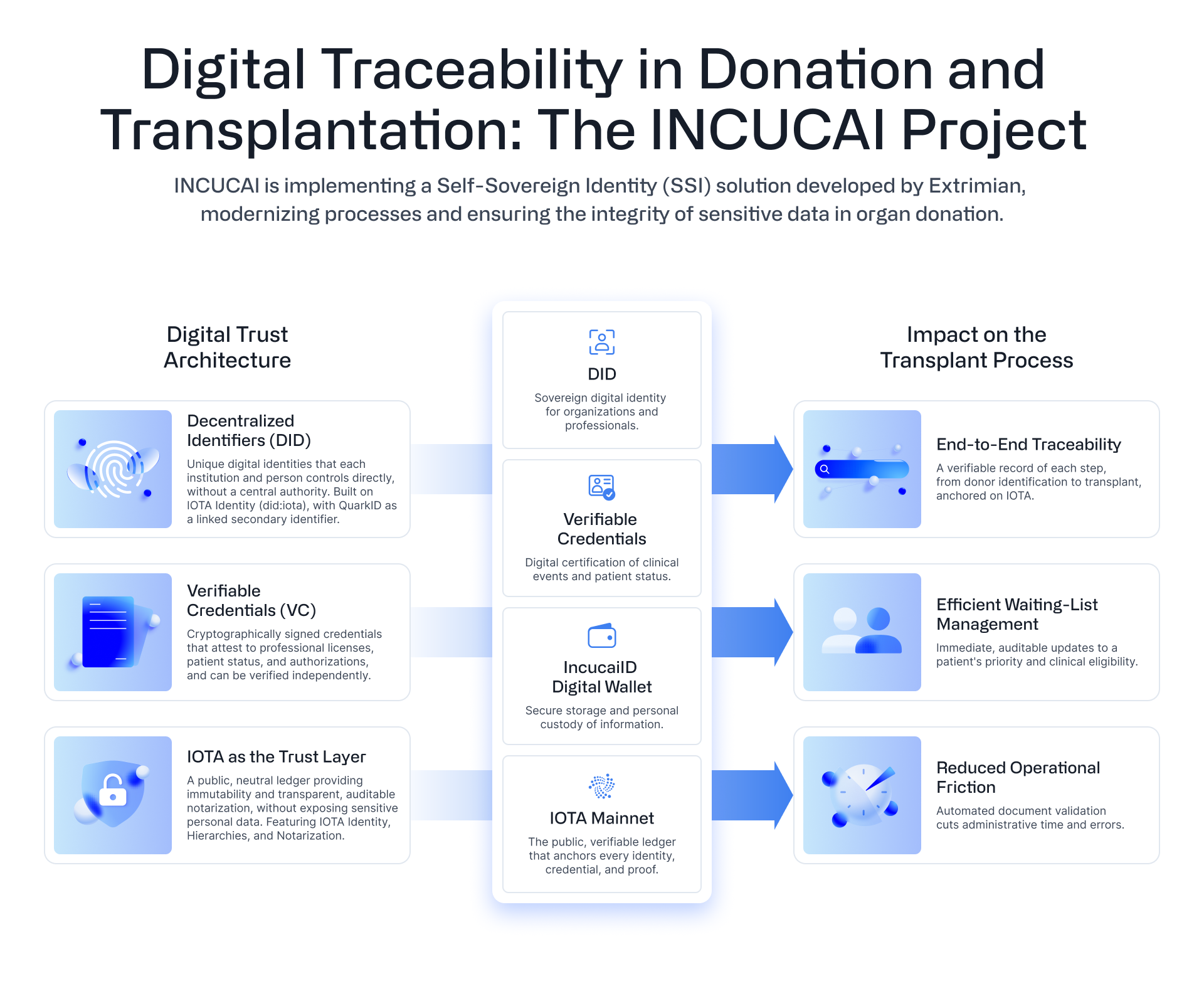
The newly deployed system leverages self-sovereign identity (SSI) and decentralized ledger technology to streamline operations. Crucially, the architecture has been meticulously engineered to protect patient privacy. Under no circumstances is patient-identifiable medical information stored on the public blockchain.
Instead, the system utilizes cryptographic proofs—specifically, cryptographic hashes of documents and critical process steps—which are permanently anchored to the IOTA ledger. This design guarantees absolute data integrity and immutability while shielding sensitive personal details. The medical data and personal histories entrusted by patients and grieving families during moments of profound vulnerability remain strictly confidential. Meanwhile, doctors, oversight agencies, and families can independently verify that every protocol was strictly followed.
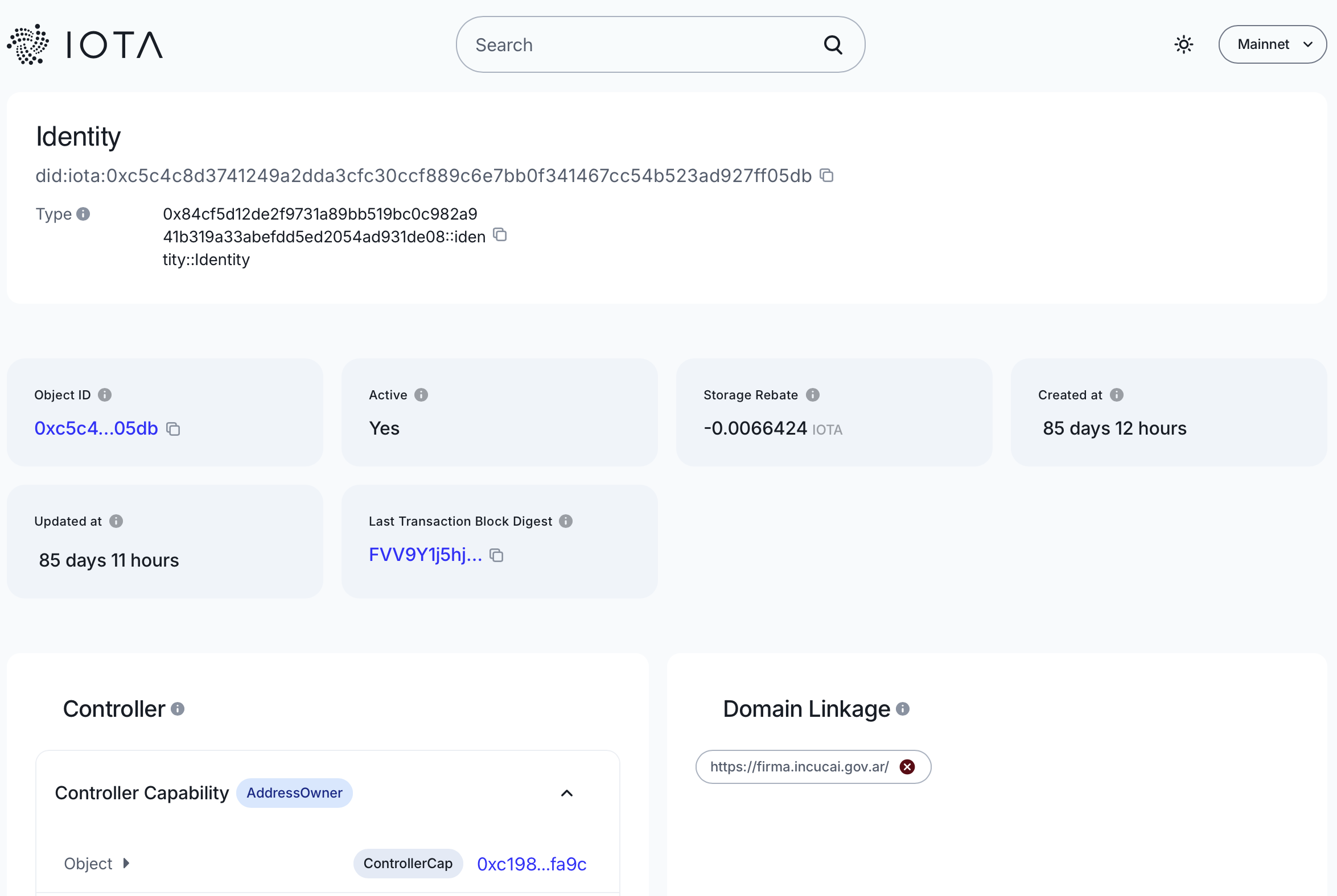
The technical framework relies on open, standardized protocols, including World Wide Web Consortium (W3C) specifications for decentralized identifiers (DIDs) and verifiable credentials. Furthermore, INCUCAI’s onchain institutional identity is cryptographically linked to its official government domain (firma.incucai.gov.ar), enabling anyone to verify that the entity executing digital actions is the genuine national authority rather than an impostor. Portions of the technical infrastructure are also integrated with ARSAT, Argentina’s state-owned telecommunications company, ensuring that critical components remain under national sovereignty.
Chronology of the Rollout
The integration of blockchain-backed digital identity into Argentina’s healthcare framework followed a deliberate, standards-compliant trajectory:
- June 2026: Resolution 199/2026 was officially published in the national Official Gazette (Boletín Oficial), providing the legal mandate for INCUCAI to implement electronic signatures across all processes managed through SINTRA (Argentina’s National Procurement and Transplant Information System).
- June 10, 2026: The decentralized identity and notarization infrastructure officially went live on the IOTA Mainnet, allowing public, independent verification of institutional credentials across all 24 provincial agencies.
- Mid-June 2026: INCUCAI launched IncucaiID, the ecosystem’s official digital wallet application, made available for download on major mobile platforms. The rollout began with the patient registration workflows for heart and lung transplants, laying the groundwork for broader integration across all organ categories.
- Independent Audit: The IOTA Foundation conducted a comprehensive, independent verification of the deployment using public endpoints and the IOTA Explorer, confirming that all 24 provincial identities resolved correctly and aligned with the national trust federation.
Official Responses and Institutional Perspectives
The adoption of blockchain technology for a national health initiative has drawn praise from technology and healthcare leaders alike, who view the deployment as a blueprint for modern public administration.
Daniela Hansen Krogh, Director of Information Technology and Information Systems at INCUCAI, emphasized the human element behind the technological upgrade: "Trust is at the heart of every organ donation and transplantation process. Our responsibility is to ensure that every decision is supported by reliable, secure, and verifiable information. By incorporating decentralized identity and cryptographic verification into our national systems, we are strengthening the integrity, traceability, and legal certainty of every critical stage, while safeguarding sensitive patient information. This initiative reflects INCUCAI’s ongoing commitment to modernizing Argentina’s transplant system through secure, transparent, and citizen-centered digital innovation."
Esteban Musso, Professional Services Manager and Partner at Extrimian, highlighted the practical value of decentralized systems in government services: "At Extrimian, we believe that trust is the foundation of every digital transformation. By combining open standards with privacy-preserving technologies, we’ve helped build a solution that enhances traceability, security, and interoperability while respecting the privacy of every participant. Projects like this demonstrate that decentralized technologies are no longer a vision for the future—they are delivering tangible value today in critical public services."
Dominik Schiener, Co-Founder and Chairman of the IOTA Foundation, underscored the significance of deploying enterprise-grade ledger technology at a national scale: "This is what IOTA’s open technology can do for critical public services at national scale: real infrastructure, already coordinating decisions that save lives."
Implications and Broader Industry Impact
The successful integration of IOTA and Extrimian’s infrastructure into INCUCAI’s operations marks a significant milestone for the practical application of decentralized ledger technology in government. For decades, public sector blockchain initiatives have frequently stalled at the proof-of-concept stage, constrained by regulatory uncertainty, scalability limits, or user experience friction.
By operationalizing decentralized identifiers, verifiable credentials, and immutable notarization within a live national healthcare network—supported by formal regulatory backing via Resolution 199/2026—Argentina has established a compelling precedent. The transition from paper-based bureaucracy to a paperless, cryptographically secure workflow eliminates administrative latency, reduces the risk of human error or document tampering, and accelerates the coordination required during critical organ matches.
As nations worldwide grapple with the challenges of digitizing public infrastructure securely, the INCUCAI deployment offers a tangible model. It demonstrates that transparency and privacy are not mutually exclusive, and that open, neutral ledger technologies can successfully anchor life-critical public services without compromising individual dignity or data sovereignty.