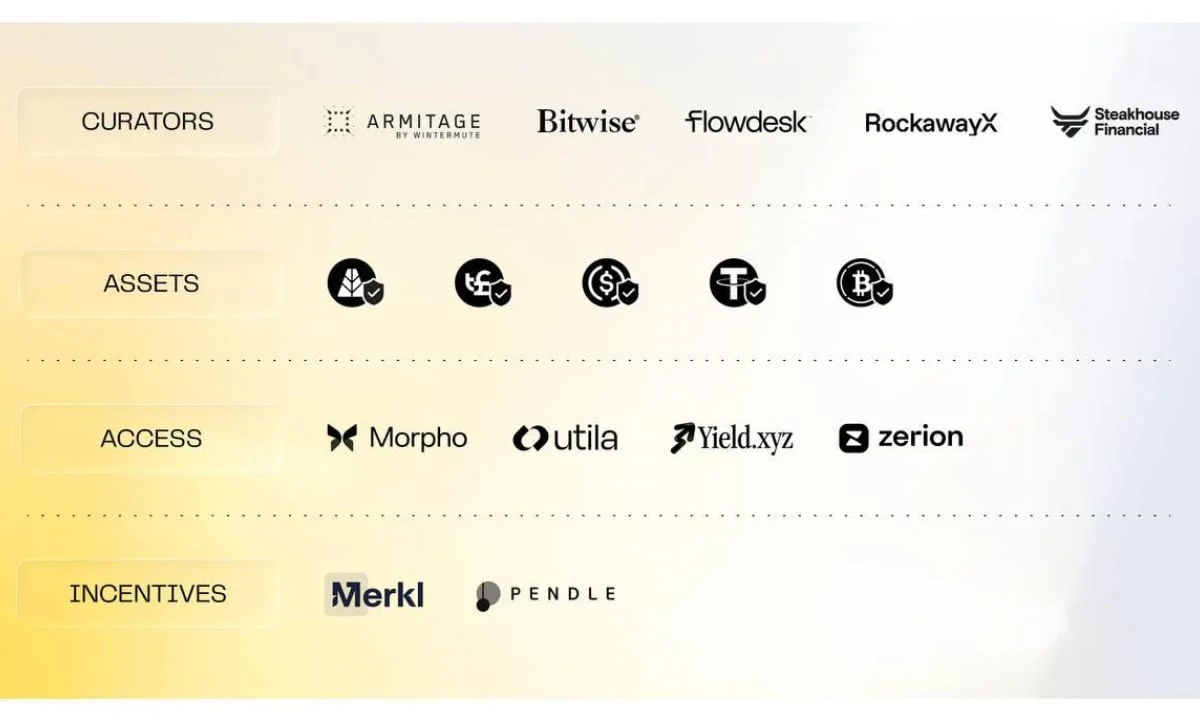
Paris, France — September 17, 2026 — Zama, a prominent confidentiality protocol operating within the decentralized finance (DeFi) sector, has officially announced a sweeping expansion of its privacy-preserving financial infrastructure. Following a successful pilot program launched earlier this summer, the protocol is scaling its footprint on Ethereum through an expanded partnership with Morpho and a coalition of five leading DeFi curators: Steakhouse Financial, Armitage by Wintermute, Flowdesk, RockawayX, and Bitwise.
This latest deployment introduces 16 confidential vaults spanning five distinct asset classes—USD Coin (USDC), Tether (USDT), Wrapped Bitcoin (WBTC), Agora U.S. Dollar (AUSD), and Tokenised GBP (tGBP). Alongside the vault expansion, Zama has initiated the public rollout of the Zama Swap Protocol, a specialized execution layer designed to facilitate private asset exchanges directly on Ethereum.
The initiative addresses one of the most persistent structural bottlenecks in public blockchain architectures: the inherent transparency of transaction history, balances, and operational strategies. By hiding these metrics from public scrutiny, Zama aims to bridge the gap between traditional institutional capital requirements and the high-yield opportunities native to decentralized ecosystems.
Background and Context: Overcoming the Transparency Barrier in Public Blockchains
Public ledgers such as Ethereum offer unmatched transparency, composability, and settlement finality. However, this radical transparency creates a challenging environment for corporate treasuries, hedge funds, institutional asset managers, and high-net-worth individuals. On a standard public network, any observer, competitor, or sophisticated market actor can view account balances, track asset allocations in real time, and identify pending transactions.
This visibility exposes institutional allocators to risks such as front-running, predatory MEV (Maximal Extractable Value), and the strategic disadvantage of having proprietary trading models exposed on-chain. Consequently, massive volumes of traditional capital remain sidelined or restricted to permissioned, walled-garden environments, missing out on the liquid yields generated within decentralized protocols.
Zama’s protocol seeks to resolve this tension by deploying Fully Homomorphic Encryption (FHE). FHE is an advanced cryptographic technique that allows computation to be performed directly on encrypted data without ever decrypting it. In the context of onchain finance, this means users can deposit funds, earn yield, and trade shares while keeping their underlying balances and transaction intentions entirely confidential.
The Chronology: From Pilot Success to Multi-Asset Scale
The groundwork for this comprehensive rollout was laid in June 2026, when Zama partnered with Morpho and Steakhouse Financial to launch the first confidential USDC prime vault on Ethereum. The market reception exceeded initial expectations. Within just seven weeks of deployment, the vault grew rapidly from zero to $40 million in Total Value Locked (TVL).
The success of the June pilot provided empirical validation that institutional and sophisticated retail depositors place a high premium on financial privacy when paired with secure, battle-tested infrastructure. Furthermore, it demonstrated that privacy and compliance do not need to be mutually exclusive; users could access high-grade yield without sacrificing regulatory clarity or exposing themselves to predatory market participants.
Capitalizing on this momentum, Zama spent the subsequent months collaborating with infrastructure providers, liquidity managers, and asset issuers to scale the model. The September 2026 rollout expands the initial single-asset proof-of-concept into a diversified ecosystem featuring 16 separate vaults, multiple asset classes, and an integrated private swapping mechanism.
Comprehensive Asset Coverage and Curated Strategies
The expanded suite of 16 vaults is designed to give allocators granular control over their risk-return profiles while maintaining privacy across various currency denominations and collateral types. The vaults are managed by five prominent DeFi curators, each bringing specialized underwriting expertise:
- Steakhouse Financial: Expanding on its initial success, Steakhouse introduces a multi-vault suite covering USDC, USDT, and tGBP, giving depositors broader options for stablecoin deployment.
- Armitage by Wintermute: Bringing institutional rigor to Bitcoin holders through the Wintermute Confidential WBTC vault, offering active risk curation for an asset class that has historically suffered from low yield-generation opportunities on-chain.
- Flowdesk: Providing institutional access to the AUSD Real-World Asset (RWA) strategy vault, creating compliant pathways for institutional capital deployment.
- RockawayX: Introducing specialized RWA vaults that apply predictable return models and rigorous credit underwriting, drawing on the firm’s zero-default lending track record since 2022.
- Bitwise and additional ecosystem partners: Ensuring institutional-grade distribution and oversight across the new offerings.
All 16 vaults are deployed natively on Morpho, ensuring that depositors tap into established liquidity pools and established smart contract architectures rather than untrusted, experimental protocols.
Introducing the Zama Swap Protocol
A critical limitation of early privacy-preserving solutions was the friction involved in moving between confidential positions and liquid assets without revealing transaction details. To solve this, Zama has launched the Zama Swap Protocol alongside the new vaults.
The swap protocol enables depositors to exchange confidential assets—including all vault share positions as well as private wrappers such as cUSDC, cUSDT, cWBTC, cAUSD, and cTGBP—directly within a confidential envelope. This creates an end-to-end operational loop: institutional allocators can deposit capital, earn yield, and rebalance their portfolios through swaps without exposing their trade size, timing, or strategic intentions to public block explorers.
Ecosystem Integration: Wallets, Custodians, and Incentive Layers
To achieve widespread adoption, institutional infrastructure must integrate smoothly into existing operational workflows. Zama has partnered with leading wallet providers, multi-party computation (MPC) custodians, and yield aggregators to ensure frictionless access:
- Zerion: Integrating Zama’s confidentiality layers directly into non-custodial wallet infrastructure, allowing retail and high-net-worth users to manage private positions natively.
- Utila: Bringing confidential Morpho vault access into institutional MPC wallet architectures, allowing treasury and investment teams to maintain strict policy controls and approval workflows.
- Yield.xyz: Serving as a unified access layer that allows wallets and financial platforms to offer Zama’s confidential vaults via simple API calls.
- Merkl: Solving the historical challenge of incentivizing confidential assets. By extending Merkl’s distribution engine to support encrypted balances (ERC7984), protocols can run reward campaigns and distribute APR yields without ever exposing user balances or public leaderboards.
Official Reactions and Industry Perspectives
The breadth of institutional participation highlights a growing consensus that privacy is a mandatory feature for the next phase of onchain market maturity.
Dr. Rand Hindi, Co-founder and CEO of Zama, emphasized the transition from theory to scalable execution:
“When we launched the first confidential USDC vault with Morpho and Steakhouse in June, we proved that confidentiality and DeFi are not mutually exclusive. Today’s expansion is proof of the model at scale. Sixteen vaults, five curators, five asset classes, all built on the same DeFi infrastructure that sophisticated capital already uses. Same vaults, same curators, same liquidity, now with confidential entry. This is how confidential DeFi becomes a category and not an experiment.”
Merlin Egalite, Co-founder of Morpho, noted the alignment with institutional demands:
“Institutions have increasingly been exploring how onchain capital allocation can be made more confidential to fit their requirements. Adding these confidential vaults on Morpho was an important step for us. It’ll scale confidential DeFi efficiently and open new possibilities for allocators onchain, without changing the strategy, the liquidity, or the risk profile.”
Guilhem Chaumont, Co-founder and CEO of Flowdesk, pointed to compliance and RWA integration:
“Confidentiality is the condition onchain capital markets have to satisfy before they can carry institutional-scale volume. Through our work with Zama, we’re opening up confidential access to our AUSD RWA Strategy Vault, giving institutional allocators a compliant path onchain.”
Sébastien Derivaux, Co-founder of Steakhouse Financial, reflected on user demand:
“We were happy to work with Zama on its first confidential vault, and the market response makes it clear that depositors value confidentiality. The natural next step was to extend that access to a five-vault suite across USDC, USDT, and tGBP. Depositors now have more choice in how they use stablecoins across Morpho, while keeping their positions private.”
Igor Igamberdiev, Armitage Lead at Wintermute, addressed the utilization of idle Bitcoin assets:
“BTC has mostly sat onchain as collateral because there has rarely been meaningful yield to earn on it. The Wintermute Confidential WBTC vault gives WBTC holders a way to actually put it to work, pairing Armitage’s active risk curation with a confidential-only design that has no public equivalent, so positions stay off the public record.”
Benoit Marzouk, CEO of BCP Technologies, issuer of tGBP, emphasized the UK market potential:
“Zama’s confidential product suite is unlocking institutional adoption opportunities globally including in the UK where stablecoin adoption with large institutions is a greenfield opportunity. The combination of confidentiality with bluechip protocols like Morpho provide a clear entry point for any institutional player integrating stablecoins into their business.”
Evgeny Yurtaev, Co-founder and CEO at Zerion, explained the wallet-level integration rationale:
“Every position a self-custodial wallet user holds is public by default. That’s one of the reasons people are reluctant to keep large amounts onchain. Zama’s confidentiality layer plugs into vaults people already use rather than asking them to move to a new chain. A wallet can support this natively with minimum friction, and why these vaults are coming to Zerion in the weeks ahead.”
Nassim Alexandre, Head of Onchain Asset Management and Curation at RockawayX, highlighted risk management:
“Institutions can be hesitant to lend onchain for two reasons. They can’t tell exactly what they’re exposed to, and anyone with a block explorer can see what they hold. RockawayX’s RWA vault handles predictable returns and collateral you can check onchain, underwritten the same way we’ve run CeFi and DeFi lending since 2022 with zero defaults. Zama handles the second with its confidentiality platform.”
Serafin Lion Engel, Co-Founder and CEO at Yield.xyz, discussed API accessibility:
“Confidentiality should not require institutions to abandon the platforms they already use. Yield.xyz makes Zama’s confidential Morpho Vaults accessible through the same integration layer that wallets and financial platforms use to offer onchain yield. That gives platforms a practical path to support confidential positions while preserving the underlying strategy, liquidity, and risk profile.”
Bentzi Rabi, Co-founder and CEO of Utila, focused on enterprise custody:
“Institutions need to protect their investment strategies while maintaining clear control over how capital is deployed. Through our work with Zama, we’re bringing confidential access to Morpho vaults into Utila’s MPC wallet infrastructure, so treasury and investment teams can access onchain yield with the policy controls and approval workflows they rely on across their digital asset operations.”
Pablo Veyrat, CEO of Merkl, highlighted the resolution of reward tracking:
“Incentives were the one thing confidential assets could not have, because rewarding a balance meant reading it. It was a real pleasure working with the Zama team to change that, extending Merkl’s engine to ERC7984 so campaigns run on encrypted balances. Depositors see an APR and earn, while no position, reward, or leaderboard entry ever becomes public.”
Broader Economic Implications and Future Outlook
The launch of Zama’s expanded vault suite and swap protocol marks a foundational shift in how privacy is integrated into public blockchain ecosystems. By refusing to compromise on liquidity or force users into proprietary, fragmented networks, Zama has created a modular layer that fits seamlessly over existing DeFi rails.
Analysts suggest that removing the visibility barrier could unlock billions of dollars in dormant institutional liquidity currently held back by regulatory and competitive concerns. Furthermore, the operational blueprint established by this 16-vault rollout paves the way for further expansion throughout late 2026 and 2027. Future milestones are expected to include the integration of additional asset issuers, onboarding more asset curators, expanding cross-chain distribution channels, and deepening native integrations with institutional custodians globally.
The 16 confidential vaults officially open for public deposits on September 15, 2026, accessible via the Zama application, with ecosystem wallet and custodian integrations rolling out in phases over the following weeks.