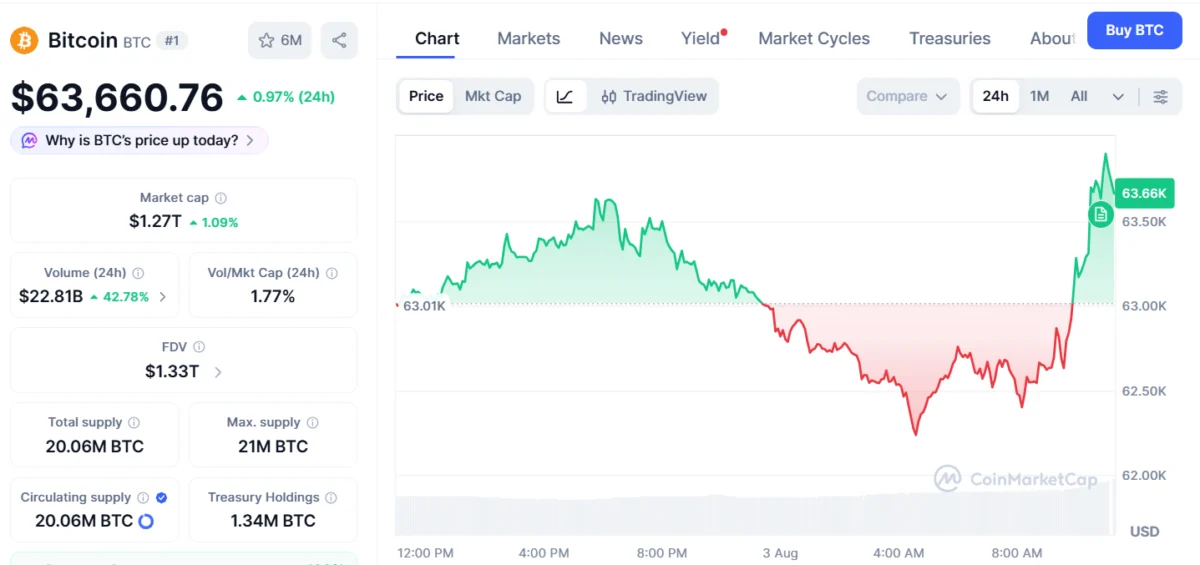
In an unexpected twist across global financial markets, the world’s largest cryptocurrency by market capitalization is exhibiting a degree of price stability that is baffling seasoned derivatives traders, while the traditionally conservative U.S. government bond market experiences a sharp spike in turbulence. While Bitcoin—an asset historically characterized by wild, unpredictable price swings—trades in a remarkably tight and subdued range, fixed-income markets are flashing warning signs as macroeconomic pressures mount.
This rare market divergence has placed the spotlight on a shifting landscape of investor sentiment. While Wall Street and digital asset participants continuously monitor the cross-currents between traditional macroeconomics and decentralized finance, the current disconnect highlights a profound recalibration in how risk, hedging, and volatility are being priced across different asset classes.
The Anatomy of Bond Market Volatility
The primary catalyst for the current nervousness in traditional finance stems from the U.S. Treasury market. Over recent trading sessions, the MOVE index—widely regarded as the bond market’s equivalent to the stock market’s VIX—has surged dramatically. Climbing from a baseline of approximately 80 earlier in the week, the MOVE index recently touched 104, marking its highest reading since March.
This sudden escalation in fixed-income turbulence reflects deep-seated anxieties among institutional debt investors. The bond market has been forced to grapple with a complex and unrelenting matrix of economic headwinds. Persistent inflation fears, stubborn energy price fluctuations, and persistent ambiguity regarding the future trajectory of the Federal Reserve’s monetary policy have combined to unsettle institutional portfolios.
Compounding these pressures, the benchmark U.S. 10-year Treasury yield recently tested the critical 5.2% threshold before experiencing a modest pullback. For institutional allocators, rapid spikes in yields translate directly into heightened economic uncertainty, altering capital-cost calculations across every sector of the global economy. Historically, severe tightening in financial conditions and turbulence within government debt markets inevitably bleed into risk-on assets, creating a domino effect that triggers liquidations and high-amplitude sell-offs in equities and digital currencies alike.
Yet, as the bond market experiences its most acute bout of anxiety in months, the anticipated contagion has failed to materialize in the cryptocurrency ecosystem in the manner historical models would predict.
Bitcoin Options and Implied Volatility Near Cyclical Lows
In stark contrast to the unrest unfolding in U.S. government debt, the digital asset options market is pricing an unusually quiet outlook for Bitcoin. Volmex’s 30-day Bitcoin implied volatility index, known as BVIV, has been hovering near the 37 mark, sitting just above its 2026 low of approximately 35.
Simultaneously, the Cboe Volatility Index (VIX)—which gauges expected 30-day volatility for the S&P 500—remains anchored near yearly lows around 14. This creates a fascinating macroeconomic juxtaposition. Government bonds, which are universally categorized as the bedrock of safe-haven liquidity and foundational collateral in global finance, are currently commanding a significantly higher volatility premium than Bitcoin, an asset that has spent the better part of its existence synonymous with hyper-volatility.
Market participants are currently paying notably steeper prices for protective options guarding against sudden shifts in Treasury market conditions, while the cost of hedging against sharp Bitcoin movements remains remarkably muted by historical standards.
Examining the Chronology and Shifting Correlations
To fully grasp the significance of this divergence, it is necessary to examine the evolving timeline of macroeconomic interactions with digital assets over recent quarters. For years, the correlation between macro fixed-income stress and Bitcoin was positive and direct. Whenever bond yields spiked aggressively or systemic liquidity contracted, Bitcoin typically absorbed the shock rapidly, suffering outsized downward corrections as leveraged positions unwound.
However, the opening weeks of the current year have introduced a notable decoupling. While Bitcoin’s broader upward momentum did encounter a recognizable stall as 10-year yields pushed toward 5.2%—demonstrating that the asset is certainly not entirely immune to traditional macro gravity—the derivatives market has refused to price in catastrophic downside scenarios.
Furthermore, statistical correlations between the MOVE index and both equity and Bitcoin volatility metrics have recently compressed toward zero or slipped into negative territory. This statistical shift signifies that short-term volatility in sovereign debt is no longer moving in lockstep with cryptocurrency price fluctuations. Financial analysts emphasize that this breakdown in correlation does not elevate Bitcoin to the status of a traditional safe-haven asset, nor does it render the crypto market entirely immune to potential macro shocks. Instead, it illustrates a distinct tactical divergence: traders positioned in sovereign debt and those positioned in digital assets are currently evaluating and pricing distinct matrices of risk.
Macroeconomic Implications and Institutional Perspectives
The broader implications of this volatility inversion are multifaceted. For institutional asset managers, the divergence challenges conventional portfolio risk models. Typically, traditional multi-asset strategies rely on the assumption that sovereign debt provides a low-volatility anchor, while alternative assets like Bitcoin introduce concentrated, high-beta risk. When the volatility curve inverts—with Treasuries exhibiting anxiety levels typically reserved for speculative growth assets—portfolio optimization strategies must be reassessed.
Market economists note that the subdued volatility in Bitcoin despite rising yields could point to structural maturation within the digital asset market. Over recent years, the maturation of institutional-grade market infrastructure, the introduction of spot Exchange-Traded Funds (ETFs), and a broader base of sophisticated long-term holders have gradually altered the market micro-structure. These developments have deepened liquidity and potentially dampened the reflexive, panic-driven sell-offs that historically characterized early-stage crypto cycles.
Conversely, some macro analysts urge caution, warning that suppressed volatility in options markets can occasionally precede sudden, sharp regime shifts. When complacency settles into derivatives pricing, unexpected macroeconomic catalysts—such as an aggressive monetary policy pivot or unexpected inflation prints—can catch market participants off guard, leading to rapid repricing.
Looking Ahead: A New Dynamic in Cross-Asset Risk
As financial markets navigate the remainder of the quarter, the relationship between fixed-income turbulence and digital asset pricing will remain a critical focal point for macro strategists. For over a decade, Bitcoin held an undisputed monopoly on the narrative of the ultimate high-volatility trade. Today, however, the nervous energy of global finance has temporarily migrated away from the frontiers of decentralized technology and settled squarely within the traditional halls of sovereign debt management. Whether this decoupling marks a permanent evolution in Bitcoin’s market behavior or merely a temporary divergence in cross-asset sentiment remains one of the most compelling narratives in modern finance.