The digital landscape is currently undergoing a fundamental transformation, shifting from the centralized paradigms of Web 2.0 toward the decentralized, user-owned architecture of Web 3.0. At the heart of this evolution lies the Decentralized Autonomous Organization, or DAO. As a concept that challenges centuries of traditional corporate theory, the DAO represents a new method of human cooperation—one that is governed not by hierarchical management or executive boards, but by immutable code and community consensus. To understand the future of work, investment, and social organization, one must first dissect the mechanics, benefits, and inherent challenges of the DAO model.
Defining the DAO: A Tripartite Concept
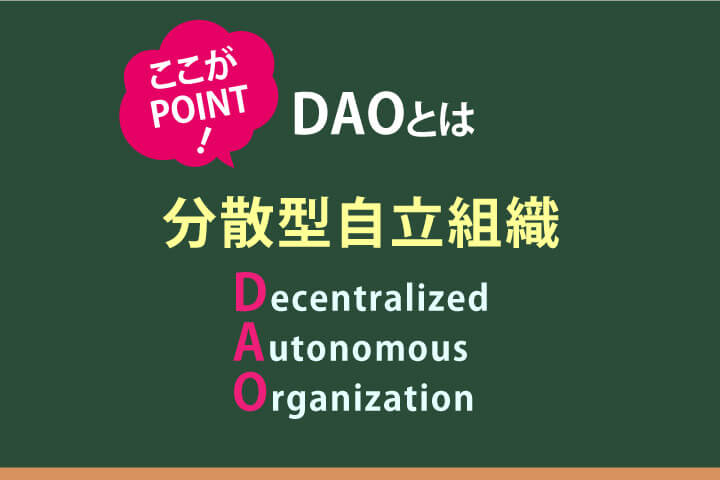
The acronym DAO stands for Decentralized Autonomous Organization. To grasp its significance, it is essential to analyze each of its three constituent parts through the lens of modern blockchain technology.
First, the term "Decentralized" refers to the removal of a central point of control. In a traditional corporation, power is concentrated at the top of a pyramid, residing with a CEO or a Board of Directors. In a DAO, authority is distributed across a network of participants. No single entity has the unilateral power to make decisions or change the organization’s direction without the consent of the collective.

Second, "Autonomous" implies that the organization functions according to pre-defined rules encoded as a computer program. These programs, known as smart contracts, automatically execute actions when specific conditions are met. This reduces the need for human intermediaries to facilitate transactions or enforce agreements, as the code itself acts as the ultimate arbiter of the organization’s logic.
Third, "Organization" signifies a group of individuals who have gathered to achieve a common goal. Whether the objective is to develop a software protocol, manage an investment fund, or coordinate a charitable effort, the DAO provides the structural framework for this collective action.

The Evolution of Decentralized Governance: A Brief Chronology
The concept of the DAO did not emerge in a vacuum; it is the result of over a decade of experimentation with cryptographic decentralization.
- 2009: The Genesis of Decentralization. Bitcoin was launched by the pseudonymous Satoshi Nakamoto. While often viewed simply as a digital currency, Bitcoin was technically the world’s first DAO. It operated without a central bank or CEO, relying instead on a decentralized network of miners and developers who followed a set of consensus rules.
- 2013-2014: Formalizing the Concept. Vitalik Buterin, the co-founder of Ethereum, popularized the term "DAO" in the Ethereum Whitepaper and subsequent blog posts. He envisioned a future where entire organizations could exist as code on the blockchain.
- 2016: "The DAO" Experiment. The first major attempt at a large-scale investment DAO, simply called "The DAO," launched on Ethereum. It raised over $150 million in ETH but was ultimately undermined by a significant vulnerability in its smart contract code. This event led to the Ethereum hard fork and served as a critical lesson in the importance of smart contract security.
- 2020: DeFi Summer. The explosion of Decentralized Finance (DeFi) protocols like Uniswap, Compound, and MakerDAO proved the viability of DAOs. These platforms used governance tokens to allow users to vote on protocol changes, creating a functional blueprint for modern DAO operations.
- 2021-Present: Diversification. DAOs expanded beyond finance into social clubs (Friends With Benefits), media (Bankless DAO), and even attempts to purchase physical assets (ConstitutionDAO).
Core Features of the DAO Model
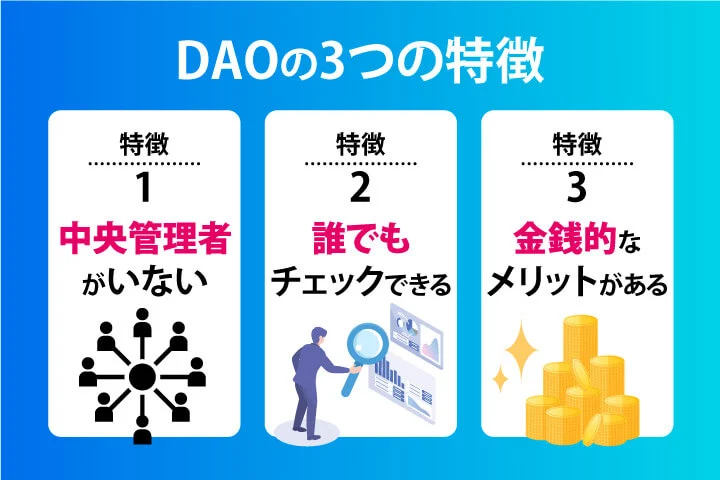
The shift from a traditional corporate structure to a DAO is characterized by three primary pillars: decentralization, transparency, and economic incentives.
Decentralization and the End of Hierarchy
In a traditional business, the "agency problem" often arises, where managers may act in their own self-interest rather than in the interest of the shareholders. DAOs mitigate this by ensuring that every participant who holds a governance token has a voice. Proposals are submitted to the community, and voting occurs on-chain. This meritocratic approach ensures that the direction of the project reflects the will of the stakeholders rather than the whims of a few executives.
Transparency and Verifiable Trust
One of the most profound advantages of a DAO is its inherent transparency. In a standard company, financial records and internal communications are often opaque, accessible only to upper management or auditors. In a DAO, every transaction, every vote, and every line of code is recorded on a public blockchain. Participants can verify how the organization’s treasury is being spent and ensure that rules are being followed without having to "trust" a human leader. This "trustless" environment is facilitated by platforms like Discord for communication and Snapshot for gasless voting, creating a verifiable audit trail of all organizational activity.
Economic Incentives and Tokenomics
DAOs utilize economic incentives to align the interests of individual participants with the health of the overall organization. This is typically achieved through the issuance of tokens. These tokens serve two purposes: they grant voting rights (governance) and they often represent a stake in the project’s success. If the DAO performs well, the value of the token may increase, rewarding those who contributed to its growth. This creates a high level of motivation among community members, who often work harder and more creatively when they have a direct financial stake in the outcome.
Supporting Data: The Growth of the DAO Ecosystem
The scale of the DAO movement is no longer theoretical. According to data from DeepDAO, a leading analytics platform, the total value of assets under management (AUM) in DAO treasuries has fluctuated between $10 billion and $25 billion over the past two years, depending on market conditions.

As of early 2024, there are thousands of active DAOs with millions of individual governance token holders. Major protocols like Uniswap and Arbitrum maintain treasuries worth billions of dollars, funded by protocol fees and token reserves. These treasuries are used to fund grants for developers, marketing initiatives, and security audits, demonstrating that decentralized entities can manage capital as effectively—if not more so—than traditional venture capital firms.
Challenges and Structural Disadvantages
Despite their potential, DAOs are currently in an "early-adoption" phase and face significant hurdles that prevent them from becoming the default organizational structure for all industries.

Legal and Regulatory Ambiguity
The most pressing issue for DAOs is the lack of a clear legal framework. Most jurisdictions do not recognize a DAO as a legal entity. This creates a "liability trap" where, in the absence of a corporate veil, every member of a DAO could potentially be held personally liable for the organization’s debts or legal infractions. While some regions, such as the state of Wyoming in the U.S. and the Marshall Islands, have passed laws allowing DAOs to register as Limited Liability Companies (LLCs), the global regulatory landscape remains fragmented and uncertain.
Inefficiency in Decision-Making
While decentralization ensures fairness, it often sacrifices speed. In a traditional company, a CEO can make a pivot in minutes. In a DAO, a proposal must be drafted, discussed in forums for days or weeks, and then put to a vote that may last another week. This "governance lag" can be detrimental in fast-moving markets or in times of crisis where immediate action is required. Furthermore, "voter apathy" is a common problem, where only a small percentage of token holders participate in votes, leading to governance by a minority.

Security and Code Vulnerability
Because a DAO is only as strong as its code, a single bug in a smart contract can lead to the total loss of funds. Unlike a traditional bank, where fraudulent transactions can often be reversed, blockchain transactions are immutable. This puts immense pressure on DAO developers to conduct rigorous security audits, which are both expensive and time-consuming.
Broader Impact and Future Implications
The rise of DAOs suggests a future where the concept of "employment" may be replaced by "contribution." Instead of working for one company, an individual might contribute to five different DAOs, earning tokens from each based on the value they provide. This gig-economy-on-steroids model offers unprecedented flexibility and ownership for workers.

Furthermore, DAOs are likely to become the infrastructure for the next generation of financial services, often referred to as DeFi (Decentralized Finance). By removing the middleman, DAOs can offer financial products—loans, insurance, and asset management—with lower fees and greater accessibility than traditional banks.
As the technology matures and legal frameworks catch up, the DAO model could expand into local governance, allowing citizens to vote directly on municipal budgets or community projects via the blockchain. While the road ahead is fraught with technical and legal obstacles, the shift toward decentralized, autonomous, and transparent organization appears to be an irreversible trend in the digital age. The next chapter of this evolution will focus on how these organizations interact with the traditional financial system, a topic deeply intertwined with the rise of Decentralized Finance.