• Home
Crypto Gohan
keep your memories alive
Ethereum & Smart Contracts

Ethereum Foundation Pioneers AI Agents for Protocol Security, Revealing Triage as Key Bottleneck

by Reynand Wu July 20, 2026
written by Reynand Wu

The Ethereum Foundation’s Protocol Security team has embarked on a groundbreaking initiative, deploying coordinated artificial intelligence agents to scrutinize the foundational code underpinning the Ethereum network. This advanced approach, targeting critical systems software, cryptographic protocols, and smart contracts, has already yielded significant results, including the discovery and remediation of a remotely-triggerable panic vulnerability in libp2p’s gossipsub, a core component of Ethereum consensus clients. This specific flaw, publicly disclosed as CVE-2026-34219, underscores the potent capabilities of AI in modern cybersecurity. However, the most striking revelation from this pioneering effort is not the AI’s ability to find bugs, but the disproportionate amount of human effort required to differentiate genuine threats from the deluge of convincing yet ultimately false positives.

This insight, shared directly by the Foundation, provides invaluable guidance for client teams and security researchers looking to integrate similar AI-driven audit methodologies. It highlights a critical shift in the cybersecurity landscape: the bottleneck in vulnerability discovery is moving from initial detection to rigorous validation and triage.

The Imperative of Ethereum Security

The Ethereum Foundation serves as a cornerstone for the development and security of the Ethereum blockchain, a decentralized platform that hosts a vast ecosystem of applications, financial instruments, and digital assets. With a market capitalization in the hundreds of billions, the integrity and resilience of Ethereum’s underlying protocols are paramount. Any vulnerability, particularly in core components like the peer-to-peer communication layer (libp2p), could have catastrophic consequences, ranging from network instability and denial-of-service attacks to the compromise of user funds. This makes the Protocol Security team’s mandate not just important, but existentially critical for the global Web3 ecosystem.

Traditional security audits, while thorough, are often labor-intensive and constrained by human limitations in scale and pattern recognition. The sheer volume and complexity of code in modern blockchain systems, combined with the continuous evolution of attack vectors, necessitate innovative approaches. The adoption of AI agents by the Ethereum Foundation reflects a proactive strategy to enhance the network’s defenses by augmenting human capabilities with machine-driven analysis, pushing the boundaries of what’s possible in automated security research.

The Rise of AI in Cybersecurity: A Converging Trend

The Ethereum Foundation’s initiative is not an isolated experiment but part of a broader trend seeing leading technology organizations harness AI for security. Companies like Anthropic, with its Frontier Red Team, have successfully built AI agents capable of writing property-based tests that uncovered real bugs across the Python ecosystem. Similarly, Cloudflare has deployed frontier models within a sophisticated security-research harness to audit their own systems. These parallel efforts confirm a converging methodology: deploy a capable AI model against a codebase, allow it to search for anomalies, and then rigorously triage the generated findings.

This rapid adoption underscores a paradigm shift. While specific AI tooling evolves at an unprecedented pace – often becoming outdated within weeks – the fundamental methods for integrating AI into security workflows are proving remarkably persistent. This focus on methodology, rather than transient tools, is a key takeaway from the Foundation’s experience, ensuring long-term applicability and effectiveness. The disclosure of CVE-2026-34219, a vulnerability identified by these agents, highlights that this is not merely theoretical research but a practical, impactful application of AI. This particular bug, a remotely-triggerable panic in gossipsub, could have severely impacted the stability and availability of Ethereum consensus clients, making its early detection crucial.

Inside the Ethereum Foundation’s AI Agent Operations

The Protocol Security team at the Ethereum Foundation employs a sophisticated, decentralized organizational structure for its AI agents. Rather than relying on a central coordinator, multiple agents operate in parallel, targeting a single codebase. Their coordination is achieved through a shared state managed within a version control repository. An agent identifies a potential vulnerability, writes down its claim, performs the necessary work to substantiate it, and then commits its findings. This approach, inspired by Anthropic’s successful method for building a C compiler with a fleet of agents, eliminates the overhead and potential single points of failure associated with a centralized orchestration system, enhancing robustness and scalability.

Crucially, the Foundation has established a stringent schema for what constitutes a "candidate" finding before it can be elevated to a "real bug." Each candidate must include:

  • Target: The specific component and entry point an attacker can realistically reach.
  • Invariant: The property that is expected to hold true under normal operation.
  • Mechanism: The precise way in which the invariant might be broken.
  • Success: An observable proof of failure, such as a program panic, a system stall, or the acceptance of invalid input.
  • Reproducer: A self-contained, executable artifact that can reliably trigger the failure against the actual code.
  • Dedup: A unique key to prevent redundant investigation of the same issue by multiple agents.

This structured schema forces agents to make specific, testable claims and provides a clear definition of "done." It prevents vague or speculative reports, ensuring that every finding is backed by concrete evidence and a verifiable exploit. The reproducer element is particularly critical, serving as an objective arbiter that transcends the AI’s "confidence" in its own findings.

"Reproducible or It Didn’t Happen": The Gold Standard of Validation

The bedrock principle governing the Ethereum Foundation’s AI-driven security audits is unwavering: a candidate is not considered a genuine finding until a self-contained, executable artifact can reliably reproduce the failure against the real code, independently verifiable by anyone. This principle, "reproducible or it didn’t happen," serves as the ultimate filter against the inherent biases and potential for hallucination in AI models.

The primary value of this reproducer lies in its ability to quickly and automatically catch false positives. The Foundation has identified three common pitfalls where AI agents often fail, which the reproducer directly addresses:

  1. Non-Default Configurations: The agent might identify a bug that only manifests in highly obscure or non-standard system configurations, which are not representative of real-world deployments. The reproducer ensures the bug is present in a relevant, default setup.
  2. Unreachable Code Paths: An agent might construct a theoretically valid attack path that, upon closer inspection, involves code that is never actually executed or accessible by an external attacker under normal circumstances. The reproducer must demonstrate actual reachability.
  3. Already Fixed Issues: AI agents, especially those trained on historical data, can sometimes rediscover vulnerabilities that have already been identified and patched. The reproducer, when run against the current codebase, will fail to trigger the bug, immediately flagging it as a stale finding.

These scenarios are analogous to traditional software tests that pass for the wrong reasons – for instance, a test designed to check a specific condition failing to actually assert that condition. The challenge with AI is the sheer volume of such "confidently incorrect" outputs. Automating this verification step through the reproducer is indispensable, as relying on the AI to self-correct is not feasible.

The Triage Imperative: Navigating the Signal-to-Noise Ratio

Experience has shown that the vast majority of candidates generated by AI agents are either incorrect, duplicate existing issues, or fall outside the defined scope. This high signal-to-noise ratio is not a flaw in the method itself, but an inherent characteristic of large language models and search-based AI. The true challenge, and where human expertise remains irreplaceable, lies in rapidly rejecting the erroneous findings and rigorously validating the legitimate ones with irrefutable proof.

Every surviving candidate undergoes a two-stage independent human review process:

  1. Attacker Reachability: Security researchers meticulously assess whether a real attacker could realistically exploit the identified vulnerability in a typical operational configuration of the Ethereum network. This involves understanding network topology, access controls, and attack prerequisites.
  2. Impact and Cost Analysis: An evaluation is performed to weigh the resources and effort an attacker would need to expend to trigger the bug against the potential damage or cost inflicted upon the network if successful. A bug triggerable by any single peer carries a vastly different risk profile than one requiring specialized access or immense computational resources.

Furthermore, all findings are continuously cross-referenced against a dynamic list of known, fixed, or previously rejected issues. Without this continuous deduplication process, AI agents would endlessly rediscover and report the same closed vulnerabilities, overwhelming the review pipeline.

The acceptance rates for AI-generated candidates vary significantly depending on the target codebase. When applied to mature, heavily audited code, very few findings typically survive the rigorous validation process. This outcome, while seemingly negative, is itself a valuable result, confirming the robustness of well-secured systems. Conversely, less-explored codebases, or those where formal verification covers only abstract models rather than deployed bytecode, tend to yield more genuine findings. This variability is a useful diagnostic tool, helping prioritize human auditing efforts. While the Foundation has not published specific numbers for its own operations, industry parallels like Anthropic’s property-based testing agent, which generated thousands of reports before human experts triaged them to an 86% top-tier accuracy, highlight the scale of this triage challenge.

Strengths and Limitations: A "Jagged Frontier" for AI

The application of AI agents in security auditing reveals a "jagged frontier" of capabilities, as described by researchers like Stanislav Fort. This refers to the inconsistent performance of AI models, where they might excel at one specific task but fail at another seemingly related one. The Ethereum Foundation’s experience provides clear insights into where AI agents currently shine and where they tend to mislead:

Good at Misleading at
Reading and correlating specifications and code Constructing call chains that appear reachable but are not
Stating and rigorously checking invariants Gaming the success check (generating a pass for the wrong reason)
Drafting proof-of-concept (PoC) code from a high-level idea Inflating severity claims to match dramatic write-ups
Suggesting potential root causes before human investigation Identifying bugs spanning sequences of individually valid steps

A critical limitation identified is the AI’s struggle with vulnerabilities that emerge from a sequence of individually valid steps, where only the order or combination of actions creates the exploit. For these complex, stateful bugs, the AI agent’s role transforms from a direct search tool to a sophisticated suggestion engine. Its value lies in proposing which specific sequences of operations are worth feeding into a dedicated stateful test harness for deeper analysis, rather than attempting to fully exploit them itself. This collaborative model leverages the AI for its generative capacity and the human/harness for its precise, sequential validation.

Ensuring Integrity: Habits for Trustworthy AI Audits

To ensure the trustworthiness of AI-generated findings, the Ethereum Foundation adheres to several fundamental habits, none of which are complex but all are critical:

  • Documenting Agent Behavior: Thorough records are kept of how agents operate, their prompts, and their decision-making processes, aiding in debugging and performance improvement.
  • Independent Human Review: Every confirmed finding undergoes a meticulous review by independent human security experts, ensuring that no AI-generated bug is accepted without human oversight.
  • Clear "Done" Criteria: Unambiguous definitions for when a task or a finding is considered complete prevent ambiguity and ensure consistent standards.
  • Testing the Agents Themselves: The AI agents are subjected to rigorous testing, including being pointed at known vulnerabilities to ensure they can identify them, and at clean codebases to gauge their false positive rate.
  • Open-Sourcing Tools and Data: Where appropriate and feasible, sharing the methodologies, tools, and anonymized data fosters community collaboration and transparency.
  • Dedicated Disclosure Process: A robust and responsible vulnerability disclosure process is in place, ensuring coordinated remediation with affected parties before public announcement.

The Bottleneck Moved: A New Era for Security Researchers

The advent of AI in security research has not rendered human security researchers obsolete; rather, it has fundamentally reshaped their role. The bottleneck has shifted. The time previously spent on manually formulating and chasing down hypotheses for vulnerabilities is now redirected towards scaling the judgment process: building robust validation oracles, managing complex triage pipelines, maintaining comprehensive lists of known issues, and orchestrating the sensitive process of vulnerability disclosure.

This transformation echoes the evolution of fuzzing over the last fifteen years, which transitioned from a niche research topic to a standard industry practice. The core principles – reproducible failures, real-world oracles, and meticulous triage – remain constant, even as the tools generating potential findings become exponentially more powerful.

The future trajectory of AI’s generative capabilities, as explored by thinkers like Nicholas Carlini, suggests an exponential growth. If the pace of AI-driven vulnerability generation continues to accelerate, the capacity for human judgment and verification must keep pace, or the gap between what AI produces and what can be reliably verified will widen to dangerous levels.

For critical systems like Ethereum, this human element of judgment is the ultimate product. AI agents offer an unparalleled ability to cover vast expanses of code that would be impossible for human teams alone. In return, they demand an even more meticulous, rigorous, and skeptical human judgment, applied across an ever-growing pile of confidently articulated claims. This trade-off is undoubtedly worthwhile, provided that the indispensable role of human judgment in validating every single finding is never overlooked.

July 20, 2026 0 comment
0 FacebookTwitterPinterestEmail
Ethereum & Smart Contracts

Ethereum Defies Bearish Price Pressure with Unprecedented Network Activity and Historic Exchange Withdrawals.

by Muslim July 20, 2026
written by Muslim

Despite mounting bearish pressure threatening to push Ethereum’s price back to the $1,500 support level, the network is demonstrating remarkable resilience and robust fundamental growth, with on-chain activity revisiting and even surpassing historic highs. This divergence between price performance and underlying network health presents a complex picture for investors and analysts alike, highlighting Ethereum’s enduring utility and adoption as a foundational layer of the decentralized web.

Ethereum’s Unprecedented Network Resurgence Amidst Market Volatility

While the market sentiment around Ethereum (ETH) has leaned bearish, with its price slowly losing stability and retesting key support levels like $1,600, the network itself is experiencing a powerful resurgence in activity. Reports from leading market experts, including Leon Waidmann, head of research at Lisk, indicate that activity across the Ethereum blockchain has climbed to record levels, signaling growing engagement across its vast ecosystem. This surge in activity underscores the network’s critical role as a fundamental layer for decentralized finance (DeFi), tokenization, and a wide array of blockchain-based applications. The sustained growth points to increasing demand from a diverse group of participants, including individual users, developers, and even institutional entities.

Historically, periods of significant price appreciation in cryptocurrencies have been accompanied by spikes in network activity. However, Ethereum’s current trajectory presents a unique scenario where robust engagement persists despite downward price momentum. This suggests a deepening intrinsic value and utility that transcends short-term market fluctuations. The network’s architecture, continuous development, and the expansion of its Layer 2 scaling solutions contribute significantly to its capacity to handle increased transaction volumes and user interactions, making it more attractive for practical applications.

Surpassing Previous Bull Market Peaks

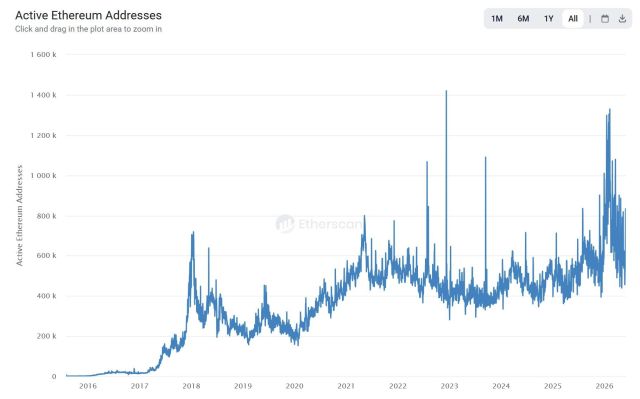
Detailed data on daily active addresses further illustrates this extraordinary trend. While ETH’s price may appear stagnant or "dead" to some observers, the number of daily active addresses on the network is consistently hovering near its highest range ever. To put this into perspective, during the 2018 bull market cycle, active wallet addresses on Ethereum peaked at approximately 720,000. The subsequent bull run in 2021 saw this figure rise to a peak of around 800,000 active addresses.

In the current market cycle, spanning from late 2025 into 2026, Ethereum has consistently pushed past the 1 million daily active address mark, at times peaking above an impressive 1.3 million. This substantial increase signifies that the network is processing a significantly higher volume of real economic activity and user interactions today than it did during the euphoria of previous bull market tops. This sustained engagement during a period of price consolidation suggests a maturing ecosystem where utility, rather than pure speculation, is becoming a more dominant driver of network usage. The growing complexity and diversity of dApps, from decentralized exchanges (DEXs) and lending protocols to NFT marketplaces and blockchain gaming platforms, all contribute to this elevated baseline of activity.

Ethereum Ecosystem Milestone: On-Chain Activity Across The Network Explodes To Historic Levels |

The Engine of Decentralized Finance and Innovation

Ethereum’s position as the bedrock of the decentralized finance (DeFi) sector is a primary driver of its enduring network activity. The vast majority of DeFi protocols, stablecoins, and non-fungible tokens (NFTs) are built on or heavily integrated with Ethereum. This makes the network indispensable for anyone participating in these burgeoning digital economies. Even with the rise of alternative Layer 1 blockchains, Ethereum’s established security, developer community, and network effects continue to attract substantial capital and innovation.

Furthermore, the continuous development roadmap for Ethereum, including ongoing improvements to its scalability, security, and sustainability (such as through sharding and further upgrades post-Merge), instills confidence among developers and users. This forward-looking approach ensures that the network remains competitive and capable of handling future demand, reinforcing its status as a critical global public utility for digital assets and decentralized applications.

Historic ETH Withdrawals Signal Strong Conviction

Further reinforcing the narrative of underlying strength is a significant trend observed in Ethereum’s supply dynamics: a massive withdrawal of ETH from centralized cryptocurrency exchanges. As of recent data, the total amount of ETH held on crypto exchanges has plummeted to approximately 14.5 million ETH, marking its lowest level in history. This historic low is particularly notable because it occurred during a period of market instability, rather than preceding it, which is an unusual market dynamic.

Typically, during periods of heightened volatility or price uncertainty, exchanges tend to experience steady inflows of assets as users prepare to sell or trade. However, the opposite has transpired with Ethereum. This phenomenon suggests a strong conviction among holders, who are moving their assets off exchanges into self-custody wallets. This action usually indicates a long-term holding strategy, reducing immediate selling pressure and signaling a belief in Ethereum’s future value.

A Divergence from Volatility Norms

Examining the timeline of these withdrawals provides even greater context. In October 2023, the ETH exchange balance stood at around 21 million ETH. Over the past two and a half years, an astonishing 6 million ETH have been pulled off centralized exchanges. This sustained outflow, particularly against a backdrop of general market bearishness, is a powerful indicator. As Leon Waidmann aptly summarized, "Whoever is buying here isn’t selling back." This statement implies that the ETH being acquired, likely by long-term investors, institutions, or those engaging in staking, is being immediately secured off-exchange, effectively removing it from the readily tradable supply and limiting its exposure to short-term market fluctuations.

Ethereum Ecosystem Milestone: On-Chain Activity Across The Network Explodes To Historic Levels |

This trend has significant implications for future price action. A reduced supply on exchanges, coupled with increasing demand driven by network activity and potential institutional adoption (such as through spot Ethereum ETFs), could create a supply shock scenario. Should market sentiment shift positively, the limited available supply on exchanges could lead to rapid price appreciation, as buyers would have fewer tokens to acquire from sellers. This dynamic highlights a quiet accumulation phase, where smart money may be positioning itself for the next market cycle, viewing current price levels as opportune for long-term investment.

Decoding Ethereum’s Price Bottom: The Delta Price Metric

While fundamental network metrics paint a bullish long-term picture, the immediate price outlook for Ethereum remains a subject of intense analysis. Seasoned crypto analyst Ali Charts has provided insight into Ethereum’s potential price bottom, anchoring his analysis on the Ethereum Delta Price metric. This sophisticated on-chain indicator has a notable track record, having accurately identified the last two major market bottoms for the altcoin.

Historical Precedent and Accumulation Zones

The Delta Price metric is designed to reflect the intricate connection between investors’ aggregated cost basis and the estimated cost of miner production. By synthesizing these two crucial components, it consistently highlights "deep accumulation zones"—periods where the price is considered to be at or near its lowest point before a significant reversal. These zones represent optimal entry points for long-term investors, as they typically coincide with periods of maximum pain for short-term holders but strong conviction for those with a longer time horizon.

After a thorough examination of this metric, Ali Charts has highlighted that Ethereum’s potential price bottom could sit near the $700 mark. This projection suggests that if historical patterns hold true, ETH could experience a retest of this $700 level before embarking on its next sustained upward trend. It’s crucial for investors to understand that while historical performance provides valuable insights, it does not guarantee future results. However, the reliability of the Delta Price metric in past cycles lends significant weight to this analysis, offering a potential roadmap for understanding Ethereum’s cyclical behavior.

Such a retest, while potentially painful for current holders, could represent a capitulation event that cleanses the market of weaker hands, paving the way for a more robust and sustainable recovery. The confluence of declining exchange balances, unprecedented network activity, and a historically reliable bottom indicator creates a compelling, albeit complex, narrative for Ethereum’s near-term price action and long-term potential.

Broader Market Context and Ethereum’s Strategic Position

Ethereum Ecosystem Milestone: On-Chain Activity Across The Network Explodes To Historic Levels |

Ethereum’s current situation unfolds within a broader cryptocurrency market grappling with various macroeconomic headwinds, including inflation concerns, interest rate policies, and geopolitical uncertainties. These external factors often contribute to bearish sentiment across the entire digital asset landscape, affecting even fundamentally strong projects like Ethereum. However, Ethereum’s ability to maintain and even increase network activity during such challenging times speaks volumes about its inherent utility and its growing role in the global financial infrastructure.

Macroeconomic Headwinds and Fundamental Strength

The current bearish pressure on Ethereum’s price cannot be isolated from the broader economic climate. Traditional financial markets have experienced periods of contraction, which often spill over into risk-on assets like cryptocurrencies. Despite these macro pressures, Ethereum’s ecosystem continues to expand, driven by innovation in areas like enterprise blockchain solutions, real-world asset tokenization, and the ongoing development of Layer 2 scaling solutions such as Arbitrum and Optimism, which enhance transaction speed and reduce costs, making the network more accessible and efficient. This continuous evolution provides a strong counter-narrative to short-term price concerns, illustrating the network’s long-term viability and growth potential.

The Evolving Landscape of Institutional Adoption

Another significant factor influencing Ethereum’s future trajectory is the increasing institutional interest. The approval and launch of spot Bitcoin Exchange-Traded Funds (ETFs) in the United States have paved the way for similar products for other major cryptocurrencies, with spot Ethereum ETFs being a highly anticipated next step. While Bitcoin funds have experienced periods of outflows, Ethereum ETFs have already seen significant inflows, such as the reported $82 million in inflows for certain Ethereum funds, highlighting growing institutional appetite. Should spot Ethereum ETFs gain regulatory approval, it would unlock a new wave of capital from traditional finance, providing easier access for institutional investors and potentially driving substantial demand for ETH. This institutionalization aligns perfectly with the observed trend of ETH being withdrawn from exchanges, as large entities often prefer to hold assets in self-custody or through regulated vehicles.

The long-term implications of these combined factors suggest that Ethereum, despite its current price struggles, is not merely surviving a bear market but is actively strengthening its foundational utility and market position. The sustained high network activity, the significant reduction in exchange supply, and the growing interest from institutional players all point to a robust ecosystem that is maturing beyond speculative trading.

In conclusion, Ethereum is navigating a complex phase where its market price is under pressure, yet its fundamental network health and user engagement are soaring to unprecedented levels. This unique divergence highlights the network’s profound utility and its growing integration into the global digital economy. While a potential retest of the $700 price level, as indicated by historical metrics, might present a short-term challenge, the underlying strength—demonstrated by record network activity and historic exchange withdrawals—underscores Ethereum’s resilience and its long-term potential for sustained growth and recovery. The ongoing development, expanding ecosystem, and looming prospect of increased institutional adoption position Ethereum as a critical and enduring force in the future of decentralized technology.

July 20, 2026 0 comment
0 FacebookTwitterPinterestEmail
DeFi (Decentralized Finance)

Synthetix Unleashes Native ETH Collateral for Perpetual Futures Trading on Ethereum Mainnet

by Muslim July 20, 2026
written by Muslim

In a landmark development for decentralized finance (DeFi), Synthetix, a prominent derivatives liquidity protocol, has officially launched multicollateral margin capabilities, integrating Ethereum’s native asset, ETH, as the inaugural non-USDT collateral option. This innovation marks a significant first in the history of the Ethereum network, empowering traders to leverage their ETH directly as collateral for perpetual futures (perps) trading on the Ethereum Mainnet. The new system allows users to deposit ETH, engage in various market trades, and manage their positions from a single, unified multicollateral margin account, all without liquidating their ETH holdings. This move is poised to redefine capital efficiency and trading strategies within the DeFi ecosystem, aligning Synthetix’s on-chain settlement with the network’s foundational asset.

A Milestone for Decentralized Finance: Trading Without Selling Your ETH

The introduction of native ETH margin on Synthetix represents a substantial leap forward for traders and the broader DeFi landscape. Traditionally, engaging in derivatives trading on decentralized exchanges often necessitated converting primary assets like ETH into stablecoins such as USDT or USDC to be used as collateral. This process introduced friction, potential slippage, and forced traders to relinquish direct exposure to their most bullish assets. Synthetix’s new feature directly addresses this challenge, enabling users to maintain their ETH exposure while simultaneously utilizing it to back their trading activities.

For the first time on Ethereum Mainnet, users can now post ETH directly as collateral, merging their conviction in the asset’s long-term value with their immediate trading strategies. This means that an investor who is fundamentally bullish on ETH no longer needs to sell a portion of their holdings to fund a perp trade. Instead, their ETH stack acts as the foundational capital, with USDT-settled positions running on top of it. This integration is particularly powerful for those who "think in ETH," providing a seamless experience that eliminates the need to leave the Layer 1 environment for collateral management. The protocol’s architecture ensures that every trade lives and settles natively on Ethereum Mainnet, making the utilization of its native asset as collateral a logical and long-awaited evolution.

Synthetix’s Evolution: A Commitment to On-Chain Innovation

Synthetix has been a foundational pillar of the DeFi ecosystem since its inception, pioneering synthetic assets and decentralized derivatives. Launched in 2017 as Havven, it evolved into Synthetix, focusing on providing deep liquidity for a wide array of synthetic assets, including cryptocurrencies, commodities, and fiat currencies. Its core strength lies in its decentralized architecture, which allows for robust on-chain settlement, eliminating counterparty risk associated with centralized exchanges. The protocol’s commitment to building directly on Ethereum Mainnet, despite the scalability challenges sometimes associated with it, underscores its dedication to decentralization and composability.

Introducing ETH as Margin on Synthetix

The journey to multicollateral margin has been a deliberate one, reflecting Synthetix’s continuous efforts to enhance its trading infrastructure. Previous iterations of the Synthetix protocol relied heavily on its native token, SNX, and later stablecoins, as collateral. The expansion to include ETH as a direct collateral asset is a natural progression, leveraging the deepest liquidity pool within the Ethereum ecosystem. This strategic move not only enhances the user experience but also reinforces Synthetix’s position as a leading innovator in the decentralized derivatives space, capable of adapting and evolving its offerings to meet the sophisticated demands of DeFi traders. The development team has been working on this feature for several months, meticulously designing the smart contracts and risk parameters to ensure a secure and efficient trading environment.

The Mechanics of Native ETH Collateral: Understanding the System

When users deposit ETH as collateral on Synthetix, the system values it using its live index price. To mitigate market volatility and associated risks, a standard risk discount, known as a "haircut," is applied to non-USDT collateral. This haircut effectively reduces the perceived value of the ETH for collateral purposes, providing a buffer against sudden price drops. For instance, if ETH is trading at $3,000 and a 10% haircut is applied, each ETH deposited would contribute $2,700 to the user’s collateral value. This calculated figure, the "Collateral Value," represents the actual amount of ETH that counts towards the user’s margin, and it is transparently displayed in the user’s balance table.

A crucial aspect of this system is that while ETH acts as collateral, positions, fees, funding, and profit and loss (PnL) continue to be settled in USDT. This design choice ensures stability in accounting and settlement, as USDT provides a relatively stable peg. Consequently, if a trader operates solely on ETH collateral without a separate USDT balance, their USDT balance can temporarily go negative while positions are open. This is an intentional feature, as the negative USDT balance is implicitly backed by the deposited ETH collateral.

Users have the flexibility to manage their USDT debt. They can repay it at any time by utilizing Synthetix’s built-in swap functionality to convert a portion of their ETH into USDT directly within their account. However, active monitoring of the collateral price is essential. A significant drop in the price of ETH will directly reduce the collateral value, potentially impacting the account’s margin health even if open positions remain unchanged. To prevent forced liquidation, traders are advised to maintain a sufficient buffer. Should USDT debt exceed the account’s predefined limits, the protocol is engineered to automatically convert a necessary amount of ETH to USDT to restore solvency. Full details regarding haircuts, swap mechanisms, withdrawal procedures, and account health parameters are comprehensively outlined in the Synthetix documentation, encouraging users to familiarize themselves with the system’s intricacies.

Enhanced Capital Efficiency and Strategic Trading Advantages

The unified multicollateral margin account is a cornerstone of this new offering, enabling ETH and USDT to work synergistically. This combined collateral pool backs every open position, optimizing capital utilization for traders. This integrated approach unlocks several strategic advantages:

Introducing ETH as Margin on Synthetix
  • Optimized Risk Management: By pooling different collateral types, traders can diversify their collateral base, potentially reducing exposure to single-asset price fluctuations. The system intelligently assesses the combined value, offering a more robust margin foundation.
  • Reduced Liquidation Risk: With a unified account, a decline in the value of one collateral asset can be offset by the stable value of another (e.g., USDT), providing greater resilience against market downturns and reducing the likelihood of premature liquidations.
  • Simplified Portfolio Management: Traders no longer need to manage separate collateral pools for different positions or assets. Everything is consolidated, streamlining the trading experience and reducing operational overhead.

One of the most compelling applications of ETH as multicollateral margin is the facilitation of "Basis Trades." Basis trading, a staple strategy in traditional finance and increasingly in DeFi, involves simultaneously taking a long position in a spot asset and a short position in its corresponding perpetual future. The goal is to profit from the "funding rate" – the periodic payments exchanged between long and short positions to keep the perpetual contract price anchored to the spot price.

With native ETH collateral, basis trades become remarkably efficient. A trader can deposit ETH as collateral and then open an equally sized short ETH perpetual future position. This creates a delta-neutral setup: the value of the collateral and the profit/loss (PnL) of the position move in opposite directions, largely offsetting each other. This significantly reduces directional price risk, allowing the trader to primarily capture the funding rate on the short position. By making basis trades more seamless and capital-efficient, Synthetix not only empowers sophisticated traders but also contributes to healthier markets. Basis traders play a crucial role in arbitrage, helping to keep funding rates in line with market dynamics. Their increased efficiency directly translates to tighter spreads and more competitive markets for all participants on the exchange.

Broader Implications for the Ethereum Ecosystem: Tapping into Billions

The strategic decision to integrate native ETH as collateral on Synthetix Perps carries profound implications for the entire Ethereum ecosystem. The opportunity presented by leveraging ETH, the network’s foundational asset, as collateral on the only perp DEX built directly on Ethereum Mainnet cannot be overstated. Ethereum boasts a market capitalization exceeding $350 billion (as of early 2024, fluctuating), with a substantial portion of this ETH held by users who are long-term holders or simply not actively trading it. Synthetix can now seamlessly tap into a significant fraction of this vast pool of "idle" ETH capital, which collectively represents hundreds of billions of dollars.

This move is not merely about attracting more liquidity to Synthetix; it’s about expanding the utility of ETH itself, natively on the Ethereum Layer 1. The upside of delivering a broad surface area of utility for ETH as an asset, particularly when considering Synthetix’s deep composability with native DeFi protocols on Ethereum, is nearly limitless. As a permissionless, composable primitive, Synthetix’s integration of native ETH collateral can cascade benefits across other DeFi applications that interact with it.

The vision articulated by Synthetix is audacious yet transformative: if the protocol can capture even 10% of today’s average monthly derivatives volume across the broader crypto market, it would ignite a "virtuous flywheel" for the entire Ethereum ecosystem. Such a level of volume and trading activity would not only generate substantial fees for the Synthetix protocol and its stakers but would also drive increased demand for block space on Ethereum, benefiting validators and increasing network security. Furthermore, it would enhance the overall liquidity and vibrancy of the L1 DeFi landscape. Every protocol within the ecosystem benefits when the core infrastructure is strengthened and its utility expanded. The entire Ethereum DeFi stack, from lending protocols to aggregators, stands to become exponentially more valuable through this enhanced capital efficiency and expanded utility for its native asset.

A Competitive Edge in the Derivatives Landscape and Roadmap Ahead

Introducing ETH as Margin on Synthetix

The decentralized derivatives market is fiercely competitive, with numerous protocols vying for liquidity and users. By offering native ETH collateral, Synthetix carves out a distinct competitive advantage. Many existing platforms, while offering perpetual futures, often rely on Wrapped ETH (wETH) or require users to bridge their assets to Layer 2 solutions or sidechains, adding layers of complexity and potential security concerns. Synthetix’s direct L1 integration simplifies the user journey and appeals to those who prioritize the security and decentralization guarantees of the Ethereum Mainnet.

This launch is positioned not as an endpoint but as the beginning of a truly multicollateral trading experience. ETH is the first non-USDT collateral asset, but Synthetix’s underlying infrastructure is explicitly designed to support a wider array of assets in the future. The development roadmap includes plans for additional collateral types, with a particular emphasis on "yield-bearing assets." This implies that users may soon be able to use assets that are simultaneously generating yield (e.g., staked ETH derivatives, interest-bearing stablecoins) as collateral, further enhancing capital efficiency and unlocking new strategies. This forward-looking approach underscores Synthetix’s ambition to remain at the forefront of DeFi innovation, continuously expanding the utility and flexibility offered to its traders.

Getting Started: Accessing ETH Margin on Synthetix

For traders eager to leverage this new capability, accessing ETH margin on Synthetix Perps is designed to be straightforward. Users can navigate to the Synthetix interface, connect their Ethereum-compatible wallet, and select ETH as their preferred collateral type. The platform’s deposit flow provides clear information on minimum deposit requirements, maximum account caps, and per-asset limits, which are subject to adjustment as the system scales and additional collateral types are introduced. Comprehensive guidance and detailed instructions are available in the official Synthetix documentation. For real-time assistance, users can also utilize the chat support feature integrated into the documentation site to connect directly with the Synthetix team.

As Synthetix continues to push the boundaries of decentralized derivatives, the integration of native ETH collateral marks a pivotal moment. It not only empowers individual traders with unprecedented capital efficiency and strategic flexibility but also strengthens the fundamental utility of Ethereum’s native asset, fostering a more robust and interconnected DeFi ecosystem on the Mainnet. This development sets a new standard for decentralized exchanges and reinforces Ethereum’s position as the premier venue for sophisticated on-chain financial instruments. The community is encouraged to follow Synthetix’s ongoing developments as it continues to shape the future of decentralized finance.

July 20, 2026 0 comment
0 FacebookTwitterPinterestEmail
NFTs & Digital Collectibles

Timothée Chalamet’s Dismissal of Opera and Ballet Ignites a Resurgence of Artistic Identity and Innovation

by Jia Lissa July 20, 2026
written by Jia Lissa

The arts world, often perceived as a realm of hushed reverence and tradition, found itself unexpectedly thrust into a public discourse sparked by a casual remark from a prominent Hollywood actor. Timothée Chalamet, during an interview earlier this year, declared that "nobody cares about opera and ballet anymore." While this sentiment might have been intended as a fleeting observation, it has inadvertently galvanized a sector often grappling with perceptions of elitism and declining relevance, prompting a renewed determination to showcase the enduring vitality and contemporary appeal of these classical art forms. Far from being disheartened, opera and ballet companies are seizing this moment as an impetus for reinvention, evident in strategic rebranding efforts and a renewed push for artistic innovation.

Seattle Opera’s sophisticated response to Chalamet’s comments was an early indicator of this emergent resilience. However, across the Atlantic, the sentiment behind the actor’s words became a direct catalyst for the Welsh National Opera’s (WNO) ambitious new branding initiative. As the WNO approaches its landmark 80th anniversary, the organization sought not merely to counter Chalamet’s assertion but to fundamentally redefine its public image. The goal was to forge a progressive, contemporary identity that would imbue opera with "the energy of an electric night out," challenging the stereotype of the art form as staid or inaccessible.

This opera company's bold rebrand aims to prove Timothée Chalamet wrong

A Bold New Identity: The "O Frame"

The ambitious rebranding project was undertaken by Bwtic, a Welsh design studio renowned for its innovative approach to visual communication. Bwtic’s objective was to reassert the WNO’s cultural authority and to signal a significant shift in its artistic vision. At the core of this striking new identity lies a minimalist yet potent symbol: the "O Frame." This distinctive mark is elegantly simple, comprising an outer circle representing the opera as a whole, enclosing an open rectangle at its center.

Bwtic articulated the conceptual genesis of the O Frame as a direct response to "the frustration that Opera is too often seen as one particular story told in one particular way." Instead, the O Frame is designed to embody opera as a dynamic platform for a multitude of narratives. The outer circle signifies the enduring medium and art form of opera, a vast and rich tradition. Within this, the inner frame acts as a crucial element, symbolizing each individual production. This inner space is deliberately left open, representing the unique story, subject matter, message, and point of view that each opera brings.

The intentional "dissonance," as Bwtic describes it, between the circular outer form and the rectilinear inner frame – the juxtaposition of "square pegs and round holes" – is a deliberate design choice. This visual tension is intended to communicate that opera, while a unified art form, is inherently diverse and capable of encompassing a wide spectrum of human experience and artistic interpretation. It challenges the notion of a singular operatic narrative, asserting instead the art form’s capacity for constant evolution and adaptation to contemporary themes.

This opera company's bold rebrand aims to prove Timothée Chalamet wrong

Celebrating Bilinguilism: A Forward-Thinking Wordmark

Complementing the O Frame is a sophisticated bilingual wordmark, meticulously designed to give equal prominence to both Welsh and English. This design choice is deeply rooted in the cultural landscape of Wales and reflects a thoughtful approach to inclusivity. The studio’s stated intention is that "the eye of the reader that finds their own language first."

This linguistic inclusivity is not merely a design flourish but a deliberate statement about the WNO’s identity and its relationship with its audience. Historically, Welsh organizations have often navigated the complexities of balancing Welsh and English, striving for an equitable representation. Bwtic’s new logotype elegantly addresses this by creating a dynamic visual experience where both languages are immediately visible, allowing individuals to connect with the brand through their preferred linguistic lens. This approach underscores the understanding that opera, like language, is a powerful tool for connection and understanding, capable of transcending linguistic barriers.

The studio’s commentary on this aspect is particularly insightful: "Opera is an art-form that has always been comfortable with interchanging languages. Welsh organisations have often struggled to find balance between the Welsh and the English language; eager to avoid any bias. In our new logotype, it is the eye of the reader that finds their own language first." This highlights a nuanced understanding of cultural identity and the power of design to foster a sense of belonging and accessibility.

This opera company's bold rebrand aims to prove Timothée Chalamet wrong

Typographic Roots: A Nod to the Past, A Vision for the Future

The typographic elements of the WNO’s new branding also carry significant historical weight. Bwtic delved into the organization’s archives, drawing inspiration from a 1946 poster that promoted the opera company’s inaugural production. This historical artifact featured a bold, condensed, uppercase sans-serif typeface, characteristic of the era.

Bwtic’s redesign process involved developing a new typographic system that pays homage to this historical font while infusing it with contemporary relevance. The resulting typeface functions as a powerful and modern extension of the original font’s direct and authoritative voice. However, it has been meticulously crafted to offer a far greater degree of flexibility, making it suitable for a wide array of applications across both digital and print media. This adaptability ensures that the WNO’s visual identity remains consistent and impactful, whether it appears on a grand theatre banner, a social media post, or even, as the article humorously suggests, in "cheeky jibes at Hollywood actors."

This typographic revival speaks to a broader trend in brand identity design: the strategic use of historical elements to imbue a brand with a sense of legacy and authenticity, while simultaneously modernizing its aesthetic to resonate with contemporary audiences. It’s a delicate balancing act that Bwtic has masterfully achieved, creating a visual language that is both rooted in tradition and forward-looking.

This opera company's bold rebrand aims to prove Timothée Chalamet wrong

The Broader Context: A Cultural Reckoning?

Chalamet’s comments, though perhaps flippant, tap into a larger, ongoing conversation about the accessibility and perceived relevance of classical arts in the 21st century. Data from various cultural institutions often reveals challenges in attracting younger and more diverse audiences to traditional opera and ballet performances. Factors contributing to this include high ticket prices, the perceived complexity of the art forms, and a lack of representation in narratives and on stage.

However, these challenges are not insurmountable. Numerous organizations have been actively experimenting with innovative programming, digital outreach, and community engagement initiatives to broaden their appeal. Seattle Opera’s response, for example, was not just a PR stunt but a demonstration of a willingness to engage with public perception and articulate the value of opera in a modern context. Similarly, the WNO’s rebrand is more than just a new logo; it represents a strategic investment in redefining its brand narrative and signaling a commitment to artistic evolution.

The implications of such rebranding efforts extend beyond mere aesthetics. A strong, contemporary brand identity can attract new talent, both on and off stage, foster stronger partnerships, and ultimately, increase audience engagement. By presenting opera as an "electric night out," the WNO is not diminishing its artistic merit but rather highlighting its potential for dramatic impact, emotional resonance, and vibrant performance. This approach acknowledges that the core elements of opera – compelling storytelling, powerful music, and virtuosic performance – are timeless and can indeed be presented in ways that captivate a modern audience.

This opera company's bold rebrand aims to prove Timothée Chalamet wrong

The Enduring Power of Opera and Ballet

The notion that opera and ballet are in terminal decline is a narrative that has been perpetuated for decades. Yet, the persistence and adaptability of these art forms suggest otherwise. The sheer dedication required from performers, the intricate craftsmanship involved in productions, and the profound emotional and intellectual experiences they offer continue to draw dedicated artists and audiences alike.

The current surge in efforts to modernize and revitalize these art forms is not a sign of weakness but of inherent strength and a commitment to survival and growth. The WNO’s rebrand, in particular, serves as a powerful case study. By embracing a bold, contemporary visual language, the organization is not abandoning its heritage but rather recontextualizing it for a new era. The O Frame, with its emphasis on diverse narratives and the "dissonance" of different elements coming together, perfectly encapsulates the potential of opera to reflect and engage with the complexities of the modern world.

As the Welsh National Opera embarks on its next chapter, its new identity stands as a testament to the enduring power of artistic expression and the strategic importance of adapting to evolving cultural landscapes. The conversation ignited by Timothée Chalamet, while perhaps unintentional, has undeniably served as a catalyst, prompting a vibrant and necessary reassertion of the relevance and excitement that opera and ballet continue to offer. The art world is watching, and the message is clear: opera and ballet are far from fading into obscurity; they are actively reinventing themselves for the future.

July 20, 2026 0 comment
0 FacebookTwitterPinterestEmail
NFTs & Digital Collectibles

Mad Lads: The Solana NFT Phenomenon That Evolved into a Digital Identity and Financial Ecosystem Flagship

by Lina Irawan July 20, 2026
written by Lina Irawan

Mad Lads is far more than just one of Solana’s most recognizable Non-Fungible Token (NFT) collections. It represents a pivotal project that emerged at a defining moment for the Solana ecosystem, injecting fresh energy into its NFT landscape and evolving into a crucial cultural layer underpinning Backpack, one of the most ambitious products developed within the space. This comprehensive analysis, presented in collaboration with Mad Lads, delves into the project’s origins, its significance during its launch, the cultivation of one of Solana’s strongest holder bases, and the enduring factors contributing to its continued relevance today. This deep dive, co-created with the Mad Lads team, transcends a simple profile of the collection, offering a shared retrospective on a project that has demonstrably shaped Solana’s NFT culture. From its innovative xNFT origins to its integral role within Backpack’s expansive ecosystem, Mad Lads exemplifies a project that transcends mere floor price, embodying identity, community, product development, and the proactive influence NFT holders can wield in shaping a brand’s future. To commemorate this in-depth exploration, a special Rarible Gacha Station giveaway is being launched, offering participants a chance to win one of five $25 Rarible Gacha Station packs. Details on how to enter can be found in the official Mad Lads Discord announcement.

Project Snapshot: Mad Lads at a Glance

Category Details
Project Name Mad Lads
Blockchain Solana
Collection Type PFP / avatar collection, xNFT, culture layer, membership-style brand connected to Backpack
Launch Date April 20-21, 2023
Mint Price 6.9 SOL
Total Supply 10,000-piece collection; 9,968 assets currently tracked
Founder(s) / Team Created by Backpack. Key figures: Armani Ferrante and Tristan Yver
Marketplace(s) Magic Eden, Tensor, Solanart
Website Official Mad Lads website (link not provided in source)
X / Discord Official Mad Lads X and Discord channels (links not provided in source)
Current Floor Price Approx. 13.66 SOL / $1,012 (as of June 22, 2026)
All-Time High Floor USD ATH: approx. $34,459 on March 18, 2024; SOL ATH: 229.425 SOL on December 9, 2023

Executive Summary: A Cultural Flagship with Evolving Ambitions

In essence, Mad Lads is a Solana-based PFP and xNFT collection distinguished by its profound integration with Backpack, its remarkably dedicated community, and its role as a cultural vanguard for the Solana ecosystem. Its primary risk lies in the long-term value proposition being heavily contingent on Backpack’s sustained execution and the broader market sentiment surrounding NFTs and Solana.

The significance of Mad Lads cannot be overstated within the Solana NFT sphere. Its launch occurred during a challenging period for the blockchain, following the reputational damage inflicted by the FTX collapse and the departure of prominent collections like DeGods and y00ts. Rather than launching as a conventional PFP project, Mad Lads positioned itself as a statement piece, merging art, technology, community engagement, and product distribution for Backpack.

The collection’s importance stems from its identity as not just an NFT brand, but as the cultural nexus surrounding Backpack’s wallet, exchange, token, and emerging financial infrastructure. Mad Lads holders have consistently been recognized as early ecosystem participants, benefiting from airdrops and later inclusion in the Backpack token distribution. The critical question for Mad Lads’ future trajectory is whether this accrued cultural value will continue to amplify as Backpack expands its scope beyond NFTs into cryptocurrency exchanges, tokenized securities, and mainstream financial services.

Origins and History: Forging a New Path for Solana NFTs

The genesis of Mad Lads can be traced back to Backpack, a venture spearheaded by Armani Ferrante and Tristan Yver. The foundational concept was to demonstrate the transformative potential of NFTs within the Backpack ecosystem. Moving beyond static JPEG images, the vision was to create xNFTs – Non-Fungible Tokens embedded with executable code, capable of unlocking interactive experiences directly within a digital wallet. In this regard, Mad Lads served a dual purpose: functioning as a PFP collection while simultaneously acting as a compelling product showcase for Backpack.

NFT Project Passport: Mad Lads

The launch of Mad Lads is etched in the annals of Solana NFT history as a highly memorable event. The overwhelming demand led to the project’s minting infrastructure buckling under immense traffic and sustained distributed denial-of-service (DDoS) style attacks. In a strategic maneuver to counter bot activity, the team ingeniously deployed a fake mint, or "honeypot," which successfully trapped over $250,000 worth of SOL before being fully refunded to participants, a testament to their innovative approach to managing demand and mitigating risks.

The timing of the launch was particularly critical. Mad Lads debuted in April 2023, amidst a prevailing bear market and at a juncture when Solana desperately needed a positive cultural narrative. The exodus of DeGods and y00ts had left a noticeable void in the Solana NFT landscape. Mad Lads stepped into this vacuum, rapidly solidifying its position as a potent symbol of Solana’s NFT culture.

From its inception, the collection was viewed as a turning point for Solana NFTs. It generated substantial secondary market volume within its inaugural week, successfully re-attracting attention to Solana as a viable NFT chain. Since then, Mad Lads has evolved from a highly anticipated mint into the definitive identity layer for the Backpack ecosystem.

Recent Developments: Expanding Horizons Beyond NFTs

The Mad Lads project, primarily through its parent entity Backpack, has been actively engaged in significant developments that extend its influence far beyond the initial NFT collection. These advancements indicate a strategic expansion into broader financial infrastructure and tokenized assets, with Mad Lads serving as the core community and cultural anchor.

Date Update Impact
January 30 / February 9, 2026 Backpack confirmed its token distribution structure, allocating 1% of total BP supply (10,000,000 BP tokens) to Mad Lads holders. This cemented the perception of Mad Lads holders not merely as NFT collectors, but as integral early contributors to the Backpack ecosystem’s cultural and developmental fabric.
March 18-23, 2026 Backpack confirmed the BP ticker and launched Backpack Token trading on Solana. This marked a significant transition for Backpack into a fully tokenized ecosystem, directly linking Mad Lads to the narrative and utility of the BP token.
June 2, 2026 Backpack announced Backpack Securities, a crypto stock broker designed to integrate traditional securities, tokenization, and unified portfolio management. This expansion positions Backpack as a comprehensive financial platform, moving beyond NFTs and crypto trading into broader financial infrastructure. For Mad Lads, it strengthens the overarching narrative of its parent ecosystem.
June 13, 2026 Backpack introduced tokenized SpaceX, known as $SPCX. This initiative demonstrates Backpack’s commitment to tokenizing real-world assets on Solana, thereby associating the Mad Lads brand with an increasingly diverse and impactful ecosystem.
June 22, 2026 Mad Lads maintained a floor price of approximately 13.66 SOL, with recent market data indicating visible momentum. Renewed market interest suggests that the active trading of Mad Lads NFTs is likely influenced by the broader momentum within the Backpack ecosystem and a resurgence of attention on Solana NFTs.

Active Development and Ecosystem Integration:

The Mad Lads project remains actively engaged in development, with the primary focus shifting to the expansion and refinement of the Backpack ecosystem rather than a standalone product roadmap for Mad Lads itself. The collection now functions as the de facto cultural and community layer supporting Backpack’s ambitious initiatives.

NFT Project Passport: Mad Lads

Product Launches and Partnerships:

Recent activities have prominently featured the launch of the BP token, the detailing of Backpack’s tokenomics, the introduction of Backpack Securities, and the tokenization of SpaceX. While these are primarily Backpack ecosystem developments, they hold significant implications for Mad Lads, given the collection’s intrinsic link to Backpack’s brand identity and future growth.

Communication Evolution:

Communication from the Backpack side has remained robust, particularly concerning product launches and the development of its financial infrastructure. However, there has been a noticeable decrease in public communication pertaining to a distinct "Mad Lads-only" roadmap. The project’s strategic direction is increasingly aligned with Backpack’s overarching strategic objectives.

Growth Beyond the NFT Community:

Backpack is demonstrably expanding its reach beyond the confines of the NFT community, venturing into exchange products, tokenized securities, and broader financial services. This strategic diversification provides Mad Lads with a more compelling long-term narrative compared to many conventional PFP collections. However, it also introduces a heightened dependence on Backpack’s overall success for the sustained value of the Mad Lads NFT.

NFT Project Passport: Mad Lads

Market Sentiment and Hype:

While the project has not become dormant, the narrative surrounding Mad Lads has shifted. The current focus is less on NFT artwork or community memes and more on the execution capabilities of Backpack, the utility of the BP token, and Backpack’s ambition to establish itself as a leading crypto-native financial platform. This evolution signifies a maturation of the project’s market perception.

Roadmap and Future Plans: Building a Comprehensive Financial Ecosystem

The future trajectory of Mad Lads is intrinsically linked to the development of the broader Backpack ecosystem, with a clear emphasis on expanding financial services and solidifying the BP token’s utility. The roadmap is less about traditional NFT-centric milestones and more about integrating Mad Lads as the cultural and community cornerstone of a burgeoning financial platform.

Plan Status Expected Impact
Continue building BP token utility Live / In progress BP is designed to offer benefits such as fee discounts, platform rewards, ecosystem access, staking opportunities, and deeper alignment with Backpack. Sustained engagement for Mad Lads holders is anticipated if the NFT maintains its cultural connection to Backpack’s growth.
Growth-triggered BP unlocks Published in tokenomics Future BP unlocks are strategically tied to platform growth milestones, including regulatory progress, product expansion, and broader market access. This approach prioritizes measurable execution over fixed emission schedules, keeping the ecosystem focused on tangible achievements.
Backpack Securities and tokenized stocks Announced / rolling out Backpack is actively expanding into tokenized securities and providing access to traditional stocks. If successful, Mad Lads could evolve into the cultural gateway to a significantly larger financial platform, enhancing its perceived value and utility.
Keep Mad Lads as the cultural arm of Backpack Ongoing The collection’s enduring value is derived from its position as the most vocal and recognizable community associated with Backpack. While this offers significant potential, it also necessitates Backpack’s consistent delivery of impactful products and services to maintain Mad Lads’ relevance and community engagement.

In essence, the roadmap signifies a departure from conventional NFT project strategies. It centers on Backpack’s evolution into a comprehensive financial ecosystem, with Mad Lads positioned at its core as the essential community, culture, and identity layer.

Strengths: Pillars of Mad Lads’ Enduring Success

The sustained relevance and impact of the Mad Lads collection can be attributed to several key strengths:

  • Strong Team and Builder Credibility: Mad Lads benefits immensely from the backing of the Backpack team, led by Armani Ferrante and Tristan Yver. Their deep-seated experience within the Solana ecosystem and Backpack’s consistent track record of product delivery beyond the initial NFT offering provide a robust foundation of trust and confidence.
  • Clear Cultural Identity: Mad Lads boasts one of the most distinctive and recognizable cultural identities within the Solana NFT space. The community has cultivated a unique lexicon, a shared sense of humor through memes, and a palpable social energy. This cohesive identity transforms the collection from a mere set of profile pictures into a vibrant movement.
  • More Than a JPEG: Innovative xNFT Integration: The project’s genesis as an xNFT collection was a pioneering move, demonstrating the potential for NFTs to be interactive, executable, and seamlessly integrated into wallet experiences. This technical narrative provides Mad Lads with a distinct advantage over many traditional PFP collections.
  • Deep Integration with Backpack: The project’s inextricable link to a tangible product ecosystem—encompassing a wallet, an exchange, a token, and now tokenized securities—offers holders exposure to a much larger and evolving narrative than what is typically available in the NFT market alone. This symbiotic relationship fuels continuous growth and relevance.
  • Proven Market Relevance and Resilience: Mad Lads has successfully navigated multiple market cycles, achieving significant floor price highs, generating substantial secondary market volume, and consistently maintaining its status as one of Solana’s most prominent NFT collections. This demonstrated resilience underscores its enduring appeal and market validation.
July 20, 2026 0 comment
0 FacebookTwitterPinterestEmail
Crypto Trading & Analysis

Transatlantic Alliance Unleashes Sweeping Sanctions Against Global Cybercrime Syndicate

by Basiran July 20, 2026
written by Basiran

On July 13, 2026, a coordinated and unprecedented wave of sanctions was unleashed by the United States, the European Union, and the United Kingdom, targeting a vast and interconnected network of nation-state hackers, cybercriminals, and their crucial enablers. This comprehensive enforcement action, hailed as one of the most significant cyber enforcement efforts to date, underscores the critical imperative of robust international collaboration in the relentless fight against ransomware and the pervasive threat of cybercrime. The infrastructure and individuals ensnared by these sanctions are collectively believed to be responsible for billions of dollars in damages, impacting businesses, critical infrastructure, and governmental bodies across the globe.

At the heart of this multilateral offensive lies the European Union’s designation of Vitaly Nikolayevich Kovalev, widely known by his moniker "Stern." Kovalev is identified as the administrator of the notorious Trickbot criminal syndicate, a sprawling organization implicated in the development and deployment of some of the most destructive ransomware strains in recent history, including Conti. While Kovalev had previously been designated by the U.S. Office of the Treasury’s Office of Foreign Assets Control (OFAC) and the U.K. Office of Financial Sanctions Implementation (OFSI) on February 9, 2023, the EU’s action marks the first time the alias "Stern" has been officially recognized as a key identifier by a major sanctioning body. Financial intelligence indicates that cryptocurrency wallets associated with "Stern" have processed over $300 million in ransom payments, positioning him as potentially the single most prolific ransomware operator ever formally identified.

Stern: The Architect of Billions in Ransomware Extortion

The European Union’s detailed designation provides a stark profile of Vitaly Nikolayevich Kovalev, a Russian national operating under a multitude of aliases, with "Stern" being the most prominent. According to EU intelligence, Kovalev has served as a senior figure within the Trickbot Group, a nexus responsible for disseminating devastating malware programs such as Ryuk and Conti ransomware, along with their numerous offshoots. These malicious tools have been employed in extensive ransomware campaigns that have crippled essential services, including healthcare systems and financial institutions, inflicting widespread disruption and financial loss.

While the $300 million figure associated with wallets linked to "Stern" represents his personal financial gains, it offers a chilling glimpse into the scale of his illicit operations. This amount is understood to be his individual cut of the proceeds, with the Trickbot group’s total earnings over its operational lifespan being substantially greater. This disparity highlights the immense financial scale and sophisticated operational structure of the syndicate under Kovalev’s alleged leadership.

Analysis of cryptocurrency transactions, visualized through tools like the Chainalysis Reactor graph, reveals "Stern’s" deep integration with a wide array of ransomware strains. His financial activities have intersected with Ryuk, Conti, Diavol, Karakurt, Royal, 3am, Quantum, and Bitpaymer, among others. This intricate web of transactions demonstrates his pivotal role in facilitating and profiting from the operations of multiple ransomware families, underscoring his central position within the broader cybercriminal ecosystem.

“Stern,” Likely Most Prolific Ransomware Operator Ever, Sanctioned by EU as Action Targets Billions in Ransomware Damage

The designation of "Stern" follows a series of targeted actions by the UK and US governments. In 2023 alone, both nations sanctioned seven, and later an additional eleven, members of the Trickbot syndicate. This latest action brings the total number of sanctioned Trickbot members to nineteen, reflecting a sustained and escalating effort to dismantle the group’s leadership and operational capabilities. The flow of cryptocurrency payments within the Trickbot Group mirrors its hierarchical structure, clearly indicating "Stern’s" centrality not only in terms of personal earnings but also in his capacity to disburse funds for infrastructure, services, and operational upkeep. The leaked "Conti Leaks" provided further damning evidence, painting "Stern" as a quasi-"CEO" figure within the syndicate, wielding significant authority over budget allocation, procurement, recruitment, and even the strategic planning of cyberattacks.

OFAC Targets Key Infrastructure Providers Enabling Ransomware

In parallel to the focus on high-level operators, the U.S. Department of the Treasury’s OFAC has also taken decisive action against critical infrastructure providers that serve as the backbone for ransomware operations. OFAC has designated First VPN Service (1VPNS), a Virtual Private Network (VPN) provider whose principal clients are identified as ransomware actors. The sanctions extend to its administrator, Dmytro Rashevskyi, and cryptor provider Yevgeniy Vladimirovich Silayev, both of whom are accused of facilitating ransomware attacks by providing essential anonymizing and obfuscation services.

OFAC has successfully identified and linked cryptocurrency wallet addresses associated with both 1VPNS and Rashevskyi across multiple major blockchains, including Bitcoin, Ethereum, Litecoin, Zcash, Dash, TRON, Dogecoin, and Solana. This extensive tracing capability is crucial for disrupting the financial flows of these illicit actors. This latest action by OFAC builds upon previous enforcement efforts. In May 2026, European law enforcement authorities, with vital support from the FBI’s Boston Field Office, successfully took down the website and infrastructure of 1VPNS, disrupting its operations and exposing its user base.

EU Broadens Scope to Encompass the Wider Cybercriminal Ecosystem

The European Union’s designation efforts have extended to encompass a more diverse range of nation-state cybercriminal actors and their essential enablers. Beyond "Stern" and the Trickbot syndicate, the EU has also sanctioned entities and individuals involved in providing crucial services that facilitate cybercriminality. These include LummaC2, identified as a Malware-as-a-Service (MaaS) platform specializing in the theft of sensitive data, browser credentials, cryptocurrency wallets, and system information. The EU’s action against LummaC2 targets the proliferation of sophisticated tools that empower less technically adept cybercriminals.

Furthermore, the EU has designated Media Land LLC, a Russian-based "bullet-proof" hosting provider. This entity has been instrumental in supporting major ransomware operations, including LockBit, EvilCorp, and BlackBasta, since 2016. By offering services designed to resist law enforcement takedowns and maintain operational continuity for malicious actors, Media Land LLC plays a critical role in the sustained success of these ransomware gangs. The EU’s targeting of such infrastructure providers signifies a strategic shift towards disrupting the entire support network that underpins cybercrime.

The Strategic Impact on Cryptocurrency Compliance and Global Security

Today’s coordinated sanctions represent a significant strategic evolution in the global effort to combat malicious cyber activity. The approach has demonstrably shifted from solely targeting the operators of ransomware attacks to comprehensively addressing the broader ecosystem of enablers that make these operations feasible. VPN providers, malware-as-a-service platforms, bullet-proof hosting services, cryptor developers, and other infrastructure providers are no longer operating in the shadows unchallenged. They are increasingly becoming the focal points of law enforcement and sanctions authorities worldwide, recognizing their indispensable role in facilitating extortion, defacement, Distributed Denial of Service (DDoS) attacks, and sabotage.

“Stern,” Likely Most Prolific Ransomware Operator Ever, Sanctioned by EU as Action Targets Billions in Ransomware Damage

The implications of this coordinated action for cryptocurrency compliance are profound. By identifying and labeling cryptocurrency addresses associated with sanctioned entities, organizations that utilize blockchain analysis tools, such as Chainalysis Reactor, can proactively identify exposure to these illicit networks. This capability is essential for maintaining global compliance standards and mitigating the risk of inadvertently transacting with sanctioned individuals or entities. The ability to monitor and detect exposure to these cybercriminal networks allows businesses and financial institutions to strengthen their defenses, enhance due diligence, and avoid becoming unwitting facilitators of criminal enterprises.

The effectiveness of such broad-based sanctions hinges on seamless international cooperation. Cybercriminals, by their very nature, exploit jurisdictional boundaries to evade detection and prosecution. Coordinated sanctions regimes, like the one announced on July 13, 2026, are instrumental in closing these legal and operational gaps. By simultaneously freezing assets across multiple financial systems and imposing travel bans, these multilateral actions significantly hinder the ability of cybercriminals to profit from their illicit activities and operate with impunity. The continued strengthening of these international alliances is paramount in creating a less hospitable environment for cybercriminals and protecting global digital infrastructure.

Chronology of Key Events

  • Prior to February 2023: Vitaly Nikolayevich Kovalev, operating under various aliases including "Stern," allegedly assumes a senior leadership role within the Trickbot Group, overseeing and facilitating the operations of ransomware strains like Conti and Ryuk.
  • February 9, 2023: The U.S. Office of Foreign Assets Control (OFAC) and the U.K. Office of Financial Sanctions Implementation (OFSI) jointly designate Vitaly Nikolayevich Kovalev, identifying him as a key figure within the Trickbot syndicate.
  • Throughout 2023: The UK and US governments continue their targeted sanctions campaign against Trickbot members, designating seven individuals and subsequently eleven more, bringing the total to nineteen.
  • May 2026: European law enforcement authorities, with assistance from the FBI’s Boston Field Office, execute a takedown of the website and infrastructure of First VPN Service (1VPNS), a provider identified as serving ransomware actors.
  • July 13, 2026: The United States, the European Union, and the United Kingdom announce a sweeping coordinated sanctions action targeting a broad network of nation-state hackers, cybercriminals, and their enablers, including the EU’s designation of Vitaly Nikolayevich Kovalev ("Stern") and OFAC’s designation of 1VPNS, its administrator, and a cryptor provider.

Broader Implications and Future Outlook

The multifaceted nature of this coordinated sanctioning effort signals a significant maturation in the global response to cybercrime. By targeting not only the direct perpetrators of ransomware attacks but also the essential infrastructure and services that enable their operations, allied nations are aiming to dismantle the entire criminal enterprise. This approach recognizes that disrupting the flow of funds, the availability of tools, and the anonymity offered by certain services can be as effective, if not more so, than simply targeting individual actors.

The inclusion of entities like bullet-proof hosting providers and VPN services in these sanctions indicates a strategic understanding of the cybercriminal supply chain. These providers, often operating with a degree of plausible deniability, are now facing direct repercussions for their role in facilitating illicit activities. This increased scrutiny is likely to force such providers to either cease their support for criminal enterprises or risk significant legal and financial penalties.

For the cryptocurrency industry, this heightened regulatory focus underscores the ongoing need for robust compliance measures. The ability to trace and label illicit cryptocurrency addresses, as demonstrated by Chainalysis, is becoming an indispensable tool for financial institutions and compliance officers seeking to navigate the complex regulatory landscape and avoid association with sanctioned entities. The trend towards greater transparency and accountability in the use of digital assets for illicit purposes is undeniable.

The success of these sanctions will ultimately be measured by their ability to disrupt the financial incentives driving ransomware operations and to degrade the operational capabilities of cybercriminal syndicates. Continued international cooperation, intelligence sharing, and the adaptive application of financial and legal tools will be critical in staying ahead of evolving threats and ensuring a more secure digital future for businesses and citizens worldwide. The message is clear: the era of operating with impunity in the cyber domain is drawing to a close, as a united front of international powers moves to dismantle the infrastructure of global cybercrime.

July 20, 2026 0 comment
0 FacebookTwitterPinterestEmail
Crypto Trading & Analysis

Retail Investors Lock In Unprecedented Gains as Tech Rally Reaches Historic Heights

by Raul Delapena Setiawan July 20, 2026
written by Raul Delapena Setiawan

Individual investors have begun offloading stocks at an unprecedented pace, a significant move that signals a widespread effort to capitalize on the substantial gains accumulated during the recent, historic bull market. This surge in selling activity, particularly among retail traders, has seen net sales in single stocks reach $370 billion over a two-week period, a sharp escalation from the $220 billion recorded at the beginning of 2026. This trend, as reported by The Kobeissi Letter, indicates a pivotal moment in market sentiment, even as broader indices continue to demonstrate remarkable strength.

Significant Retail Outflows Across Major Tech Stocks

The data reveals a pronounced shift in retail investor behavior, with substantial outflows observed in several high-profile technology companies. Last week alone, SanDisk (SNDK) experienced the largest single-stock divestment by retail investors, totaling $125 million. This was closely followed by significant sales of Apple (AAPL) shares, amounting to $120 million, and Tesla (TSLA) shares, with $105 million being sold off by individual investors. When aggregated over the past two weeks, the retail sales volume for both Apple and Tesla has reached $200 million each, underscoring the concerted effort by retail traders to realize profits from these tech giants.

Beyond these leading tech players, other prominent companies have also seen considerable retail selling. Nvidia (NVDA), a consistent performer in recent market cycles, experienced outflows of $65 million. American Airlines (AAL) saw $40 million in retail shares sold, and Meta Platforms (META), formerly Facebook, registered $22 million in similar divestments. These figures collectively paint a picture of retail investors strategically exiting positions that have appreciated significantly, driven by a desire to secure profits from a prolonged and robust tech rally.

A Historic Bull Market Context

The current wave of retail profit-taking is occurring against the backdrop of one of the most remarkable bull markets in recent history. The Kobeissi Letter’s analysis highlights the extraordinary nature of the current equity run, noting that the S&P 500 has surged by an impressive 95% since the end of 2022. This performance places the current bull market within the top 10% of historical bull markets at this stage of the cycle, based on data extending back to 1928. For context, the top 25% of historical bull markets typically gained around 50% over a similar timeframe, while the median bull market delivered approximately 35% after 3.5 years.

The current bull run has maintained its position within the strongest 10% of historical performances for two full years, even accounting for a brief correction experienced between March and April of 2025. Since the market low in April 2025 alone, the S&P 500 has witnessed a remarkable rebound of over 51%, underscoring the persistent strength and momentum in the broader market. This sustained upward trajectory has created substantial wealth for investors, both institutional and retail, setting the stage for the current profit-taking activity.

Retail Investors Dump $370,000,000,000 in Stocks Including Tesla and Apple in Over Two Weeks

Underlying Factors Driving Retail Selling

Several factors likely contribute to this surge in retail selling. Firstly, the sheer magnitude of gains in technology stocks has created a compelling incentive for investors to lock in profits. Many retail investors, having entered the market or increased their holdings during the downturns of previous years, are now seeing their investments more than double. This creates a psychological tipping point where the fear of missing out on further gains is being outweighed by the desire to secure existing profits.

Secondly, the sustained period of market highs may be triggering a natural cycle of portfolio rebalancing. As certain asset classes, particularly growth-oriented tech stocks, have experienced exponential growth, investors may be looking to diversify their portfolios or reduce their exposure to potentially overvalued sectors. This strategic adjustment is a common practice aimed at managing risk and preserving capital.

Furthermore, the increasing accessibility of trading platforms and the proliferation of financial information online have empowered retail investors with greater market awareness and trading capabilities. While this has democratized investing, it also means that collective actions, like widespread profit-taking, can have a more noticeable impact on market dynamics. The ability to monitor market trends and execute trades with ease allows retail investors to respond more rapidly to perceived market shifts.

Historical Context and Market Cycles

To understand the significance of this retail selling, it’s helpful to examine historical market cycles. Bull markets are characterized by sustained periods of rising asset prices, driven by factors such as economic growth, low interest rates, and investor optimism. However, these cycles are not indefinite. As markets mature, valuations can become stretched, and the pace of growth may slow. This often leads to periods of consolidation or correction as investors reassess risk and adjust their strategies.

The current bull market, which began its ascent following the market lows of early 2020 and further accelerated after the dip in late 2022, has been largely fueled by technological innovation, particularly in areas like artificial intelligence, cloud computing, and digital transformation. Companies at the forefront of these advancements have seen their stock prices soar, attracting significant investment from both institutional and retail participants.

The current retail selling can be interpreted as a sign that a portion of the market believes the most aggressive phase of this bull run may be nearing its peak, or at least a period of slower growth. This doesn’t necessarily signal an imminent market crash, but rather a recalibration of expectations and a move towards more cautious investment strategies. The fact that the S&P 500 remains robust despite these outflows suggests that institutional investors may still be maintaining a bullish outlook, or that other market participants are absorbing the retail selling pressure.

Retail Investors Dump $370,000,000,000 in Stocks Including Tesla and Apple in Over Two Weeks

Potential Implications for the Market

The substantial retail selling could have several implications for the broader market.

  • Increased Volatility: A significant shift in retail sentiment, moving from accumulation to distribution, can contribute to increased market volatility. As more individual investors seek to sell, the supply of shares may temporarily outstrip demand, leading to price fluctuations.
  • Sector Rotation: The focus on tech stocks in the retail selling suggests a potential shift in investor preferences. This could lead to a rotation into other sectors that are perceived as undervalued or poised for growth, such as industrials, energy, or consumer staples.
  • Opportunity for Bargain Hunters: For investors with a longer-term perspective, significant selling by retail participants can create buying opportunities. As prices potentially dip due to profit-taking, astute investors may step in to acquire shares of quality companies at more attractive valuations.
  • Impact on Market Sentiment: While the broader market remains strong, a sustained trend of retail investors locking in gains could gradually influence overall market sentiment. If this trend continues and is accompanied by other indicators of caution, it might signal a shift towards a more risk-averse environment.

Official Responses and Analyst Views

While there have been no official statements from regulatory bodies or major financial institutions specifically addressing this surge in retail selling, financial analysts and market strategists are closely observing these trends. Many are reiterating the importance of strategic asset allocation and risk management, particularly for retail investors. The emphasis is on understanding individual risk tolerance and investment goals rather than chasing market trends.

Analysts at The Kobeissi Letter, who highlighted the data, are themselves providing commentary on the market’s historical performance. Their analysis suggests a market that has been exceptionally strong, and the current retail selling is a natural, albeit significant, response to the substantial gains achieved. Their reporting serves as a factual observation of market movements rather than a prescriptive piece of advice.

Future Market Outlook

The coming weeks and months will be crucial in determining the long-term impact of this retail selling. Several factors will influence the market’s trajectory:

  • Economic Data: Key economic indicators, such as inflation rates, employment figures, and GDP growth, will continue to play a pivotal role in shaping investor sentiment and central bank policy.
  • Corporate Earnings: The upcoming earnings season for major corporations will provide crucial insights into their financial health and future growth prospects, potentially influencing investor decisions.
  • Geopolitical Events: Global economic and political developments can introduce unforeseen risks and opportunities, impacting market stability and investor confidence.
  • Technological Advancements: Continued innovation, particularly in areas like AI, could fuel further growth in the tech sector and attract renewed investment.

In conclusion, the unprecedented pace of retail stock offloading signifies a strategic move by individual investors to secure profits from a historic bull market. While this trend highlights a potential shift in retail sentiment, the broader market’s resilience suggests that institutional investors may maintain a different outlook. The coming period will be a critical test for market dynamics, as investors navigate the interplay of profit-taking, economic fundamentals, and ongoing technological advancements.

July 20, 2026 0 comment
0 FacebookTwitterPinterestEmail
Blockchain Technology & Development

Verify your Workflows with IOTA Audit Trails

by Laily UPN July 20, 2026
written by Laily UPN

The IOTA Foundation has announced the alpha release of IOTA Audit Trails, an open-source solution designed to bring verifiable, ordered histories to business processes. This new offering, part of the IOTA Notarization toolkit, aims to address the inherent trust issues arising from fragmented data across disparate databases and spreadsheets. By anchoring governed histories on a shared, tamper-resistant ledger layer, IOTA Audit Trails enables independent verification of every record and the authority behind it. The solution is accessible now through a Move package, a Rust SDK, and WebAssembly bindings.

Every operational process within an organization, from manufacturing and supply chain logistics to clinical trials and regulatory compliance, generates a digital footprint. These trails, however, are often scattered across a complex web of databases, spreadsheets, internal logs, and manual reports. This fragmentation poses a significant challenge to establishing trust, as records can be susceptible to alteration, deletion, or backfilling. Furthermore, access controls are typically confined to individual applications, leaving external parties reliant on potentially unreliable exported reports rather than direct, verifiable evidence.

IOTA Audit Trails seeks to resolve this by providing a structured mechanism to anchor critical events, cryptographic hashes, metadata, and operational proofs onto the IOTA public ledger. This approach ensures that these elements can be independently verified across organizational boundaries without necessitating the migration of entire private business systems or the exposure of sensitive raw documents on-chain. The core proposition is to offer a transparent and immutable record of who performed what action, when, and under what permissions. Developers can integrate this functionality via Move smart contracts, a robust Rust SDK for backend integrations, or WebAssembly bindings for seamless incorporation into JavaScript and TypeScript applications.

The Imperative of Verifiable Histories in a Distributed World

Traditional audit systems are often designed with an inward-looking perspective, primarily serving internal incident investigation and reporting obligations. These systems typically rely on a central administrator or a singular database, with trust placed in a single point of control. This model falters significantly when workflows extend beyond the confines of a single organization. The critical question then becomes: how can a regulator, a business partner, an insurer, a customer, or a downstream system confidently verify that a record was created at the correct time, by the appropriate entity, and with the requisite authority?

IOTA Audit Trails provides an explicit answer to this challenge. It establishes a system where roles define permissible actions, capabilities delegate these roles to specific wallets or services, and records are immutably written into an ordered on-chain history. This architecture empowers verifiers to directly inspect the state of the trail and the sequence of records through read-only clients, eliminating the need for write permissions or reliance on intermediaries. This democratizes verification, fostering greater trust and transparency in inter-organizational processes.

Navigating Data Visibility and Privacy on the Ledger

A fundamental consideration for any solution operating on a public ledger, such as the IOTA network, is data visibility and privacy. IOTA Audit Trails operates on the IOTA public ledger, meaning that any data anchored on-chain should be treated as publicly readable. Consequently, organizations handling sensitive information – be it proprietary documents, personal data, confidential reports, or medical records – must adopt a strategic approach. The recommended practice is to store the original, sensitive content off-chain and to anchor only hashes, cryptographic references, or non-sensitive metadata to the audit trail.

This strategy allows organizations to establish a verifiable record of existence, order, and integrity for their data without compromising confidentiality. The public ledger ensures the integrity and availability of the anchored information, while application-level design remains responsible for implementing robust privacy measures, encryption, and access controls for the underlying off-chain data. This separation of concerns is crucial for building trust and compliance into data-intensive workflows.

Evolving from Individual Notarizations to Governed Histories

The introduction of IOTA Audit Trails builds upon the foundation laid by the earlier IOTA Notarization service. While IOTA Notarization enabled developers to anchor individual records onto the IOTA ledger, Audit Trails extends this capability by transforming it into a structured, ordered history with integrated governance mechanisms.

An audit trail, in this context, is a shared on-chain object that meticulously stores records in chronological sequence. Each record can encapsulate text or binary data, along with optional metadata and tags. Crucially, the trail itself retains immutable creation metadata, modifiable operational metadata, configuration for locking mechanisms, defined roles, assigned capabilities, and rules for tag management. This comprehensive approach moves beyond simply answering "has this data changed?" to addressing more nuanced questions: "who added this record, under which defined role, in what specific order, and according to which lifecycle rules?" This granular level of detail is invaluable for complex regulatory and operational environments.

Defining Roles, Capabilities, and Permissions: The "Who, What, and When"

IOTA Audit Trails is specifically engineered for environments characterized by diverse actors with distinct responsibilities. Consider a scenario involving a product manufacturer responsible for logging lifecycle events, an auditor tasked with inspecting records, a compliance officer managing retention policies, and a system operator overseeing tag management or metadata updates. The solution elegantly accommodates this separation of duties through a sophisticated role-based access control (RBAC) framework.

This framework typically encompasses:

Business Records That Cross Every Boundary
  • Roles: Predefined sets of permissions assigned to specific functions or entities.
  • Capabilities: Specific actions that a role is authorized to perform, such as creating records, updating metadata, or locking the trail.
  • Permissions: The explicit granting of capabilities to roles, defining what actions can be taken on a given audit trail.
  • Actors: The entities (e.g., wallets, services) that are assigned specific roles, thereby enabling them to perform authorized actions.

By combining these controls, development teams can effectively model practical governance structures without the prohibitive overhead of developing custom smart contracts for every unique audit workflow. This significantly accelerates development and ensures consistency across different applications.

The Lifecycle of an Audit Trail: From Inception to Finality

The operational flow of an IOTA Audit Trail is designed to be intuitive for developers. The creation and management of these trails can be executed directly through the Rust SDK, WebAssembly bindings, or the Move package.

A typical lifecycle of an audit trail might involve the following steps:

  1. Trail Creation: An authorized entity initiates the creation of a new audit trail, defining initial roles, capabilities, and any relevant metadata. This establishes the foundational governance structure.
  2. Record Appending: Designated actors, assigned specific roles with appending capabilities, can add new records to the trail. Each record is time-stamped and anchored immutably to the IOTA ledger, along with associated metadata.
  3. Metadata Updates: Certain roles may be granted permissions to update specific operational metadata associated with the trail or individual records, providing flexibility for evolving operational needs.
  4. Trail Locking: At a defined point in its lifecycle, an audit trail can be locked by an authorized entity. This action typically renders the trail immutable, preventing further record additions or modifications, thus signifying a state of finality or completion for a specific phase of the process.
  5. Verification: Any authorized party, or even the public if the trail is designed for broad transparency, can query the IOTA ledger to verify the integrity, order, and authenticity of the records within the audit trail.

This iterative process provides developers with a reusable and robust pattern for constructing append-oriented histories that incorporate explicit authority and lifecycle controls, fostering accountability and trust.

Comprehensive Developer Tooling for Seamless Integration

IOTA Audit Trails is provisioned as a core component of the IOTA Notarization toolkit, offering developers multiple pathways for integration:

  • Move Package: This package is designed for on-chain smart contract logic, enabling the direct implementation of audit trail governance within the Move programming language.
  • Typed Rust SDK: For backend integrations and enterprise-level applications, the typed Rust SDK provides a performant and reliable interface for interacting with audit trails.
  • WebAssembly Bindings: These bindings offer a convenient way to integrate audit trail functionality into JavaScript and TypeScript applications, facilitating frontend and full-stack development.

The repository also features ready-to-run examples that demonstrate practical applications, including customs clearance, clinical trial data management, and digital product passports. A key design principle is the separation of transaction construction from submission. This allows developers the flexibility to integrate IOTA Audit Trails with their existing wallet solutions, custom signing processes, or established "gas station" flows for transaction fee management.

Transformative Impact Across Industries Through Shared Verification

The general-purpose nature of IOTA Audit Trails makes it applicable to any workflow demanding a verifiable and ordered history. Its impact is particularly profound in sectors where records frequently cross organizational boundaries, carry significant regulatory weight, or require validation by parties external to the originating system.

  • Supply Chains and Digital Product Passports: Manufacturers can meticulously record lifecycle events, maintenance logs, inspection reports, and certifications. This creates an unbroken chain of custody for components, tracing their journey from production to end-use and providing irrefutable proof of provenance.
  • Legal and Compliance: Teams can establish verifiable histories for critical processes such as approvals, regulatory filings, contract execution, and operational records subject to strict compliance mandates. This streamlines audits and reduces the risk of disputes.
  • Customs and Trade: The solution can facilitate coordinated clearance steps, inspections, and declarations across multiple participating entities. Role-scoped updates ensure that each party contributes to the verifiable record in a controlled and authorized manner.
  • IoT and Automation Systems: Machine events, sensor attestations, automated maintenance actions, and system state changes can be logged with clear provenance, enhancing the reliability and trustworthiness of automated processes.

In all these applications, the transformative value of IOTA Audit Trails lies in the principle of shared verification. Instead of disparate parties needing to reconcile their own internal logs after the fact, all participants can rely on a single, immutable, and ordered history, significantly reducing friction and fostering collaboration.

Embarking on the Journey with IOTA Audit Trails

Teams eager to explore the capabilities of IOTA Audit Trails are encouraged to engage with the provided resources:

  • Documentation: Comprehensive guides and API references detailing the functionality and integration points.
  • Code Repository: Access to the open-source code, enabling detailed inspection and contribution.
  • Examples: Practical, ready-to-deploy examples showcasing diverse use cases.
  • Community Channels: Forums and discussion platforms for seeking support and sharing insights with the IOTA developer ecosystem.

IOTA Audit Trails is currently available for teams looking to experiment, validate architectural designs, and provide valuable feedback to the IOTA builder community. Initial deployments can be hosted on the IOTA Testnet, offering a risk-free environment for development and testing. As confidence grows and validation is achieved, organizations can seamlessly transition to the IOTA Mainnet for production-ready deployments.

The inherent trustworthiness of audit logs is fundamentally tied to the integrity of the underlying system. When that system is a centralized database or managed by a single administrator, trust often fails to propagate effectively across organizational divides. IOTA Audit Trails fundamentally alters this paradigm by transforming fragmented record histories into shared, verifiable objects. This empowers any authorized party, irrespective of their position within a workflow, to independently inspect and validate these histories, fostering unprecedented levels of transparency and accountability. The IOTA Foundation invites developers to explore the examples, model their initial audit trails, and rigorously verify their records, roles, and governance rules, anticipating the innovative solutions that will emerge from this new capability.

July 20, 2026 0 comment
0 FacebookTwitterPinterestEmail
Altcoins & Token Projects

XRP Price Targets $1.20 Resistance as Upbit Wallet Flow Dominance Signals Rising South Korean Momentum

by Reynand Wu July 20, 2026
written by Reynand Wu

The digital asset market is currently focusing its attention on XRP as the token approaches a critical technical juncture at the $1.20 price level, bolstered by a significant shift in regional exchange activity. On-chain data indicates that momentum is increasingly concentrating within the South Korean market, specifically through Upbit, the nation’s largest cryptocurrency exchange. This geographical shift in liquidity and trading volume has historically served as a precursor to heightened volatility for XRP, a token that maintains a deeply rooted following among South Korean retail investors. As the asset tests multi-month resistance, the convergence of exchange flow data and technical price structures suggests a pivotal week ahead for one of the industry’s highest-cap altcoins.

The Shift in Exchange Flow Dominance

According to recent data provided by CryptoQuant, a leading provider of on-chain analytics, the distribution of XRP wallet flows has undergone a rapid transformation. On June 7, Upbit’s XRP Net Wallet Flow Dominance—a metric that measures the concentration of deposit and withdrawal activity across major global exchanges—stood at approximately 13%. By June 14, this figure surged to 31%, marking the highest level of dominance recorded for the exchange since May 2024.

This 18-percentage-point increase in just one week signifies a sharp rotation of capital toward South Korean infrastructure. In the context of the global cryptocurrency market, "dominance" in wallet flows suggests that a plurality of the network’s transactional activity is being routed through a single entity. For XRP, which is traded globally on platforms such as Binance, Coinbase, and OKX, the fact that nearly one-third of all exchange-related wallet activity is centralized on Upbit highlights a significant regional imbalance that often precedes major price movements.

Market analysts observe that such spikes in exchange-specific flow often reflect a buildup of local demand or a coordinated movement by large-scale holders, often referred to as "whales," positioning themselves within a specific regulatory or liquidity environment. South Korea’s crypto market is unique due to its high retail participation and the occasional presence of the "Kimchi Premium," where digital assets trade at higher prices on local exchanges compared to the global average.

Technical Analysis: The $1.20 Resistance Zone

While the on-chain data points toward South Korea, the price chart remains the primary arbiter of market sentiment. XRP has established the $1.20 level as a formidable psychological and technical barrier. This zone is not merely a round number; it represents a historical area of supply where previous rallies have stalled and selling pressure has intensified.

A clean break above $1.20 is viewed by technical analysts as a "line in the sand" for the current bullish cycle. For a breakout to be considered valid, market participants are looking for a daily close above this level accompanied by an expansion in trading volume. A sustained hold above $1.20 would likely flip the level from resistance to support, potentially opening a path toward the $1.50 and $2.00 targets.

However, the risk of a "liquidity sweep" remains high. In such a scenario, the price might briefly pierce the $1.20 level to trigger "buy-stop" orders and attract breakout traders, only to reverse sharply as large sellers use the influx of buy orders to exit their positions. Traders are currently monitoring the "depth" of the order books on Upbit and other major exchanges to determine if there is sufficient "follow-through" buying power to sustain a move above this threshold.

Chronology of Recent Market Developments

The current push toward $1.20 is the culmination of several weeks of building momentum and external fundamental shifts.

  1. Early June Consolidation: XRP spent the first week of June trading in a tight range, hovering between $0.95 and $1.05. During this period, wallet flow dominance was relatively evenly distributed across global exchanges.
  2. June 7 – The Pivot: On-chain data began to show the first signs of divergence. While the price remained stable, Upbit’s share of wallet flows began to climb from its baseline, suggesting that South Korean investors were beginning to accumulate or transfer XRP in anticipation of a move.
  3. June 10–13 – Momentum Building: As Bitcoin and Ethereum showed signs of stability, XRP began to outperform the broader market on a relative basis. During this window, the wallet flow dominance on Upbit crossed the 25% threshold.
  4. June 14 – Peak Dominance: Upbit reached 31% dominance in XRP wallet flows. Simultaneously, the price of XRP began its ascent toward the $1.20 resistance level, creating a "perfect storm" of high-volume regional activity and technical pressure.
  5. Present State: The market is currently observing how the asset reacts to the $1.20 level. The elevated flow on Upbit remains consistent, indicating that the regional interest has not yet dissipated despite the proximity to resistance.

The Role of the South Korean Market

South Korea has long been a powerhouse for XRP trading. Unlike many other digital assets that find their primary liquidity in the United States or Europe, XRP has a "cult-like" status among Korean retail traders. The regulatory environment in South Korea, while strict, provides a framework that has allowed exchanges like Upbit, Bithumb, and Korbit to thrive.

XRP Eyes $1.20 Breakout As Upbit Flows Hit Highest Share Since May 2024

The concentration of activity on Upbit is particularly telling because the exchange is often the epicenter of retail "fomo" (fear of missing out) in the region. When XRP begins to trend on South Korean social media and trading platforms, it can lead to a self-reinforcing cycle of buying. This regional enthusiasm often provides the necessary "delta" to push XRP through resistance levels that might otherwise hold firm in a more fragmented market.

However, observers also note that South Korean volume can be "mercenary" in nature. The capital that flows into XRP during a momentum spike can just as quickly exit or rotate into other high-beta altcoins once the trend shows signs of exhaustion. Therefore, while the 31% dominance is a bullish indicator for current momentum, it also introduces a degree of fragility if the $1.20 level is not breached successfully.

Fundamental Context and Institutional Sentiment

Beyond the technicals and exchange flows, the broader narrative surrounding Ripple Labs and the legal status of XRP continues to provide the fundamental backdrop for price action. While the primary legal battles with the U.S. Securities and Exchange Commission (SEC) have seen significant resolutions, the market remains sensitive to any updates regarding appeals or final judgments.

Furthermore, Ripple’s expansion into the stablecoin market with the announcement of RLUSD and its continued efforts to integrate XRP into cross-border payment corridors provide a "floor" of fundamental utility. Institutional sentiment toward XRP has gradually improved as the "regulatory clarity" narrative takes hold, distinguishing it from other altcoins that are still mired in legal uncertainty.

While the current move is largely driven by retail-led exchange flows on Upbit, the underlying institutional framework provides the confidence necessary for traders to hold through volatility. If the $1.20 level is broken, it may signal not just a retail rally, but a re-entry of institutional capital that has been waiting for a confirmed trend shift.

Analysis of Implications and Market Risks

The primary implication of the current data is that XRP is no longer moving in lockstep with the broader altcoin market, but is instead being driven by specific regional demand. This "decoupling" can be advantageous during periods of Bitcoin consolidation, as it allows XRP to capture idiosyncratic gains.

However, several risks remain:

  • The Bitcoin Factor: Historically, XRP struggles to maintain an independent rally if Bitcoin experiences a sharp correction. Even with 31% wallet flow dominance on Upbit, a broader market sell-off would likely see XRP rejected at $1.20.
  • The Difference Between "Flow" and "Buying": It is critical to distinguish between wallet flows and net buying. High wallet flow dominance can indicate that coins are moving onto an exchange to be sold just as easily as it can indicate they are being moved to facilitate trading. However, when paired with a rising price, the data usually leans toward an accumulation or high-turnover speculative environment.
  • Overextension: The rapid jump from 13% to 31% dominance suggests a "crowded trade." If the $1.20 level is not broken quickly, the "fast money" on Upbit may become impatient, leading to a sharp retracement as they liquidate positions.

Conclusion and Future Outlook

As XRP sits at the doorstep of $1.20, the data from Upbit serves as a vital barometer for market health. The concentration of activity in South Korea highlights a localized surge in demand that has the potential to catalyze a broader breakout. For bulls, the objective is clear: maintain the momentum on Upbit, secure a daily close above $1.20, and leverage the resulting media attention to attract global liquidity.

The coming days will determine whether the 31% dominance in wallet flows was a precursor to a new bullish era for XRP or a temporary spike in regional speculation. For now, the market remains in a "wait-and-see" posture, with all eyes on the order books of Seoul and the psychological barrier of $1.20. Success at this level would not only validate the current regional momentum but could also redefine XRP’s price trajectory for the remainder of the quarter.

July 20, 2026 0 comment
0 FacebookTwitterPinterestEmail
Altcoins & Token Projects

JPMorgan Chase CEO Jamie Dimon Vows to Oppose CLARITY Act Over Crypto Regulatory Concerns and Financial Stability Risks

by Nila Kartika Wati July 20, 2026
written by Nila Kartika Wati

Jamie Dimon, the Chairman and Chief Executive Officer of JPMorgan Chase, has issued a stark warning regarding the current trajectory of cryptocurrency legislation in the United States, specifically targeting the Clarity for Payment Stablecoins Act, commonly referred to as the CLARITY Act. Speaking in a recent high-profile interview, the leader of the nation’s largest bank by assets asserted that the financial sector is prepared to mount a significant defense against the bill in its current form. Dimon’s primary contentions center on what he perceives as a lack of fundamental investor protections and a failure to integrate stringent anti-money laundering (AML) and Know Your Customer (KYC) protocols that have long been the bedrock of the traditional banking system.

The CLARITY Act represents a landmark attempt by U.S. lawmakers to establish a comprehensive federal regulatory framework for stablecoins—digital assets pegged to the value of a sovereign currency, typically the U.S. dollar. While proponents of the bill argue it provides the legal certainty necessary for innovation and American leadership in the digital asset space, Dimon and a growing coalition of banking executives argue that the proposed rules create a "tilted playing field." According to Dimon, the legislation effectively allows non-bank crypto entities to perform functions traditionally reserved for regulated financial institutions—such as holding deposits and paying interest—without being subject to the same rigorous oversight, capital requirements, and consumer protection mandates.

The Core Arguments: AML, BSA, and Investor Protection

At the heart of Dimon’s opposition is the perceived erosion of the Bank Secrecy Act (BSA) and Anti-Money Laundering (AML) standards. For decades, the BSA has required financial institutions to assist U.S. government agencies in detecting and preventing money laundering. Dimon argues that the CLARITY Act, as currently drafted, does not do enough to ensure that stablecoin issuers are held to these same standards. In his view, the anonymity or pseudo-anonymity often associated with digital asset transactions poses a systemic risk to the integrity of the global financial system.

"It allows them to effectively pay interest on deposits—stablecoins or something like that—without the protection that they should have, and it doesn’t do anything for AML/BSA," Dimon stated during the interview. "It has almost no legal protection." This critique highlights a broader concern within the banking industry: regulatory arbitrage. If crypto firms can offer bank-like services without bank-like costs, they gain a competitive advantage that Dimon believes could destabilize the traditional banking sector.

Furthermore, Dimon highlighted the lack of a "safety net" for investors. Unlike traditional bank deposits, which are insured by the Federal Deposit Insurance Corporation (FDIC) up to $250,000, stablecoin holdings often lack such guarantees. While some stablecoin issuers claim to hold one-to-one reserves in liquid assets like U.S. Treasuries, the lack of a federal mandate for transparency and auditing remains a point of contention for skeptics like Dimon.

The Banking Coalition and the American Bankers Association

The opposition to the CLARITY Act is not limited to Wall Street giants like JPMorgan Chase. Dimon emphasized that the American Bankers Association (ABA), which represents banks of all sizes, including community banks and credit unions, is unified in its concern. This collective pushback suggests that the friction between traditional finance and the burgeoning crypto industry has reached a critical juncture.

Last month, ABA President Rob Nichols took an active stance by urging member bank CEOs to contact their respective senators. The ABA’s primary grievance involves provisions in the CLARITY Act that would permit crypto firms to offer "stablecoin rewards." The banking lobby argues that these rewards are functionally equivalent to interest payments on deposits. If non-bank entities can offer yield on digital dollars without the overhead of banking regulations, the ABA fears a massive "flight of deposits" from traditional banks into private stablecoins.

"The banks will not accept it that way," Dimon remarked, underscoring the breadth of the opposition. "The ABA, the small banks, the credit unions—it’s not just the big guys. We will fight it. If we lose, we lose and we’ll leave, but it will be fought."

Legislative Timeline and the Path Forward

The CLARITY Act has been a centerpiece of the House Financial Services Committee’s agenda, spearheaded by Chairman Patrick McHenry (R-NC). The bill has undergone several iterations and "markup" sessions, where lawmakers debate and amend the text. Despite some bipartisan support, the bill has faced hurdles in the Senate, where figures like Elizabeth Warren (D-MA) have echoed concerns similar to Dimon’s regarding AML and illicit finance.

The chronology of the bill’s development reflects the intense lobbying efforts from both the tech and finance sectors:

  • Early 2023: Initial drafts of stablecoin legislation emerge in the House, aiming to define who can issue stablecoins and what assets can back them.
  • Mid-2023: The House Financial Services Committee advances a version of the bill despite objections from some Democratic members and the White House regarding the role of the Federal Reserve.
  • May 2024: Reports surface of a potential breakthrough in negotiations between Chairman McHenry and Ranking Member Maxine Waters (D-CA), aiming for a bipartisan package.
  • June 2024: The ABA and JPMorgan Chase ramp up public opposition as the bill nears potential floor votes or inclusion in broader legislative packages.

The upcoming markup sessions are expected to be a primary battleground for these interests. Banks are expected to lobby for amendments that would either force stablecoin issuers to obtain banking charters or strictly limit their ability to offer yield-bearing products.

Supporting Data: The Rise of Stablecoins and Deposit Competition

The urgency felt by Jamie Dimon and the ABA is reflected in the rapid growth of the stablecoin market. As of mid-2024, the total market capitalization of stablecoins exceeds $160 billion, with Tether (USDT) and USD Coin (USDC) dominating the landscape. While this is a fraction of the trillions held in the U.S. banking system, the growth rate and the potential for stablecoins to facilitate "off-ramp" transactions from traditional finance are significant.

Data from the Federal Reserve and various financial analysts suggest that in a high-interest-rate environment, consumers are increasingly sensitive to yield. If stablecoin issuers can pass through the yield from their U.S. Treasury reserves to users—something traditional banks are often slow to do for checking and savings accounts—the incentive for consumers to shift funds becomes a tangible threat to bank liquidity.

Moreover, the "shadow banking" aspect of stablecoins is a point of empirical concern. A 2023 report by the Financial Stability Oversight Council (FSOC) noted that stablecoins could be subject to "runs" if the quality of their backing assets is questioned, potentially leading to contagion in the broader financial markets where those assets (like commercial paper or Treasuries) are sold off.

Implications for the Financial Ecosystem

The confrontation between Jamie Dimon and the proponents of the CLARITY Act signifies more than just a legislative dispute; it represents a fundamental debate over the future of money. If the CLARITY Act passes in its current form, it could signal a new era where digital asset firms compete directly with banks on a global scale, potentially leading to a more fragmented and decentralized financial system.

Conversely, if the banking lobby succeeds in stalling or significantly altering the bill, the U.S. crypto industry warns that innovation will move offshore. Countries in Europe (under the MiCA regulation) and jurisdictions like Singapore and the UAE have already established clearer rules for stablecoins, seeking to attract the very firms that the U.S. is currently debating how to regulate.

Dimon’s stance also reflects a complex internal duality at JPMorgan. While the CEO remains a vocal critic of the broader crypto market—once famously calling Bitcoin a "pet rock"—his firm has been a leader in blockchain adoption. JPMorgan’s "Onyx" platform and its proprietary "JPM Coin" facilitate hundreds of billions of dollars in wholesale payments and repo transactions for institutional clients. However, JPM Coin operates within a "closed-loop" system, fully compliant with existing banking regulations, which is the exact model Dimon believes the rest of the industry should follow.

Conclusion and Official Responses

As the CLARITY Act moves toward its next phase of legislative scrutiny, the tension between the "disruptors" of Silicon Valley and the "gatekeepers" of Wall Street is at an all-time high. Proponents of the bill, including various crypto advocacy groups like the Blockchain Association, have argued that the banking industry’s opposition is an attempt to protect a monopoly on the movement of money. They contend that the CLARITY Act actually introduces more oversight than currently exists in the unregulated corners of the crypto market.

However, for Jamie Dimon, the issue is one of systemic integrity. His commitment to "fight" the bill suggests that the banking industry will utilize its considerable political capital to ensure that any crypto framework mirrors the strictures of the traditional financial world. Whether the CLARITY Act can bridge this divide—satisfying the need for innovation while maintaining the rigorous standards of the Bank Secrecy Act—remains the most significant question for U.S. financial policy in 2024.

As the markup sessions approach, all eyes will be on Washington to see if a compromise can be reached or if the "war of words" between the titans of finance and the architects of digital policy will lead to a legislative stalemate. For now, Dimon’s message is clear: the banking sector will not yield its territory without a significant struggle.

July 20, 2026 0 comment
0 FacebookTwitterPinterestEmail
Newer Posts
Older Posts

Recent Posts

  • Market Analysts Reveal What Must Happen for Altcoin Season to Make a Comeback
  • Official Trump Memecoin Team Moves $17 Million in Tokens as CLARITY Act Deadlines Loom
  • The Taxation of Cryptocurrency Block Rewards and the Misconception of Immediate Income
  • Senate updates Clarity Act to bar presidents from issuing crypto assets.
  • Ethereum Holds Support at $1,860 as Prediction Markets Forecast Consolidation Ahead of FOMC Meeting and Robinhood Chain Ecosystem Expansion

Recent Comments

No comments to show.
  • Facebook
  • Twitter

@2021 - All Right Reserved. Designed and Developed by PenciDesign


Back To Top
Crypto Gohan
  • Home

We are using cookies to give you the best experience on our website.

You can find out more about which cookies we are using or switch them off in .

Crypto Gohan
Powered by  GDPR Cookie Compliance
Privacy Overview

This website uses cookies so that we can provide you with the best user experience possible. Cookie information is stored in your browser and performs functions such as recognising you when you return to our website and helping our team to understand which sections of the website you find most interesting and useful.

Strictly Necessary Cookies

Strictly Necessary Cookie should be enabled at all times so that we can save your preferences for cookie settings.