The legal battle lines between artificial intelligence pioneer OpenAI and consumer electronics titan Apple have shifted dramatically, with OpenAI filing a sweeping series of counterclaims in a California federal court on November 27, 2026. This latest legal salvo severely escalates an already high-stakes dispute, transforming what began as a targeted intellectual property lawsuit into a wide-ranging antitrust and trade secret clash. OpenAI’s filings accuse Apple of orchestrating a calculated campaign to intercept proprietary hardware blueprints, coercing shared manufacturing suppliers to sabotage OpenAI’s supply chain, and weaponizing restrictive employment agreements to stifle talent mobility. As both technological giants converge on the emerging AI hardware frontier, this courtroom confrontation threatens to rewrite the rules of Silicon Valley recruitment, supplier exclusivity, and corporate espionage litigation.
The Chronology of a Fractured Alliance: From ChatGPT Partnership to Federal Courtroom
To understand the volatile nature of the current litigation, one must trace the rapid deterioration of a relationship that initially promised to reshape the consumer technology landscape. The friction between Apple and OpenAI did not emerge in a vacuum; it is the direct byproduct of shifting commercial horizons and overlapping ambitions.
- July 10, 2026: Apple officially initiates legal proceedings against OpenAI and two former employees—Tang Tan and Chang Liu—in the U.S. District Court for the Northern District of California, alleging widespread trade secret misappropriation regarding hardware design and supply-chain logistics.
- October 2026: The presiding federal judge grants Apple limited expedited discovery, allowing the iPhone maker to pursue specific evidence-gathering measures while underscoring that no definitive judgments on trade secret theft have yet been rendered.
- November 27, 2026: OpenAI strikes back, formally filing comprehensive counterclaims in the same California federal court. These new filings accuse Apple of predatory supplier pressure tactics, retaliatory employee tracking, and targeted industrial espionage executed through a returning double-agent employee.
This trajectory represents a stunning reversal from the optimistic days when Apple proudly integrated ChatGPT into its operating system ecosystem, branding the partnership as a consumer-facing revolution. However, as OpenAI pivoted aggressively toward hardware development—underscored by its acquisition of io Products in 2025, the hardware startup closely linked to former Apple design chief Jony Ive—the once-complementary partnership curdled into an existential corporate rivalry.
Anatomy of OpenAI’s Countersuit: Stolen Blueprints and Supplier Sabotage
OpenAI’s November 27 counterclaims introduce harrowing allegations regarding corporate infiltration and operational obstruction. At the heart of OpenAI’s defense is a narrative concerning a former Apple employee who defected to the AI company, spent roughly six months inside its research and development hubs, and subsequently returned to Apple.
According to OpenAI’s legal team, this individual leveraged their brief tenure to siphon away highly classified product roadmaps, schematics, and unreleased device concepts. The filing takes a particularly aggressive stance on the employee’s underlying motivations, stating bluntly that the timing and nature of the data exfiltration suggest the individual may have joined OpenAI solely to extract trade secrets on Apple’s behalf.
Beyond digital espionage, OpenAI’s lawsuit exposes the fragile and fiercely contested ecosystem of consumer electronics manufacturing. The company alleges that Apple has systematically abused its dominant market position and enormous purchasing leverage to pressure tier-one hardware suppliers. In one cited instance, an anonymous manufacturing partner was allegedly forced to relocate its metal-finishing operations for OpenAI components to an overnight shift simply because Apple objected to a shared facility handling both companies’ physical fabrication simultaneously. According to OpenAI, this heavy-handed intervention artificially inflated production overhead, delayed prototyping timelines, and disrupted its overarching hardware introduction strategy. Furthermore, another unnamed manufacturer reportedly severed communications and backed out of pre-contracted development projects altogether, explicitly citing direct pressure and intimidation from Cupertino executives.
Decoding Apple’s Employment Agreements and Talent Retention Tactics
A foundational battleground in the ongoing litigation involves the legal mechanisms governing engineering talent mobility. With approximately 400 former Apple employees having migrated to OpenAI’s burgeoning hardware and software divisions, human capital has become a primary flashpoint.
OpenAI’s counterclaims launch a scathing critique of Apple’s intellectual property and employment agreements. The AI firm argues that Apple deliberately constructs overly broad, restrictive covenants designed to chill competition and penalize workers who seek employment at rival tech enterprises. More controversially, OpenAI alleges that Apple encourages personnel to execute work-related tasks on personal accounts and private hardware devices—access to which Apple allegedly retains and monitors even after employees terminate their tenure.

By maintaining backdoor access to legacy personal accounts, OpenAI claims that Apple creates a perpetual surveillance apparatus. This infrastructure allegedly allows the iPhone maker to manufacture retaliatory trade secret lawsuits against departed engineers and their new employers whenever competitive threats arise. Apple, for its part, has dismissed these assertions as an elaborate PR smoke-screen engineered to deflect public scrutiny away from the core accusations of intellectual property theft leveled in its original July complaint.
The Stakes of the AI Hardware Gold Rush
The underlying catalyst for this escalating legal war is the multi-billion-dollar race to embed generative intelligence into physical consumer devices. For over a decade, Apple has enjoyed virtually unchallenged dominance over the premium hardware market, commanding an ecosystem defined by proprietary silicon, immaculate industrial design, and tightly controlled supply chains.
When OpenAI acquired io Products in 2025 and onboarded seasoned design veterans like Tang Tan—who spent nearly 24 years helping shape the iPhone and Apple Watch—it signaled an unambiguous intent to challenge Apple on its home turf. Developing dedicated AI hardware requires immense capital, specialized micro-architecture expertise, and privileged access to elite manufacturing hubs predominantly anchored in Asia. By allegedly throttling supply chain partners and leveraging aggressive litigation, Apple is accused of attempting to suffocate nascent hardware competitors before they can scale production.
Conversely, Apple maintains that its legal campaign is a routine, necessary defense of its intellectual property. The original complaint highlighted specific incidents, such as former Apple engineer Chang Liu allegedly downloading confidential circuit schematics and testing them via simulation software like LTspice shortly after joining OpenAI in early 2026.
Broader Industry Implications and Outlook
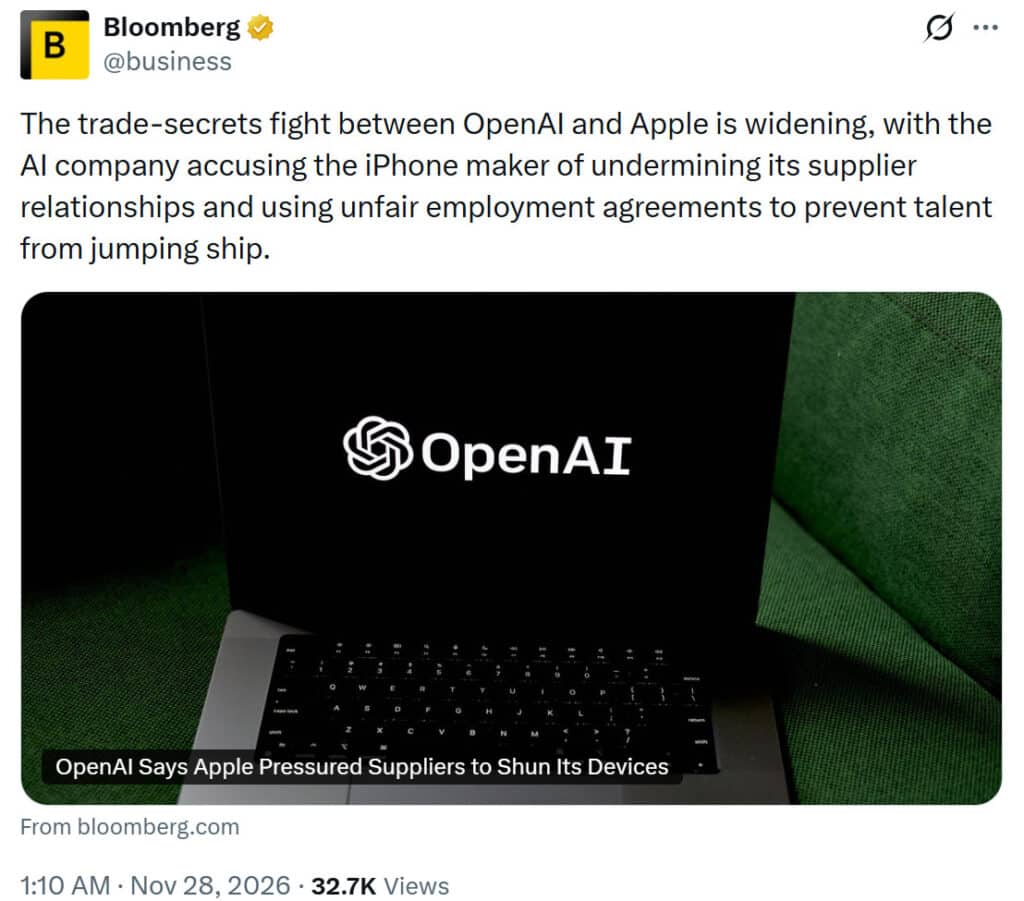
As the legal proceedings grind forward in the California federal court, the ramifications of this dispute extend far beyond the immediate corporate balance sheets of Apple and OpenAI. The case is poised to establish critical legal precedents regarding how modern technology companies handle the murky boundary between open innovation and proprietary trade secrets.
If OpenAI’s allegations of supplier coercion are substantiated during formal discovery, it could trigger broader regulatory inquiries into antitrust behavior and supply-chain monopolization within the consumer electronics sector. On the other hand, a ruling in favor of Apple could severely constrain employee mobility, making Silicon Valley engineers far more hesitant to transition between major competing institutions out of fear of protracted litigation.
Ultimately, the courtroom drama highlights a profound paradigm shift: the dividing lines between pure software innovation and physical hardware engineering have officially dissolved. As artificial intelligence companies transform into device manufacturers, the peaceful coexistence of Silicon Valley’s elite has been permanently replaced by a zero-sum war for talent, supply chains, and market supremacy.