The United States spot Bitcoin exchange-traded fund (ETF) market is currently weathering one of its most challenging macroeconomic phases since the inception of these financial products. Data compiled by Farside Investors highlights an aggressive, sustained capital flight from major digital asset investment vehicles, with institutional and retail investors alike rapidly reducing their exposure. At the center of this downturn is BlackRock’s iShares Bitcoin Trust (IBIT). Over an eight-session trading streak stretching from November 17 through November 27, the fund recorded a staggering $2.79 billion in net withdrawals. This massive sum accounts for approximately 81% of the total $3.44 billion pulled out from the entire aggregate US spot Bitcoin ETF sector during the exact same timeframe.
The persistent bleeding underscores a broader market sentiment shift, complicating the cryptocurrency’s recovery efforts and raising questions among financial analysts regarding institutional conviction as the year draws to a close. While these redemptions have heavily weighed on market psychology, understanding the mechanics behind the outflows requires a closer look at fund operations, macroeconomic pressures, and historical context.
A Relentless Outflow Streak: Chronology and Scale
The current downturn began on Monday, November 17, when US spot Bitcoin ETFs registered $239.9 million in combined net outflows. Of that initial daily total, BlackRock’s IBIT contributed $209.5 million, signaling an immediate and aggressive exit by major market participants. This momentum did not abate; rather, it accelerated sharply over the subsequent days.
By Tuesday, November 18, combined outflows surged to $306.5 million. The downward pressure reached its weekly peak mid-week. On Wednesday, November 19, the market experienced a severe shock as aggregate net withdrawals hit $582.3 million—with BlackRock’s IBIT alone accounting for $541.1 million, or roughly 93% of the day’s total capital loss. The following day, November 20, proved equally punishing, registering $669.2 million in total sector outflows, of which $544.7 million came from IBIT.
The downward trajectory continued unabated into the following week. On Monday, November 23, the sector shed $569.7 million, with IBIT contributing $509.3 million. Though outflows dipped slightly on November 24 to $231.4 million ($175.3 million from IBIT) and rose again on November 25 to $453.0 million ($329.7 million from IBIT), the market found no genuine relief.
Following the Thanksgiving holiday closure on Thursday, November 26, markets reopened for a shortened trading session on Friday, November 27. Despite the reduced hours, US spot Bitcoin ETFs still hemorrhaged $389 million in combined net outflows. BlackRock’s IBIT accounted for $327.2 million of this figure, proving that the appetite for liquidation remained robust even in a truncated trading window.

Detailed Breakdown of the Eight-Session Withdrawal Streak
To fully grasp the magnitude of the recent capital contraction, a granular examination of the daily figures provided by Farside Investors reveals how heavily BlackRock’s flagship product has dictated broader market trends:
- November 17: IBIT recorded -$209.5M out of a total sector outflow of -$239.9M (87% share).
- November 18: IBIT recorded -$148.7M out of a total sector outflow of -$306.5M (49% share).
- November 19: IBIT recorded -$541.1M out of a total sector outflow of -$582.3M (93% share).
- November 20: IBIT recorded -$544.7M out of a total sector outflow of -$669.2M (81% share).
- November 23: IBIT recorded -$509.3M out of a total sector outflow of -$569.7M (89% share).
- November 24: IBIT recorded -$175.3M out of a total sector outflow of -$231.4M (76% share).
- November 25: IBIT recorded -$329.7M out of a total sector outflow of -$453.0M (73% share).
- November 27 (Shortened session): IBIT recorded -$327.2M out of a total sector outflow of -$389.0M (84% share).
- Cumulative Total: IBIT recorded -$2.79B out of a total sector outflow of -$3.44B (81% share).
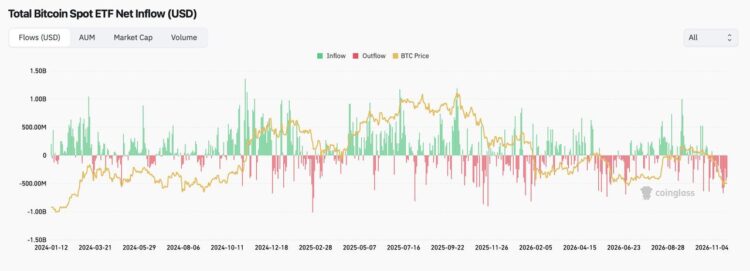
Data visualization tools from platforms like CoinGlass highlight the stark contrast between these outflows and the heavy net inflows witnessed during previous phases of Bitcoin’s macro rally. During earlier bullish phases, daily inflows routinely measured in the hundreds of millions, propelling the underlying asset to new local highs. The sudden reversal highlights a rapid tactical repositioning by market participants.
Deconstructing the Dominance of BlackRock’s IBIT
The concentration of nearly 81% of all sector outflows within a single fund—BlackRock’s IBIT—warrants careful analytical context. At first glance, such a high percentage might lead casual observers to conclude that investors are specifically losing faith in BlackRock, its management team, or the operational structure of its iShares product. However, financial analysts and industry experts urge caution against such a reductive interpretation.
BlackRock commands a dominant market share within the US spot Bitcoin ETF landscape. Because of its sheer size, depth of liquidity, and massive assets under management (AUM) compared to competing products from issuers like Fidelity, Ark Invest, or Bitwise, IBIT naturally acts as the primary liquidity conduit for institutional players. When large institutional allocators—such as hedge funds, pension funds, or corporate treasuries—decide to de-risk or reallocate capital due to macroeconomic headwinds, they typically execute those trades through the largest and most liquid vehicle available. Consequently, large-scale redemptions are bound to disproportionately impact IBIT simply due to its scale, rather than any fundamental flaw intrinsic to BlackRock’s offering.
Furthermore, it is critical to distinguish between ETF redemptions and direct corporate selling by BlackRock. IBIT functions as a passive investment vehicle that holds physical Bitcoin in secure custody on behalf of its shareholders. Net withdrawals reflect the execution of the fund’s authorized participant creation and redemption mechanism. When institutional investors redeem their shares, underlying Bitcoin is sold to fulfill the cash value of those redemptions, but this activity does not represent a discretionary decision by BlackRock to liquidate its own corporate balance sheet.
Has Selling Pressure Actually Eased?
A superficial glance at Friday, November 27’s figures might suggest that the bleeding is slowing down. After all, the $389 million in combined net outflows registered on Friday was lower than Wednesday’s $453 million. However, a deeper examination of the timeline and market conditions quickly dispels any premature optimism.
Wednesday, November 25, represented a full, standard trading session. In contrast, Friday, November 27, was a shortened trading window following the Thanksgiving holiday, a period historically characterized by lower trading volumes, reduced market participation, and more restrained capital movement. When evaluated in this context, BlackRock’s IBIT recording $327.2 million in net withdrawals on Friday—barely beneath the $329.7 million recorded during Wednesday’s full session—indicates that selling pressure remained exceptionally intense.
A smaller daily absolute dollar outflow during a shortened session does not signal a bullish return of buyer demand; rather, it merely reflects the restricted duration of the trading window. Historical data from CoinGlass confirms that until net inflows definitively replace these multi-million-dollar daily redemptions, the market remains in a vulnerable distribution phase.
Implications for Bitcoin’s Macro Recovery
The persistence of heavy, multi-day outflows from spot Bitcoin ETFs introduces severe structural headwinds for the cryptocurrency’s broader price recovery. As previous market analyses have noted, the introduction of spot ETFs fundamentally altered Bitcoin’s market micro-structure, tethering traditional financial market liquidity directly to digital asset spot prices.
When institutional and retail capital flows heavily out of these ETFs, authorized participants must liquidate underlying Bitcoin holdings to satisfy redemption requests. This creates immediate downward spot market pressure, swallowing up organic buy-side liquidity and capping upward price momentum. Consequently, Bitcoin’s recent attempts to establish a stable price floor and build a sustainable recovery trajectory have been repeatedly frustrated by this persistent institutional capital drain.
Adding to the complexity, current ETF data does not explicitly reveal the exact demographic profile of the entities driving these redemptions. It remains unclear to what extent the outflows are being driven by short-term tactical hedge funds, conservative financial advisors trimming portfolio risk ahead of year-end, or retail participants reacting to short-term price volatility.
Market participants are now closely watching the upcoming trading sessions, particularly the final US market close of the month, to determine whether institutional demand is beginning to stabilize or if the withdrawal streak will bleed into the new month. For the moment, however, market data offers little empirical evidence that the heavy withdrawal pressure has materially abated. Until net inflows return to the sector, Bitcoin’s path toward renewed price discovery will remain tightly constrained by ongoing institutional de-risking.