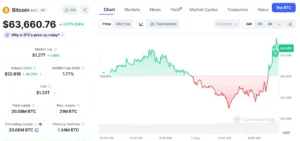
The digital asset market is currently witnessing a critical threshold as on-chain analytics reveal that more than 10 million Bitcoins are being held below their initial acquisition cost. This metric, which accounts for roughly half of the entire circulating supply of just under 21 million coins, places the world’s largest cryptocurrency in a statistical zone that has historically aligned with significant macroeconomic turning points and market capitulation phases. With Bitcoin trading near $63,242 following a prolonged correction exceeding 40% year-over-year, analysts are intensely debating whether this widespread unrealized loss points toward an imminent cyclical bottom or simply marks another phase in an ongoing bearish trend.
The Scale of Unrealized Losses and On-Chain Metrics
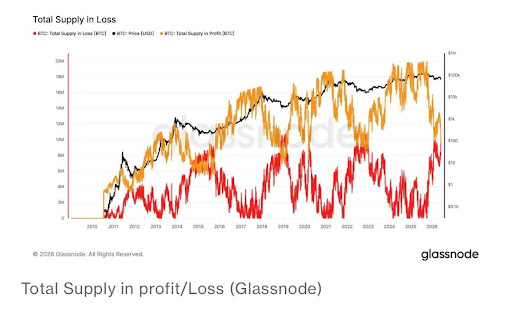
According to comprehensive data supplied by blockchain intelligence platform Glassnode, the Total Supply in Loss metric reached approximately 10.46 million BTC. This massive influx of coins into negative territory is a direct consequence of Bitcoin retreating sharply from its previous cycle highs. As prices pulled back across multiple timeframes, the volume of profitable holdings shrank exponentially, while the supply sitting at a loss ballooned to historic proportions.

Market observers note that this phenomenon is not isolated but mirrors previous cyclical corrections. Historically, major market bottoms have frequently materialized when the amount of Bitcoin held at a loss breached the 10-million-coin mark. During past deep market drawdowns, these identical conditions served as the precursor to prolonged accumulation periods before subsequent recoveries took hold.
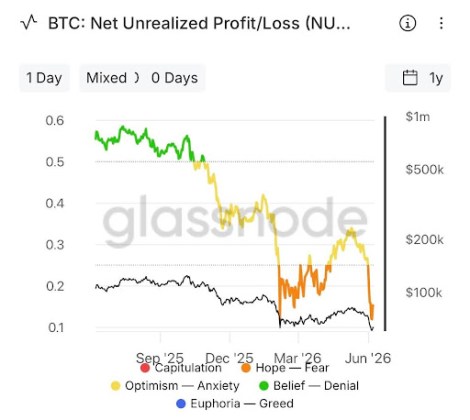
Accompanying the surge in underwater coins is a notable shift in market sentiment. The Net Unrealized Profit/Loss (NUPL) indicator has plummeted into the "Hope–Fear" zone. For much of the preceding year, the NUPL indicator resided in far more optimistic territory, reflecting high confidence among retail and institutional participants. The sudden transition into lower historical ranges indicates that investor confidence has been thoroughly shaken, leading to widespread anxiety across retail and short-term holding cohorts.
Market Chronology and Price Action Context
To understand the gravity of the current market structure, it is necessary to examine the trajectory of Bitcoin’s valuation over recent quarters. The cryptocurrency experienced aggressive upward momentum that eventually culminated in new cycle highs, driven by institutional adoption, macroeconomic factors, and the ongoing integration of spot exchange-traded funds (ETFs).

However, this exuberance was met with robust macroeconomic headwinds, including persistent inflation concerns, shifting central bank monetary policies, and broader risk-off sentiment across global financial markets. As liquidity tightened, Bitcoin suffered a steep downward correction, bleeding value consistently over the prior twelve months. By mid-2026, the cumulative downward pressure pushed the asset down to approximately $63,242.
This sustained decline systematically eroded the profit margins of investors who entered the market during late-stage rallies. Consequently, millions of coins transitioned from profit to loss, culminating in the 10.46 million threshold that has drawn intense scrutiny from on-chain analysts and institutional researchers alike.
Analyst Perspectives: Capitulation Versus Exhaustion of Sellers
Prominent crypto analyst Ali Martinez recently highlighted these on-chain developments, suggesting that an elevated volume of underwater holdings can fundamentally alter market dynamics. From a behavioral economics perspective, when a vast majority of market participants are holding assets significantly below purchase price, the immediate incentive to liquidate positions often diminishes significantly.
Rather than locking in realized losses—a process commonly referred to as capitulation—many market participants choose to adopt a posture of inaction, holding their assets through periods of heightened volatility. This psychological shift tends to cause immediate selling pressure to gradually exhaust itself. When short-term, nervous capital is flushed out of the system, the market frequently transitions from active distribution to quiet accumulation, largely driven by long-term holders and institutional entities who remain unfazed by medium-term price volatility.
Despite these historical parallels, market analysts remain divided on whether a definitive bottom has been established. While on-chain metrics point to historical accumulation zones, external macroeconomic factors continue to introduce uncertainty. Technical indicators on major charting platforms, such as TradingView, illustrate persistent bearish pressure, suggesting that while the velocity of selling may be slowing, a confirmed reversal pattern requires further validation through sustained volume and structural breakout confirmations.
Broader Implications for the Digital Asset Ecosystem
The convergence of over 10 million BTC in loss, depressed sentiment indicators, and deep retracements from historical highs carries profound implications for the broader cryptocurrency ecosystem.
First, the behavior of long-term holders versus short-term speculators remains a decisive factor. Historically, periods characterized by high unrealized losses test the conviction of market participants. Institutional investors and corporate treasuries utilizing Bitcoin as a reserve asset evaluate these macro-technical conditions to optimize their capital allocation strategies. If historical cycles repeat, periods characterized by high supply-in-loss metrics serve as foundational bases for subsequent structural bull markets.
Second, the regulatory and macroeconomic backdrop differs fundamentally from previous cycles. With greater institutional integration through regulated financial products, market liquidity behaves differently than it did in earlier retail-dominated eras. Consequently, the time required for the market to absorb the current supply overhang may vary compared to historical precedents.
Ultimately, while the current on-chain data does not offer an absolute guarantee of an immediate price reversal, it highlights that Bitcoin is operating within a statistically significant value zone. As the market digests these heavy unrealized losses, the balance between nervous liquidation and resilient accumulation will dictate the trajectory of the next major market phase.