Mutsamudu, Comoros — MEXC, a recognized pioneer in zero-fee digital asset trading, has released its financial and trading performance data for August 2026, revealing a dramatic surge in traditional finance (TradFi) participation across its platform. According to the newly published metrics, the trading volume for stock, index, and ETF futures skyrocketed by 130% month-on-month. Simultaneously, the platform’s available contract inventory expanded by 35%, crossing the milestone of over 400 distinct contracts. This growth was mirrored in the spot markets, where tokenized stocks and exchange-traded fund (ETF) spot trading volumes climbed by 30%, with nearly every single existing asset listing registering positive gains.
The report highlights a broader ongoing transformation in how retail and institutional market participants interact with global equities. By bridging traditional financial instruments with high-efficiency blockchain infrastructure, platforms like MEXC are altering how capital flows across international borders, bypassing legacy brokerage barriers to offer round-the-clock exposure to Wall Street, Asian markets, and beyond.
Memory and Semiconductor Dominance Reshapes Stock Futures
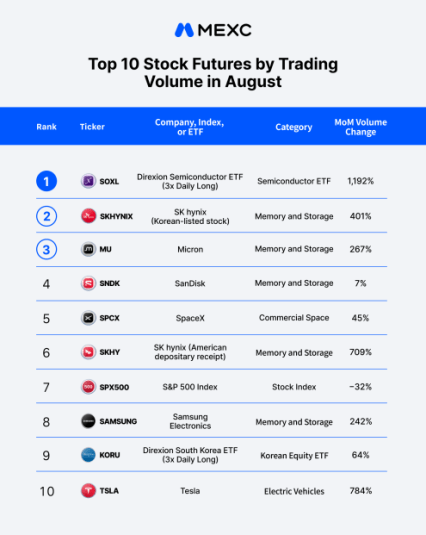
The most pronounced shift in August trading behavior occurred within stock futures, where activity pivoted away from single-stock dominance toward a diversified array of U.S. and Korean memory and semiconductor enterprises. Historically, trading in this segment was heavily concentrated in a small handful of headline assets. In August, however, five of the top ten stock futures by volume were tied directly to memory and storage infrastructure providers.
Leading this charge was SKHYNIX (SK hynix), which captured the second overall spot globally and ranked first among stock futures tracking individual corporations. SK hynix witnessed an astounding 401% month-on-month volume expansion. Close behind was Micron Technology (MU), which claimed the third position with a 267% volume increase.
Combined trading activity across stock futures tracking South Korean equities and regional indices—specifically SKHYNIX, SKHY, SAMSUNG, and the leverage-focused KORU product—surged by roughly 348%. Consequently, Korean market exposure ballooned from 14% of total stock futures volume in July to 27% in August. Meanwhile, SanDisk (SNDK) sustained consistent volume growth, though its relative market share adjusted from 25% down to 11% due to the explosive entry of broader regional competitors.
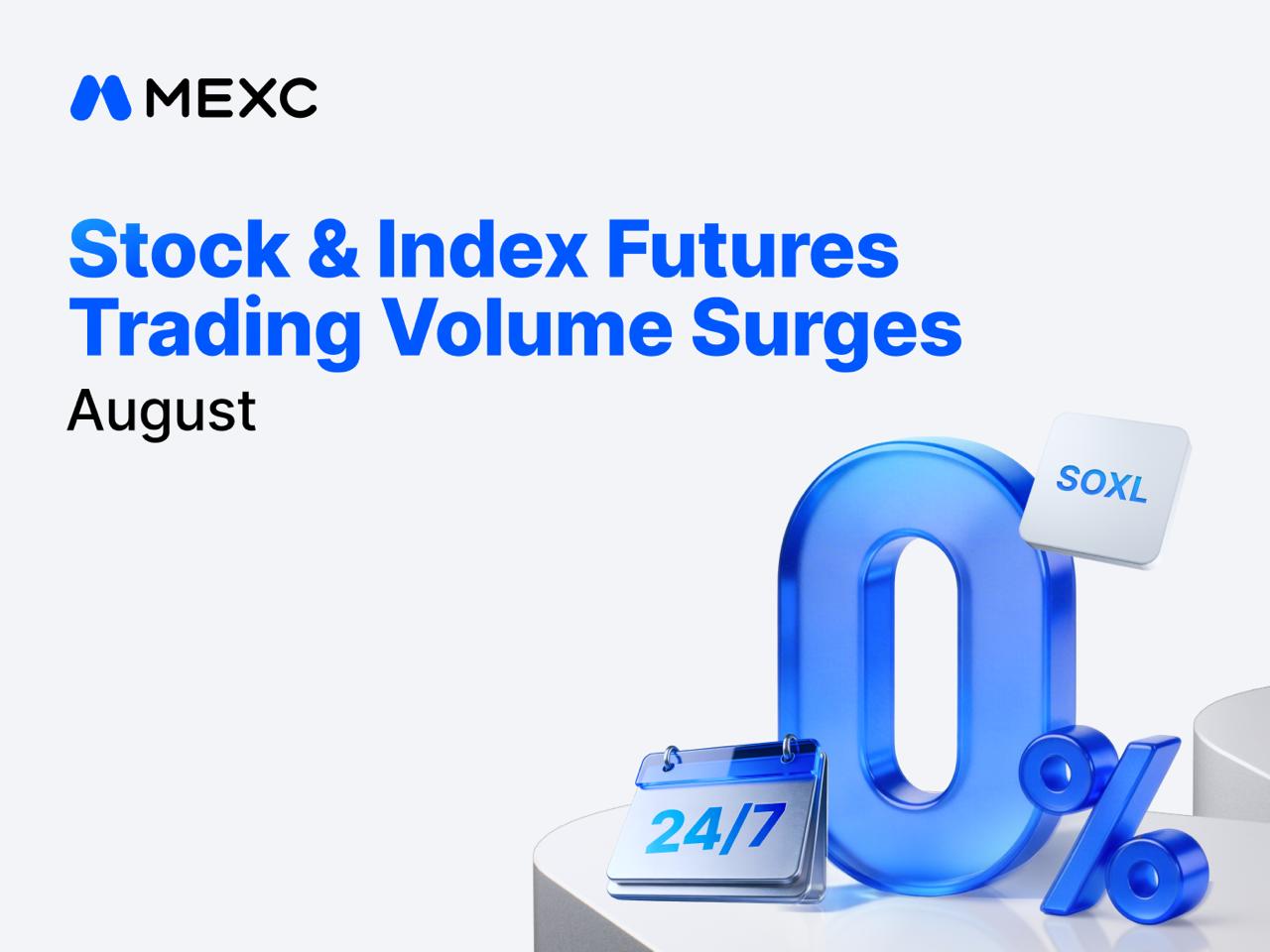
Beyond individual equities, the appetite for semiconductor-adjacent leverage intensified significantly. SOXL stock futures, which track a prominent semiconductor ETF offering triple daily long exposure, surged to the number one spot after recording a staggering 1,192% volume explosion. The asset’s market share leapt from under 4% in July to 20% in August. Its inverse counterpart, SOXS stock futures—designed to provide triple inverse daily leveraged exposure to the U.S. Semiconductor Index—simultaneously registered a robust 436% expansion.
Conversely, broader macroeconomic indicators saw capital reallocation. S&P 500 Index stock futures (SPX500) dropped by approximately 32%, illustrating a clear behavioral pivot among traders away from defensive, broad-market index tracking and toward high-beta, sector-specific growth opportunities, particularly within artificial intelligence and hardware manufacturing supply chains.
Beyond semiconductors, speculative and industrial interest gravitated toward commercial space exploration and electric mobility. Space Exploration Technologies (SPCX / SpaceX) and Tesla (TSLA) stock futures recorded respective volume gains of 45% and 784%, securing the fifth and tenth overall rankings.
Tokenized Stocks and Spot Markets Experience Broad-Based Expansion
In the spot market division, tokenized stocks and ETFs continued their steady upward trajectory, posting a 30% month-on-month volume increase. These instruments cemented their dominance within the platform’s TradFi spot category, expanding their market share from 63% in July to 73% in August.
Crucially, the rally was not driven by isolated outliers. Approximately 99% of all existing tokenized listings recorded higher volumes compared to the previous month. Furthermore, the top ten assets accounted for a mere 12% of the segment’s total volume, pointing toward a healthy, highly decentralized distribution of capital across a wide basket of equities rather than speculative crowding into a singular narrative.
Crypto-adjacent equities performed strongly within the spot ecosystem. Circle (CRCL) secured the top spot with a 69% month-on-month volume increase, while industry peers Coinbase (COIN) and Robinhood (HOOD) maintained strong positions inside the top ten. Combined trading volumes for these three crypto-centric equities rose by 47%.
Artificial intelligence infrastructure also captured significant spot market capital. Nebius (NBIS), an AI cloud infrastructure provider, ranked third overall, registering a remarkable 188% volume growth rate—the highest among the top ten spot assets. Semiconductor titan NVIDIA (NVDA) secured fifth place with a 54% volume increase. Together, these figures demonstrate that retail demand for artificial intelligence exposure spanned the entire technological stack, from hardware manufacturing to cloud computing and software execution.
Democratizing Global Markets Through Unified Account Architecture
The rapid scaling of tokenized and derivative TradFi products underscores the shifting utility of modern multi-asset trading platforms. MEXC has positioned itself at the center of this evolution by offering infrastructure that allows users to access instruments tied to U.S., Korean, and Hong Kong equities using tethered stablecoins (USDT) through a single unified account.
This architecture addresses longstanding friction points in traditional finance, such as fragmented account structures, high minimum deposit requirements, and strict regional operating hours. MEXC’s stock futures contracts feature around-the-clock accessibility, enabling participants to manage positions, hedge portfolios, and capitalize on geopolitical or earnings news outside of standard regional exchange operating hours.
The value of this continuous market access was clearly demonstrated during August, a period during which traditional equity exchanges were closed for ten weekend days. Weekend trading alone accounted for roughly 11% of the platform’s total monthly stock futures volume, proving an insatiable demand for out-of-hours risk management and price discovery.
To stimulate user adoption and reward platform loyalty, MEXC launched its "0808: Stock Season" zero-fee trading campaign during the period. The promotional event attracted more than 86,000 active participants, collectively saving traders over $1 million in operational fees.
Executive Perspective and Industry Implications
Commenting on the unprecedented expansion of the platform’s traditional asset division, MEXC CEO Vugar Usi emphasized the structural shifts occurring within global retail finance.
"The sustained growth in stock-related trading across multiple asset classes and markets underscores the accelerating global demand for accessible, diversified market exposure," Usi stated. "We remain committed to expanding our equity-linked offerings and simplifying access for users worldwide, consolidating trading into a single account and delivering on our core proposition: trading Wall Street, without walls."
Financial analysts tracking the intersection of blockchain technology and legacy capital markets view data points like MEXC’s August report as indicative of a wider paradigm shift. By tokenizing equities and offering perpetual or futures-style derivative exposure settleable in digital assets, platforms are effectively bypassing traditional clearinghouses and custodial layers. This disintermediation reduces transaction overhead and opens sophisticated hedging tools to demographics in emerging economies who have historically been locked out of U.S. and Asian capital markets due to stringent cross-border banking regulations.
However, market observers also point out the inherent risks associated with high-leverage products—such as triple-leveraged semiconductor ETFs—during periods of macroeconomic volatility. While retail participation in high-beta sectors like AI infrastructure and memory chips signals robust confidence in ongoing technological disruption, it also highlights the need for continued investor education regarding margin management and systemic market risks.
About MEXC
Established in 2018, MEXC has evolved into a prominent global multi-asset trading platform engineered to serve as a zero-fee gateway to diverse financial opportunities. Operating across more than 170 jurisdictions, the platform provides efficient, streamlined access to digital assets, traditional equities, tokenized commodities, and derivatives through a single unified account.
Designed for modern retail traders seeking fast execution, deep liquidity, and reduced structural barriers, MEXC continues to bridge the gap between decentralized finance and traditional capital markets. As both sectors converge, the platform remains focused on empowering users to navigate international markets with greater efficiency and lower overhead costs.