Binance has reached a critical turning point in its post-hack recovery phase, reporting that hourly user deposits surpassed hourly withdrawals for the first time by 03:00 UTC on November 3. This milestone comes on the heels of one of the most devastating cyberattacks in the history of digital asset exchanges, a staggering $6.3 billion security breach that took place on October 29. While the platform has successfully replenished roughly 95% of the impacted assets using its corporate treasury and the Secure Asset Fund for Users (SAFU), the incident has sent shockwaves through the global cryptocurrency ecosystem. Federal investigators have since linked the brazen theft to North Korean state-backed cybercrime syndicates, prompting heightened vigilance across the entire blockchain industry. As Binance systematically lifts withdrawal suspensions across major networks and implements robust new security architectures, market participants are closely monitoring the platform’s liquidity flows, operational resilience, and long-term standing in the digital economy.
Chronology of the Crisis: From the October 29 Breach to the November 3 Stabilization
The sequence of events began unfolding in the early hours of October 29, when abnormal transaction patterns were detected within Binance’s infrastructure. Unauthorized withdrawals quickly drained billions of dollars from the platform’s hot wallets before automated circuit breakers and manual intervention could fully halt the bleeding. Preliminary forensic analyses conducted by Binance’s internal security team suggested that an attacker may have compromised a DevOps engineer’s laptop, subsequently exploiting access to a service container to execute unauthorized withdrawal requests. Notably, the exchange’s preliminary reviews indicated that core wallet private keys remained secure and uncompromised, mitigating an even more catastrophic outcome.
By October 31, the Federal Bureau of Investigation (FBI) formally weighed in on the incident, attributing the massive theft to North Korean state-sponsored threat actors operating under the umbrella of the "TraderTraitor" campaign. Intelligence agencies noted that the perpetrators immediately began laundering the stolen capital, converting vast amounts of digital assets into Ethereum and cross-chain equivalents such as Bitcoin via decentralized finance (DeFi) protocols and instant-swap privacy tools.
Amid the escalating crisis, Binance acted swiftly to stem the panic. On November 1, the exchange initiated a phased restoration of withdrawal services, opening up access for major cryptocurrencies like Bitcoin (BTC), Ethereum (ETH), Tether (USDT), USD Coin (USDC), Binance Coin (BNB), Solana (SOL), XRP, and Zcash (ZEC). This initial rollout was accompanied by aggressive replenishment measures, with Binance successfully replacing 90% of the stolen funds by day one, a figure that climbed to 95% shortly thereafter using internal financial reserves.
As November 2 progressed, Binance bolstered market confidence by publishing comprehensive zero-knowledge (ZK) proofs verifying its Proof of Reserves snapshot from October 31. This cryptographic mechanism allowed users to independently verify that their account balances were backed by physical reserves at a minimum 1:1 ratio without compromising user privacy. By November 3, exchange metrics finally tipped into positive territory: hourly deposits officially outpaced withdrawals by 03:00 UTC, signaling a gradual restoration of institutional and retail trust.

Liquidity Flows and Financial Metrics: Analyzing the 46-Hour Outflow Window
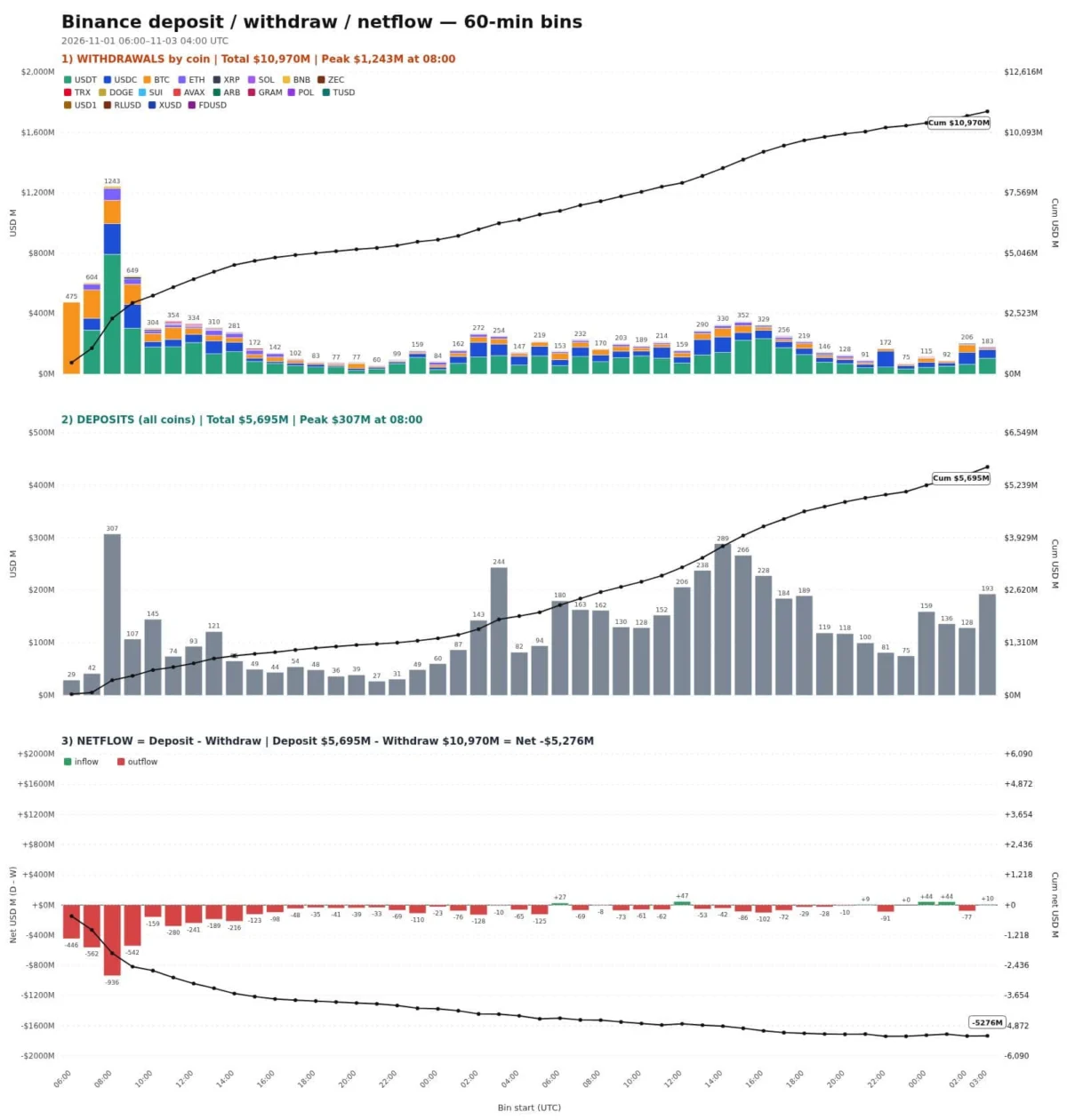
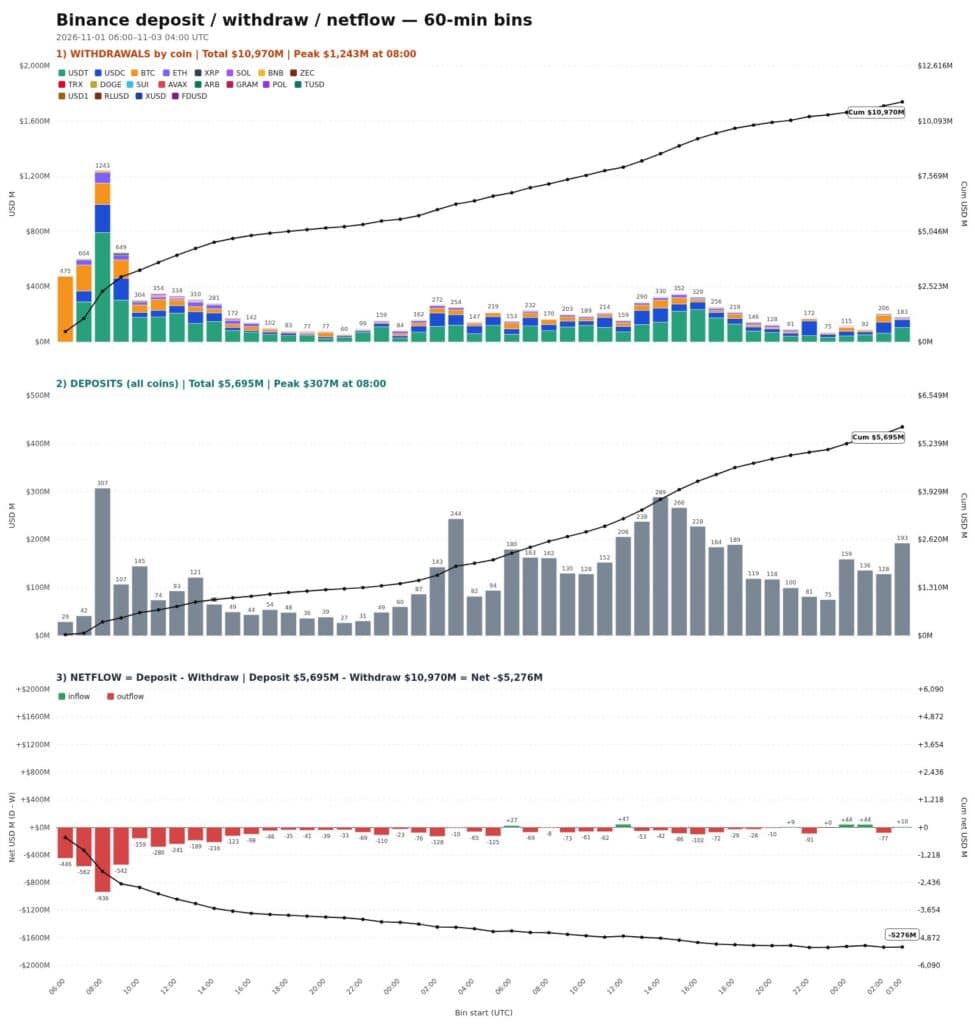
To provide transparency regarding the fallout from the October 29 breach, Binance published a detailed 60-minute interval chart tracking deposits, withdrawals, and net flows between November 1 and November 3. The data paints a vivid picture of the extreme volatility and liquidity pressure experienced by the world’s largest cryptocurrency exchange during the 46-hour measurement period.
According to the published figures, Binance processed approximately $10.97 billion in total customer withdrawals against roughly $5.695 billion in deposits, culminating in a cumulative net outflow of approximately $5.276 billion. The peak of the panic occurred shortly after services partially resumed on November 1, with the single largest hourly outflow reaching an astronomical $1.243 billion during the 08:00 UTC interval.
However, the velocity of these departures moderated significantly as the days progressed. Subsequent hourly readings demonstrated a steady tapering of withdrawal volumes coupled with a concurrent rise in incoming customer deposits. By the final hourly interval recorded on the chart, the tide had visibly turned: deposits reached approximately $193 million, narrowly eclipsing the $183 million in withdrawals and generating a modest net inflow of roughly $10 million.
Industry leaders sought to contextualize these figures during public appearances. Speaking at Hong Kong Fintech Week on November 3, Binance Co-CEO Richard Teng addressed the exchange’s financial health, noting that while withdrawal activity spiked immediately following the breach, volumes had since "pretty much normalised." Reuters figures corroborated that net customer withdrawals stood at approximately $4.72 billion by Monday, accounting for roughly 3% of the platform’s total assets under management—a testament to Binance’s immense balance sheet depth, which allowed it to absorb the shock without suffering systemic insolvency.
Phased Network Reopenings and Enhanced Security Protocols
In tandem with stabilizing transaction flows, Binance has maintained a cautious, methodical approach to reopening withdrawal channels. Rather than lifting all restrictions at once, the exchange adopted a phased strategy designed to subject every token and blockchain network to rigorous security and operational readiness checks prior to reactivation.
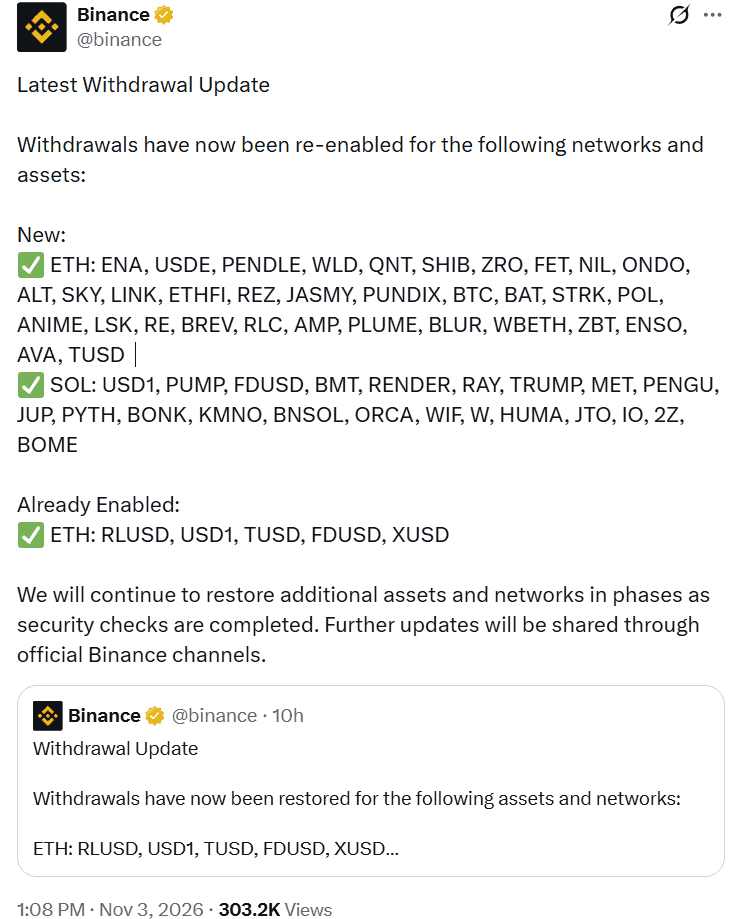
On November 3, Binance announced a sweeping expansion of withdrawal capabilities starting at 04:00 UTC. This update covered dozens of additional cryptocurrencies distributed across major Layer-1 and Layer-2 networks, including BNB Smart Chain, Ethereum, Solana, XRP Ledger, Sui, Arbitrum, Optimism, Tron, and Base. The newly accessible assets spanned a wide gamut of market capitalizations and sectors, ranging from large-cap digital currencies like Cardano (ADA), Litecoin (LTC), and Polkadot (DOT) to high-demand tokens and speculative memecoins such as Shiba Inu (SHIB), Chainlink (LINK), Pendle (PENDLE), dogwifhat (WIF), and Bonk (BONK).
Despite the broad rollout, Binance emphasized that asset availability would not roll out instantaneously. Every individual token and network pairing must individually clear stringent security verifications. Furthermore, the platform prioritized its queue based on historical user demand data gathered over the preceding week. Throughout these temporary withdrawal bottlenecks, deposit channels remained fully operational, enabling users to seamlessly fund their accounts while withdrawal pipes were being structurally reinforced.
Beyond restoring functionality, the exchange instituted proactive security overhauls. On November 1, Binance refreshed its Proof of Reserves address directory, generating brand-new wallet addresses to manage future distributions. The company confirmed that all subsequent withdrawals would be securely routed through these freshly minted, audited addresses to isolate legacy operational vulnerabilities.
Corporate Response, Asset Replenishment, and the Shadow of State-Sponsored Cybercrime
The financial architecture supporting Binance’s rapid recovery relies heavily on its proactive capitalization strategies. By leveraging a combination of corporate treasury reserves and the Secure Asset Fund for Users (SAFU)—an emergency insurance fund established specifically to protect users against extreme tail-risk events—Binance managed to backfill 95% of the missing capital within days of the exploit.
The remaining 5% of stolen assets consists primarily of less-liquid altcoins and niche tokens situated outside the top ten most heavily impacted categories. Binance management has stated that acquiring these specific assets requires specialized over-the-counter (OTC) coordination and extended procurement timelines to avoid causing severe market slippage or price distortion. The exchange reiterated its binding commitment that no retail customer will bear any financial loss stemming from the security breach.
Meanwhile, the geopolitical and law enforcement dimensions of the hack continue to cast a long shadow over the cryptocurrency industry. The FBI’s attribution of the $6.3 billion heist to North Korea’s state-backed hacking apparatus underscores the growing sophistication of cyber threats targeting centralized financial intermediaries. According to federal warnings, North Korean cyber cells routinely leverage illicitly acquired crypto funds to bypass international economic sanctions and finance state weapons programs.
The international community has met these revelations with predictable friction. While Western law enforcement agencies have urged global crypto exchanges, decentralized finance protocols, and blockchain analytics firms to blacklist wallet addresses associated with the TraderTraitor campaign, North Korean officials have vehemently rejected the allegations, dismissing them as unfounded political rhetoric designed to malign Pyongyang.
Broader Implications for the Cryptocurrency Ecosystem
The Binance security breach and its subsequent management carry profound implications for the future trajectory of centralized cryptocurrency exchanges (CEXs) and the broader digital asset economy.
First, the incident has catalyzed a renewed industry-wide focus on hot-wallet security architecture, credential management, and internal DevOps controls. As hackers deploy increasingly advanced social engineering and zero-day vectors against exchange personnel, firms are re-evaluating their multi-sig governance models and real-time anomaly detection frameworks.
Second, the crisis has dramatically accelerated the adoption and normalization of cryptographic transparency standards. Binance’s rapid deployment of zero-knowledge proof verifications sets a high benchmark for exchange accountability, proving that platforms can transparently demonstrate 1:1 asset backing without exposing proprietary trade secrets or compromising user confidentiality. The willingness of users to resume deposits following such a historic exploit suggests that transparent, verifiable accounting mechanisms, coupled with immediate financial restitution, can successfully restore consumer confidence even in the wake of catastrophic failures.
Ultimately, while Binance’s return to positive net hourly inflows marks a vital psychological and operational milestone, the exchange’s journey toward total recovery remains ongoing. With comprehensive post-incident forensic investigations still underway, ongoing efforts to acquire the remaining 5% of affected tokens, and heightened regulatory and law enforcement scrutiny, the crypto industry enters a new era characterized by heightened defensive postures, uncompromising cryptographic transparency, and persistent vigilance against state-sponsored cyber threats.