The global cryptocurrency market faced a tumultuous downturn, yet Western Europe demonstrated remarkable resilience, cementing its position as the world’s second-largest crypto economy. Between July 2025 and June 2026, the region recorded a staggering $2.08 trillion in all-in crypto activity, representing a modest 1.2% growth during the reporting period. This performance placed Western Europe among an elite group of only three global regions to record positive growth, trailing just behind Sub-Saharan Africa and Latin America.

As traditional finance continues its convergence with blockchain technology, the region is undergoing a profound structural evolution. Driven by incoming regulatory frameworks, escalating institutional investments, and an expanding euro footprint, the European digital asset landscape is rapidly transitioning from a niche asset class into an established pillar of mainstream finance.
The Macroeconomic Backdrop and Regional Concentration

The macroeconomic environment over the 2025-2026 reporting period was heavily characterized by rising economic uncertainty, shifting user preferences, and mounting fiscal pressures across several European states. Despite these headwinds, activity remained heavily concentrated within a handful of core markets.
Data from the regional analysis indicates that six key nations account for roughly two-thirds of Western Europe’s entire crypto economy. The United Kingdom maintained its crown as the region’s largest crypto economy, commanding $424.5 billion—equivalent to 20% of the regional total. As a historic global financial capital with deep capital markets, the UK’s digital asset ecosystem has largely matured as an extension of its traditional financial sector. However, the UK experienced an 8% contraction in crypto activity over the reporting period, largely attributable to a downturn in decentralized exchange (DEX) volumes.

Germany followed as the second-largest market at $288.8 billion, with France securing the third spot at $215.8 billion. Like the UK, Germany experienced a modest contraction driven by declining DEX activity, while France’s crypto economy remained relatively flat. Conversely, Spain ($156.1 billion) and Switzerland ($132.8 billion) registered growth, fueled predominantly by increased activity on centralized exchanges (CEXs). Combined with the Netherlands, which recorded $207.8 billion, these six hubs form the backbone of Western Europe’s digital asset framework.
The Regulatory Landscape: The MiCA Framework Takes Center Stage

A defining catalyst for the European digital asset market has been the full implementation and enforcement of the European Union’s Markets in Crypto-Assets (MiCA) regulation. Designed to establish a harmonized legal framework for crypto-asset issuers and service providers across all member states, MiCA has significantly reduced regulatory uncertainty.
Industry leaders have widely praised the legislation for fostering long-term institutional confidence. Laurynas Spangevičius, General Manager at Robinhood Europe, highlighted the overarching weight of the policy shift, noting that the complete rollout of MiCA has effectively replaced regulatory ambiguity with mainstream, long-term investor confidence.

Furthermore, once providers achieve MiCA licensing in one member state, they benefit from passporting rights, allowing them to scale operations across the entire EU bloc without navigating fragmented national regulatory hurdles. This structural clarity has coincided with a notable shift in how financial institutions view blockchain infrastructure. Faustine Fleuret, Global Head of Public Affairs at Morpho, emphasized that the industry is witnessing a clear migration from trial-and-error experimentation toward the deep integration of blockchain into core financial workflows, with traditional banks and asset managers increasingly treating on-chain infrastructure as a foundational technology rather than a parallel competing system.
The Euro’s Expanding Role in Global Crypto Trading

Reflecting its traditional dominance in foreign exchange (FX) markets, the euro has experienced a significant surge in its adoption as a bridge asset within the global cryptocurrency ecosystem. According to Bank for International Settlements (BIS) data from April 2025, the euro was involved in 28.9% of global FX turnover. Using an adjusted benchmark of 14.5% to account for one-sided crypto order-book data, recent metrics show that euro-denominated trading has risen to capture 11.8% of crypto volume across the 33 leading government-issued currencies.
This dramatic increase brings the euro’s digital footprint much closer to its traditional FX benchmark. Analysts attribute this growth not only to the general expansion of the EU’s crypto economy but also to the regulatory harmonization brought about by MiCA, which has streamlined institutional and retail onboarding into euro-quoted pairs.

Stablecoin Holdings Surge Amid Diverging National Trends
While traditional fiat bridges expand, stablecoins have emerged as a dominant vehicle for value storage and transfer across Western Europe. Regional stablecoin holdings surged by an impressive 131% between July 2025 and June 2026, vastly outpacing the global average growth rate of 52%. Consequently, Western Europe’s share of global stablecoin balances expanded from 3.4% to 5.1%, with Austria and France leading the charge in 2026.

This rapid expansion has sparked intense policy debates among traditional banking regulators. In September 2026, the European Central Bank (ECB) and EU national central banks formally opposed specific requirements within MiCA regarding reserve holdings. Current rules mandate that stablecoin issuers hold a minimum threshold of 30%—and up to 60% for significant issuers—of their reserves in European bank deposits. Central bankers cautioned that this requirement could expose commercial banks to systemic vulnerabilities if sudden, large-scale redemptions triggered massive liquidity withdrawals.
Despite regulatory friction, traditional institutions are increasingly leveraging stablecoins for innovative use cases. Jan-Oliver Sell, CEO of Qivalis, pointed to emerging applications such as serving as the on-chain cash leg for tokenized assets and facilitating programmable business-to-business payments like payment-on-delivery. Meanwhile, representatives from multinational institutions like CaixaBank emphasized that these regional stablecoin initiatives are vital for preventing Europe from becoming overly dependent on U.S. dollar-denominated stablecoins.

Divergence in the United Kingdom: Domestic Stablecoin Expansion
While the EU experienced stable expansion, the United Kingdom’s trajectory diverged significantly. After years of outperforming the rest of Western Europe, the UK crypto economy contracted by 8% during the 2026 reporting period, contrasted against a 3.8% growth rate across the rest of Western Europe and 2.2% within the EU proper. This slowdown coincided with a transitional phase as market participants awaited the finalization of the Financial Conduct Authority’s (FCA) comprehensive cryptoasset regime.

Despite the broader economic contraction in trading volumes, the UK experienced an unprecedented explosion in domestic stablecoin utility. UK domestic wallet-to-wallet stablecoin transfers skyrocketed from $109 million in the previous 12-month period to $2.09 billion in 2026. The UK now commands 60% of the region’s total domestic transfer value, outpacing the rest of Western Europe combined.
Furthermore, UK retail investors demonstrated a heightened propensity to use stablecoins as long-term stores of value rather than fleeting mediums of exchange. On-chain metrics reveal that 1.03% of eligible UK retail personal wallets converted at least 80% of their crypto holdings into stablecoins during the 2026 period, marking the highest conversion rate among major European economies and widening the UK’s lead over the Netherlands and Italy.

Fiscal Pressures and Safe-Haven Dynamics in France
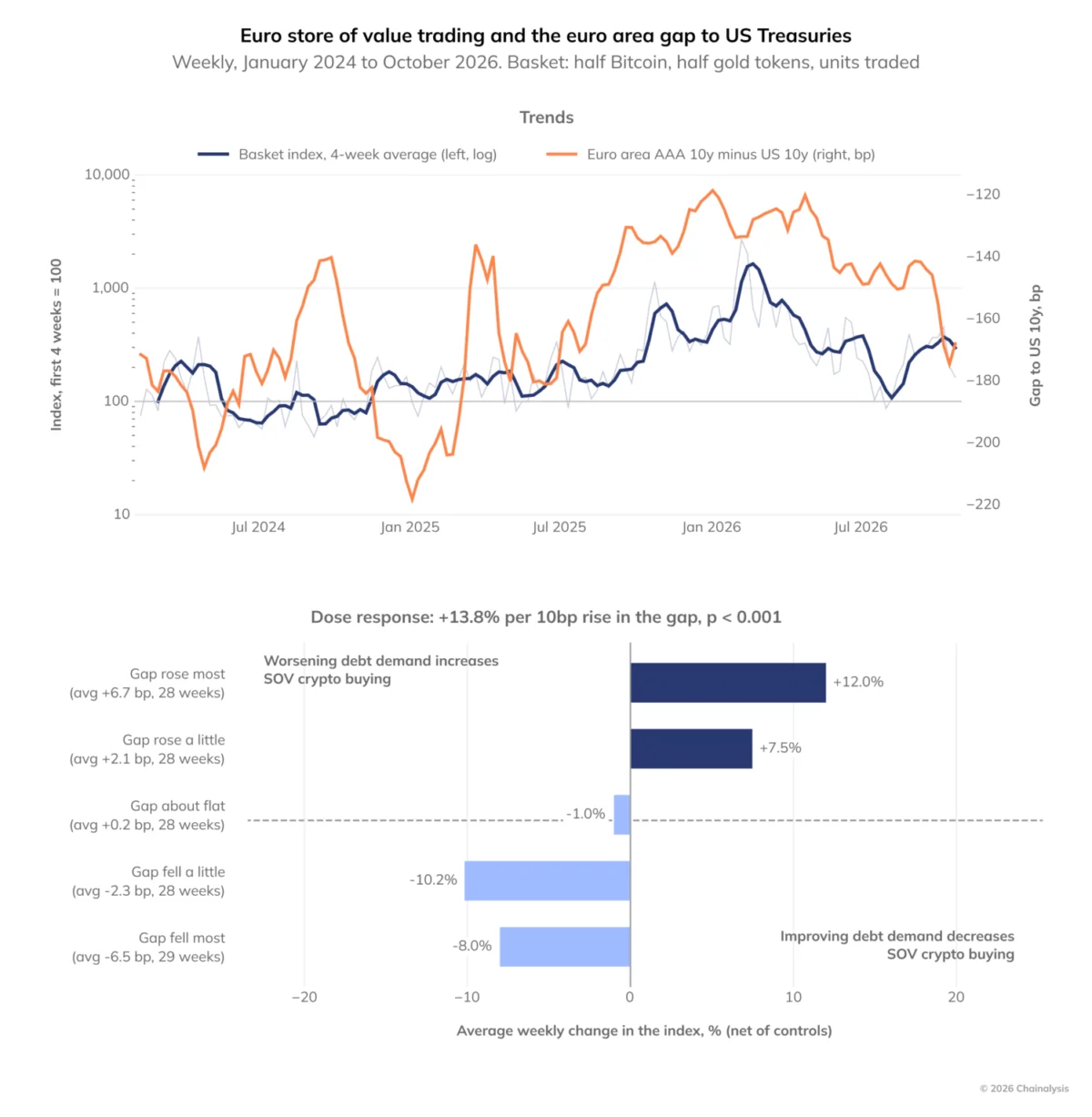
France has similarly become a fascinating case study in how macroeconomic and political instability can influence digital asset behavior. Grappling with rising public debt, fragmented parliamentary politics, and frequent legislative battles over austerity measures, France has faced intense bond market stress, with 10-year government bond yields climbing above 5.14% in October—reaching highs unseen in over two decades.

Against this backdrop of fiscal uncertainty, French users increasingly turned to self-custodied stablecoins. France vaulted from 10th place in 2023 to 1st place in Western Europe by 2026 in terms of stablecoin-related withdrawals from centralized exchanges, capturing 54.2% of total service withdrawals. Concurrently, the number of French personal wallets holding stablecoins more than tripled, surging from 3,577 in June 2025 to 12,255 by June 2026. Self-custodied stablecoin balances in France expanded by an astronomical 192% over the reporting period, utterly eclipsing the modest 2% growth recorded in traditional French bank deposits.
Pan-European Integration and Spain’s Rising Prominence

Beyond individual market shifts, Western Europe is experiencing a structural knitting-together of its national ecosystems. Spain has emerged as a premier regional hub, with its centralized exchanges increasingly drawing the vast majority of their inflows from international European users rather than domestic participants.
Inflows from neighboring countries to Spain-registered platforms accelerated dramatically, growing at an average rate of 198% during the 2026 reporting period. Italy and Portugal spearheaded this wave, with inbound flows surging 329% and 751% respectively. Industry experts, such as Gabriel Ayala, Director of API & Banks at Bit2Me, attribute this phenomenon to structural gaps in neighboring markets, where regulatory complexity and fragmented local operators have cleared the path for well-capitalized, MiCA-compliant Spanish platforms to capture cross-border market share.

Implications for the Future of European Finance
The 2025-2026 data compiled in the latest geographical reports underscore a fundamental maturity within Western Europe’s digital asset landscape. No longer defined purely by speculative retail fervor, the region’s crypto economy is increasingly dictated by institutional integration, sophisticated regulatory compliance, and macroeconomic hedging strategies.

As regulatory clarity solidifies under MiCA and the UK frameworks, and as traditional financial institutions continue to build upon blockchain rails, the dividing line between traditional finance and decentralized infrastructure continues to dissolve. Moving forward, the trajectory of Western Europe’s $2.08 trillion crypto economy will depend heavily on how policymakers balance systemic financial stability with innovation, and how market participants navigate an increasingly complex global financial climate.