Developing state-of-the-art frontier artificial intelligence models represents one of the most resource-intensive and strategically vital endeavors in modern technology. Requiring massive clusters of specialized semiconductor chips, billions of parameters, and astronomical amounts of capital and electricity, the creation of these systems carries profound national security implications. Recognizing this reality, the United States government has implemented stringent export controls and access restrictions, barring users, enterprises, and research laboratories in the People’s Republic of China from directly interacting with leading Western AI systems such as Anthropic’s Claude and OpenAI’s ChatGPT.
Despite these regulatory roadblocks, a comprehensive investigation by the Chainalysis Global Intelligence Team reveals that banned and suspected Chinese users are routinely breaching these safeguards. They are accomplishing this through an entrenched, multi-tiered shadow economy consisting of export control-sidestepping services. These entities sell discounted access to restricted Western AI models, allowing unauthorized users to cheaply mine advanced systems. By siphoning capabilities, these actors can drastically accelerate the training of domestic systems at a fraction of the traditional research and development cost, fundamentally undermining the geopolitical strategy behind U.S. trade restrictions.
The Mechanics of the AI Proxy Ecosystem
The cornerstone of this illicit trade is the "proxy service"—an intermediary network that functions as a technological waystation. These services ingest queries from restricted users, route those requests through legitimate or fraudulently obtained accounts into advanced American AI models, and return the output while meticulously concealing the true origin of the traffic.
While many of these services transact in traditional fiat currency via domestic Chinese payment processors like WeChat Pay and AliPay, an expanding faction of the ecosystem relies heavily on digital assets. A recent market survey of 100 distinct AI proxy domains revealed that approximately 40% accept cryptocurrency, with stablecoins serving as the preferred medium of exchange. Observers note that integrating digital currencies into these transactions is not merely a convenience, but a deliberate operational strategy designed to obfuscate financial footprints, evade strict state-mandated capital controls, and maintain unmonitored connectivity for sensitive users.
The commercial sophistication of this shadow market has evolved far beyond casual file-sharing or simple account-sharing arrangements. It now features a fully segmented supply chain. Upstream actors procure model access through tactics such as industrial-scale account farming and model swapping. Meanwhile, downstream proxy providers manage customer acquisition, subscription billing, and query routing. This modular architecture grants the network immense resilience; if a specific vendor or domain is blocked or disrupted by cloud providers, alternative intermediaries rapidly fill the vacuum.

The Threat of Model Distillation and National Security Risks
The primary danger posed by these proxy networks extends well beyond unauthorized chat interactions. Security researchers and Western AI laboratories have identified "model distillation" as the principal mechanism driving this illicit demand. Distillation is a machine learning technique whereby a smaller, domestic model is trained using the outputs, reasoning steps, and datasets generated by a superior frontier model.
By utilizing proxy services to extract capabilities from American models, Chinese laboratories can shortcut the multi-billion-dollar R&D cycle required to build competitive architectures from scratch. The scale of this exploitation is staggering. Anthropic recently formally accused three prominent China-based AI companies—DeepSeek, Moonshot, and MiniMax—of orchestrating a massive evasion campaign. According to Anthropic’s findings, these labs funneled queries through roughly 24,000 fraudulent accounts managed via proxy infrastructure to systematically extract core capabilities from the Claude model family.
This unauthorized transfer of technology carries severe security implications. Industry leaders and defense agencies have repeatedly warned that models created through illicit distillation often bypass or lack the rigorous safety guardrails, alignment protocols, and red-teaming protections embedded in the original frontier systems. Last month, the United States National Security Agency (NSA), alongside international intelligence partners, issued a formal public advisory warning that China-based AI companies employing distillation techniques are introducing significant vulnerabilities. These derivative models, lacking core safety controls, pose substantial threats across critical infrastructure, military readiness, economic stability, and sensitive technological domains.
Cryptocurrency Rails and Regional Payment Corridors
An analysis of the wallet activity funding these proxy services highlights a distinct geographic concentration. Researchers identified a high density of payment-originating wallets located in mainland China, supplemented by regional financial hubs including Hong Kong, Japan, Singapore, and South Korea. This distribution aligns closely with patterns of regional actors routing traffic through intermediary corridors to obscure their ultimate jurisdiction.
Crucially, the investigation revealed that these proxy platforms rarely accept direct, peer-to-peer cryptocurrency transfers from individual users. Instead, transactions are routinely routed through third-party custodial cryptocurrency payment processors. This structural layer offers several distinct advantages for operators in the shadow economy:
- It establishes a cryptographic buffer between the end user and the proxy service provider.
- It circumvents stringent national capital controls enforced by Beijing.
- It reduces the operational and regulatory exposure of proxy operators who might otherwise face severe legal penalties within China for unauthorized foreign exchange transactions.
However, this layered financial architecture introduces systemic compliance risks for the broader digital asset economy. Funds originating from illicit proxy usage frequently pass through custodial services before re-entering regulated crypto exchanges and mainstream financial platforms, effectively laundering the proceeds of export control violations with few visible ties back to the initial infraction.

Temporal Correlations: Spikes Following Frontier Model Releases
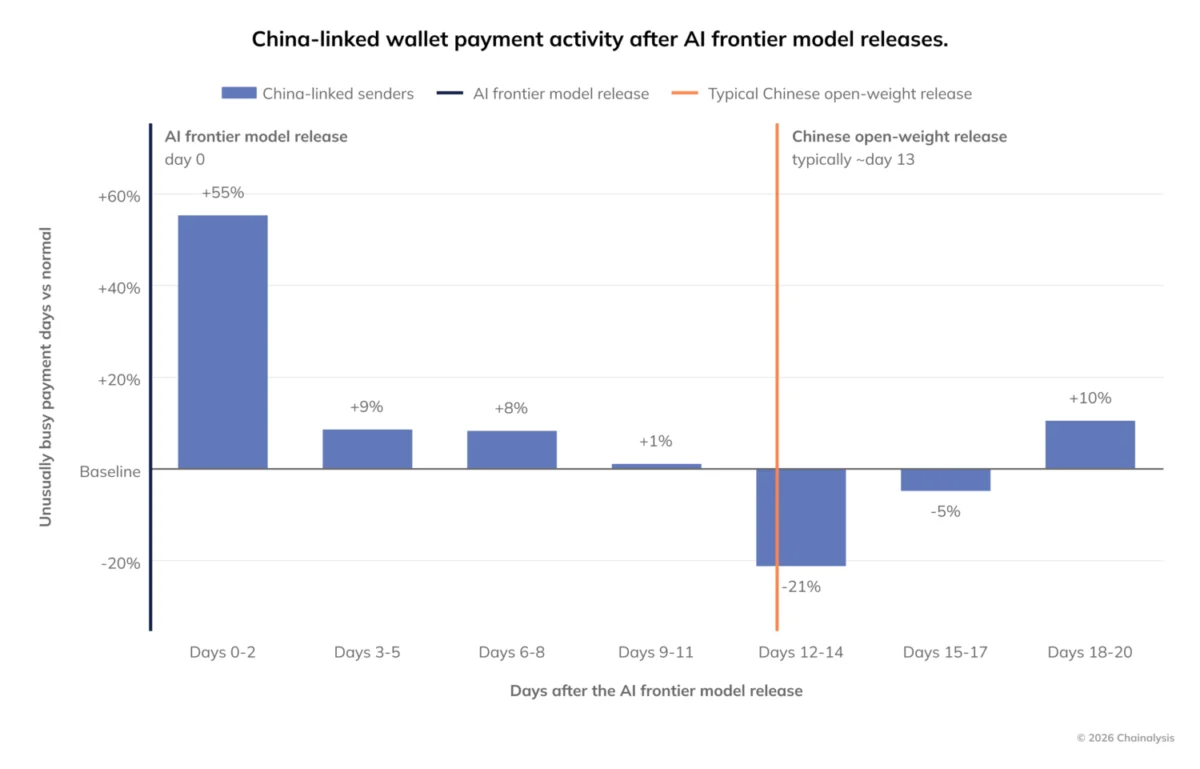
To test the hypothesis that proxy services are actively utilized for rapid model distillation, analysts examined blockchain data to track suspected Chinese-linked wallet activity around major U.S. AI model releases. Logic dictates that if domestic developers rely on these networks to capture new technological breakthroughs, financial transactions directed toward proxy services should surge immediately following a high-profile product launch.
Empirical analysis confirmed this pattern. Suspected China-linked wallets exhibited a pronounced increase in payment activity during the three-day window immediately following the release of new U.S. frontier models—a spike significantly higher than the baseline activity observed across non-suspect wallets utilizing the same proxy infrastructure. While aggregate blockchain data cannot independently verify the explicit intent behind every transaction, the temporal alignment strongly correlates with an organized rush to exploit novel model weights and capabilities before defensive patches or access restrictions can be updated.
The Enforcement Challenge and Blockchain Intelligence Solutions
The maturation of the AI proxy shadow economy has fundamentally altered the enforcement landscape for export control regulators. Historically, U.S. policy focused on restricting the physical export of advanced hardware, such as NVIDIA graphics processing units (GPUs), and blocking direct API access from restricted jurisdictions. Today, those perimeter defenses are insufficient. As long as a commercial ecosystem exists to resell API access through decentralized proxy networks, geographic IP blocks can be trivially circumvented.
Combating this multi-tiered supply chain requires advanced technological countermeasures. Traditional financial surveillance often hits dead ends when faced with obfuscated proxy architectures and custodial crypto rails. Consequently, government regulators, law enforcement agencies, and compliance officers are increasingly turning to blockchain intelligence.
By leveraging advanced ledger analytics, investigators can map complex transaction webs, unmask the financial intermediaries sustaining proxy operators, and trace funds from end-users to the fiat off-ramps and exchanges where profits are ultimately realized. Identifying these critical pressure points provides a viable roadmap for disrupting the illicit financial and technological infrastructure that underpins unauthorized access to Western artificial intelligence. As the global race for AI dominance intensifies, dismantling the shadow economy will remain a central priority for safeguarding technological superiority and national security.