
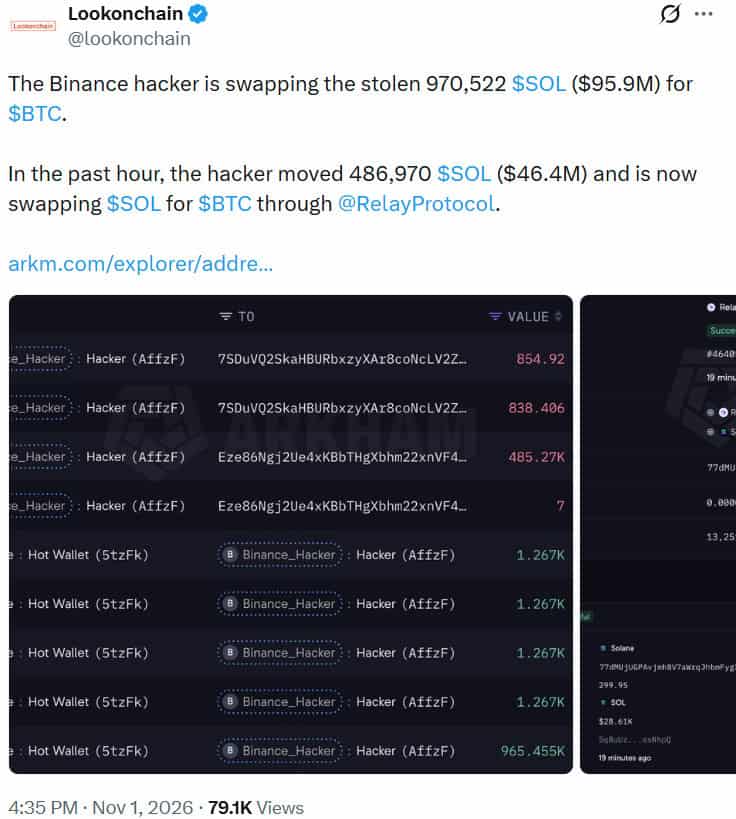
The multi-billion-dollar security breach that shook the digital asset ecosystem late last month continues to evolve on-chain, as the perpetrator actively obfuscates and maneuvers ill-gotten gains across multiple blockchains. According to intelligence provided by on-chain analytics platform Lookonchain, the attacker behind the record-breaking $6.3 billion Binance compromise has initiated the conversion of nearly $96 million in stolen Solana (SOL) into Bitcoin (BTC). This sophisticated financial restructuring represents a critical new phase in the ongoing saga of the largest known cryptocurrency heist in history, introducing complex cross-chain tracing challenges for international law enforcement agencies, private cybersecurity investigators, and digital asset exchanges alike.
The recent transactional activity centers on a massive reserve of approximately 970,522 SOL—valued at roughly $95.9 million—tied directly to addresses flagged by Arkham Intelligence as belonging to the principal threat actor. On-chain logs indicate that a significant portion of this liquidity has already been put into motion. Specifically, a wallet associated with the exploit routed approximately 486,970 SOL, amounting to roughly $46.4 million, through the Relay Protocol to execute cross-chain swaps into Bitcoin. While the initial movement accounts for about half of the total targeted Solana pool, with the remaining balance fluctuating near $49.5 million depending on market conditions, the strategy underscores a deliberate attempt by the hacker to migrate funds away from high-throughput altcoin ecosystems into the premier proof-of-work asset.
Timeline of the Binance Security Breach and Subsequent Fund Movements
To fully comprehend the gravity of the ongoing Solana-to-Bitcoin conversion, it is necessary to examine the rapid sequence of events that began in the final days of October. The chronology of the incident highlights an unprecedented level of operational speed and technical coordination by the threat actors:
- October 29: Binance suffers a catastrophic security breach. Within an estimated 20-minute window, approximately $6.36 billion in digital assets are drained from exchange wallets across ten distinct blockchain networks.
- October 31: The Federal Bureau of Investigation (FBI) formally attributes the multi-billion-dollar hack to North Korea’s state-sponsored cyber operations unit, specifically identifying the notorious TraderTraitor hacking group. Concurrently, Binance provides its first major recovery update, announcing that roughly 90% of the affected user funds have been secured through internal resources.
- November 1: On-chain tracking platform Lookonchain detects the initial movement of 486,970 SOL ($46.4 million) toward Bitcoin via the Relay Protocol. Binance updates its compensation metrics, revealing that 95% of the stolen assets have now been covered by the exchange, while a phased resumption of global withdrawal services commences.
- Early November: Intelligence firms and centralized platforms ramp up cross-chain surveillance. Law enforcement issues urgent warnings regarding the use of decentralized finance (DeFi) protocols, privacy-enhancing tools, and cross-chain bridges to launder the remainder of the $6.3 billion haul.
Attribution and the North Korean Cyber Threat Landscape

The formal attribution of the October 29 incident by the FBI to North Korea’s TraderTraitor group cements a troubling reality for global cybersecurity: state-sponsored actors are increasingly relying on industrial-scale cryptocurrency thefts to fund geopolitical objectives and evade international economic sanctions. Prior to the FBI’s public announcement, specialized blockchain intelligence firms, including TRM Labs, had already flagged behavioral signatures matching historical North Korean campaigns.
The TraderTraitor collective has long been on the radar of Western intelligence agencies, having been linked to numerous high-profile heists targeting decentralized finance bridges, centralized exchanges, and validator nodes. However, the scale of the Binance compromise dwarfs all previous operations, setting a grim benchmark for digital asset vulnerability. Following the initial extraction of $6.36 billion across ten blockchains, intelligence reports noted that the perpetrators immediately began fragmenting the capital. Initial investigative updates from federal authorities highlighted heavy concentrations of stolen funds moving into Ethereum (ETH) and various decentralized finance (DeFi) liquidity pools designed to obscure the trail.
The introduction of cross-chain swaps targeting Solana and subsequent conversions into Bitcoin demonstrate an adaptive laundering playbook. By utilizing cross-chain infrastructure such as the Relay Protocol, the hackers are leveraging decentralized liquidity pools to bypass traditional surveillance mechanisms native to centralized exchanges, complicating the real-time tracking capabilities of blockchain forensic experts.
Binance Response: Asset Replenishment and Phased Withdrawal Restorations
While the perpetrator attempts to launder fractions of the stolen capital through alternative networks, Binance has executed a robust containment and remediation strategy aimed at shielding its global user base from financial ruin. In official statements released concurrently with the unfolding on-chain movements, exchange executives reiterated a firm commitment to user protection.
By November 1, Binance confirmed that its internal treasury, supplemented by the Secure Asset Fund for Users (SAFU) and portions of the Futures Insurance Fund, had successfully covered approximately 95% of the total assets impacted by the security breach. This represents a notable 5% increase from the 90% coverage milestone reported just 48 hours prior. The remaining 5% of the affected portfolio primarily comprises low-liquidity or exotic tokens, which require careful over-the-counter (OTC) acquisition and measured market purchasing to prevent localized price distortion or slippage.
Furthermore, Binance emphasized that customers will bear zero financial liability for the exploit. "Binance will absorb the financial impact of the stolen funds, not our users," the company stated in its regular incident briefings. Concurrently, the exchange initiated a phased restoration of global withdrawal services. The initial rollout successfully brought back network operations for major assets including Bitcoin, Ethereum, BNB, Solana, XRP, and Dogecoin (DOGE), alongside specific stablecoin deployments on Layer-2 scaling networks like Optimism (USDT, USDC, and ETH). Additional withdrawal corridors are slated for reactivation as internal engineering and security audits reach completion.
In a parallel line of defense, Binance and various blockchain analytics firms announced that approximately $3 billion worth of the stolen assets had been successfully frozen on-chain. This containment was achieved through direct cooperation with major token issuers, smart contract administrators, and compliant exchange partners who blacklisted associated wallet addresses instantly upon identification.
Technical Implications of Bitcoin Conversions on Asset Recovery
The decision by the Binance hacker to route nearly $96 million in Solana through cross-chain protocols to accumulate Bitcoin introduces distinct technical hurdles for forensic investigators and asset recovery teams.
Unlike centralized stablecoins—such as USDT or USDC—where issuing authorities can unilaterally freeze tokens at the smart contract level regardless of where they are held, Bitcoin operates on a decentralized proof-of-work network devoid of central administrators, master keys, or freeze functions. Once capital is successfully converted into native Bitcoin, it cannot be programmatically halted or seized by an issuer.
Nevertheless, digital asset forensics experts note that the immutability and transparency of the Bitcoin ledger work both ways. While funds cannot be frozen natively on the Bitcoin blockchain, the public nature of the transaction history ensures that every satoshi remains permanently traceable. Analytics firms employ sophisticated graph-clustering algorithms and heuristic analysis to monitor inbound liquidity entering major Bitcoin mining pools, mixing services, or liquidity aggregators.

The primary complication arises when stolen assets pass through cross-chain bridges like the Relay Protocol. These protocols fragment transactions, pool liquidity from disparate networks, and re-issue assets across disparate cryptographic architectures. Investigators must bridge off-chain identity data, exchange KYC records, and multi-chain transaction graphs to maintain continuity in tracking the threat actor’s movements.
Broader Industry Ramifications and Future Outlook
The convergence of a multi-billion-dollar exchange compromise, state-sponsored cyber warfare, and complex multi-chain laundering techniques serves as a watershed moment for the cryptocurrency industry. The incident has catalyzed closer collaboration among competing exchanges, infrastructure providers, and regulatory bodies, fostering a unified defense posture against advanced persistent threat (APT) groups.
Industry reactions have emphasized the necessity of proactive security measures. Major platforms have accelerated the adoption of automated anomaly detection systems, cross-chain surveillance tools, and decentralized multi-signature governance frameworks to mitigate the risk of lightning-fast, multi-network exploits. Moreover, the FBI’s direct appeal to cryptocurrency businesses, miners, and decentralized finance protocols to monitor and reject transactions linked to TraderTraitor addresses highlights a growing public-private synergy in cybersecurity enforcement.
As the investigation progresses, the fate of the remaining stolen capital hangs in the balance. While Binance continues to finalize its asset replenishment protocols and law enforcement agencies tighten the net around known entry and exit points, the ongoing conversion of Solana into Bitcoin demonstrates the persistent adaptability of modern cybercriminals. For the broader digital asset market, the event underscores both the vulnerability of cross-chain infrastructure and the remarkable resilience of an ecosystem capable of absorbing a historic shock while maintaining structural integrity.