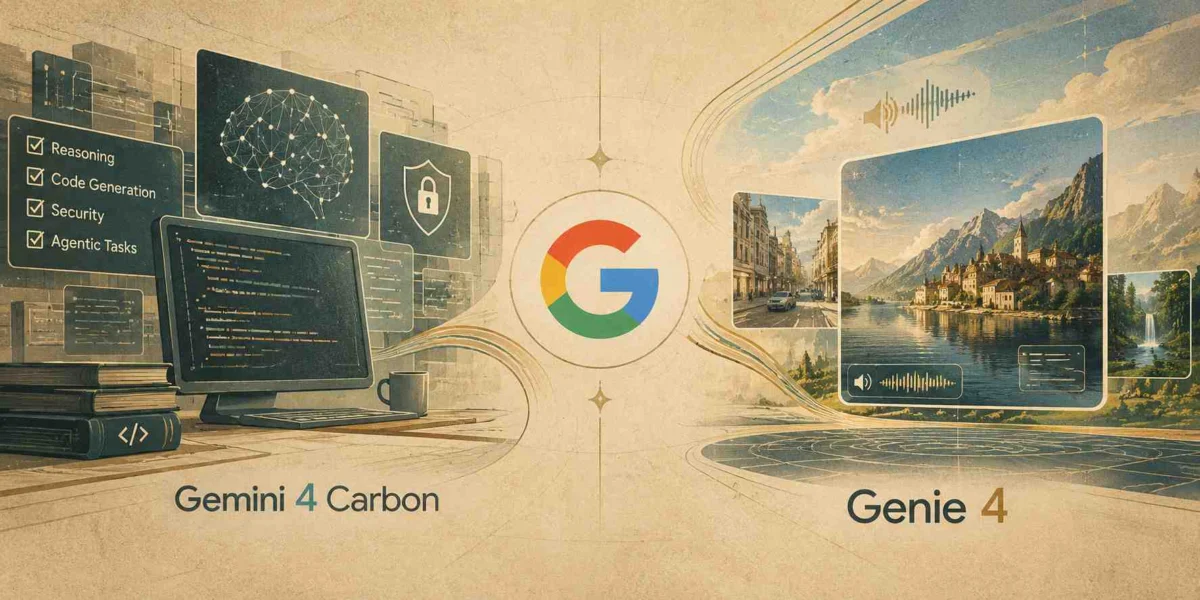
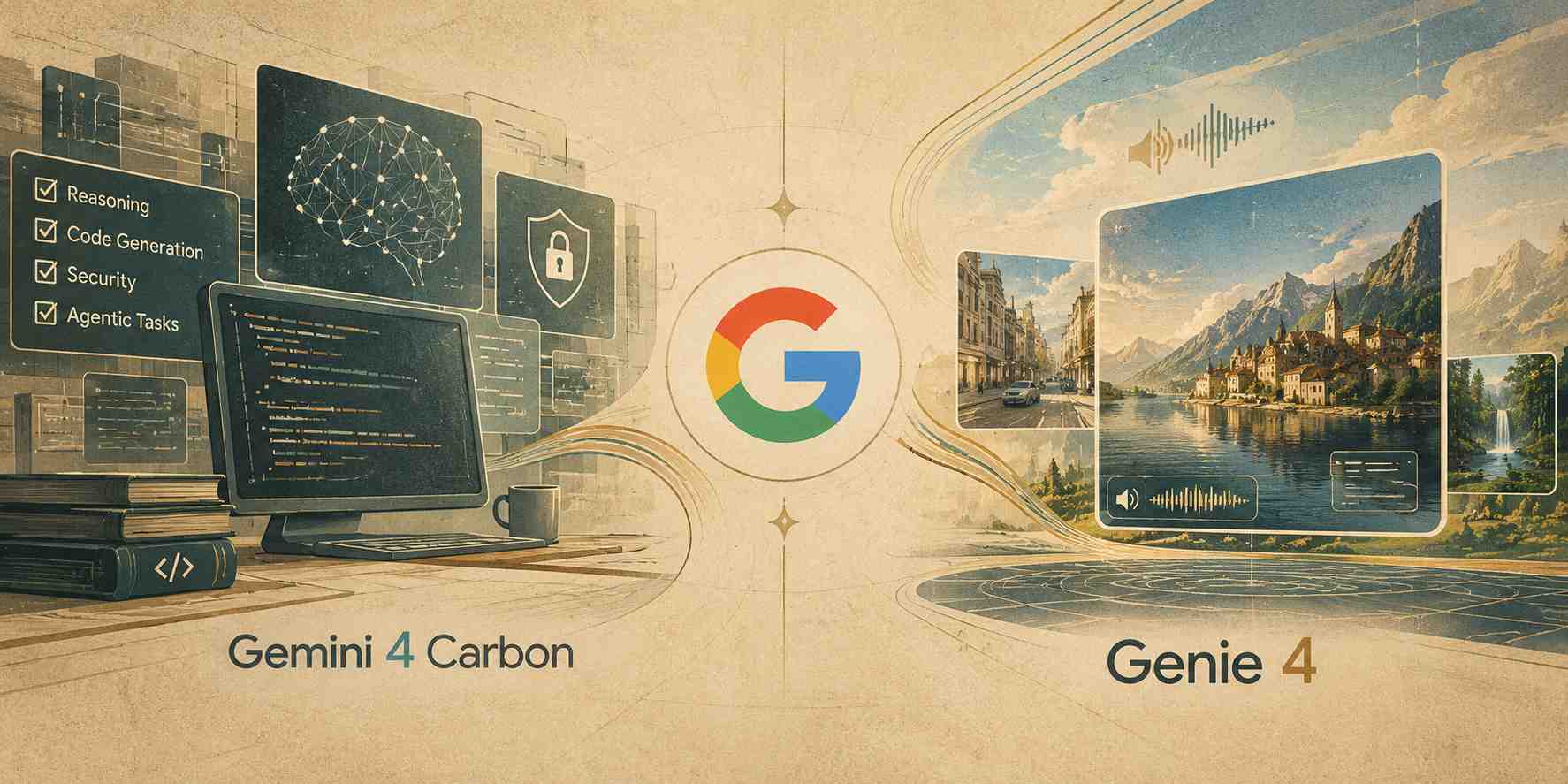
Google has significantly expanded its artificial intelligence portfolio with the introduction of Gemini 4 Carbon and Genie 4, marking a substantial leap forward in enterprise-grade reasoning, cybersecurity, software development, and real-time interactive world simulation. Announced by Google CEO Sundar Pichai and Google DeepMind, these two distinct models address the industry’s growing demand for highly specialized, mission-critical AI applications. While Gemini 4 Carbon is engineered to tackle demanding technical workloads, advanced software engineering, and multi-step agentic cybersecurity tasks, Genie 4 steps into the realm of generative media as an advanced world model capable of producing photorealistic, real-time interactive environments complete with synchronized native audio.
The unveiling of these models underscores the rapid acceleration of Google’s technological roadmap. Coming hot on the heels of the Gemini 4 Argon release just two weeks prior, the launch highlights an aggressive development cycle within the company as it races to maintain its competitive edge against rival frontier systems from OpenAI, Anthropic, and other major technology firms. Both Gemini 4 Carbon and Genie 4 are currently being rolled out through tightly controlled, limited-access programs and research previews, allowing Google to gather critical user feedback, refine system safeguards, and rigorously test model behavior prior to broader commercial and developer availability.
Gemini 4 Carbon Sets New Benchmarks in Technical Reasoning and Cybersecurity
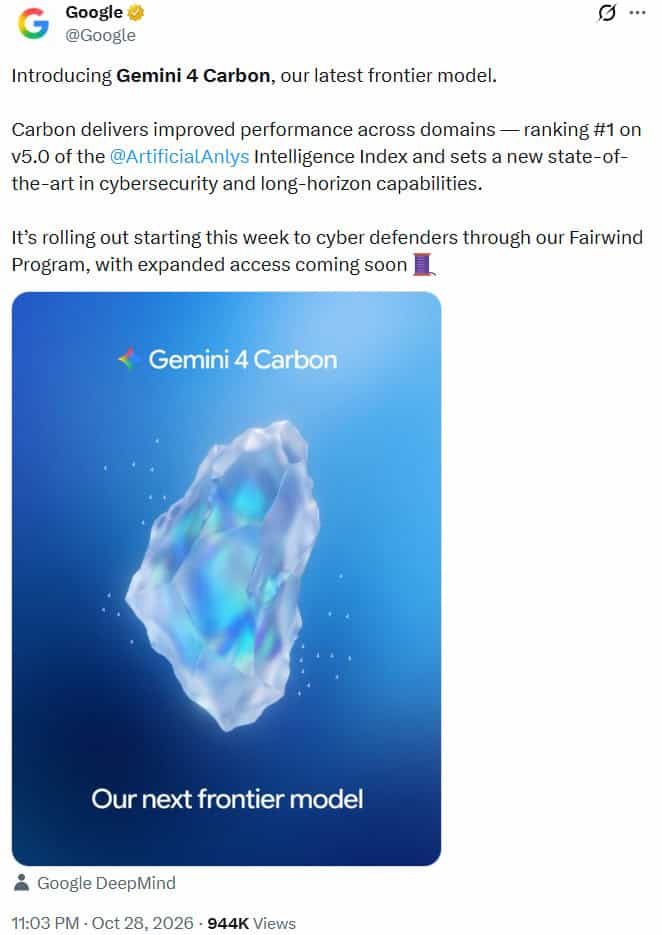
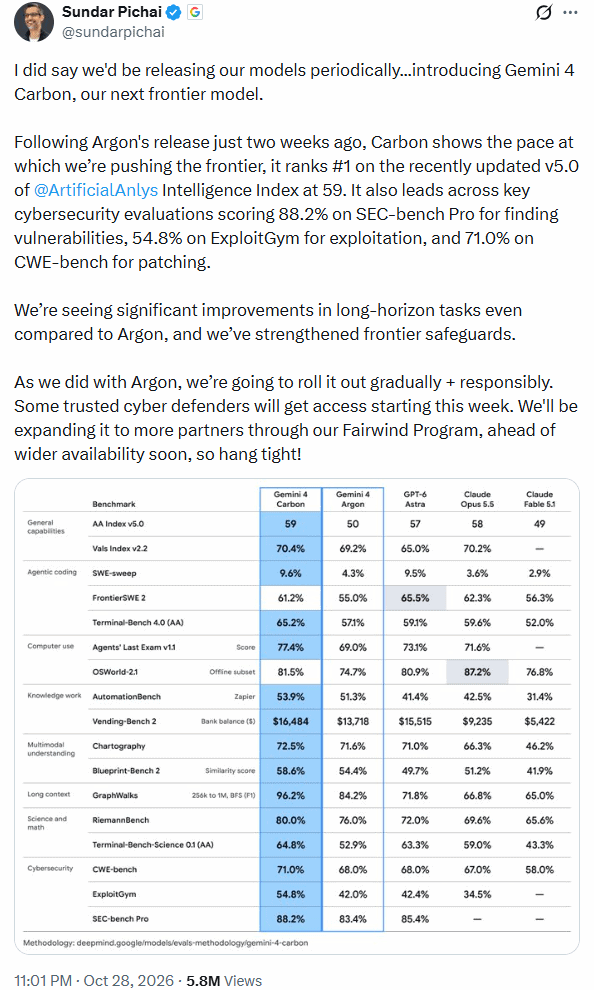
At the core of Google’s enterprise-focused updates is Gemini 4 Carbon, a frontier model explicitly designed for complex reasoning, long-running agentic workflows, and secure software development. According to official performance metrics and benchmark evaluations released by the company, Carbon has claimed the top position on the Artificial Analysis Intelligence Index v5.0, registering an impressive score of 59 points.
Beyond general intelligence metrics, Carbon has demonstrated extraordinary aptitude in specialized cybersecurity evaluations. The model scored 88.2% on SEC-bench Pro for automated vulnerability detection, 54.8% on ExploitGym, and 71.0% on CWE-bench for automated software patching. These quantitative evaluations indicate a massive leap in how automated systems can assist human developers and security analysts. Google reports that Carbon delivers a twofold improvement in secure code generation compared to its predecessor, Gemini 4 Argon, while featuring significantly enhanced safeguards designed to mitigate the risks of indirect prompt injection attacks and model misalignment. In internal evaluations cited by the company, Carbon achieved near-perfect resistance to tested forms of indirect prompt injection—a critical milestone for defending automated software pipelines against malicious data tampering.
Despite these promising metrics, industry experts emphasize that benchmark performance does not always translate seamlessly into flawless real-world execution. Cybersecurity workloads require rigorous independent validation to ensure that automated code generation and patching do not inadvertently introduce novel vulnerabilities or logical flaws into production environments. Nevertheless, the initial indicators suggest that Carbon is well-positioned to assist security professionals in navigating increasingly sophisticated cyber threats.
Advanced 3D Modeling and Computer-Aided Design Capabilities
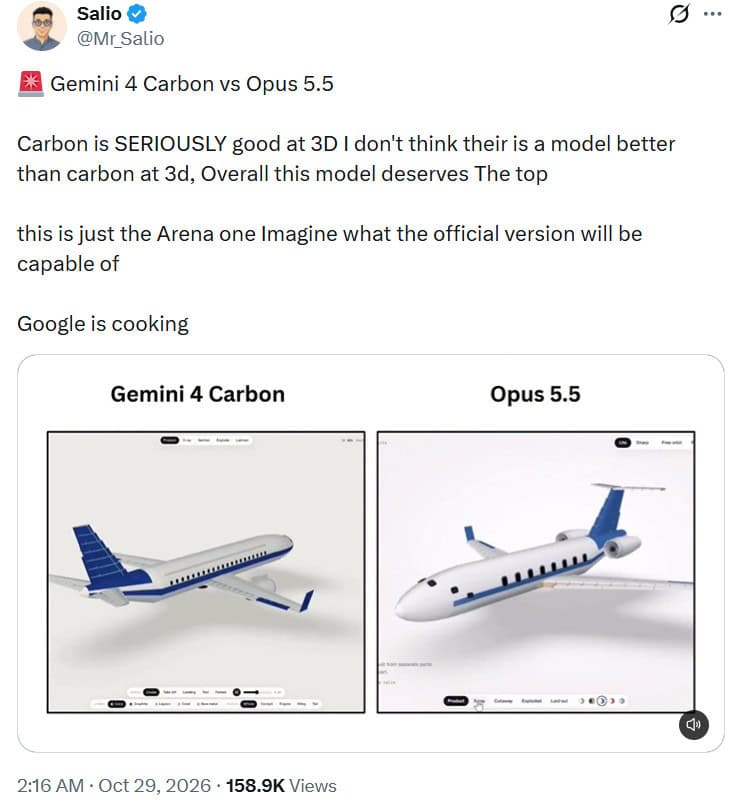
In addition to its software and cybersecurity prowess, Gemini 4 Carbon has captured the attention of the engineering and design communities through its advanced capabilities in computer-aided design (CAD) and complex 3D modeling. Demonstrations shared across digital platforms, including a prominent side-by-side video comparison by AI tracker @Mr_Salio pitting Carbon against Opus 5.5, highlighted the model’s ability to conceptualize and render highly intricate technical designs.
The comparative demonstration focused on an advanced airplane-design task characterized by extreme structural complexity. The generated models reportedly incorporated between 1,400 and more than 2,600 distinct parts, demanding that the underlying AI architecture maintain strict spatial and structural consistency across thousands of interconnected mechanical components. Carbon excelled in generating detailed internal views, exploded assemblies, and intricate internal mechanics with remarkable coherence.
For industries reliant on engineering visualization, aerospace prototyping, and advanced product design, such capabilities hint at a future where generative AI can actively participate in the mechanical drafting process. However, technology analysts caution that static video demonstrations do not fully prove production readiness. Comprehensive independent testing remains necessary to evaluate the dimensional accuracy, editability, adherence to engineering constraints, and overall reliability of AI-generated CAD assets within professional manufacturing pipelines.
The Fairwind Program and Staged Enterprise Deployment Strategy
To manage the inherent risks associated with advanced cybersecurity and code-generation models, Google has adopted a cautious, phased rollout strategy. Gemini 4 Carbon is initially being made available exclusively to a curated group of cybersecurity professionals and enterprise defenders through the newly established Fairwind Program. This controlled deployment is intended to evaluate the model’s real-world utility while closely monitoring safety guardrails and preventing potential misuse.
Given that models capable of identifying vulnerabilities and generating exploits can theoretically be leveraged by bad actors, Google’s gatekept approach reflects a broader industry consensus on responsible AI governance. By partnering with trusted cyber defenders, Google hopes to fine-tune the system’s defenses and ensure that its capability to secure software infrastructure outweighs any associated risks.
Following the initial Fairwind phase, Google plans to expand access to software developers and enterprise clients via the Gemini API. Introductory API pricing has been established at $2 per million input tokens and $10 per million output tokens, though these rates remain subject to change upon the model’s eventual general public release. As organizations increasingly integrate autonomous agents into their daily operations, the success of Carbon’s public rollout will largely depend on its long-horizon reliability and resilience against sophisticated adversarial attacks.
Genie 4 Redefines Real-Time Interactive World Simulation
While Gemini 4 Carbon tackles the rigors of software engineering and security, Google DeepMind’s Genie 4 represents a monumental shift in generative media and interactive world modeling. Unlike conventional generative video models that output a static, predetermined sequence of frames, Genie 4 is an interactive simulation engine capable of generating dynamic virtual environments that respond instantaneously to user commands, physical inputs, and real-time text instructions.
Genie 4 introduces several groundbreaking features, most notably photorealistic visual fidelity combined with synchronized native audio. The model generates comprehensive acoustic layers—including ambient background sounds, realistic engine revs, environmental noise, and responsive character dialogue—that dynamically adapt to events unfolding within the simulation. DeepMind’s demonstrations showcased a variety of complex scenarios, ranging from a first-person motorcycle journey along a sunlit coastal highway responding to changing traffic signals, to dragon flights, bustling railway stations, and robotic systems safely manipulating liquids.
Underpinning these capabilities is deep integration with Gemini architecture, which allows Genie 4 to maintain state persistence across multi-step events. By tracking the positions of objects, environmental physics, and user modifications over time, the model preserves structural and narrative continuity, preventing the jarring visual inconsistencies that historically plagued AI-generated video loops.
Expanding Access Through Project Genie and the Gemini API
Recognizing the immense potential of interactive world models, Google DeepMind is systematically expanding access to Genie 4 through multiple channels. The system is currently accessible as an exclusive research preview for trusted testers, with plans to scale availability to Google AI Ultra subscribers under the banner of Project Genie. Additionally, selected enterprise partners and developers will gain early access through the Gemini API and Google AI Studio.
The implications of Genie 4 extend far beyond entertainment and video game development. In the field of robotics and autonomous systems, interactive world models offer a transformative tool for training and validation. Researchers can simulate rare, hazardous, or economically prohibitive physical scenarios—such as extreme weather conditions, complex industrial accidents, or intricate navigation challenges—allowing robotic agents to learn and adapt safely in virtual spaces before deployment in the physical world. Similarly, architects, urban planners, and virtual prototypers can utilize real-time simulation to test spatial designs under variable environmental constraints.
Nevertheless, experts emphasize that virtual simulations cannot completely replicate the chaotic, friction-filled constraints of physical reality. Rigorous validation protocols will be essential to determine whether scenarios generated by Genie 4 provide sufficiently accurate training environments for high-stakes robotics and engineering applications.
Broader Implications and the Future of Enterprise AI
The simultaneous introduction of Gemini 4 Carbon and Genie 4 illustrates Google’s multifaceted strategy to push the boundaries of artificial intelligence far beyond basic text and image generation. By developing specialized frontier architectures tailored to distinct operational needs—reasoning and security on one hand, and interactive physical simulation on the other—Google is positioning its ecosystem as foundational infrastructure for the next generation of computing.
As these models transition from limited research previews to broader public availability, the technology sector will be watching closely. For Gemini 4 Carbon, the ultimate test will lie in its consistency, reliability, and security compliance within live enterprise software environments. For Genie 4, scrutiny will center on its real-time responsiveness, physical accuracy, and long-term environment consistency. Ultimately, the long-term success of these ambitious models will be measured not by curated benchmark scores or polished promotional demonstrations, but by their safety, utility, and enduring value in solving complex, real-world problems.